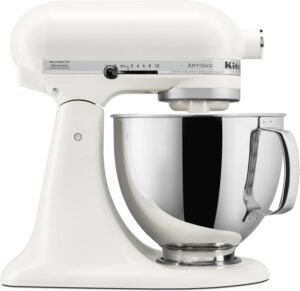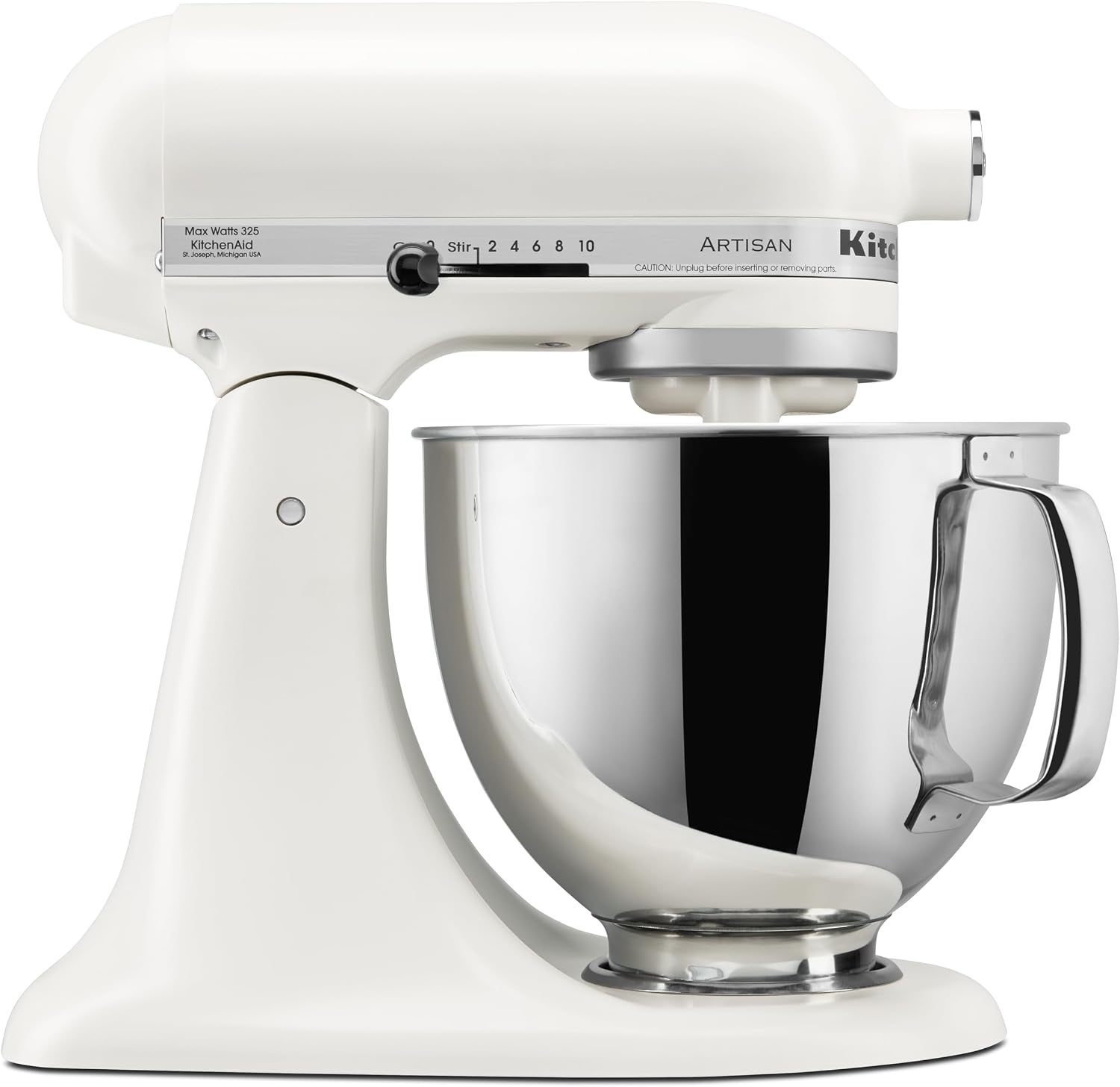
The KitchenAid Artisan Stand Mixer is built for home bakers who make cookies, cakes, and the occasional bread loaf a few times a month, not high-volume bakers. Its 325-watt motor, tilt-head design, and hub-powered attachment system — supporting a pasta roller, food grinder, and more — set it apart from single-purpose mixers in its price range. The all-metal, gear-driven build has kept decades-old units running in home kitchens. The trade-off: doubling recipes or kneading stiff dough at higher speeds pushes the motor toward its limits.
Pros
- Iconic all-metal gear-driven design built to last decades
- 10-speed tilt-head with pouring shield for easy ingredient access
- Attachment hub unlocks 10+ optional accessories, from pasta rollers to food grinders
- 5-quart bowl handles standard-batch cookies, cakes, and bread with ease
Cons
- 325-watt motor struggles with double batches or very stiff dough
- Higher mixing speeds can cause wobble during heavy kneading
- Step-up Artisan Plus and premium rivals add more power for serious bread bakers
As an Amazon Associate I earn from qualifying purchases. Disclosure
Overview
The tilt-head silhouette on KitchenAid’s countertop mixer has barely changed since 1955, and that’s mostly the point — the KitchenAid Artisan Stand Mixer is the version most home bakers picture when someone says “stand mixer” at all. It’s sold on Amazon.com and Amazon.ca in more than 20 finishes, sized for the person who bakes a batch of cookies most weekends or kneads bread dough once or twice a month, not someone running a home bakery out of their kitchen.
What keeps the Artisan relevant against newer, more powerful machines is the attachment ecosystem built around its power hub: the same mixer that creams butter for a cake can drive a pasta roller, a food grinder, or a spiralizer with a $30–$60 add-on instead of a second appliance. KitchenAid’s own newer Artisan Plus adds a digital speed dial and an LED bowl light for roughly $100 more — real upgrades, but not ones that change what the standard Artisan is actually good at.
Key Specifications
| Model | KSM150PS |
| Bowl Capacity | 5 quart, stainless steel |
| Motor | 325 watts |
| Speeds | 10 |
| Head Type | Tilt-head |
| Included Attachments | Flat beater, wire whip, dough hook, pouring shield |
| Dishwasher-Safe Parts | Yes — beater, whip, hook, bowl, and shield |
| Weight | approx. 25 lbs |
| Price (USD) | $489.00 (last Amazon price, Oct 18, 2026) |
KitchenAid Artisan Stand Mixer Mixing & Kneading Performance
The Kitchn’s test of the Artisan’s C-shaped dough hook found it kneaded a 2-pound loaf of whole wheat bread dough to a smooth, elastic finish in about 8 minutes on Speed 2, with the hook’s curve reaching the corners of the bowl that a straight hook tends to skip. That same testing noted the mixer handled a high-hydration focaccia dough about as well as a stiffer sandwich-loaf dough, which is a wider range than a lot of budget mixers manage.
The trade-off shows up at the edges of that range. Reviewers testing the Artisan line have found the 325-watt motor is best kept at Speed 2 for kneading — pushing higher speeds on stiff dough causes the head to work harder and the whole unit to walk slightly on the counter, and doubling a bread recipe is where the motor’s limits start to show. For single-batch cookies, cake batter, and whipped cream, none of that matters; the planetary mixing action (the beater spins on its own axis while orbiting the bowl) hits every part of the bowl without the manual scraping smaller hand mixers require.
Bowl Capacity & Everyday Baking Batches
KitchenAid rates the 5-quart bowl for up to 9 dozen cookies in one batch, and that number tracks with what the shape is actually built for: a wide, shallow bowl paired with a tilt-head that swings up and out of the way, rather than a narrow deep bowl meant for larger commercial-style volumes. A double batch of chocolate chip cookie dough, a standard two-loaf bread recipe, or a full angel food cake all fit without the bowl feeling crowded.
Where that capacity runs out is stiff dough at scale — a triple batch of bagel or pizza dough, for instance, is closer to what a 6-quart bowl-lift mixer or a dedicated dough mixer is built to handle. For the batch sizes most home kitchens actually make in a single session, 5 quarts is the same capacity KitchenAid has sold as its standard size for decades because it matches how most people bake.
Build Quality, Attachments & Cleanup
The all-metal body and gear-driven transmission are the reason 20-year-old KitchenAid mixers still show up working at garage sales — there’s no plastic gearbox to strip under load, which is a common failure point on cheaper mixers pushed past their rated capacity. The power hub on the front of the machine accepts more than 10 optional attachments, including a pasta roller and cutter set, a food grinder, and a vegetable sheet cutter, so the mixer’s base price effectively buys access to a small appliance ecosystem rather than a single-purpose tool.
Cleanup is straightforward: the stainless bowl, flat beater, wire whip, dough hook, and pouring shield are all dishwasher-safe, and only the motor housing needs a wipe-down. The one recurring complaint in longer-term reviews is the head-lock lever loosening slightly over years of heavy use, which KitchenAid’s one-year warranty and widely available service network make a minor issue rather than a reason to avoid the mixer.
How Does It Stack Up Against the Competition?
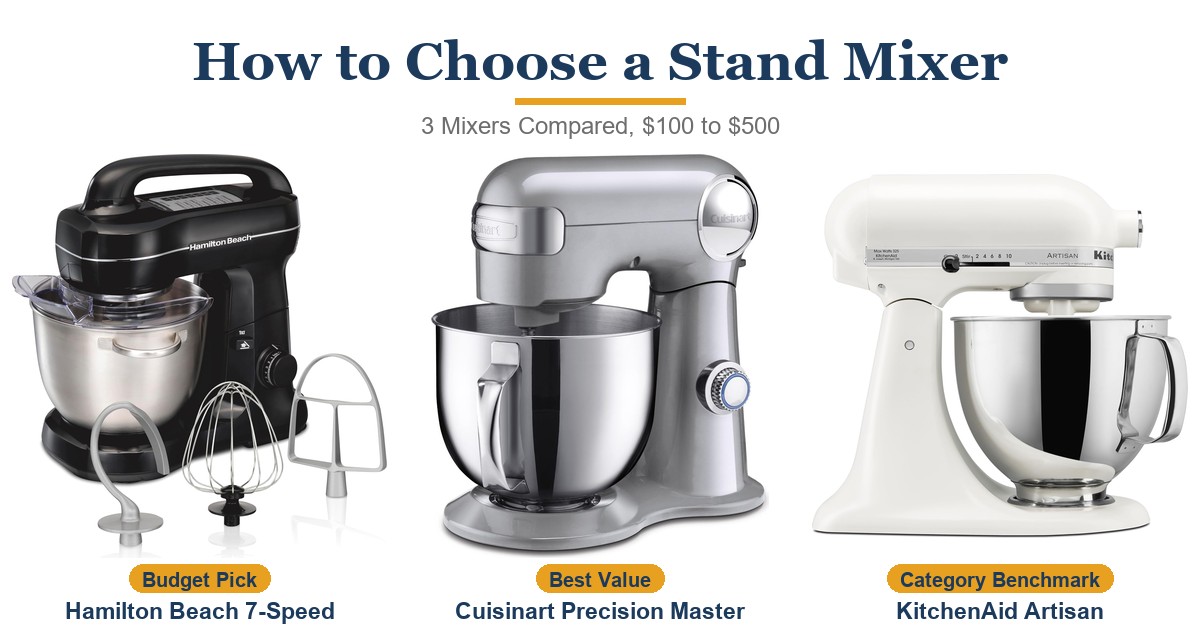
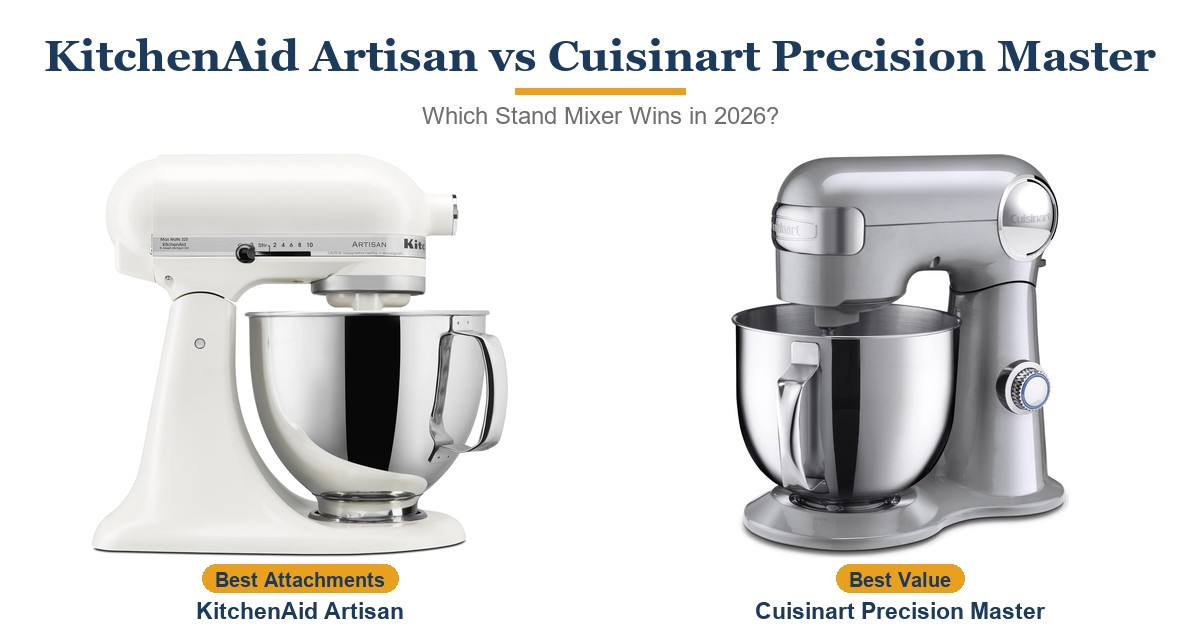
The Artisan sits in the middle of the stand mixer field — more capable than entry-level hand-mixer-adjacent machines, less powerful than mixers built for frequent bread baking.
| Feature | KitchenAid Artisan | Cuisinart Precision Master | Hamilton Beach Eye Candy | Breville Bakery Chef |
|---|---|---|---|---|
| Price (USD) | $489.00 (last Amazon price, Oct 18, 2026) | $289.95 | $129.99 | $762.51 (last Amazon price, Oct 11, 2026) |
| Bowl Capacity | 5 qt | 5.5 qt | 4 qt | 5 qt |
| Motor Power | 325 W | 500 W | approx. 300 W | approx. 550 W |
| Speeds | 10 | 12 | 7 | 12 + digital timer |
| Attachment Hub | Yes — 10+ accessories | No | No | No |
| Dishwasher-Safe Parts | Yes | Yes | Yes | Yes |
| TTP Review | This review ↑ | Read our review → | — | — |
| Amazon | View on Amazon | View on Amazon | — | View on Amazon |
Prices change frequently — always verify current pricing before purchasing.
Is the KitchenAid Artisan Stand Mixer Worth It?
For the person baking cookies, cakes, and the occasional loaf of bread a few times a month, the Artisan is still the mixer most worth owning — the attachment hub alone justifies the price over a single-purpose competitor, and the all-metal build means it’s a genuinely long-term purchase rather than something to replace in five years.
Anyone kneading bread dough weekly, doubling recipes routinely, or running a small side business out of their kitchen should look at the more powerful Breville Bakery Chef or step up to KitchenAid’s own bowl-lift Professional line — the 325-watt motor here is sized for home baking, not production volume.