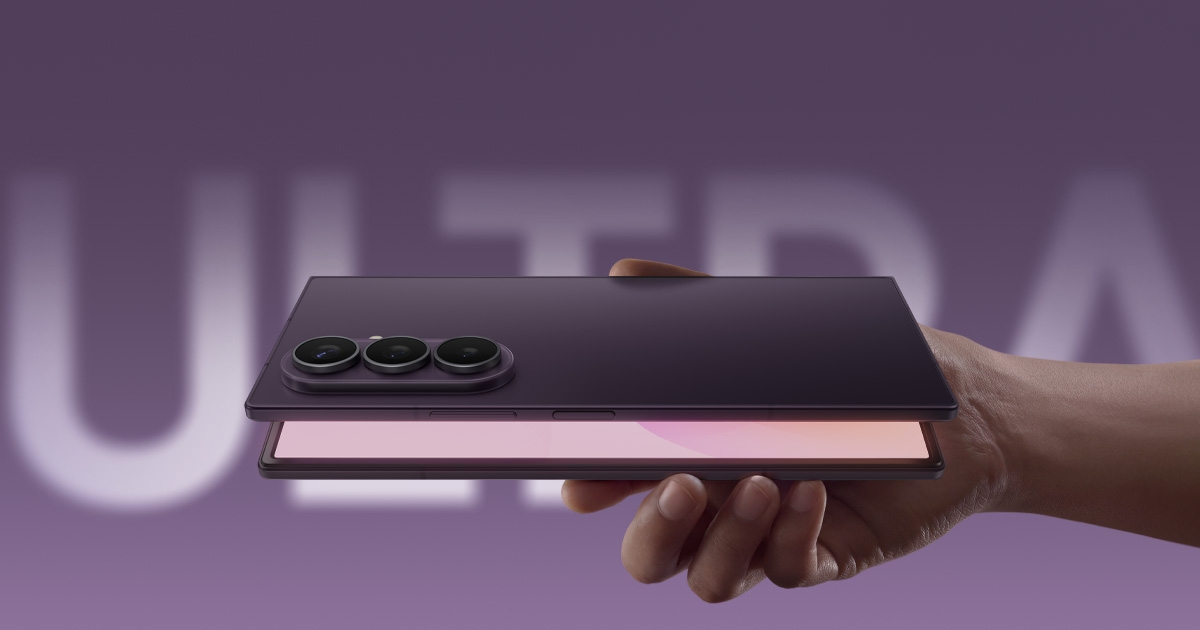
The Galaxy Z Fold8 Ultra is the foldable to buy if you want a tablet-size screen in a phone that still carries like a regular one: it weighs 215 g, its brighter, nearly creaseless 8-inch display is a pleasure for work and reading, and its bigger battery now lasts a full day of mixed use. Its 3x telephoto trails rival zoom cameras; if zoom comes first, the Galaxy S26 Ultra, also sold on Amazon.ca, is the better camera phone. If you'd rather have a lighter, wider fold, several testers preferred the Galaxy Z Fold8, though it has no telephoto camera.
Pros
- Bright, anti-reflective 8-inch inner screen with a near-invisible crease
- Light and thin enough to carry like a regular phone
- Bigger battery and longer life than the Fold7
- Excellent 200MP main and new 50MP ultrawide cameras
- Top-tier Snapdragon performance
- Up to seven OS upgrades and security updates
Cons
- Weak 3x telephoto for the price
- IP48 rating isn't sealed against sand or fine dust
- No S Pen support
- No built-in magnets for magnetic chargers
As an Amazon Associate I earn from qualifying purchases. Disclosure
Overview
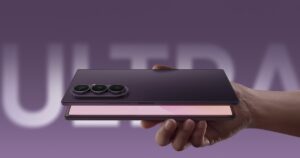
The Galaxy Z Fold8 Ultra is for someone who wants a tablet-size screen in a phone that still carries like a regular one. Folded, it is 8.9 mm thick and weighs 215 g, about the same as Samsung’s Galaxy S26 Ultra, and it opens into an 8-inch display with room for apps side by side. It went on sale in August 2026 and, despite the new name, it is the direct successor to the Galaxy Z Fold7; the Galaxy Z Fold8 sold alongside it is a different, wider model.
Most of what changed is inside. The battery grows from 4,400 to 5,000 mAh, wired charging goes from 25W to 45W, the inner screen gets brighter with an anti-reflective coating, the crease is close to invisible, and the ultrawide camera jumps from 12MP to 50MP. In Canada it is sold as model SM-F976W, and the 256GB Graphite version was $2,699.99 CAD on Amazon.ca in October 2026. What didn’t change matters too: the IP48 rating still leaves out dust protection, and there is still no S Pen support.
Key Specifications
| Price (CAD) | $2,699.99 |
| Inner display | 8.0-inch, up to 120Hz, up to 3,000 nits peak, anti-reflective |
| Cover display | 6.5-inch, up to 120Hz |
| Size folded | 158.4 x 72.8 x 8.9 mm |
| Size unfolded | 158.4 x 143.2 x 4.1 mm |
| Weight | 215 g |
| Processor | Snapdragon 8 Elite Gen 5 for Galaxy |
| Memory and storage | 12GB RAM with 256GB or 512GB; 16GB RAM with 1TB |
| Rear cameras | 200MP wide, 50MP ultrawide, 10MP 3x telephoto |
| Selfie cameras | 10MP on the cover screen, 10MP on the inner screen |
| Battery | 5,000 mAh, up to 27 hours of video playback (Samsung’s rating) |
| Wired charging | 45W (with a 45W charger, sold separately) |
| Water and dust rating | IP48 |
| S Pen | Not supported |
| Software | Android 17 with One UI 9; up to seven OS upgrades and security updates |
Samsung Galaxy Z Fold8 Ultra Design and Build
Closed, it handles like a slim regular phone, and the hinge now opens with a smoother, less stiff action than the Fold7’s. Samsung’s 4.1 mm unfolded figure is a tenth of a millimetre under the Fold7’s, but HotHardware points out that the figure apparently refers to the aluminum frame; the real gain is a wider gap between the two halves, which makes the phone easier to open. A new chamfered edge along the fold helps as well, though BGR still found it nearly impossible to open with one hand.
Under the folding screen, Samsung’s new Flex Titanium layers make the crease far less visible than on the Fold7. Looking at it head-on you mostly stop noticing it, but it still shows at an angle with the screen off, and some testers could still feel it with a finger. MobileSyrup, using it next to the Pixel 11 Pro Fold for several weeks, found both creases grew visible over time, the Samsung’s more slowly.
Durability is where rivals now lead. The cover screen sits under Gorilla Glass Ceramic 3 and the back under Gorilla Glass Victus 2, in an aluminum frame, but the IP48 rating only covers solid particles larger than 1 mm, BGR notes, so sand and fine dust are a risk; Google’s Pixel 11 Pro Fold and Samsung’s own Galaxy S26 Ultra are both rated IP68. The thick camera bump also makes the phone rock when you use it flat on a desk.
Displays and Multitasking
The inner screen is the best reason to buy this phone. Samsung rates it at up to 3,000 nits, 15% brighter than the Fold7, and adds an anti-reflective coating that cuts glare. Tom’s Guide measured a peak of 2,687 nits, the brightest of any phone it has tested, and its reviewer could still see the screen clearly in direct sun while wearing sunglasses. Other labs measured less: MySmartPrice recorded 2,365 nits on the inner screen, and Expert Reviews’ highest reading was 1,425 nits with HDR content; in its testing, the screens performed roughly as well as last year’s.
The 6.5-inch cover screen is narrow but comfortable for typing, messaging and browsing, so many quick tasks never need the phone opened; TechRadar found it occasionally overwhelmed by direct sunlight, since it doesn’t get as bright as the inner panel, while MySmartPrice measured 2,265 nits on it and found both screens easy to see in bright sun. Opened, the 8-inch screen runs several apps at once, with a taskbar, saved app pairs and drag and drop between windows. MobileSyrup also found Samsung’s DeX desktop mode, which turns the phone into a computer on an external monitor, far more capable than the Pixel’s.
Two things haven’t changed. The squarish inner screen leaves wide black bars on most video, which is where the wider Galaxy Z Fold8 is the better screen for watching. And the S Pen is gone for a second year: Samsung removed the digitizer layer with the Fold7 to save thickness and hasn’t brought it back, while Expert Reviews points out that the Honor Magic V6 and Motorola Razr Fold both still support a stylus.
Cameras
The main and ultrawide cameras are excellent. The 200MP main camera is carried over from the Fold7, and testers disagree on how much Samsung’s updated image processing adds: in Tom’s Guide’s side-by-side shots it picked up noticeably more detail than the Fold7, and a clearer, sharper image than the iPhone 17 Pro Max, while HotHardware found photos similar to the Fold7’s apart from the ultrawide. The new 50MP ultrawide, up from 12MP, is the biggest camera upgrade, and Expert Reviews rates its shots among the best ultrawide photos it has seen from any smartphone.
Night shots picked up much more detail than the Fold7’s in Tom’s Guide’s tests, though HotHardware found the low-light gain marginal and MySmartPrice would have liked a little more detail in pure low light; the Galaxy S26 Ultra still pulls more detail out of dark scenes. Expert Reviews ties that to the S26 Ultra’s wider f/1.4 main-camera aperture, against f/1.7 here. Video is a strength: 8K at 30 fps, 4K at 120 fps in 10-bit HDR, and a LOG mode for colour grading in editing software.
The weak spot is the 3x telephoto, the same 10MP camera as last year. Expert Reviews calls it “far from bad, it’s just a little bit behind the quality you can get from other foldables,” while Tom’s Guide found its photos “appalling for a phone that costs this much.” Several tests saw image quality fall away beyond 10x zoom, though it is still fine for portraits and moderate zoom.
Battery Life and Charging
Battery life is the upgrade Fold7 owners will feel most, though tests disagree on how big it is. Tom’s Guide recorded 14 hours and 33 minutes on its 5G browsing test, close to four hours beyond the Fold7 and its best result yet for a Galaxy foldable, though its Galaxy S26 Ultra and Motorola Razr Fold results (16 hours and 10 minutes, and 14 hours and 44 minutes) were longer. The 5,000 mAh battery uses silicon-carbon cells, which fit more capacity into the same thin body. 91mobiles’ PCMark run lasted 20 hours and 45 minutes from 100% down to 20%, the highest that outlet has recorded for a foldable.
Not every test found a jump that large. Expert Reviews’ video-loop test ran for 24 hours and 51 minutes on the main screen, roughly an hour and a half more than the Fold7 managed, and the Honor Magic V6 lasted longer still. In mixed everyday use, testers got through full days with charge to spare, but heavy use, especially lots of photos and video, still drains it quickly.
Wired charging moves to 45W, and two tests reached 76% after half an hour of charging, while Expert Reviews’ test took 32 minutes to reach 50% and 1 hour and 22 minutes for a full charge, just three minutes faster than the Fold7. Wireless charging is supported, but there are no built-in magnets, so magnetic chargers and mounts need a magnet case.
Performance and Software
This is the first Galaxy foldable with the “for Galaxy” version of Qualcomm’s top chip, the same Snapdragon 8 Elite Gen 5 for Galaxy used in the Galaxy S26 Ultra. In Tom’s Guide’s Geekbench 6 run it scored 3,733 single-core and 11,457 multi-core, up from 3,052 and 9,735 on the Fold7 and just behind the S26 Ultra. Gaming results differ: Tom’s Guide played PUBG Mobile at the highest settings without the phone noticeably heating up, while MySmartPrice saw it throttle in a 15-minute stress test, with frame drops in long gaming sessions.
The software makes good use of the big screen. One UI 9 on Android 17 adds Galaxy AI features such as Now Nudge, which surfaces suggestions based on what you’re doing and can open them in split screen next to your current app. Samsung promises up to seven OS upgrades and security updates, in line with the seven years Google gives the Pixel 11 Pro Fold. The speakers are loud but, in TechRadar’s view, can sound tinny, with virtually no bass.
How Does It Stack Up Against the Competition?
Google’s Pixel 11 Pro Fold is the main book-style rival from another brand, and the Galaxy S26 Ultra is here for anyone weighing a foldable against Samsung’s best regular phone. Honor’s Magic V6 beat it in several of Expert Reviews’ tests, but Chinese foldables like it are hard to get in North America.
| Feature | Samsung Galaxy Z Fold8 Ultra | Google Pixel 11 Pro Fold | Samsung Galaxy S26 Ultra |
|---|---|---|---|
| Price (CAD) | $2,699.99 (256GB) | $2,099.00 (256GB) (last Amazon price, Oct 6, 2026) | $2,049.99 (256GB) |
| Folding inner screen | 8.0-inch | 8-inch | None (not a foldable) |
| Outer screen | 6.5-inch | 6.5-inch | 6.9-inch |
| Weight | 215 g | 239 g (8.4 oz) | 214 g |
| Thickness | 8.9 mm folded, 4.1 mm open | 10.1 mm folded, 5 mm open | 7.9 mm |
| Battery capacity | 5,000 mAh | 4,806 mAh (typical) | 5,000 mAh |
| Rear cameras | 200MP wide, 50MP ultrawide, 10MP 3x telephoto | 48MP wide, 10.5MP ultrawide, 10.8MP 5x telephoto | 200MP wide, 50MP ultrawide, 50MP 5x and 10MP 3x telephoto |
| Water and dust rating | IP48 | IP68 | IP68 |
| Processor | Snapdragon 8 Elite Gen 5 for Galaxy | Google Tensor G6 | Snapdragon 8 Elite Gen 5 for Galaxy |
| TTP Review | This review ↑ | Read our review → | Read our review → |
| Amazon | View on Amazon | View on Amazon | View on Amazon |
Prices change frequently — always verify current pricing before purchasing.
Samsung Galaxy Z Fold8 Ultra: Worth It as a Phone That Doubles as a Tablet
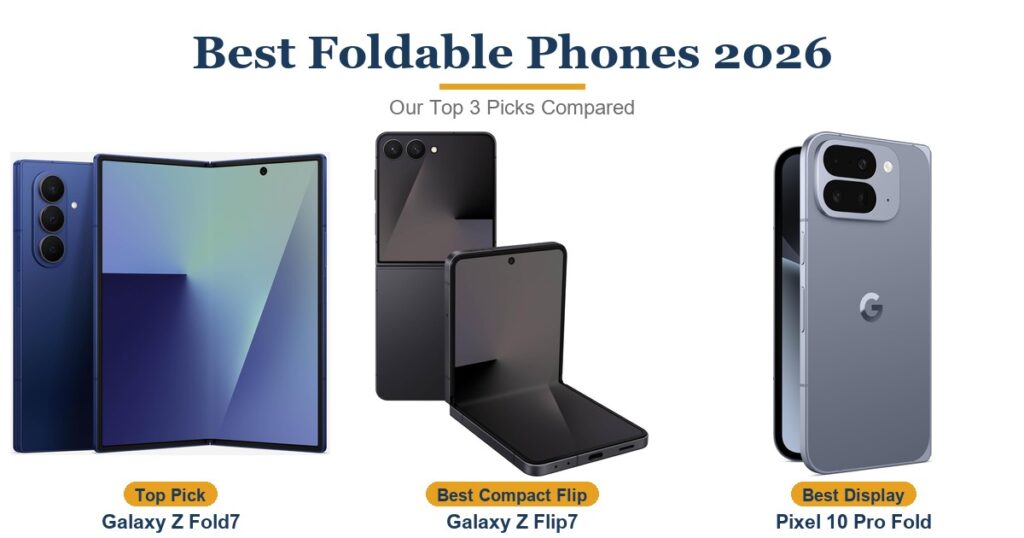
Buy it if you’ll use the inner screen every day: answering email next to a chat, editing documents, following maps, or watching with the phone propped half-open in Flex Mode. On Amazon.ca, the Pixel 11 Pro Fold wasn’t available new in October 2026 (Google and Canadian carriers sell it), so the closest Amazon.ca alternative is the wider Galaxy Z Fold8, at $2,399.99 CAD for 256GB against $2,699.99 CAD for this one. Fold7 owners have less reason to upgrade: BGR’s verdict is that “your Z Fold 7 is still most of this phone at none of the additional cost” if the bigger battery, the new ultrawide and the brighter screen aren’t must-haves for you.
Look elsewhere if your priorities sit outside that big screen. If you zoom a lot, the Galaxy S26 Ultra gets far more from its 5x camera, adds a built-in S Pen and IP68 protection, and was $2,049.99 CAD on Amazon.ca in October 2026. If dust protection and Google’s software matter more, the Pixel 11 Pro Fold is rated IP68, though it is heavier and, in MobileSyrup’s comparison, didn’t last a full day of heavy use. And if you’d rather have a shorter, wider fold, the Galaxy Z Fold8 is the one several testers preferred for everyday use: it is lighter at 201 g, more pocketable, easier to type on when closed and better for video, though it gives up the Ultra’s 200MP main camera and has no telephoto at all.
Sources
- Samsung — Galaxy Z Fold8 Ultra product page
- Samsung — Galaxy Z Fold8 product page
- Samsung — Galaxy S26 Ultra product page
- Google — Pixel 11 Pro Fold tech specs
- Google — Pixel 11 Pro Fold tech specs (metric)
- Samsung Galaxy Z Fold8 Ultra — Amazon.ca Product Listing
- Tom’s Guide — Samsung Galaxy Z Fold 8 Ultra review
- Tom’s Guide — Samsung Galaxy Z Fold 8 Ultra vs Galaxy Z Fold 7
- TechRadar — Samsung Galaxy Z Fold 8 Ultra review
- Expert Reviews — Samsung Galaxy Z Fold 8 Ultra review
- BGR — Samsung Galaxy Z Fold 8 Ultra review
- HotHardware — Samsung Galaxy Z Fold8 and Fold8 Ultra review
- 91mobiles — Samsung Galaxy Z Fold 8 Ultra review
- MySmartPrice — Samsung Galaxy Z Fold 8 Ultra review
- MobileSyrup — Samsung Galaxy Z Fold 8 Ultra vs Pixel 11 Pro Fold
- SamMobile — Galaxy Z Fold 8 vs Fold 8 Ultra: which one replaces your Fold 7
- Samsung Canada — Galaxy Z Fold8 Ultra product page
Reader Poll
What would you use the Fold8 Ultra's big inner screen for most?
Help Our Editors Know What Matters to You
Explore on Amazon →