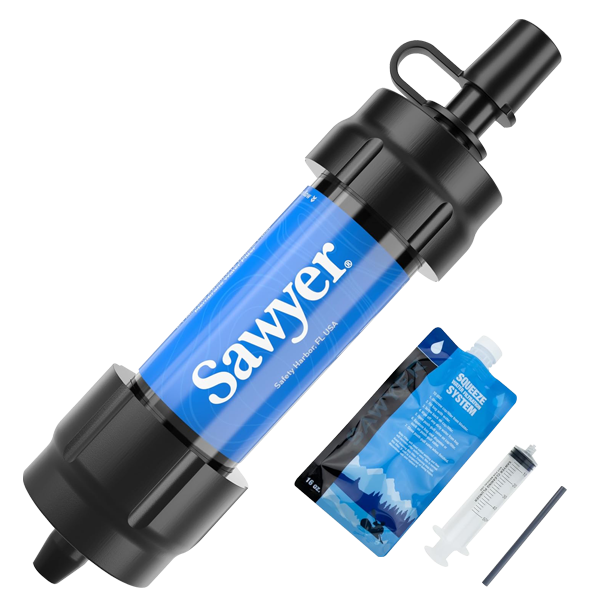
Buy the Sawyer Mini if you hike solo and want a dependable filter, available on Amazon.ca, that weighs about 57 g (2 oz), threads onto standard bottles and goes inline on a hydration hose without an adapter. Its 0.1-micron membrane stops bacteria and protozoa and is rated for about 378,500 L, so there is no cartridge to keep buying. The trade-off is flow: it is slower than the Sawyer Squeeze and needs backflushing more often, which matters most to groups and anyone filtering silty water. Long-distance hikers are better served by the Squeeze.
Pros
- About 57 g and palm-sized
- Barbed ends go inline on a hydration hose
- Fits standard 28 mm bottles
- Rated for about 378,500 L
- Straw, pouch and backflush syringe included
Cons
- Slower flow than the Sawyer Squeeze
- Needs frequent backflushing in silty water
- Small included pouch
- Doesn't remove viruses or chemicals
As an Amazon Associate I earn from qualifying purchases. Disclosure
Overview
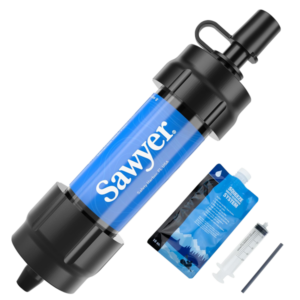
Small enough to fit in the palm of your hand, the Sawyer Mini (model SP128) weighs about 57 g (2 oz) and turns water from a stream or lake into drinking water for one person. It is made for day hikers, trail runners, solo backpackers, travelers and emergency kits, and it comes with a 473 mL (16-ounce) squeeze pouch, a drinking straw and a syringe for cleaning.
The Mini is the narrow member of Sawyer’s family of hollow-fiber filters. Sawyer’s own comparison puts it at about half the width of the full-size Squeeze and at roughly the same 57 g (2 oz) as the shorter Micro Squeeze. Unlike those two dual-threaded filters, it has barbs on both ends, so it drops straight into a hydration-pack hose without an adapter. That detail carries more weight in Canada: as of November 2026 Amazon.ca lists the Mini at $50.34 CAD from a third-party seller and the Micro Squeeze at $48.61 CAD, so price barely separates them, while Sawyer says the Mini needs backwashing more often than either.
Key Specifications
| Price (CAD) | Deal $43.25 |
| Model | SP128 (blue); also sold in other colours and multi-packs |
| Filter | 0.1 micron absolute hollow fiber membrane |
| Removal claims (Sawyer) | 99.99999% of bacteria, 99.9999% of protozoa, 100% of microplastics |
| Viruses and chemicals | Not removed (no virus rating, no carbon stage) |
| Rated filter life | About 378,500 L (up to 100,000 gallons) |
| Weight | 57 g (2 oz) filter; 140 g (4.93 oz) listed retail weight |
| Connections | 28 mm bottle thread on the intake end; barbed ends for hydration tubing |
| In the box | Filter, 473 mL (16 oz) pouch, syringe, straw |
| Pressure limit | 20 psi; Sawyer advises against fitting it to a spigot or faucet |
Sawyer Mini Water Filter Flow Rate and Clogging
Flow is the one area where the Mini gives ground: every comparison we found had it slower than the Squeeze, though Packstack notes results vary, citing a blogger whose Mini and Squeeze ended up flowing about the same after extensive use. FarOut timed Sawyer’s three filters with six different containers and on a gravity setup, and the Mini’s flow averaged about 30% below the Squeeze’s; on gravity it managed less than half of the Squeeze’s rate. CleverHiker lists the Mini’s flow at 1 L/min and found that, compared with the Squeeze, it adds about 30 seconds when filtering clear water from a bottle or bladder and roughly 5 minutes on gravity.
How much that matters depends on the drinker. Paddling Light’s reviewer, testing the Mini at its 2013 launch (Sawyer now sells a second-generation version) on kayak trips and hikes, found the flow more than adequate in every setup tried apart from a soda bottle that collapsed mid-drink. The reviewer reckoned a 1.9 L (64-ounce) gravity bag took about 10 minutes, which was fine to leave running while setting up camp. Home Grail, by contrast, could not get water through fast enough when catching its breath after a climb, and learned to carry some already-filtered water for those moments.
The thin cartridge also clogs sooner, and Sawyer itself says the Mini needs cleaning more often than the Squeeze. CleverHiker’s routine is a flush every few days on a long trek plus one at home after shorter trips. It adds that murkier water means more frequent flushing, and it suggests a different primary filter for especially silty or still sources. Trail Hiking Australia’s reviewer found the flow great at first but saw it fall over time, to the point where cleaning didn’t seem to improve it.
What It Removes, and What It Doesn’t
Sawyer rates the membrane at 0.1 micron absolute and says it removes 99.99999% of bacteria such as salmonella, cholera and E. coli, 99.9999% of protozoa such as giardia and cryptosporidium, and 100% of microplastics. Sawyer also says every filter is performance tested three times during manufacturing. For a Canadian reference point, the BC Centre for Disease Control says a filter needs an absolute pore size of 1 micron, or an NSF rating for cyst removal, to stop giardia cysts, which are 8 to 12 microns long. The Mini’s 0.1-micron rating is well inside that. The same agency advises assuming that untreated water from lakes, rivers and streams is contaminated with animal waste.
It does not remove viruses, and it has no carbon stage, so heavy metals, pesticides and dissolved chemicals pass straight through. Sawyer adds that tastes, colours and odours from dissolved solids, such as chlorine or tannins, pass through too. The sources split on travel: Sawyer pitches the Mini for trips abroad where tap and bottled water can’t be trusted, while CleverHiker lists “Not rated for viruses, international trips” among its cons. Where viruses are a real risk, add a purification step such as chemical treatment.
Ways to Use It, and the Weight
The Mini’s strength is how many ways it connects. It screws onto the included pouch or any standard 28 mm disposable bottle, takes the straw so you can drink directly from a stream, splices into a hydration-pack hose, and works as the filter in a two-bag gravity setup. Testers often skip the pouch and screw it onto a bottle instead. The barbed ends are the reason to choose it over the Micro Squeeze if you drink through a hose. The flip side is that the standard Mini has threads on one end only, so it can’t use Sawyer’s cleaning coupling or its threaded adapters.
Weight is where the Mini is hard to beat. FarOut weighed its filters after testing at 51 g for the Mini, 69 g for the Micro and 103 g for the Squeeze, so the Mini saves about half the Squeeze’s weight.
Pouch, Backflushing and Cold-Weather Care
The included 473 mL (16-ounce) pouch is the weakest part of the kit. CleverHiker, which says the pouches are notorious for blowing a seam, suggests carrying spares or a 1.9 L (64-ounce) bag, since the included one suits a trail run more than a backpacking trip. A sturdy bottle with the right thread does the same job.
Sawyer’s advice is to backflush when the flow drops, before storing the filter and again before its next use. You don’t have to carry the syringe for the job. In FarOut’s test, a Smartwater bottle’s flip-top nozzle beat the syringe on every Sawyer filter it tried, at 6 g to the syringe’s 31 g.
Three care rules come from Sawyer itself. Overtightening a bottle can unseat the washer in the intake end and cause leaks (the washers are replaceable). The fibers are designed for up to 20 psi, so the filter should never go straight onto a spigot. And a wet filter must not freeze: there is no way to tell whether freezing damaged it, Sawyer recommends replacing a filter you suspect has frozen, and its warranty does not cover a frozen filter. In freezing weather keep it in a pocket by day and in your sleeping bag at night. Beyond replacement pouches there is nothing to keep buying, because Sawyer rates the filter for about 378,500 L (100,000 gallons) with no cartridge to change.
How Does It Stack Up Against the Competition?
All five are squeeze-style filters that stop bacteria and protozoa but not viruses. The Mini’s case against them is its weight and rated life; only the BeFree skips backflushing altogether, cleaning with a shake.
| Feature | Sawyer Mini | Sawyer Squeeze | Sawyer Micro Squeeze | Katadyn BeFree 0.6L Water Filter | LifeStraw Peak Squeeze 1L |
|---|---|---|---|---|---|
| Price (CAD) | Deal $43.25 (1-pack) | $69.99 (2-pouch kit) (Nov 2) | Deal $48.71 (1-pack) | $62.16 (0.6 L) | $42.39 (1 L) (Nov 2) |
| Weight | 57 g (2 oz), filter (Sawyer) | 85 g (3 oz), filter (Sawyer) | 57 g (2 oz), filter (Sawyer) | 96 g (3.4 oz) with bottle (OutdoorGearLab); Katadyn’s listing says 59 g | 68 g (2.4 oz), filter only (CleverHiker) |
| Pore size | 0.1 micron absolute | 0.1 micron absolute | 0.1 micron absolute | 0.1 micron | 0.2 micron |
| Rated filter life | About 378,500 L (100,000 gal) | 378,000 L (CleverHiker) | About 378,500 L (100,000 gal) | About 1,000 L | 2,000 L |
| Field cleaning | Backflush with included syringe | Backflush with included plunger | Backflush with included plunger | Shake or swish in water, no tools | Backflush with included syringe |
| Rated to remove viruses | No | No | No | No | No (not claimed by LifeStraw) |
| Amazon | View on Amazon | View on Amazon | View on Amazon | View on Amazon | View on Amazon |
Prices change frequently — always verify current pricing before purchasing.
Sawyer Mini Water Filter: Worth It for Ultralight Solo Trips
Buy the Mini if you are one person drinking from mostly clear lakes and streams and you care about every gram: day hikes, trail runs, weekend trips, travel kits and the backup filter in an emergency bag. It is also the Sawyer to pick if you drink through a hydration hose, thanks to its barbed ends. The price picture in Canada differs from the US: as of November 2026 on Amazon.ca it costs about as much as the Micro Squeeze and more than the LifeStraw Peak Squeeze 1L. So the case for it here rests on its weight and those barbs rather than on price. CleverHiker rates it 4.5 out of 5 and calls it “almost a no-brainer choice” as a backup or on trails with clearer sources.
Look elsewhere if you filter for a group, hike long distances day after day or rely on silty or stagnant water. Sawyer’s own comparison puts both the full-size Squeeze and the Micro Squeeze ahead of the Mini on flow. That is why the testers who compared them point long-distance hikers to the Squeeze or the Micro; the Micro also threads on both ends at about the Mini’s weight. If you’d rather not backflush at all, the Katadyn BeFree cleans with a shake, and OutdoorGearLab found it one of the easiest of the squeeze designs to use. OutdoorGearLab’s favorite filter for personal use is the LifeStraw Peak Squeeze, which it says “doesn’t have the same durability complaints as the Sawyer soft bottles.”
Sources
- Sawyer — MINI Water Filtration System
- Sawyer — Micro Squeeze (incl. the Mini, Micro and Squeeze comparison)
- Sawyer — Squeeze Water Filtration System
- Sawyer — Lifetime Warranty
- Sawyer Mini Water Filtration System — Amazon.ca Product Listing
- CleverHiker — Sawyer Mini Water Filter Review
- CleverHiker — Best Backpacking Water Filters of 2026
- CleverHiker — Sawyer Micro Squeeze Filter Review
- FarOut — Sawyer Mini, Micro and Squeeze Compared
- FarOut — Should I carry the Sawyer Syringe?
- Home Grail — Sawyer MINI Water Filter Review
- Paddling Light — Sawyer Mini Water Filter Review
- Trail Hiking Australia — Sawyer Mini Water Filter Review
- Packstack — Sawyer Mini Water Filter Review
- OutdoorGearLab — Katadyn BeFree Review
- OutdoorGearLab — Best Backpacking Water Filters
- BC Centre for Disease Control — Giardiasis
Reader Poll
How would you use a Sawyer Mini?
Help Our Editors Know What Matters to You
Explore on Amazon →