The eero Max 7 is the router to buy for an internet plan above 5 Gbps or a 10 Gigabit wired setup if you want Wi-Fi 7 speed without fiddling: testers measured some of the fastest close-range Wi-Fi they had seen, and setup takes minutes in the app. Its two 10 Gigabit ports leave headroom for faster plans and wired gear. The trade-off is control: the app offers few settings, and ad blocking, a VPN and advanced security need a paid eero Plus subscription. If you want a fiber port or USB storage on the router, TP-Link's Deco 7 Elite BE85 fits better.
Pros
- Among the fastest close-range Wi-Fi 7 speeds tested
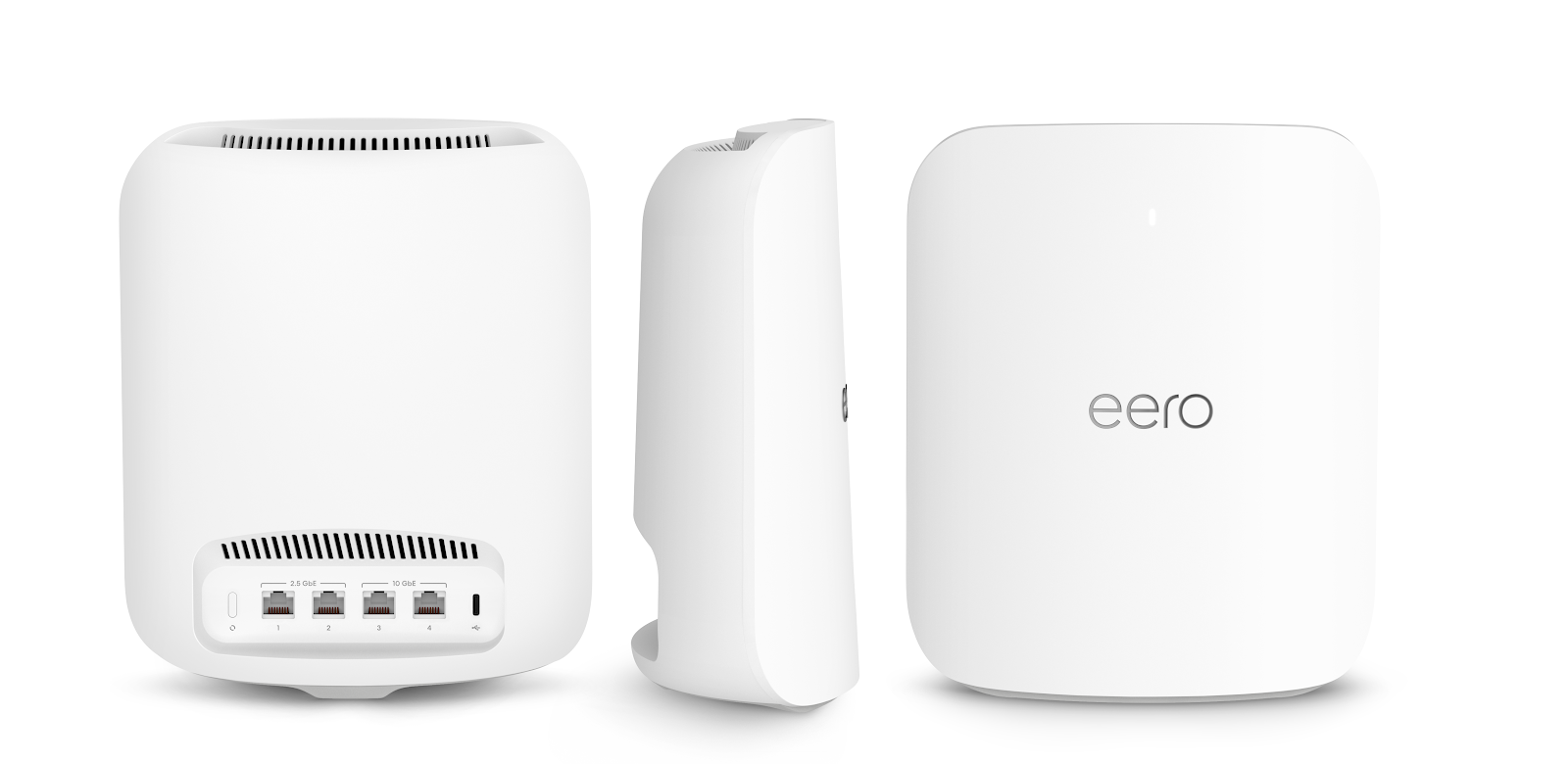
- Two 10 Gigabit and two 2.5 Gigabit Ethernet ports
- Setup takes minutes in the app
- Built-in Zigbee, Thread and Matter hub
- Fanless and silent
Cons
- Few settings and no web interface; ad blocking, VPN and advanced security need paid eero Plus
- Speed dropped off faster with distance in Tom's Guide's test
As an Amazon Associate I earn from qualifying purchases. Disclosure
Overview
Amazon’s eero Max 7 is the top model in eero’s Wi-Fi 7 mesh line: a tri-band router on the 2.4, 5 and 6 GHz bands with two 10 Gigabit and two 2.5 Gigabit Ethernet ports. eero rates it at up to 4.3 Gbps over Wi-Fi and 9.4 Gbps over Ethernet, and says it can handle internet plans up to 10 Gbps. It is aimed at busy homes on fast fiber or cable plans that want Wi-Fi to run itself, and it is sold on Amazon as a single router or in multi-packs that form a mesh.
The Max 7 went on sale in October 2023 and is still the model eero calls its most advanced, above the cheaper eero Pro 7. Tom’s Guide called it “the simplest Wi-Fi 7 mesh system to set up and use”, and testers measured some of the fastest close-range Wi-Fi they had seen from it. Where reviewers part ways is range: some tests found its speed fell off quickly with distance.
Key Specifications
| Wi-Fi standard | Wi-Fi 7 (802.11be), tri-band 2.4 / 5 / 6 GHz |
| Rated wireless speed | Up to 4.3 Gbps (eero) |
| Rated wired speed | Up to 9.4 Gbps (eero) |
| Ethernet ports | 2x 10 Gigabit + 2x 2.5 Gigabit, all auto-sensing |
| Rated coverage (one unit) | Up to 2,500 sq. ft. (232 m²) |
| Devices | 250+ (eero) |
| Smart-home hub | Zigbee, Thread, Matter; works with Alexa |
| Size (each unit) | 222 x 184 x 90 mm |
| Cooling | Passive vents, no fan |
| Management | eero app (iOS and Android) |
| Warranty | 3 years (eero’s US store page) |
| Price (USD) | $599.99 |
eero Max 7 Wi-Fi Speed and Range
Up close, the Max 7 is among the fastest Wi-Fi systems reviewers have measured. Trusted Reviews recorded an average of 1895.4 Mbps from a Wi-Fi 7 phone at close range, which it called the fastest wireless throughput it had seen. Tom’s Hardware saw a Wi-Fi 7 phone reach 2.02 Gbps six feet from the main unit, though that fell to 327 Mbps at 25 feet with several walls in between.
Range is where the tests split. RTINGS lists outstanding range performance among its pros, and T3 found speeds stayed high and stable through a two-storey home. Tom’s Guide saw the opposite in a 100-year-old house: at 50 feet the Max 7 delivered 146.9 Mbps, about a fifth of the TP-Link Deco BE85’s 790.4 Mbps, and its three units left dead zones at the far edges of the home. Dong Knows Tech estimated that a single unit covers about 1,500 sq. ft. That is well short of the 2,500 sq. ft. eero claims.
The harshest result came from Dong Knows Tech: in its early-2024 testing, none of its Wi-Fi 6E or Wi-Fi 7 devices would connect on the 6 GHz band. That left a 5 GHz band it judged the slowest of more than a dozen Wi-Fi 7 routers it had tried. Its reviewer expected firmware updates to make 6 GHz easier to reach, and the other tests cited here connected on 6 GHz. Results depend heavily on the house and the devices in it.
Multi-Gig Ports and Mesh Backhaul
The four Ethernet ports are the clearest reason to pay for this model. Any of them can take the internet connection, so one feeds the modem and three stay free for a console, a PC or a network drive, and the two 10 Gigabit ports leave room for plans well beyond 2 Gbps. Dong Knows Tech found the 10 Gbps ports sustained around 6 Gbps, which it notes is normal for multi-gig routers, and called the Max 7 excellent as a wired device.
Between units, it has no band set aside for mesh traffic, so a wireless mesh shares bandwidth with your devices. eero says its software sends that traffic over whichever bands are fastest and least congested, and linking units with Ethernet avoids the issue. Over wireless, Dong Knows Tech measured 1.8 Gbps between the router and a satellite, the slowest backhaul result in its testing at the time.
eero says the Max 7 works alongside older eeros but warns that mixing generations may reduce performance across the network. Trusted Reviews saw exactly that: added to an existing eero Pro 6E network, the Max 7 performed about like a standard Wi-Fi 6 system until it was set up as a new network on its own.
App, Setup and Smart-Home Hub
Setup runs entirely through the eero phone app. Tom’s Hardware had its first unit running in about two minutes, and Tom’s Guide finished a three-unit system in just over six minutes, half the time a Netgear Orbi RBE973 kit took. Each extra unit has to be added by hand, unlike the presynced Deco BE85 kit, and Dong Knows Tech needed just under 30 minutes for its three-pack.
That ease comes from a short settings list. There is no web interface, you can’t give each band its own network name or force a device onto one band, and the system picks channels itself. Ad blocking, active threat protection, content filters, advanced scheduling and a VPN sit behind the paid eero Plus subscription, and testers found the app prompts for it often. The free app covers device profiles, pausing a device, limiting online access and backup through your own phone hotspot, which is why reviews disagree on whether parental controls cost extra.
Built into each unit is a smart-home hub for Zigbee, Thread and Matter gear, which lets Alexa reach compatible devices without a separate bridge. Voice control has limits: Trusted Reviews could pause a profile with Alexa but had no way to switch the guest network on or off.
Design, Heat and Power Use
The Max 7 is far bigger than earlier eeros: an upright white unit of 222 x 184 x 90 mm with large vents at the top and bottom and no fan, so it runs silently. Power comes from a USB-C adapter, and that USB-C port is for power only, with no port for a storage drive.
Most tests found it stays cool or only gets warm: T3 saw no sign of the units getting hot, Dong Knows Tech found it stayed relatively cool, and Tom’s Guide found it never got more than warm to the touch. Tech Advisor was the exception, noting it gives off a fair amount of heat. Tom’s Guide measured 19.1 watts at the router and 18.2 watts at each satellite under load; by its estimate, that adds up to more electricity a year for its three-unit system than the Orbi RBE973 or Deco BE85 kits it tested used.
How Does It Stack Up Against the Competition?
Against other tri-band Wi-Fi 7 mesh routers sold as single units, the Max 7 trades TP-Link’s extra connections for eero’s simpler app, while the eero Pro 7 keeps the same app with slower ports.
| Feature | eero Max 7 | TP-Link Deco 7 Elite BE85 | eero Pro 7 |
|---|---|---|---|
| Price (USD) | $599.99 (1-pack) | $449.99 (1-pack) | $299.99 (1-pack) |
| Wi-Fi | Wi-Fi 7, tri-band (2.4 / 5 / 6 GHz) | Wi-Fi 7, tri-band (2.4 / 5 / 6 GHz) | Wi-Fi 7, tri-band |
| Ethernet ports | 2x 10 Gbps + 2x 2.5 Gbps | 2x 10 Gbps (one RJ45/SFP+ combo) + 2x 2.5 Gbps | 2x 5 Gbps |
| Smart-home hub | Zigbee, Thread, Matter (controller) | Matter controller | Zigbee, Thread, Matter (controller) |
| Security extras | eero Plus (paid) | HomeShield Basic free; Pro plan paid | eero Plus (paid) |
| Amazon | View on Amazon | View on Amazon | View on Amazon |
Prices change frequently — always verify current pricing before purchasing.
eero Max 7: Worth It for 10 Gbps-Ready Homes That Want Hands-Off Wi-Fi
The Max 7 earns its place in a home with an internet plan above 5 Gbps, or 10 Gigabit wired gear, where nobody wants to manage a router. Its close-range speeds rank with the fastest tested, the 10 Gigabit ports leave headroom, and setup takes minutes. As of November 2026 it costs more than TP-Link’s Deco 7 Elite BE85 on Amazon, a system with very similar hardware, so the premium buys eero’s software rather than extra hardware.
If you want a fiber module or a USB drive on the router, the Deco BE85 fits better. It adds an SFP+ combo port and a USB 3.0 port, includes TP-Link’s free HomeShield Basic plan, and held far more speed at 50 feet in Tom’s Guide’s test. If your plan stays below 5 Gbps, the eero Pro 7 gives you the same app and mesh system for about half the Max 7’s price as of November 2026. And if you want ad blocking or a VPN built into the router, count on adding eero Plus.
Sources
- eero — eero Max 7 (support article with specifications)
- eero — eero Max 7 product page
- eero — eero Pro 7 product page and model comparison
- eero — eero Plus features and pricing
- TP-Link — Deco 7 Elite BE85 specifications
- eero Max 7 — Amazon Product Listing
- RTINGS — eero Max 7 Router Review
- Trusted Reviews — Eero Max 7 Review
- Tom’s Hardware — Amazon Eero Max 7 Wi-Fi 7 Mesh Router Review
- Tom’s Guide — Eero Max 7 review
- T3 — Eero Max 7 review
- Tech Advisor — Amazon Eero Max 7 Review
- Dong Knows Tech — Amazon eero Max 7 Review
Reader Poll
What matters most in your next mesh router?
Help Our Editors Know What Matters to You
Explore on Amazon →