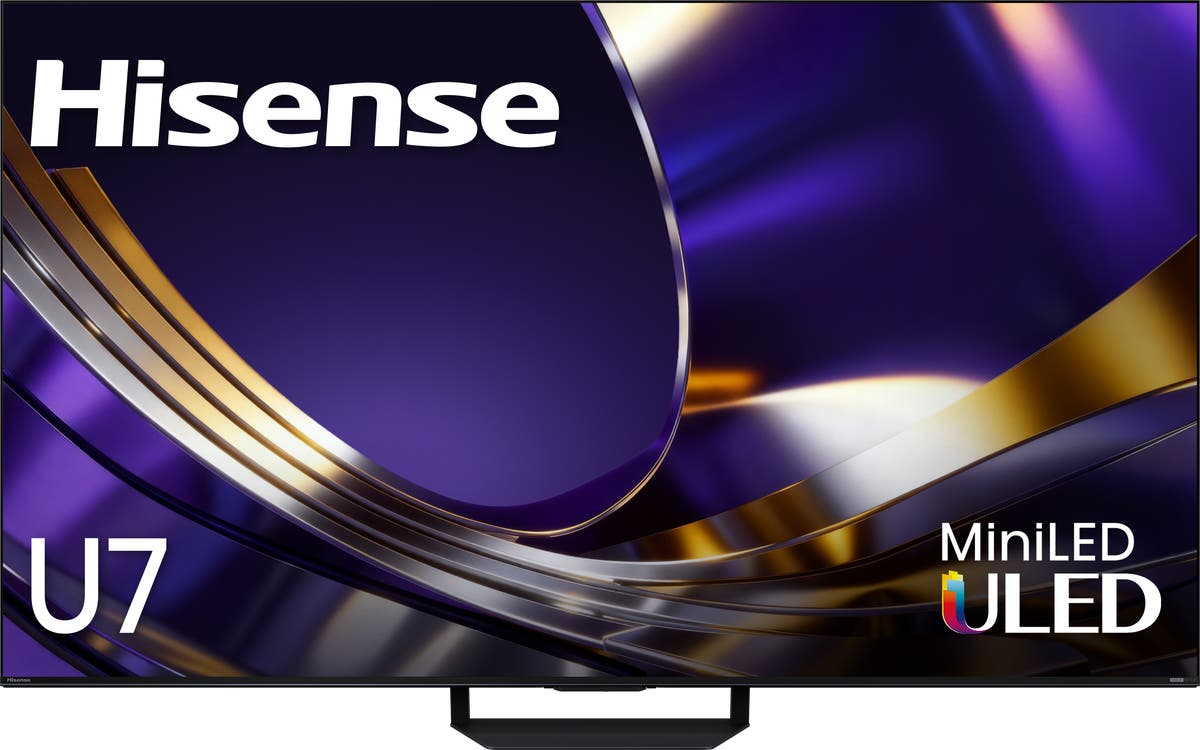
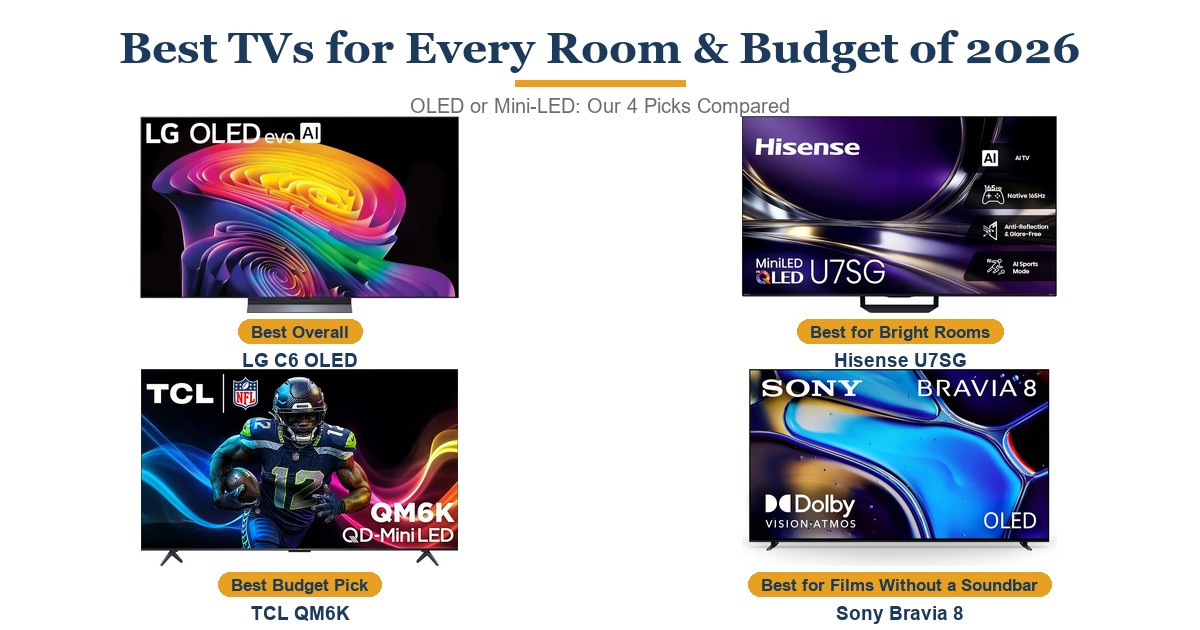
For a bright living room that also hosts a console or gaming PC, the U7SG is the TV to buy in Canada: its matte screen holds up in daylight, all four HDMI inputs run at full speed, and Amazon.ca sells it directly. Its 2.1.2-channel speaker system with a built-in subwoofer sounds big enough to put off a soundbar. The trade-off comes in dark scenes: Tom's Guide's reviewer saw gray blacks and crushed shadow detail, though RTINGS found deep blacks.
Pros
- Very bright, with a matte anti-glare screen
- Four HDMI 2.1 inputs and a 165Hz panel
- Low input lag and a full Game Bar
- Strong 2.1.2-channel, 50W built-in sound
- Accurate color out of the box
Cons
- Blacks looked gray in Tom's Guide's test (RTINGS disagrees)
- Picture fades quickly off-angle in RTINGS' test
- Slow response time and dirty screen effect in RTINGS' test
- Gemini voice control was inconsistent in TechRadar's test
As an Amazon Associate I earn from qualifying purchases. Disclosure
Overview
For a midrange TV, the Hisense U7SG gets very bright, and a matte screen keeps sunlight from washing it out. It is Hisense’s main Mini-LED TV line for 2026, sold in sizes from 55 to 116 inches and running Google TV, with the RGB Mini-LED UR8 and UR9 above it in Hisense’s lineup. It went on sale in early March 2026. This review covers the 65-inch 65U7SG, priced at $1,198 CAD on Amazon.ca in November 2026.
Canadian pricing works in the U7SG’s favour. Amazon.ca sells the 65-inch 65U7SG itself, at $1,198 CAD in November 2026, against $1,698 CAD for TCL’s 65-inch QM7L on the same day. So as of November 2026, a Canadian buyer gets the U7SG’s 165Hz panel, four HDMI 2.1 inputs and 2.1.2-channel, 50-watt sound for well less than its closest rival.
Key Specifications
| Price (CAD) | $1,198.00 |
| Model | 65U7SG (also sold in 55, 75, 85, 100 and 116 inches) |
| Panel and backlight | 4K VA panel, Mini-LED with 960 local dimming zones (65″) |
| Peak brightness | Up to 3,000 nits (Hisense’s rating) |
| Refresh rate | 165Hz native; VRR from 48 to 165Hz; up to 330Hz at lower resolutions with Game Booster |
| HDR formats | Dolby Vision, Dolby Vision IQ, HDR10, HDR10+, HDR10+ Adaptive, HLG |
| Gaming | AMD FreeSync Premium Pro, ALLM, Game Bar |
| HDMI | 4 x HDMI 2.1; eARC on HDMI 3 |
| Speakers | 2.1.2-channel, 50W, built-in subwoofer; Dolby Atmos, DTS Virtual:X |
| Smart platform | Google TV; Wi-Fi 6E, Bluetooth 5.4 |
| Antenna tuner | ATSC 3.0 (NextGen TV) |
| Size without stand | 1,445.3 x 838.2 x 58.4 mm (56.9 x 33.0 x 2.3 in), 19.6 kg (43.2 lb) |
| Stand and wall mount | Center pedestal stand with two height positions; VESA 400 x 300 |
| Warranty | 1 year (Hisense Canada) |
Hisense U7SG Picture Quality
In Filmmaker mode, standard-range content measured a modest 185.4 nits in Tom’s Guide’s lab, on the dim side for that mode. HDR highlights are a strength: they reached roughly 2,900 nits, well above the 1,683.5-nit average Tom’s Guide has recorded for newer 65-inch LCD TVs. Testers split on HDR overall, though: Tom’s Guide listed middling HDR performance among its reasons to avoid it, while Audioholics called the HDR outstanding.
Black levels are where testers split. RTINGS found deep, uniform blacks and very good local dimming on the 65-inch it bought. Tom’s Guide’s reviewer disagreed, seeing more gray than black in dark film scenes, and its later head-to-head with the TCL QM7L noted that the U7SG can crush near-black shadow detail in some HDR content.
Color is accurate for the class. RTINGS rated its out-of-the-box SDR accuracy great, and Tom’s Guide measured a Delta-E of 3, in line with its average for 2025 and 2026 models. TechRadar found two smaller flaws: colors can bleed together when many objects of the same saturated color sit side by side, such as a field of red flowers, and there is minor vignetting, a slight darkening, in the corners.
Where you sit matters. In RTINGS’ test the picture lost quality quickly off to the side, so the ends of a wide sofa get a worse view. For sports and games, RTINGS flagged a slow response time and a very distracting dirty screen effect, the blotchy look of uneven panel uniformity. Audioholics saw the opposite in a 4K soccer broadcast: the grass stayed even across the whole field, and fast passes and long camera pans stayed sharp.
Bright Rooms and Glare
This is the U7SG’s best case. Hisense describes a dual-layer screen with a low-reflection coating and a matte finish, and testers found it handles a bright room well, keeping its contrast and color with daylight and lamps in the room. Audioholics watched it at midday with sunlight coming through a large window directly behind the TV, and it still did not look washed out.
The Filmmaker mode, which most TVs make too dim for daytime viewing, was still watchable in a bright room in Tom’s Guide’s test. One size caveat from RTINGS: Hisense gives the 100- and 116-inch versions a glossy screen rather than the matte one, so reflections are worse and those sizes are less suited to a bright room.
Gaming and PC Use
All four HDMI 2.1 inputs accept 4K at 120Hz from a PlayStation 5 or Xbox Series X, and a capable gaming PC can run it at up to 4K and 165Hz. Variable refresh covers 48 to 165Hz with AMD FreeSync Premium Pro, ALLM is supported, and Game Booster raises the refresh rate to as much as 330Hz at lower resolutions. In game mode it measured 9.8 ms of input lag, half a millisecond off the best result Tom’s Guide has recorded for newer 65-inch LCD TVs.
The Game Bar shows an FPS counter, game-specific picture modes and a crosshair, though TechRadar found it takes a trip through the Menu button rather than a direct shortcut. Because eARC sits on HDMI 3, a soundbar still leaves three full-speed inputs free for consoles and a PC. The slow response time RTINGS found is the main caveat for fast games, though TechRadar found the action smooth and clear in every game it played on a PS5.
Sound
The built-in sound is a highlight. Along with the usual stereo pair, the 50-watt 2.1.2-channel system has a built-in subwoofer and two extra channels for Dolby Atmos, more power than many TVs in its price class, and many buyers can put off a basic soundbar. In Tom’s Guide’s listening, action films had thundering bass, though on one music track it turned Bass Boost down a few steps to keep the low end in check. Audioholics ranked it among the most satisfying built-in systems it has heard in this price class.
TechRadar’s tester heard it differently: clear highs and solid mids, but little low-end punch, with explosions in The Batman lacking impact. A dedicated surround system still sounds bigger, and Audioholics would like Hisense to offer an optional wireless subwoofer for it. Hisense includes an eight-band EQ, a wall-mount setting, room calibration and a dialogue booster.
Google TV, Remote and Setup
Google TV runs the apps and Gemini handles voice requests hands-free. TechRadar found Gemini inconsistent: it could find shows and answer questions, but it would not open a show directly in a streaming app, and the separate “Intelligent” picture and sound menus locked other settings while switched on. The home screen leads with large promoted content and ads, and Tom’s Guide found an Apps Only Mode that gives a plainer layout. Tom’s Guide found the backlit voice remote chunky, with plenty of buttons. TechRadar called it slightly larger than usual but not bulky, and missed a dedicated play/pause button.
The TV stands on a single center pedestal rather than two feet, so it fits on a narrower piece of furniture, and Hisense lists high and low stand positions.
How Does It Stack Up Against the Competition?
The U7SG’s closest rivals are TCL’s QM7L Mini-LED, Sony’s BRAVIA 3 II and, as a step up, LG’s C6 OLED. Here’s how the 65-inch models compare.
| Feature | Hisense U7SG | TCL QM7L | Sony BRAVIA 3 II | LG C6 OLED TV |
|---|---|---|---|---|
| Price (CAD) | $1,198.00 (65") | $1,698.00 (65") | Deal $988.00 (65") until Dec 3 | $1,998.00 (65") |
| Display type | Mini-LED, 960 dimming zones (65″) | SQD-Mini LED | LED | OLED, pixel dimming |
| Native refresh rate | 165Hz | 144Hz | 120Hz | 120Hz (VRR up to 165Hz) |
| HDMI inputs | 4, all HDMI 2.1 | 4, two at 4K 144Hz | 4, all HDMI 2.1 | 4, all 4K 120Hz |
| HDR10+ | Yes | Yes | Not listed by Sony | No (Dolby Vision, HDR10, HLG) |
| Built-in audio | 2.1.2-channel, 50W, with subwoofer | Audio by Bang & Olufsen | Dolby Atmos and DTS:X | 2.2-channel, Dolby Atmos |
| Smart platform | Google TV | Google TV | Google TV with Gemini | webOS 26 |
| TTP Review | This review ↑ | Read our review → | — | Read our review → |
| Amazon | View on Amazon | View on Amazon | View on Amazon | View on Amazon |
Prices change frequently — always verify current pricing before purchasing.
The QM7L is the closest match, and testers disagree on which is better. Tom’s Guide picked the QM7L for its punchier Super Quantum Dot color and tighter contrast, plus slightly better upscaling of sub-4K video. TechRadar found the QM7L’s local dimming more refined but the U7SG brighter, and said that with little to separate them, the choice will most likely come down to price at the time of purchase. RTINGS rates the U7SG a bit better overall, citing much better reflection handling, better upscaling of low-quality content, more accurate color out of the box and clearer motion. Tom’s Guide’s lab measured the two close on color accuracy, at a Delta-E of 3 against 2.6. The U7SG’s four HDMI 2.1 inputs are the deciding point for a setup with several consoles or a gaming PC.
Sony’s BRAVIA 3 II has the wider viewing angle: RTINGS found it one of the few TVs in this price range suited to a wide seating area, though it rated its black levels terrible in a dark room and called the U7SG far better overall. LG’s C6 OLED is the step up for movie nights with the lights off, with inky blacks, no haloing around bright highlights and nearly instantaneous response time for gaming in RTINGS’ testing; as of November 2026 it costs more on Amazon than the U7SG.
Hisense U7SG: Worth It for Bright Rooms, Gaming and Big Sound
For a Canadian living room with daylight and a console, the U7SG is the Mini-LED to get. On Amazon.ca it was the cheaper of the two Mini-LED rivals here as of November 2026, and Hisense Canada’s spec sheet lists a one-year warranty and on-screen menus in English and French, so a bilingual household can set it up in either language. TechRadar’s verdict calls it “undeniable good value”, a case the Canadian price gap makes stronger. Tom’s Guide scored it lower than we do, mostly over its muddy blacks and shadows and the stiff competition at this price; we give more weight to the bright-room, gaming and sound results that most testers agree on.
Look elsewhere if people watch from the ends of a wide sofa: Sony’s BRAVIA 3 II holds its picture better off-axis, and LG’s C6 OLED does too if your budget stretches. If color punch matters more to you than inputs, TCL’s QM7L is the one Tom’s Guide would choose.
Sources
- Hisense — 65-inch U7 Series 65U7SG specifications
- Hisense Canada — 65U7SG specification sheet
- Hisense U7SG (65-inch) — Amazon.ca Product Listing
- RTINGS — Hisense U7SG TV Review
- Tom’s Guide — Hisense U7SG ULED Mini-LED Google TV review
- Tom’s Guide — Hisense U7SG vs TCL QM7L
- TechRadar — Hisense U7 review
- Audioholics — Hisense U7SG review
- Notebookcheck — Hisense U7SG Mini LED TVs launch
- TCL — 65-inch QM7L specifications
- Sony — BRAVIA 3 II 65-inch K-65XR30M2
- RTINGS — Sony BRAVIA 3 II TV Review
- LG — 65-inch C6 OLED specifications
- RTINGS — LG C6 OLED review
Reader Poll
Where would a Hisense U7SG go in your home?
Help Our Editors Know What Matters to You
Explore on Amazon →