Keep one in a Canadian emergency kit, travel bag or day pack: it removes bacteria and parasites such as Giardia from fresh water with no batteries or pump, and LifeStraw rates an unused straw's shelf life as unlimited. At 46 g (1.6 oz) it goes everywhere. The trade-off is that it is sip-only and can't batch filter water for later, which matters most to backpackers. Anyone who wants to fill bottles fits better with the Sawyer MINI, and it is no substitute for boiling during a boil water advisory.
Pros
- Weighs just 46 g (1.6 oz)
- Removes bacteria and parasites such as Giardia
- Certified to EPA and NSF P231 standards for bacteria and parasites
- No batteries, pump or chemical wait time
- Rated for up to 4,000 L, unlimited shelf life unused
Cons
- Sip-only: no way to batch filter water
- Doesn't remove viruses or chemicals
- Usually takes firm suction, especially in murky water
- Clogs are hard to clear and a used straw must not freeze
As an Amazon Associate I earn from qualifying purchases. Disclosure
Overview
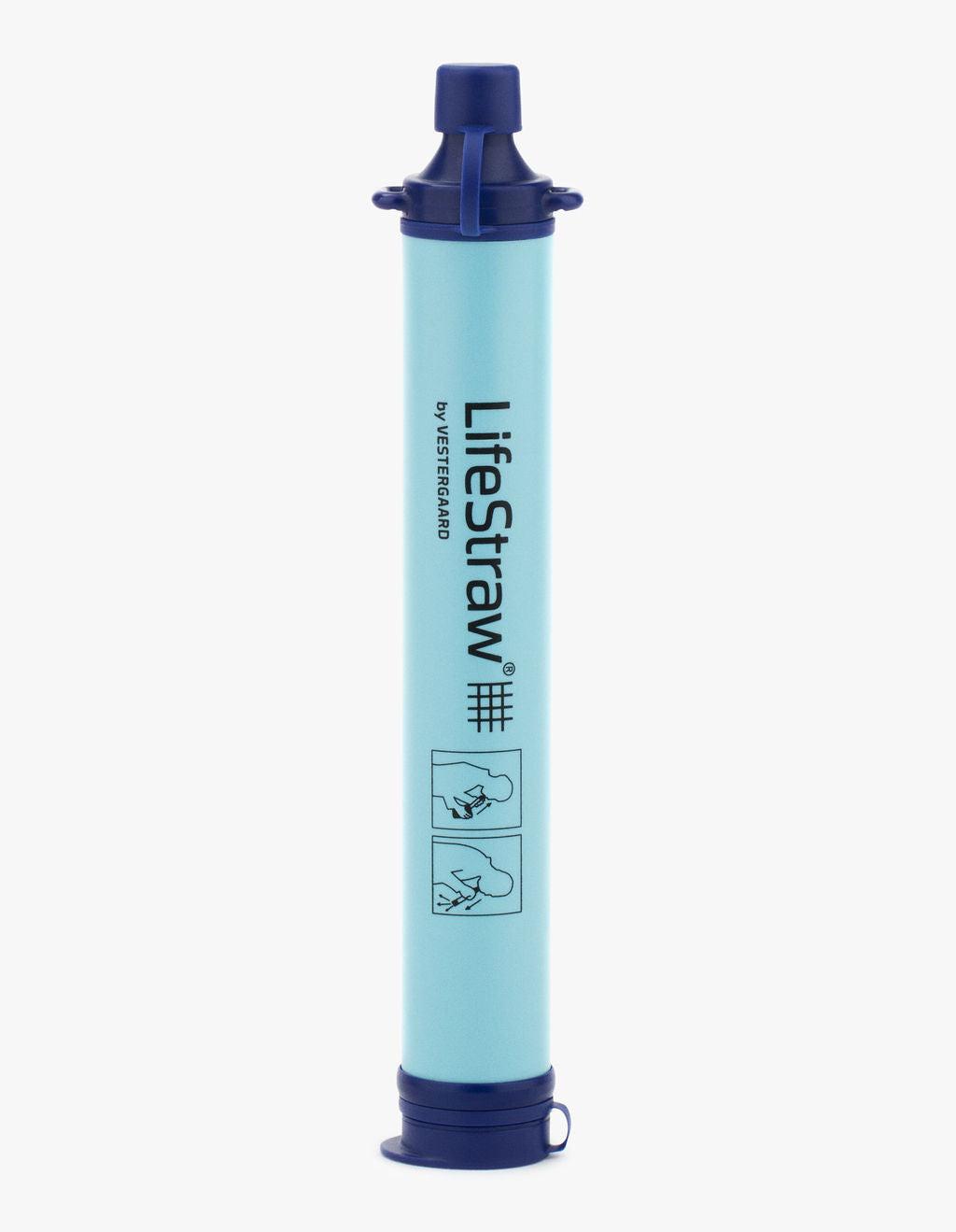
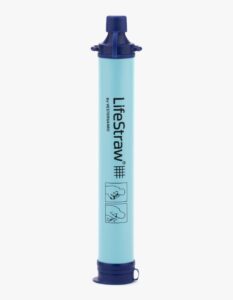
A blue straw that needs no batteries, no pump and no chemical wait is the reason the LifeStraw Personal Water Filter turns up in so many emergency kits and day packs. You put one end in a stream, a lake or a cup of doubtful water and drink through the other, and a hollow-fiber membrane with 0.2-micron pores holds back bacteria and parasites such as Giardia and Cryptosporidium. It weighs 46 g (1.6 oz) and is sold on Amazon in the US and Canada.
For Canadian buyers the appeal is the same, with a few local points to weigh. LifeStraw’s user manual is printed in English and French, among other languages, and Amazon.ca sells the same blue single straw (part LSPHF017) as the US store. It does not remove viruses, so during a boil water advisory it is no substitute for boiling: BC’s Island Health advises boiling even with a home treatment unit unless the unit’s manufacturer can guarantee it is safe to use.
Built from 12 sources, including OutdoorGearLab and Outdoor Life. Here’s where they agree, and where they don’t.
Where the reviews agree
- It removes bacteria and protozoa such as Giardia and Cryptosporidium, but it does not remove viruses.
- Drinking straight from a stream or lake means kneeling or crouching at the edge, so a cup or wide-mouth bottle makes it far easier to use.
- It is light and simple, with no pump, no batteries and none of the wait that chemical treatments need.
Where they split
- Sipping effort: OutdoorGearLab and Outdoor Life needed strong suction, and a three-year-old in Outdoor Life’s test couldn’t manage it; SectionHiker found it took little effort.
Key Specifications
| Price (CAD) | $25.53 |
| Filter type | Membrane microfilter (hollow fiber), 0.2-micron pore size |
| Removes (maker’s figures) | 99.999999% of bacteria, 99.999% of parasites, 99.999% of microplastics, dirt, sand and cloudiness |
| Not designed for | Viruses, chemicals, heavy metals, seawater |
| Standards | Meets US EPA and NSF P231 drinking water standards for bacteria and parasites |
| Rated filter life | Up to 4,000 L (1,000 gal) |
| Shelf life | Unlimited when unused and stored properly |
| Weight | 46 g (1.6 oz) |
| Dimensions | 22.9 x 2.5 cm (9 x 1.2 in) |
| In the box | LifeStraw, lanyard, user manual |
| Made in | South Korea |
LifeStraw Personal Water Filter Filtration and Safety
Against bacteria and parasites such as Giardia it does the job; against viruses, chemicals and salt water it does nothing. That line decides when you can trust it.
LifeStraw rates the membrane at 99.999999% of bacteria and 99.999% of parasites, including Giardia and Cryptosporidium, and has it lab tested against US EPA and NSF P231 standards for both. Its performance sheet lists the organisms behind cholera, typhoid and E. coli infections among those it removes.
Viruses are the gap. Outdoor Life calls this the biggest problem from an emergency-preparedness standpoint, since water drunk through it could still carry norovirus or rotavirus. LifeStraw also says the straw is not built for chemicals or heavy metals such as lead, and its manual warns never to use it on seawater, or on water that may hold chemicals, such as mine tailing ponds or water close to big farms.
Murky water is harder on it than clear water. OutdoorGearLab gave it 8 out of 10 for water quality, finding it works best in clear water and struggles a little with turbid sources.
Sipping Effort and Flow
Drinking through it takes more effort than a normal straw, most of all in the first few seconds and in silty water. Adults in the tests managed; a young child did not.
The manual says to stand a new or dried-out straw in clean water for 20 seconds and then take five quick sips to get water moving. OutdoorGearLab found nothing arrives for the first few seconds while the tube fills, and the flow dropped significantly in murky water.
How hard you have to pull is where the testers part ways. OutdoorGearLab and Outdoor Life both needed strong suction: OutdoorGearLab’s advice was to “suck with all you’ve got” and it scored ease of filtration 3 out of 10, and in Outdoor Life’s family test both adults managed while a three-year-old gave up after a few seconds. SectionHiker found the opposite, an easy drink without much work. LifeStraw itself says the straw must not be used by children without adult supervision.
OutdoorGearLab’s overall score of 66 judges it as a backpacking filter, where slow sipping and a sealed, hard-to-clear filter weigh heavily. We rate it higher because we judge it for the backup and emergency role it suits best, where its weight, simplicity and long rated life count for more.
Weight, Water Carrying and Day-to-Day Use
It weighs almost nothing and fits in a side pocket, so it is easy to keep with you as a backup.
At 46 g (1.6 oz) it barely registers in a pack. It comes with a removable lanyard, and its tethered end caps help keep unfiltered water away from the mouthpiece; SectionHiker counts those caps as more important than they look, because they cut the risk of swallowing a stray drop of dirty water. OutdoorGearLab found it a little too long to sit comfortably on a hydration vest.
There is no way to batch filter water with it for the next stretch of trail or for cooking. The workaround is to carry untreated water in a bottle or cup and sip through the straw later; it works in any bottle whose neck it fits.
It fits best wherever you can fill a container: a home emergency kit, a campsite by a lake, a trip abroad. SectionHiker also rates it a good backup for day hikers who carry their own water but occasionally run out.
Care, Clogging and Cold Weather
It needs a little care to keep flowing, and a used straw should never be left to freeze.
SectionHiker notes that hollow-fiber filters slow down as sediment and organisms clog the pores, and that backflushing (blowing gently back through it after drinking) makes it last longer. OutdoorGearLab found it pretty durable overall but scored durability and maintenance 4 out of 10, because the sealed housing makes a stubborn clog hard to clear (blowing water back through helps, slowly); its one worry was that the long tube could snap.
LifeStraw says you’ll know a straw has reached the end of its life when water stops passing through it. Before storing a used one for more than a month, LifeStraw’s instructions are to disinfect it with a weak bleach solution and keep it in salt water, because a membrane that dries out completely can be hard to get flowing again. For a straw that has clogged in storage, it suggests soaking it for an hour in a mix of coconut milk and water.
Cold is the other risk. The manual lists use in or exposure to freezing temperatures among the conditions that can make it less effective, and SectionHiker warns that putting it in a freezer is likely to destroy the filter. Keep a used straw indoors over winter, and stop using one if you see cracks in the body.
How Does It Stack Up Against the Competition?
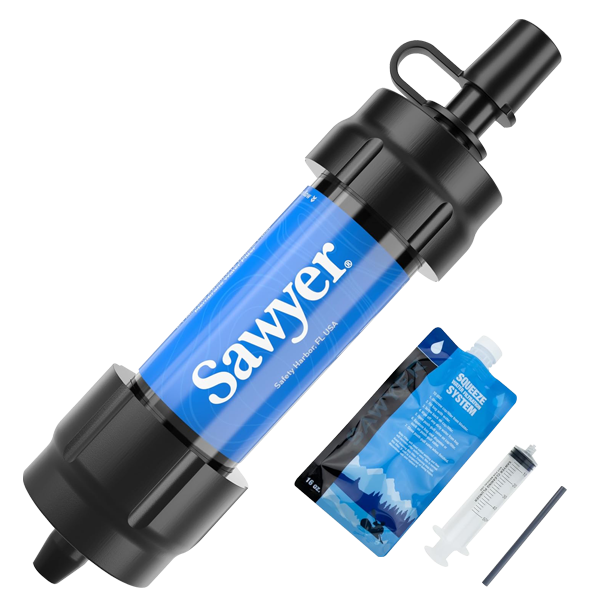
Sawyer’s Mini and Micro Squeeze are the alternatives testers name most often at this price, and both can fill a bottle or pouch as well as work as a straw.
| Feature | LifeStraw Personal Water Filter | Sawyer MINI | Sawyer Micro Squeeze |
|---|---|---|---|
| Price (CAD) | $25.53 | Deal $43.82 | $51.37 |
| Pore size | 0.2 micron | 0.1 micron absolute | 0.1 micron absolute |
| Rated filter life | Up to 4,000 L (1,000 gal) | Up to about 378,500 L (100,000 gal; Sawyer’s rating) | Up to about 378,500 L (100,000 gal; Sawyer’s rating) |
| Ways to use it | Straw: drink from the source or a container | Straw, included pouch, 28mm bottles, hydration-pack tubing | Straw, included pouch, 28mm bottles, hydration-pack tubing |
| Cleaning | Blow air back through it | Backwash with the included syringe | Backwash with the included plunger |
| TTP Review | This review ↑ | Read our review → | — |
| Amazon | View on Amazon | View on Amazon | View on Amazon |
Prices change frequently — always verify current pricing before purchasing.
LifeStraw Personal Water Filter: Worth It as an Emergency Kit Filter
If you want a filter that waits in a go-bag, a home emergency kit or the bottom of a day pack until the day the water is in doubt, this is an easy one to own in Canada. It removes bacteria and parasites such as Giardia, it has no parts to lose or batteries to charge, and an unused straw keeps without a time limit. A used one needs care here: keep it indoors through the winter, since LifeStraw’s manual lists freezing temperatures among the conditions that can make it less effective. During a boil water advisory, though, boil your water as the advisory directs rather than relying on the straw.
Backpackers who need to batch filter water for camp cooking or the next dry stretch should look elsewhere. The Sawyer MINI costs more as of November 2026, and the extra buys a drinking pouch, bottle and hydration-pack use, and a far higher rated filter life. Sawyer says its Micro Squeeze flows faster than the Mini and comes with a 1-litre pouch. OutdoorGearLab found the Micro Squeeze flows better and takes less suction than the LifeStraw, though it too slows in silty water.
Outdoor Life, which tested it as an emergency-kit filter, thought LifeStraw’s Peak Series straw worth the upgrade because it attaches to a bottle and was easier to sip through. A related model, the Peak Series Solo, screws onto a bottle and LifeStraw rates its flow at 3 litres a minute, though it is rated for half the Personal’s filter life. If you need protection from viruses, none of these is enough: SectionHiker points to purifiers such as a Grayl GeoPress bottle, a SteriPEN UV light or chlorine dioxide tablets.
Sources
- LifeStraw — LifeStraw Personal Water Filter Straw: Official Product Specifications
- LifeStraw — LifeStraw Personal User Manual
- LifeStraw — Personal Water Filter Filtration Performance Sheet
- LifeStraw — Long Term Storage and Unclogging Instructions
- LifeStraw Personal Water Filter — Amazon.ca Product Listing
- OutdoorGearLab — LifeStraw Review
- Outdoor Life — LifeStraw Review: We Put This Affordable Water Filter to the Test
- SectionHiker — LifeStraw Water Filter Review
- Sawyer Products — MINI Water Filtration System
- Sawyer Products — Micro Squeeze Water Filtration System
- LifeStraw — Peak Series Solo Water Filter
- Island Health — Boil Water FAQs
Reader Poll
Where would a LifeStraw earn its keep for you?
Help Our Editors Know What Matters to You
Explore on Amazon →