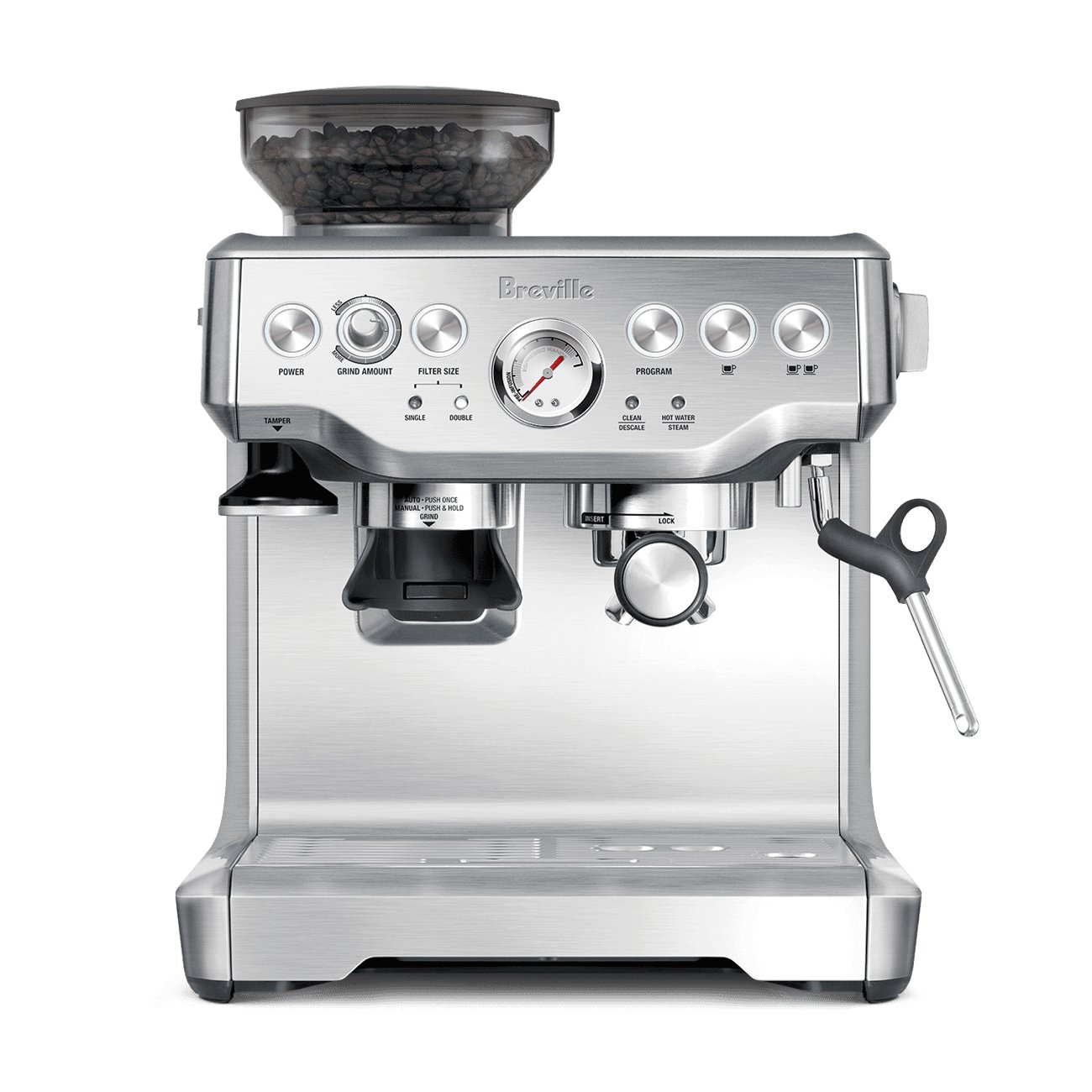
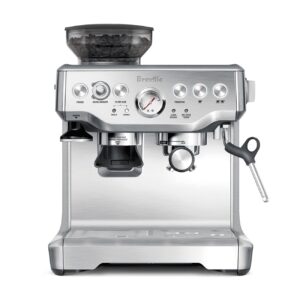
Buy the Breville Barista Express if you want to learn to make real espresso and lattes at home with one machine: its built-in burr grinder and front pressure gauge let you dial in shots yourself, and testers found it pulls excellent espresso. Its steam wand is a second reason to buy it, and Canadians get the same BES870XL model sold in the US. The trade-off is a learning curve, so expect some practice before the shots come out right. If you want the machine to guide you instead, the Ninja Luxe Café Premier fits better.
Pros
- Pulls excellent espresso once the grind is dialed in
- Built-in conical burr grinder with 16 settings
- Steam wand makes thick, creamy foam for lattes
- Pressure gauge and adjustable brew temperature
- 54 mm parts fit a wide range of aftermarket upgrades
Cons
- Learning curve before shots come out right
- Coarse grind-timer steps and no grind pause
- No low-water warning on the rear tank
- One-year warranty, shorter than newer Breville machines
As an Amazon Associate I earn from qualifying purchases. Disclosure
Overview
Breville’s Barista Express has been sold in North America, largely unchanged, since 2013, and it remains one of the best-selling espresso machines you can buy. It puts a conical burr grinder with 16 grind settings, a 54 mm portafilter, a PID-controlled Thermocoil heater and a manual steam wand in one brushed stainless steel body, so a latte goes from whole beans to cup without a separate grinder. It sold for $749.99 CAD on Amazon.ca in October 2026.
In Canada it is the same BES870XL model, and Breville has claimed it is the best-selling espresso machine in both Canada and the US, as CoffeeGeek reported in 2024. It leaves the important steps in your hands: a pressure gauge on the front shows how each shot is extracting, you set the grind size and dose yourself, and you steam the milk by hand, which makes it a better machine to learn espresso on than one that makes the decisions for you. CNET named it the best espresso machine overall in a guide based on testing more than 20 models, and Tom’s Guide gave it 4.5 stars.
Key Specifications
| Price (CAD) | $749.99 |
| Model | BES870XL |
| Grinder | Integrated conical burr grinder, 16 grind settings, dose control |
| Bean hopper | 225 g (½ lb) |
| Portafilter | 54 mm stainless steel, single and dual wall baskets, 18 g double dose |
| Pump and extraction | 15 bar pump; low-pressure pre-infusion, then 9 bar extraction |
| Heating | Thermocoil with PID temperature control, 93.3°C (200°F) |
| Water tank | 2 L (67 fl oz), removable, with replaceable water filter |
| Milk | Manual steam wand, stainless steel milk jug included |
| Dimensions (W x D x H) | 40.5 x 33.4 x 31.6 cm (15.9 x 13.1 x 12.4 in) |
Breville Barista Express Espresso and Grinder
The espresso is the reason to buy it. Once the grind is dialed in, it pulls excellent shots, and CNET measured shots from it at up to 12.4% total dissolved solids with an 18.6% extraction, inside the 18% to 22% range CNET gives for a balanced espresso. It brews at 93.3°C (200°F) by default, and the temperature can be moved in steps of about 1.1°C (2°F) between 91.1°C (196°F) and 95.5°C (204°F); CoffeeGeek got better shots from its test coffee at 94.5°C (202°F).
The built-in grinder is good enough that you don’t need to buy a separate one to start. CoffeeGeek found its burr group and assembly identical to Breville’s Dose Control Pro grinder and judged the grind quality on par with it. Its weak point is fine control: the dose is set with a timer dial that CoffeeGeek found jumps one to two seconds per click, enough for dose differences of as much as 3 g, and the grinder tends to load more coffee toward the back of the basket, so you even out the dose before tamping. There is no pause button for stopping mid-grind to settle the grounds, a feature Breville’s Barista Pro and Barista Touch have.
Testers disagree on noise. CoffeeGeek called the machine very quiet overall for something that grinds coffee and runs a vibration pump, while Tom’s Guide’s comparison found the grinder “a bit loud and whiny when in use.” You can also stretch the low-pressure pre-infusion on any shot by holding the brew button for as long as you want it to last.
Milk Steaming and Hot Water
The steam wand is the other half of the case for this machine. It produces thick, creamy foam suitable for lattes and cappuccinos, it swivels a full 360 degrees, and it reached full steam power in under 30 seconds in CoffeeGeek’s testing, which rated its steaming performance “excellent for its class.” A mid-wand ring gives you somewhere to hold it, though the wand itself gets hot.
It is a manual wand, so you hold the pitcher and texture the milk yourself, unlike the Ninja Luxe Café Premier and Breville’s own Bambino Plus, which can froth milk hands-free. A separate hot water outlet in front of the wand covers Americanos and tea.
Learning Curve, Upkeep and Running Cost
Most testers found it takes some know-how: the control panel may look a little intimidating at first, and you have to learn how grind size affects pressure and brew time before the shots come out right. Popular Mechanics was more upbeat, finding that it lets even first-timers pull a near-perfect shot. Either way, the machine shows you the result on its pressure gauge rather than telling you what to change, where the Ninja Luxe Café suggests grind adjustments for you.
A few daily-use details are worth knowing. The 2 L (67 fl oz) tank sits at the back with no low-water warning, so it’s easy to miss when it runs low, and Tom’s Guide found it could be hard to lift out if the machine sits under an overhanging cabinet. CoffeeGeek measured the drip tray at 1.1 litres, with a pop-up indicator for when it needs emptying, and a hidden compartment behind it stores the filter baskets and cleaning tools.
Running costs are low. Breville’s manual says to replace the charcoal water filter every two months, and a six-pack of its BWF100 filters was $23.98 CAD on Amazon.ca in October 2026, so about $24 CAD a year. CoffeeGeek expects it should last up to 10 years or more of daily use with regular maintenance and care, but the warranty is short: CoffeeGeek confirmed with Breville in 2024 that the Barista Express carries one year, against two years on newer Breville machines such as the Bambino Plus and the Barista Express Impress.
How Does It Stack Up Against the Competition?
Its main rivals trade the Breville’s hands-on workflow for automation, a smaller footprint without a grinder, or a different take on the built-in grinder.
| Feature | Breville Barista Express | Breville Bambino Plus | Ninja Luxe Café Premier | De’Longhi La Specialista Arte |
|---|---|---|---|---|
| Price (CAD) | $749.99 | $479.99 | $799.99 | $749.99 |
| Built-in grinder | Conical burr, 16 settings | None | Conical burr, 25 settings | 8 grind levels |
| Portafilter | 54 mm | 54 mm | 53 mm | 51 mm |
| Milk frothing | Manual steam wand | Automatic or manual steam wand | Hands-free (steam plus whisk) | Steam wand |
| Drip coffee and cold brew | No | No | Yes | No |
| TTP Review | This review ↑ | Read our review → | — | — |
| Amazon | View on Amazon | View on Amazon | View on Amazon | View on Amazon |
Prices change frequently — always verify current pricing before purchasing.
Breville Barista Express: Worth It for Learning Real Espresso
Buy it if you want café-style lattes and cappuccinos at home and you enjoy the process of getting there: grinding, dosing, tamping and steaming by hand. In return you get excellent espresso, a steam wand that textures milk for latte art, and 54 mm parts that take a huge range of aftermarket upgrades, from bottomless portafilters to single-dose hoppers. Canadian prices change the comparison with its closest rivals: on Amazon.ca in October 2026 it was $749.99 CAD, the same as De’Longhi’s La Specialista Arte ($749.99 CAD) and below the Ninja Luxe Café Premier ($799.99 CAD). In the US in October 2026 the Ninja sold for less than the Breville on Amazon, so its value edge narrows in Canada at these prices.
Look elsewhere if you would rather not learn. The Ninja Luxe Café Premier ($799.99 CAD on Amazon.ca in October 2026) weighs the dose, suggests grind changes, froths milk hands-free and adds drip coffee and cold brew, and CoffeeGeek gave it a Best in Class award for entry-level espresso systems, with a score of 88.5 out of 100. The split between the two is clear: the Breville for people who want to learn espresso as a craft, the Ninja for good drinks with as little effort as possible. If budget or counter space is tight, Breville’s Bambino Plus ($479.99 CAD on Amazon.ca in October 2026) steams milk automatically in a much smaller body, but it has no grinder, so you’ll need to buy one. Breville’s Barista Express Impress, a step up in the same line, keeps this design and adds assisted tamping and a dose that corrects itself from the last one.
Sources
- Breville — the Barista Express (BES870) product page and technical specifications
- Breville — the Barista Express BES870XL instruction book
- Breville Barista Express (BES870XL) — Amazon.ca Product Listing
- CoffeeGeek — Breville Barista Express First Look
- Tom’s Guide — Breville Barista Express review
- Tom’s Guide — Ninja Luxe Café vs Breville Barista Express
- CNET — The Best Espresso Machines of 2026
- Popular Mechanics — Best Espresso Machines
- CoffeeGeek — Ninja Luxe Café Premier Full Review
- Ninja — Luxe Café Premier Series (ES601) product page
- TechRadar — De’Longhi La Specialista Arte EC9155MB review
- Breville — the Bambino Plus product page
- Breville — the Barista Express Impress product page
- Breville Canada — the Barista Express (BES870) product page
Reader Poll
What would you rather have in an espresso machine at this price?
Help Our Editors Know What Matters to You
Explore on Amazon →