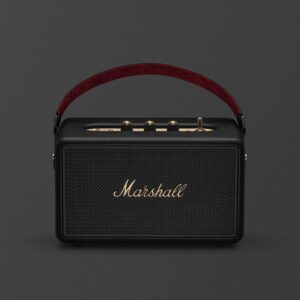
Buy the Marshall Kilburn III if you want a home-and-weekend speaker that sounds big, looks great on a shelf and lasts for days: Marshall rates it at more than 50 hours, and testers' runs back that up. Physical knobs for volume, bass and treble make it easy to tune by hand, and Canadian buyers who order from Marshall's own store get a two-year warranty instead of one. The trade-off is IP54 protection, made for splashes rather than a dunk, so pool and beach buyers are better served by the waterproof Bose SoundLink Max.
Pros
- Big, room-filling 360-degree sound
- 50+ hour rated battery, backed by tests
- Brass knobs for volume, bass and treble
- Replaceable battery; charges your phone
- App adds a five-band EQ and placement tuning
Cons
- IP54: splash-resistant, not waterproof
- Bulky to carry far (27 cm wide, 2.8 kg)
- No Wi-Fi or built-in microphone
- No aptX or LDAC support
As an Amazon Associate I earn from qualifying purchases. Disclosure
Overview
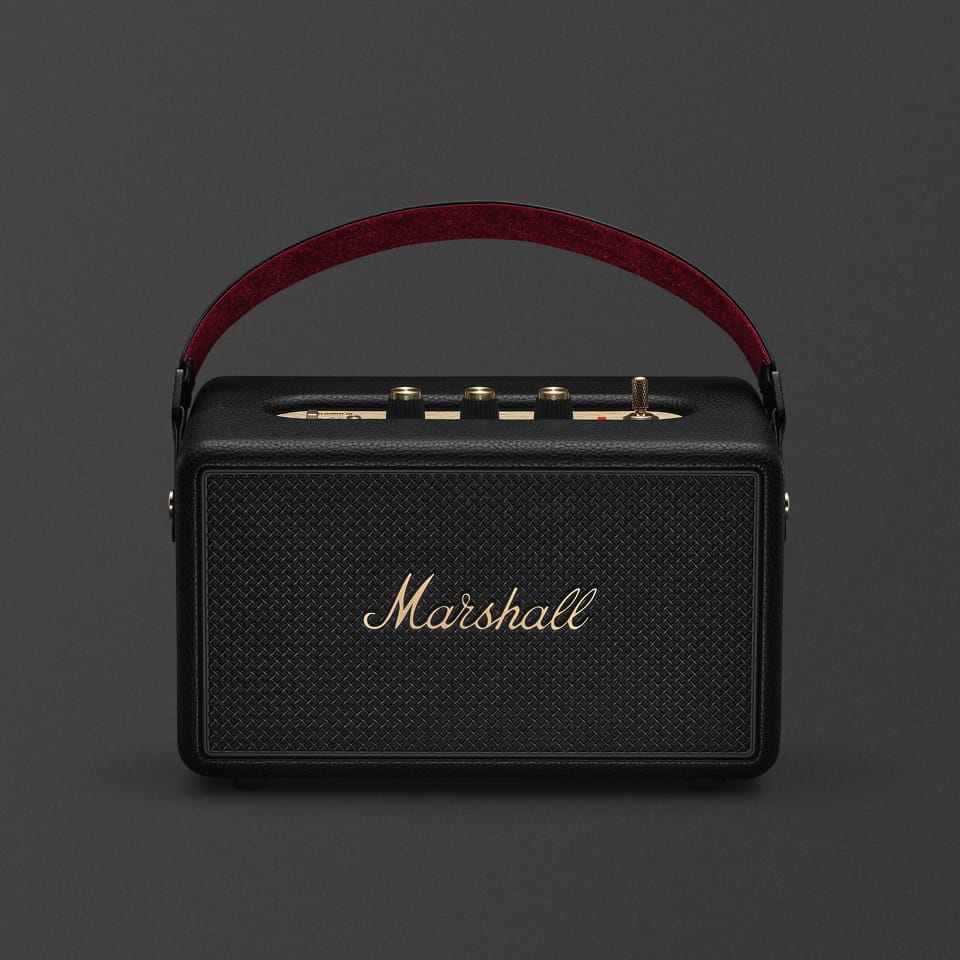
The Marshall Kilburn III is a mid-sized Bluetooth speaker for people who want one box that fills a living room, then follows them out to the deck or away for the weekend without a charger. It keeps the look of a shrunken Marshall guitar amp, with brass knobs for volume, bass and treble on top, and Marshall rates its battery at more than 50 hours. Tom’s Guide named it the best Bluetooth speaker overall in its buying guide.
It went on sale at the end of May 2025, almost seven years after the Kilburn II, with reworked acoustics around a 10 cm (4-inch) woofer and two 5 cm (2-inch) full-range drivers arranged for 360-degree stereo, more than double the old model’s battery life and better dust and water protection. On Amazon.ca it was $479.98 CAD in October 2026, close to the JBL Xtreme 5’s $469.98 CAD on the same day.
Key Specifications
| Price (CAD) | $479.98 |
| Drivers | One 10 cm (4-inch) woofer, two 5 cm (2-inch) full-range drivers; bass reflex |
| Amplifiers | One 30 W class D (woofer), two 10 W class D (full-range drivers) |
| Frequency range | 45 Hz to 20 kHz |
| Maximum sound level | 91 dB SPL at 1 m |
| Battery | 50+ hours rated; replaceable lithium-ion |
| Charging | USB-C; about 3 hours to full and 8 hours of play from 20 minutes (30 W USB-C PD charger, not included); can charge a phone |
| Wireless | Bluetooth 5.3 with multipoint, Auracast; 10 m (32.8 ft) range |
| Codecs | SBC, AAC, LC3 |
| Wired input | 3.5 mm aux |
| Microphone | None |
| Water and dust | IP54 |
| Size | 273 x 169 x 150 mm (10.74 x 6.65 x 5.9 in) |
| Weight | 2.8 kg (6.17 lb) |
| Colours | Black and Brass, Cream, Brown, Pitch Black |
| Warranty | 1 year (2 years when bought from marshall.com) |
Marshall Kilburn III Sound Quality
The sound is the main reason to buy it, and most testers came away impressed. Bass is deep and well controlled, vocals stay clear, and busy rock or electronic tracks keep their detail instead of blurring together. It also plays very loud for its size without much distortion, so it can carry a gathering on its own. Tom’s Guide’s reviewer reckoned it is the best-sounding Bluetooth speaker in its price range, and T3 gave it five stars.
The 360-degree driver layout is what you notice in a real room. Because it doesn’t beam sound in one direction, it sounds wide and full from in front of it and from across the room, which makes it a good fit for the middle of a table rather than against a wall. Testers differed on how heavy the low end is: Tom’s Guide found it slightly bassy and thought some listeners might find the low end a touch much in some rooms, while T3 called it substantial without being excessive. Either way, the bass knob on top dials it back in a second.
One reviewer wasn’t won over. Gamereactor liked the deep, tight bass but heard a thin, somewhat messy midrange, and preferred an older JBL speaker of about the same size.
Battery Life and Charging
Marshall rates the battery at more than 50 hours, and the testing so far supports that. In Tom’s Guide’s test, about eight hours of continuous play at a third of full volume left 85% of the battery, and BGR’s reviewer, usually listening above half volume, got more than a week of daily use from one charge. The Bose, JBL and Sonos rivals in the table below are rated for 20 to 24 hours.
With a 30 W USB-C PD charger, 20 minutes of charging adds about eight hours of play and a full charge takes about three hours; Marshall includes a USB-C cable but no charger. The same port lets the speaker top up your phone. BGR found the speaker itself charged much more slowly while it was playing music.
It is built to be kept for years. The battery is user-replaceable, and Marshall sells spare parts and authorised repairs through its own site, though availability varies by market. The app’s battery-preservation settings can cap charging at 90% and slow charging when the temperature is outside the ideal range. Marshall Canada’s standard warranty runs one year from purchase; Marshall gives two years only when the speaker is bought from its own online store at marshall.com.
Controls, App and Features
The brass top panel is a big part of the appeal. Three knobs set volume, bass and treble, each ringed with lights that show the level, and a small jog switch plays, pauses and skips tracks. A chunky switch turns it on, a Bluetooth button handles pairing, and the M button jumps between EQ presets you choose in the app. Reviewers liked being able to shape the sound without reaching for a phone.
The Marshall Bluetooth app adds a five-band EQ with presets and Placement Compensation, which retunes the sound when the speaker sits near a wall, an edge or a corner; testers found the settings made a real difference. The app can’t control playback, so you use the speaker’s own controls or your music app for that. It also handles firmware updates, and the speaker works without it.
Some things are missing. There is no microphone, so it can’t double as a speakerphone, and no Wi-Fi, so it can’t join a whole-home system the way a Sonos speaker can. It connects over Bluetooth 5.3 with multipoint and can tune in to Auracast broadcasts, but there’s no aptX or LDAC, only SBC, AAC and LC3; the 3.5 mm aux input covers wired sources. Nor can you pair two for stereo or link several for more volume, which the Bose and JBL rivals can do.
Size, Build and Weather Resistance
Most reviews praise the build: a faux-leather wrap, grilles on the front and back, a brass control plate and a carry strap with a red velvet underside, though Gamereactor found the strap plasticky and sharp-edged. It is also a substantial object. At 2.8 kg (6.17 lb) and 27 cm (10.7 in) wide, it is easy to move from room to room or to load into the car, but T3 found it a little large to carry on a camping trip.
Weather protection is its weakest point. The IP54 rating means limited dust protection and resistance to splashes from any direction: fine for a spilled drink on the deck, not for a fall into the pool. Many portable speakers are now rated IP67 or higher, including the Bose and JBL rivals below, and Marshall told TechRadar the Kilburn wasn’t meant to compete with its rugged models.
How Does It Stack Up Against the Competition?
Bose’s SoundLink Max and JBL’s Xtreme 5 are the big-name Bluetooth rivals in the same class, while Sonos’s Move 2 is the step up that adds Wi-Fi and voice control.
| Feature | Marshall Kilburn III | Bose SoundLink Max | JBL Xtreme 5 | Sonos Move 2 |
|---|---|---|---|---|
| Price (CAD) | $479.98 | $549.00 | $319.98 | $649.00 |
| Rated battery (maker) | 50+ hr | Up to 20 hr | 24 hr (4 more with Playtime Boost) | Up to 24 hr |
| Water and dust rating | IP54 | IP67 | IP68 | IP56 |
| Weight | 2.8 kg (6.17 lb) | 2.1 kg (4.7 lb) | 2.9 kg (6.4 lb) | 3 kg (6.61 lb) |
| Wireless | Bluetooth 5.3, Auracast | Bluetooth 5.4 | Bluetooth 6.0, Auracast | Wi-Fi 6 and Bluetooth; AirPlay 2 |
| Wired audio input | 3.5 mm aux | 3.5 mm | USB-C (charging and audio) | Line-in via adapter (sold separately) |
| TTP Review | This review ↑ | — | Read our review → | — |
| Amazon | View on Amazon | View on Amazon | View on Amazon | View on Amazon |
Prices change frequently — always verify current pricing before purchasing.
Marshall Kilburn III: Worth It for Big Sound That Lasts for Days
Buy it for a speaker that spends most of its time on a shelf, a counter or a deck table and still comes along on weekends away: it sounds bigger than its size, the knobs make it easy to adjust by hand, and the battery is long enough that charging becomes an occasional chore. In a side-by-side test against JBL’s Xtreme 4, TechRadar gave the Marshall the slight edge on sound. In Canada it also undercut the Bose SoundLink Max and Sonos Move 2 on Amazon.ca in October 2026, at $479.98 CAD against $549.00 CAD and $649.00 CAD.
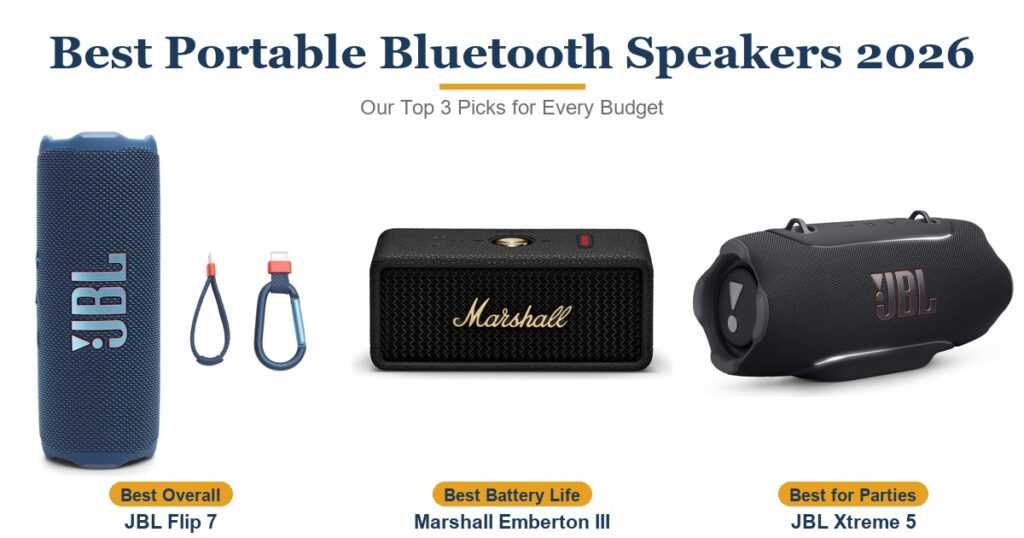
Look elsewhere if it will live by the pool or ride in a beach bag: it only resists splashes, and the Bose SoundLink Max or the JBL Xtreme 5 are built to survive a dunk. For Wi-Fi, AirPlay and voice control, the Sonos Move 2 is the one to look at, though it is rated for less than half the Kilburn’s battery life. And if you want something much smaller, Marshall’s own Emberton III is the better fit.
Sources
- Marshall — Kilburn III Product Specifications
- Marshall Kilburn III — Amazon.ca Product Listing
- Marshall — Warranty & repairs support
- Tom’s Guide — Marshall Kilburn III review: Marshall’s best sounding speaker yet
- Tom’s Guide — Best Bluetooth speakers
- TechRadar — Marshall Kilburn III review
- T3 — Marshall Kilburn III review
- BGR — Marshall Kilburn 3 Review: Bold Sound With Unbeatable Battery Life
- Senses — Review: Marshall Kilburn III
- Gamereactor — Marshall Kilburn III
- Bose — SoundLink Max Portable Speaker
- What Hi-Fi? — Bose SoundLink Max review
- JBL — JBL Xtreme 5 product page
- What Hi-Fi? — JBL Xtreme 5 review
- Sonos — Move 2
- Marshall Canada — Kilburn III product page
- Marshall Canada — Warranty & repairs support
Reader Poll
Where would a Kilburn III spend most of its time at your place?
Help Our Editors Know What Matters to You
Explore on Amazon →