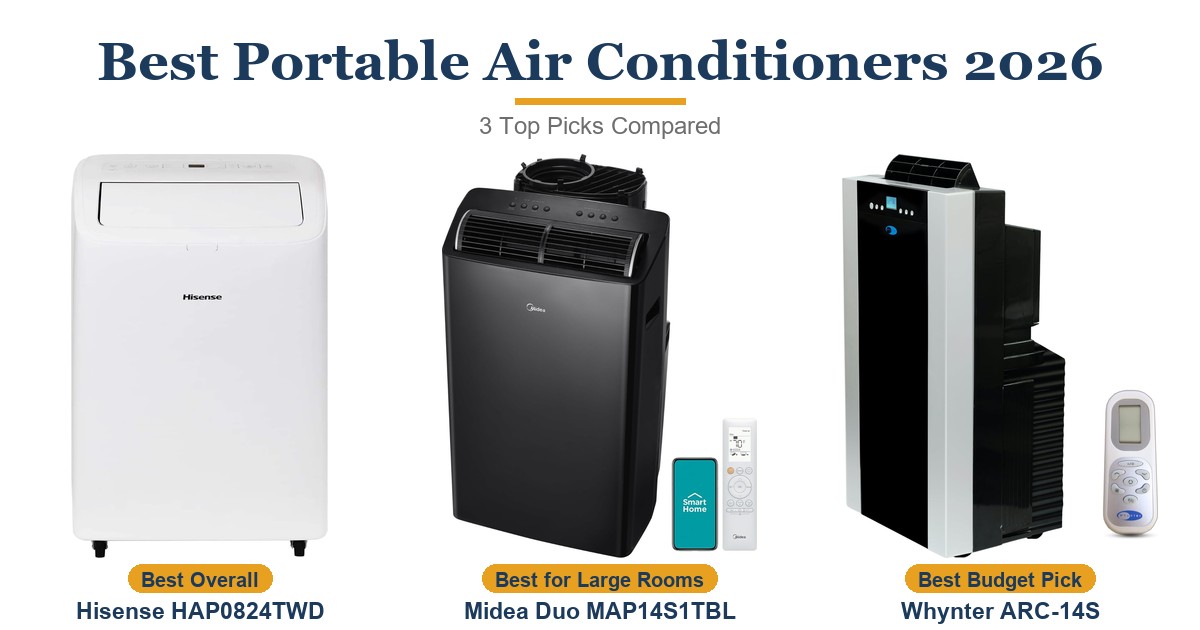
The Midea Duo MAP14S1TBL is built for anyone who wants the most efficient portable AC available and is willing to pay for it — independent testing found it delivers more seasonally adjusted cooling per watt than any rival in its class. Its dual-hose design and inverter compressor keep temperatures steady in rooms up to 550 square feet, a useful capacity for larger Canadian apartments and open-concept condos without central air. The trade-off is that it isn't any quieter than cheaper competitors on higher fan speeds, and at nearly 75 pounds it's not the easiest unit to move between rooms.
Pros
- Best-in-class SACC-to-watt efficiency in independent testing
- Dual-hose design avoids negative-pressure re-heating
- Inverter compressor holds a steady temperature while saving energy
- Reaches full cooling in about an hour in a mid-size room
- Wi-Fi app control plus Alexa and Google Assistant support
Cons
- Runs about as loud as cheaper single-hose competitors above the lowest fan speed
- Nearly 75 lbs, more cumbersome to relocate than lighter models
- Costs more upfront than the Whynter ARC-14S or Black+Decker BPACT08
As an Amazon Associate I earn from qualifying purchases. Disclosure
Overview
The Midea Duo MAP14S1TBL is a 14,000 BTU (ASHRAE) / 12,000 BTU (DOE/SACC) dual-hose portable air conditioner built for anyone who wants the most efficient cooling available in a plug-and-play unit — no permanent installation required. It cools, dehumidifies, and runs as a standalone fan, covers rooms up to 550 square feet, and connects to Wi-Fi through Midea’s app for remote scheduling and monitoring. It’s sold across the US at Amazon, Home Depot, and Menards.
What separates the Duo from most portable ACs in its price range is the pairing of an inverter compressor with a true dual-hose system. Independent testing from ConsumerAnalysis.com found it delivers a SACC-to-watt ratio of 9.2 and a CEER rating of 12.3 — figures the reviewers described as the most energy efficient among the 14,000 ASHRAE BTU portable units they compared it against. The Duo ships to Canadian addresses through Amazon.ca, a useful option for condo and apartment dwellers from Toronto to Vancouver who need real cooling without a permanent window installation.
Key Specifications
| Cooling Capacity | 14,000 BTU ASHRAE / 12,000 BTU DOE/SACC |
| Coverage Area | Up to 550 sq ft |
| Hose Configuration | Dual hose |
| Compressor | Inverter (variable speed) |
| Modes | Cool, Dehumidify, Fan (3-in-1) |
| Noise Level | From 42 dB(A) in Quiet mode |
| Connectivity | Wi-Fi app, Amazon Alexa & Google Assistant |
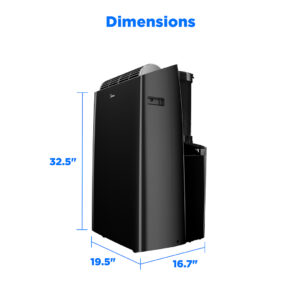
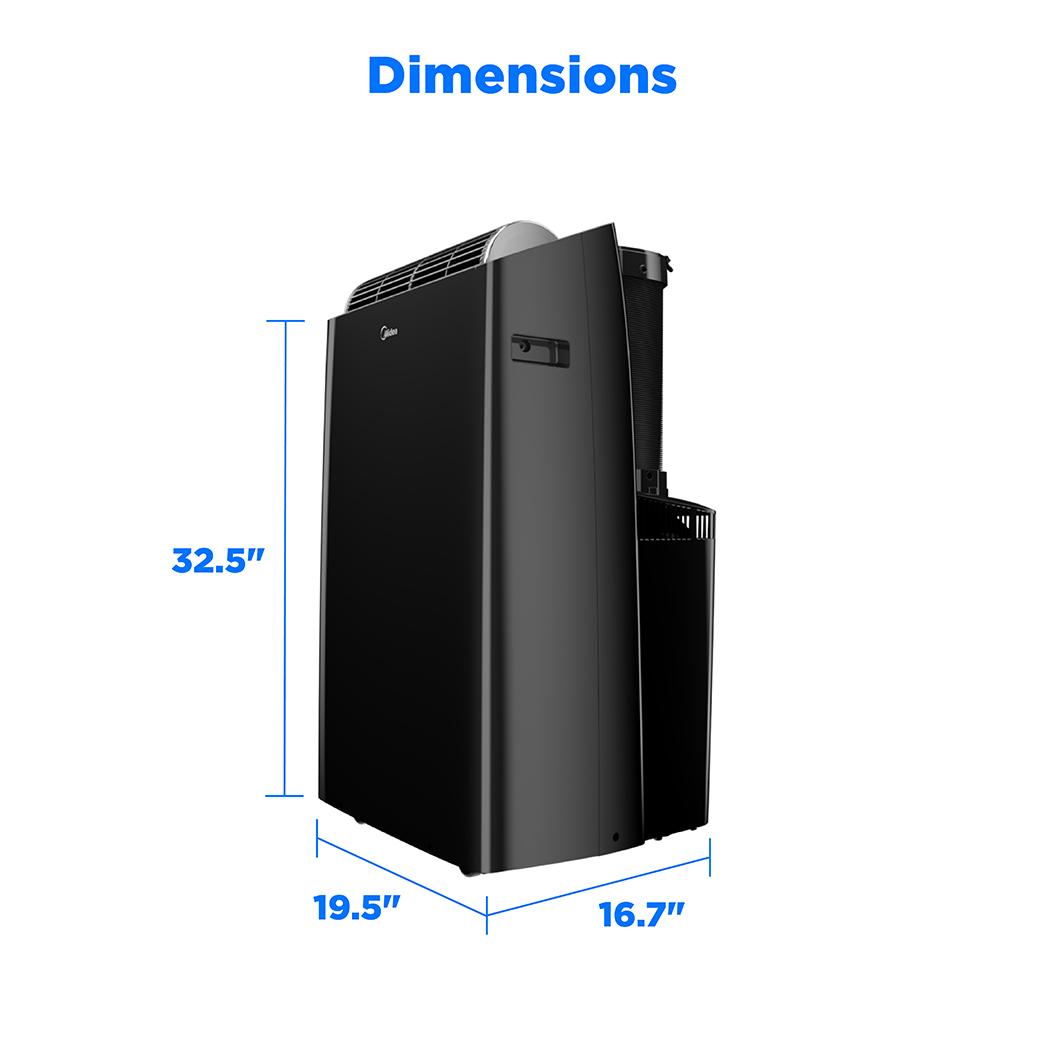
| Dimensions | 19.53 in W x 16.73 in D x 32.48 in H |
| Weight | Approx. 75 lbs |
| Included | Window kit, remote control |
Midea Duo MAP14S1TBL Cooling Performance
In ConsumerAnalysis.com’s test space of roughly 150 square feet, the Duo lowered the room from 90°F to 80°F in about 10 minutes and continued down to 72°F within roughly an hour — a pace the reviewers noted put it ahead of the group of 14,000 ASHRAE BTU competitors it was tested against, including the Black+Decker BPP10WTB, Frigidaire FHPW142AC1, LG LP1419IVSM, and Whynter ARC-14S. The same testing credited the Duo with the highest actual cooling capacity of the group at 12,000 SACC BTU, the metric that reflects real-world performance more accurately than the inflated ASHRAE number printed on most portable AC boxes.
The dual-hose design is a meaningful part of that result. Single-hose units pull air from the room to cool their own compressor, creating negative pressure that draws warm air back in through door and window gaps. The Duo’s second hose supplies outside air for the compressor loop instead, so conditioned air stays in the room rather than leaking back out. The practical takeaway: for a bedroom, home office, or open living space up to 550 square feet, this unit reaches target temperature faster and holds it more consistently than a comparable single-hose model.
Energy Efficiency & Inverter Technology
Most budget portable ACs use a fixed-speed compressor that simply switches fully on and off, cycling around the target temperature rather than holding it steady. The Duo’s inverter compressor instead ramps its speed up and down continuously, which both smooths out temperature swings and reduces the power spikes that come with a compressor kicking back on from a dead stop.
ConsumerAnalysis.com measured a SACC/watt ratio of 9.2 and a CEER of 12.3 for the Duo — per their comparison, the strongest efficiency numbers among the six 14,000 ASHRAE BTU models they reviewed, none of the others tested included an inverter compressor at all. For anyone running a portable AC through a full summer, that efficiency gap shows up directly on the electricity bill, not just on a spec sheet.
Noise Levels & Livability
Midea rates the Duo at 42 dB(A) in its Quiet setting, which is low enough to run overnight in a bedroom. That said, ConsumerAnalysis.com’s testing found the unit “just as loud as competitors” once you move past the lowest fan speed, with the tradeoff being that quieter settings also cool more slowly. In other words, the 42 dB figure is a best-case number, not what you’ll hear running the unit at full cooling power on a 95-degree afternoon.
At just under 75 pounds, the Duo is also noticeably heavier than smaller single-hose alternatives, and the dual-hose kit makes it a bit more of a project to move between rooms than a lightweight unit you can wheel around in seconds. Once it’s set up in a window, though, most owners are unlikely to relocate it often.
Smart Controls & Setup
The Duo connects to home Wi-Fi and pairs with Midea’s app, letting you set schedules, switch modes, and adjust the temperature remotely — useful for cooling a room down before you get home. It also works with both Amazon Alexa and Google Assistant for voice control, and a physical remote is included for anyone who’d rather skip the app entirely.
The included window kit covers most standard window widths, and the control panel on the unit itself mirrors the app’s core functions. As with most Wi-Fi portable ACs, initial pairing is smoothest on a 2.4 GHz network rather than 5 GHz — worth keeping in mind before setup if your router broadcasts both bands under the same name.
How Does It Stack Up Against the Competition?
The Duo sits at the top of the 14,000 ASHRAE BTU class on efficiency and real-world cooling capacity. Here’s how it compares to three popular alternatives.
| Feature | Midea Duo MAP14S1TBL | Hisense HAP0824TWD | Whynter ARC-14S | Black+Decker BPACT08 |
|---|---|---|---|---|
| Price (CAD) | Deal $608.99 until Oct 30 | $708.00 | $1,099.00 | $488.98 |
| Cooling (SACC) | 12,000 BTU | 8,000 BTU | 9,500 BTU | ~5,000 BTU |
| Hose Type | Dual hose | Dual hose | Dual hose | Single hose |
| Inverter | Yes | Yes | No | No |
| Wi-Fi / App | Yes | Yes | No | No |
| TTP Review | This review ↑ | Read our review → | Read our review → | Read our review → |
| Amazon | View on Amazon | View on Amazon | View on Amazon | View on Amazon |
Prices change frequently — always verify current pricing before purchasing.
Is the Midea Duo MAP14S1TBL Worth It?
If you want the most efficient, highest-capacity portable AC in the 14,000 ASHRAE BTU class and don’t mind paying a premium for it, the Duo is the one to get. Its combination of an inverter compressor and dual-hose design delivered the strongest real-world cooling and efficiency numbers in independent testing, and the Wi-Fi app adds genuine day-to-day convenience.
Where it makes less sense is on a tight budget or for a smaller room where you don’t need the full 550-square-foot capacity. The Hisense HAP0824TWD offers a similar inverter and dual-hose combination for less if your space is under 350 square feet, and the Whynter ARC-14S or Black+Decker BPACT08 cost meaningfully less if efficiency isn’t your top priority. But for anyone cooling a larger room through a full summer, the Duo’s efficiency advantage pays for itself over time.