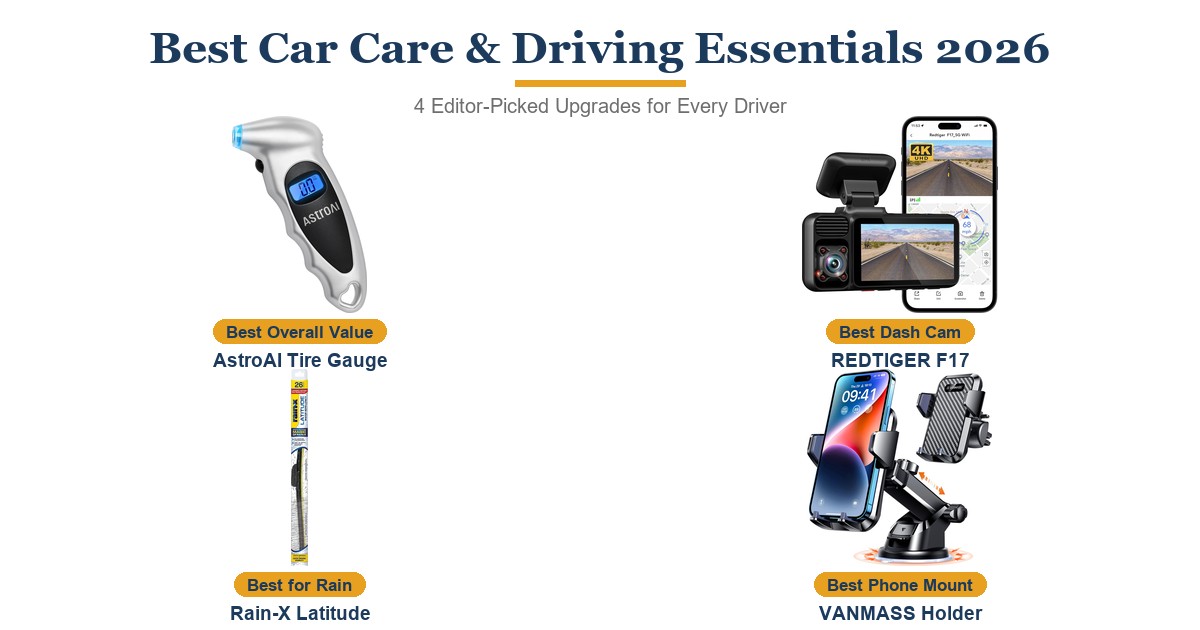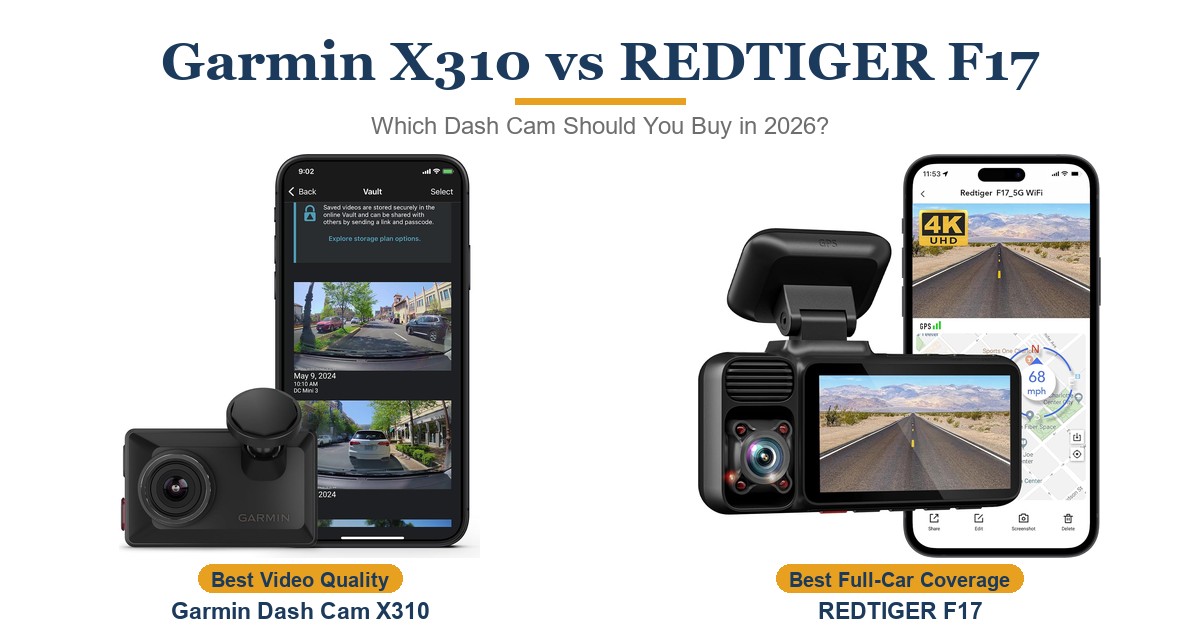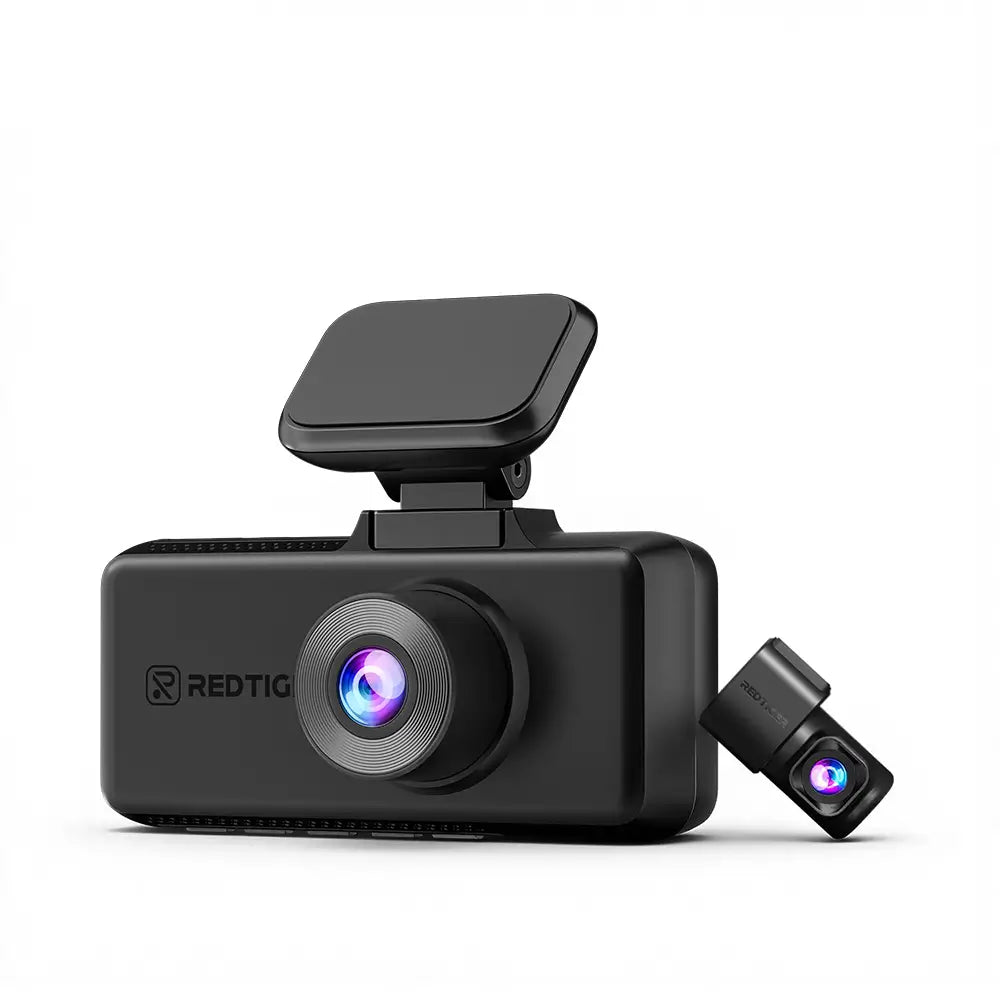
The REDTIGER F17 4K 3-Channel Dash Cam suits Canadian drivers who want full front, cabin, and rear coverage without paying flagship prices, and it's sold directly on Amazon.ca. Its Sony STARVIS 2 sensor delivers sharp 4K front footage and usable low-light performance through dark winter commutes, and the supercapacitor-backed parking mode holds up better across hot summers and cold winters than battery-based rivals. Built-in dual-band WiFi and GPS round out a feature set usually reserved for pricier systems. The trade-off is that only the front channel records in 4K, so the cabin and rear cameras are capped at 1080p.
Pros
- 4K front camera with Sony STARVIS 2 IMX675 sensor and WDR
- 24/7 parking mode backed by a heat-resistant supercapacitor
- 5.8GHz WiFi transfers footage noticeably faster than 2.4GHz-only rivals
- Built-in GPS logs speed and location automatically
- Sold on Amazon.ca for well under 3-channel rivals with similar specs
Cons
- Rear and cabin cameras cap at 1080p while the front records 4K
- No full-color night vision, reserved for the pricier F17 Elite
As an Amazon Associate I earn from qualifying purchases. Disclosure
Overview
A 4K front-facing dash cam used to mean choosing between resolution and price — spend $300+ for a name-brand 4K unit, or settle for 1080p to stay under $150. The REDTIGER F17 4K 3-Channel Dash Cam closes that gap by pairing a 4K front sensor with 1080p rear and cabin cameras, built-in GPS, and a 24/7 parking mode, all while regularly selling well under $200 CAD on Amazon. It’s aimed at drivers who want full front/cabin/rear coverage without paying flagship pricing.
The sensor behind the front camera is Sony’s STARVIS 2 IMX675, the same generation of low-light sensor showing up in dash cams two and three times the price, and it’s the same unit sold to Canadian drivers through Amazon.ca. Paired with WDR processing, it’s the single biggest reason this camera punches above its price bracket — resolution numbers only matter if the sensor behind them can actually resolve detail in real driving conditions, including glare, tunnels, and the low winter sun that makes Canadian highway driving miserable for cheaper cameras.
Key Specifications
| Front Resolution | 4K (2160P), Sony STARVIS 2 IMX675 sensor |
| Cabin / Rear Resolution | 1080P each |
| Field of View | Front 150°, cabin 160°, rear 155° |
| Connectivity | 5.8GHz + 2.4GHz WiFi, built-in GPS |
| Storage | 64GB microSD included, supports up to 256GB |
| Parking Mode | 24/7 monitoring via built-in supercapacitor |
| Screen | 3-inch IPS |
| Price (CAD) | $159.99 |
REDTIGER F17 Video Quality & Resolution
Most budget dash cams top out at 1080p; the front camera’s 4K output paired with the STARVIS 2 IMX675 sensor is the clear step up from that crowd. License plates and road signs stay legible at highway speed, and the wide dynamic range handles the harsh transition from a dark tunnel into bright sunlight without blowing out the highlights or crushing the shadows — a common failure point for cheaper sensors.
The trade-off is that only the front camera gets the 4K treatment; the cabin and rear channels record at 1080p. That’s still enough resolution to identify a following vehicle’s plate in a rear-end incident or clearly capture a rideshare passenger, but drivers expecting 4K on all three channels will need to step up to the pricier F17 Elite variant, which adds a second high-resolution sensor.
Night Vision & Low-Light Performance
Night and low-light driving is where sensor generation matters more than headline resolution, and the STARVIS 2 sensor combined with WDR processing keeps footage usable after dark — brake lights and headlights don’t wash out the frame the way they do on older CMOS sensors, and license plates stay readable under streetlight-level lighting. The cabin camera adds IR illumination for interior visibility with the cabin lights off, useful for rideshare or delivery drivers who need a clear record of everyone in the vehicle.
It stops short of true full-color night vision — the image still shifts to grayscale-leaning tones in very low light, the same limitation shared by nearly every dash cam at this price. REDTIGER reserves genuine full-color night recording for the step-up F17 Elite, which uses a different sensor pairing built specifically for that feature.
Parking Mode, Loop Recording & Connectivity
The 24/7 parking monitor runs off a built-in supercapacitor rather than a lithium battery, which matters in a car that sits in direct sun — capacitors tolerate heat far better than batteries and don’t degrade the same way over repeated charge cycles. Loop recording keeps the most recent footage on the included 64GB card, automatically locking clips when the G-sensor detects an impact so they aren’t overwritten.
Getting footage off the camera is handled through 5.8GHz WiFi, which the REDTIGER app uses to transfer clips noticeably faster than the 2.4GHz-only connection found on many competing dash cams — a real difference when pulling a full-resolution 4K clip off the card after an incident. Built-in GPS logs speed, route, and location automatically, without needing a separate GPS mount or accessory.
The choice of a supercapacitor over a lithium-ion battery matters more in Canada than the spec sheet suggests: lithium-ion batteries can lose more than half their effective capacity below freezing, which is why battery-powered parking-mode cameras are prone to failing on cold winter mornings. BlackboxMyCar.ca’s cold-weather dash cam guide recommends supercapacitor-based cameras specifically for Canadian winters, rating them reliable down to roughly -40°C where a lithium-ion unit would already be struggling. For anyone parking outdoors through a Canadian winter, that’s the more consequential advantage over the heat-tolerance angle alone.
Dash Cam Rules and Insurance for Canadian Drivers
Dash cams are legal to use across every Canadian province, but placement matters: mounting low on the windshield or just behind the rearview mirror keeps the camera clear of the driver’s sightline, which is the standard most provinces actually enforce. The F17’s compact 3-inch body and windshield mount fit that placement without extending far into view.
Insurance treatment varies by province rather than offering a blanket discount — per iSure’s coverage of dash cams and Canadian auto insurance, most insurers don’t currently discount premiums simply for owning one, though footage can still speed up a claims decision when fault is disputed. Coverage for the camera itself as after-market equipment differs too: Ontario typically covers it under a policy’s after-market electronics limit (often capped around $1,500), while Quebec requires the camera to be permanently attached to the vehicle for it to be covered at all. Check with your own insurer for how a dash cam purchase affects your specific policy.
How Does It Stack Up Against the Competition?
Here’s how the F17 compares to two well-known 3-channel dash cams and REDTIGER’s own step-up model.
| Feature | REDTIGER F17 | VIOFO A229 Pro 3CH | Vantrue N4 3-Channel |
|---|---|---|---|
| Price (CAD) | $159.99 | $399.99 | $299.99 |
| Front Resolution | 4K | 4K | 2K/1440P |
| Cabin / Rear Resolution | 1080P / 1080P | 1440P / 1080P | 1440P / 1080P |
| Built-in GPS | Yes | Optional add-on | Yes |
| WiFi | 5.8GHz + 2.4GHz | 5GHz + 2.4GHz | 2.4GHz only |
| Amazon | View on Amazon | View on Amazon | View on Amazon |
Prices change frequently — always verify current pricing before purchasing.
Is the REDTIGER F17 Worth It?
For drivers who want genuine 4K front coverage plus cabin and rear cameras without paying $250 or more, the F17 is a strong value: the STARVIS 2 sensor, dual-band WiFi, and built-in GPS are features usually reserved for pricier 3-channel systems. The heat-resistant supercapacitor parking mode is a meaningful advantage for anyone who parks outdoors in direct sun.
Drivers who specifically want 4K resolution on all three channels, or true full-color night vision, should look at the REDTIGER F17 Elite or a higher-tier VIOFO model instead — this camera’s cabin and rear channels are capped at 1080p, which is the compromise that keeps the price down.