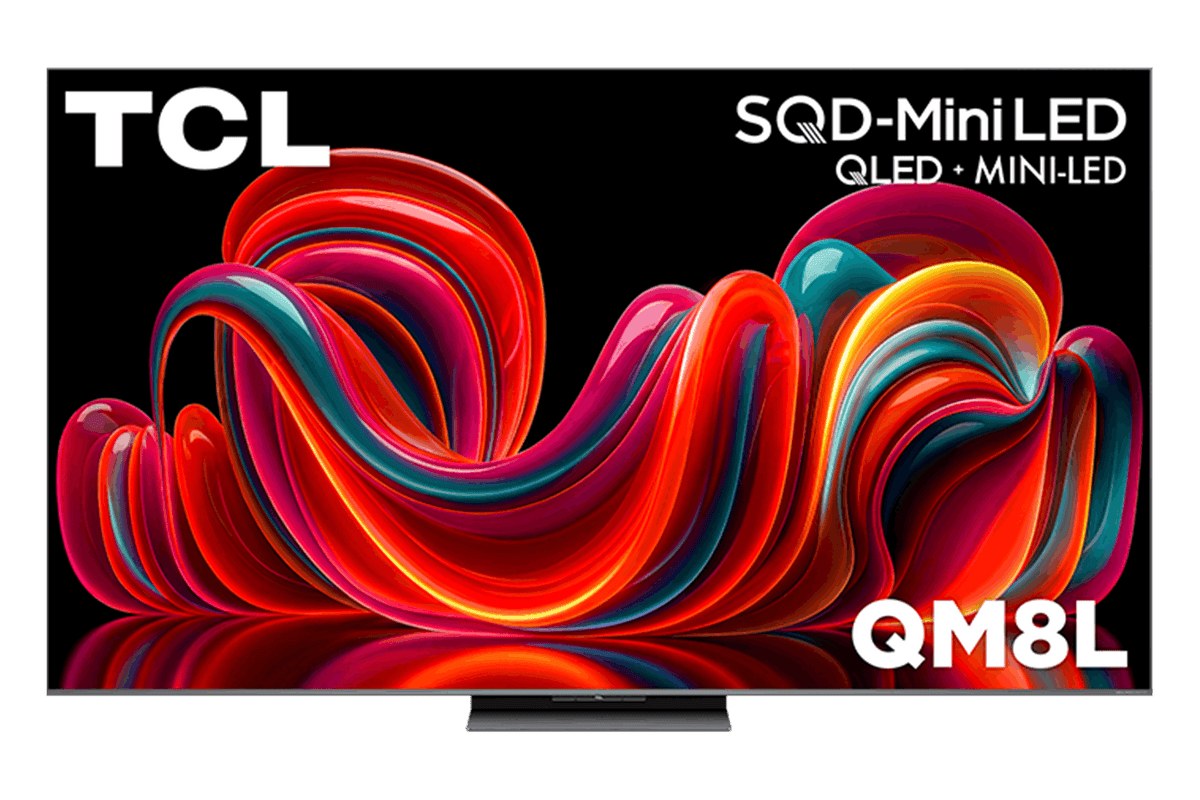
For a sunny Canadian living room that also hosts a console or gaming PC, the QM8L is the Mini-LED TV to buy: it overpowers glare and keeps bright objects nearly halo-free in dark scenes. All four HDMI ports run at full HDMI 2.1 speed, input lag is among the lowest Tom's Guide has measured, and TCL Canada lists French on-screen menus. The trade-off is color accuracy out of the box, which trails the best rivals, most of all in HDR. If you want an OLED's perfect blacks, LG's C6 fits better.
Pros
- Extremely bright, beats glare easily
- Almost no blooming, deep uniform blacks
- Four full-speed HDMI 2.1 ports
- Very low input lag
- Wide color range
- Quick Google TV with hands-free Gemini
Cons
- Color accuracy out of the box trails the best rivals, especially in HDR
- Colors fade quickly off to the sides in RTINGS' test
- Motion blur in fast games in RTINGS' test
- Plastic stand on a premium TV
As an Amazon Associate I earn from qualifying purchases. Disclosure
Overview
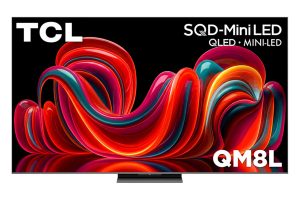
The TCL QM8L brings most of the picture technology from TCL’s X11L flagship down a tier, into TCL’s 2026 premium Mini-LED model. It sits between the QM7L and the X11L and replaces last year’s QM8K. It went on sale in April 2026 in 65-, 75-, 85- and 98-inch sizes, and this review covers the 65-inch 65QM8L, the same model number TCL Canada sells.
For Canadian buyers the price step depends on the rival. TCL Canada lists the 65-inch 65QM8L at $1,799.99 CAD in November 2026, close to the $1,698 CAD Amazon.ca charged for the 65-inch QM7L that same month but well above the $1,198 CAD it charged for the 65-inch U7SG. TCL Canada also lists its on-screen menus in English and French as well as Spanish. What the money buys is the same as in the US: testers rank it among the brightest TVs they have measured, its local dimming keeps halos almost invisible, and all four HDMI ports run at full HDMI 2.1 speed. Tom’s Guide names it the best TV for sports in its buying guide. TechRadar lists it as its best cheap big-screen TV.
Key Specifications
| Price (CAD) | $1,799.99 (65") (Nov 15) |
| Model | 65QM8L (also sold in 75, 85 and 98 inches) |
| Panel and backlight | 4K WHVA 2.0 Ultra panel, SQD-Mini LED with up to 4,000 dimming zones depending on size |
| Peak brightness | Up to 6,000 nits (TCL’s rating) |
| Refresh rate | 144Hz native; up to 288Hz at 1080p with Game Accelerator 288 |
| HDR formats | Dolby Vision IQ, HDR10, HDR10+, HLG; IMAX Enhanced |
| Gaming | VRR, AMD FreeSync Premium Pro, ALLM, Game Bar |
| HDMI | 4 x HDMI 2.1 (4K at 144Hz); eARC on HDMI 1 |
| Speakers | Audio by Bang & Olufsen; Dolby Atmos, DTS:X; Dolby Atmos FlexConnect (up to 4 Z100 speakers and 1 Z100-SW subwoofer) |
| Smart platform | Google TV with Gemini; Chromecast, Apple AirPlay 2; Wi-Fi 6, Bluetooth 5.4 |
| Antenna tuner | ATSC 3.0 (NextGen TV) |
| Stand | Center pedestal with two height positions (65 to 85 inches) |
TCL QM8L Picture Quality
Brightness is the headline. On the 65-inch model it bought, RTINGS found small highlights pass 6,000 nits when about 5% of the screen is lit, and it rated the QM8L brighter than Sony’s BRAVIA 7 II and Hisense’s UR9SG. Tom’s Guide’s lab measured 3,719 nits on a 10% window with the 75-inch, about twice its average for TVs tested in 2025 and 2026. Like most TVs, it can’t hold that level when most of the screen is bright, but RTINGS found it still bright enough for most real content.
Contrast is where the extra money shows. Every test we saved found very little blooming, the gray halo that can surround bright objects on a dark background. RTINGS rated the contrast excellent, with backlight control precise enough to keep subtitles nearly halo-free and black uniformity it called amazing. In Tom’s Guide’s viewing, a bright neon sign against black kept clean edges, and fine shadow detail survived in dim film scenes.
The color range is wide. TCL claims 100% of the BT.2020 color space; independent lab tests measured about 90%, with coverage in the high 90s of DCI-P3, the space most streaming content is mastered in. RTINGS noted colors wash out slightly in exceptionally bright scenes, which it says isn’t noticeable with most real content.
Color accuracy out of the box is the weak spot. In Filmmaker mode, Tom’s Guide measured a Delta-E (color error) of 3.7 against a 2.5 average for the TVs it has tested (its LG C6 OLED test scored 1.6). Its sister site TechRadar measured 9.9 in the Standard mode many people leave on, though Tom’s Guide judged it “a relatively strong performer on color fidelity” in Standard. Digital Trends got a better 3.0 in Filmmaker mode. RTINGS found SDR close to target but HDR clearly off it, and a full calibration only slightly improved HDR on its unit; Digital Trends and CGMagazine found a little calibration cleaned up what remained. In everyday viewing, testers still found the picture pleasing, and Tom’s Guide called the 3.7 just on the edge of what a casual viewer would notice.
Lower-quality video holds up well. RTINGS found it does a very good job smoothing blocky, low-bitrate streams, and testers found older shows and cable sports upscaled cleanly. RTINGS did see some banding in dark grays and in bright greens and blues.
Bright Rooms, Reflections and Viewing Angle
In a sunny room, the QM8L’s brightness does the work: testers agree it overpowers glare with ease, so daytime sports stay vivid. The screen itself does less to cut reflections. Lamps and windows stay clearly visible on it, and RTINGS saw a distracting rainbow smear around bright lights. RTINGS found TCL’s step-down QM7L slightly better at dimming direct reflections, though neither excels.
Where you sit matters more. RTINGS rated the viewing angle mediocre on the 65-inch it tested, with colors washing out quickly to the sides and blues dropping off fast. Digital Trends found color held up better than it expected at moderate angles but washed out from a sharp one, and called that a non-issue for most living rooms. Two testers of the 75-inch found the picture held up well from the side.
Gaming
All four HDMI ports are full HDMI 2.1, taking 4K at up to 144Hz, where last year’s QM8K had only two full-speed ports. Game Accelerator 288 adds a 288Hz mode at 1080p for competitive titles; TechRadar describes it as doubling the perceived refresh rate at a lower resolution. Tom’s Guide measured 9.5 ms of input lag, one of the fastest results it has recorded (it measured the LG C6 at 9.1 ms), and other tests agree it is very responsive in game mode. It supports all three types of variable refresh rate, plus AMD FreeSync Premium Pro, ALLM, which switches to game mode when a console turns on, and a Game Bar with an FPS counter.
Fast motion is the catch. RTINGS found pixel transitions slow at 120Hz and 144Hz, which leaves visible motion blur, and it found VRR misbehaves with NVIDIA graphics cards locked at 4K 60Hz, though it works at 120Hz or higher. TechRadar found PS5 games crisp and snappy at 120 fps, but Digital Trends’ advice is that competitive players chasing milliseconds still belong on a gaming monitor.
Sound
Dialogue comes through clearly, and testers found the speakers good enough to skip a soundbar for everyday viewing. They split on the bass: Digital Trends, RTINGS and CGMagazine heard a bit more than most TV speakers give, while TechRadar found the low end the weakest part and Tom’s Guide rated the system only a little above average. Bang & Olufsen tuned it, with two rear-mounted woofers behind speakers that fire down from the bottom edge. For movie nights, testers would still add a soundbar or subwoofer, and RTINGS heard noticeable thumping at max volume.
TCL sells an optional wireless subwoofer, and the TV works with its Dolby Atmos FlexConnect speakers, up to four Z100 satellites and a Z100-SW subwoofer, for real surround sound without speaker wire. Dolby Atmos and DTS:X are both supported.
Google TV, Gemini and Design
Google TV is quick here: Digital Trends had Netflix, YouTube and Apple TV playing in under 10 seconds each. Gemini answers hands-free through microphones in the bottom bezel and handles conversational follow-up questions, though TechRadar found it sometimes gave the wrong streaming service for a film. The home screen carries ads that can’t be turned off; RTINGS notes a Basic TV mode removes them along with most smart features. Chromecast and AirPlay 2 are built in.
The 65-inch stands on a center pedestal with two height settings, so it fits on narrower furniture and can clear a soundbar, and cable management is built into the stand and back panel. Opinions on the stand differ. TechRadar found the center stand left its 75-inch feeling more balanced and stable than many TVs, while CGMagazine found its plastic felt less sturdy than the metal stands on Samsung and LG TVs, and Digital Trends wanted more heft.
How Does It Stack Up Against the Competition?
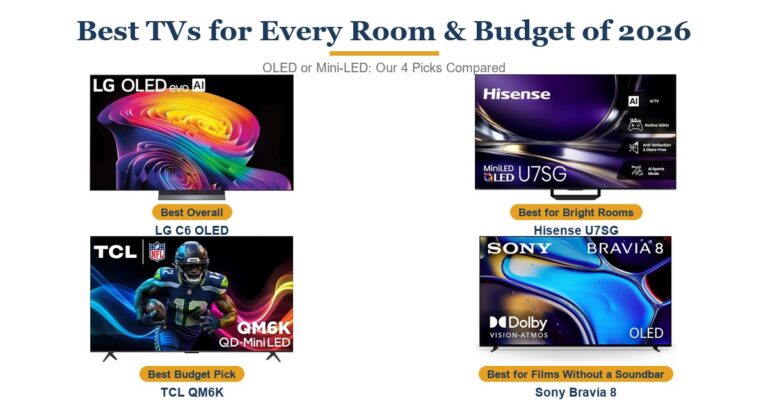
TCL’s own step-down QM7L and Hisense’s U7SG are the closest Mini-LED rivals, and LG’s C6 OLED is the OLED alternative for a dark room. Here’s how the 65-inch models compare.
| Feature | TCL QM8L | TCL QM7L | Hisense U7SG | LG C6 OLED TV |
|---|---|---|---|---|
| Price (CAD) | $1,799.99 (65") (Nov 15) | $1,698.00 (65") | $1,198.00 (65") | $1,998.00 (65") |
| Display type | SQD-Mini LED | SQD-Mini LED | Mini-LED | OLED, pixel dimming |
| Native refresh rate | 144Hz | 144Hz | 165Hz | 120Hz (VRR up to 165Hz) |
| HDMI inputs | 4, all 4K 144Hz | 4, two at 4K 144Hz | 4, all HDMI 2.1 | 4, all 4K 120Hz |
| HDR formats | Dolby Vision IQ, HDR10, HDR10+, HLG | Dolby Vision IQ, HDR10, HDR10+, HLG | Dolby Vision IQ, HDR10, HDR10+, HLG | Dolby Vision, HDR10, HLG |
| Built-in audio | Audio by Bang & Olufsen | Audio by Bang & Olufsen | 2.1.2-channel, 50W, with subwoofer | 2.2-channel, down-firing |
| Smart platform | Google TV | Google TV | Google TV | webOS 26 |
| TTP Review | This review ↑ | Read our review → | Read our review → | Read our review → |
| Amazon | View on Amazon | View on Amazon | View on Amazon | View on Amazon |
Prices change frequently — always verify current pricing before purchasing.
The QM7L uses the same SQD color technology. RTINGS rates the QM8L better, with brighter SDR and HDR, slightly more vivid colors, deeper blacks with less haloing and better upscaling, while the QM7L does a little better at dimming direct reflections. Only two of the QM7L’s HDMI ports run at 4K 144Hz, which matters with more than two consoles or a PC. In November 2026, TCL Canada’s price for the QM8L was a little higher than the QM7L’s on Amazon.ca.
Hisense’s U7SG adds a 165Hz panel, a matte anti-glare screen and a 2.1.2-channel, 50W speaker system with a built-in subwoofer; we review it separately. LG’s C6 OLED lights each pixel on its own, so it has no backlight to bloom, and LG rates its response time at under 0.1 ms. TechRadar calls it a very strong OLED rival to the QM8L as its price drops, though Mini-LED TVs like the QM8L get far brighter than OLEDs. RTINGS also compares the QM8L with Sony’s BRAVIA 7 II, an RGB Mini-LED TV, and calls the two fairly evenly matched. In its view the TCL is brighter and much better for gaming, while the Sony has more faithful color and cleans up low-quality streams and cable channels better.
TCL QM8L: Worth It for Bright Rooms, Sports and Gaming
Buy the QM8L if your TV room gets daylight and the screen doubles as a game display. It beats glare easily, keeps halos to a minimum in dark scenes and gives every console and PC a full-speed HDMI 2.1 port with very low input lag. In Canada it is a bigger spend: as of November 2026, TCL Canada’s price for the 65-inch sat above both Mini-LED rivals in the table. It earns that price when brightness, contrast and four full-speed ports are what you want. The compromise is color accuracy out of the box, so use Filmmaker mode for the most natural picture.
Look elsewhere if you want an OLED’s perfect blacks: LG’s C6 delivers them, though in November 2026 it cost more on Amazon.ca than TCL Canada’s price for the QM8L. If people often watch from the ends of a wide sofa, weigh RTINGS’ finding that colors fade quickly to the sides. If you mostly want the SQD color look for less, the QM7L shares the technology at a lower price. And if you play fast competitive games, Digital Trends’ advice stands: for matches where every millisecond counts, it still points players to a gaming monitor over a TV.
Sources
- TCL — 65-inch QM8L (65QM8L) specifications
- TCL — QM8L and QM7L launch announcement
- TCL QM8L (65-inch) — Amazon.ca Product Listing
- RTINGS — TCL QM8L TV Review
- Tom’s Guide — TCL QM8L TV review
- Tom’s Guide — TCL QM8L vs QM8K
- Tom’s Guide — The best TVs we’ve tested
- TechRadar — TCL QM8L review
- TechRadar — The best TVs in 2026
- Digital Trends — TCL QM8L review
- CGMagazine — TCL QM8L SQD Mini LED 75 Inch TV review
- TCL — 65-inch QM7L specifications
- Hisense Canada — 65U7SG specification sheet
- LG — 65-inch C6 OLED specifications
- TCL Canada — 65-inch QM8L (65QM8L) product page
Reader Poll
What would you use a TCL QM8L for most?
Help Our Editors Know What Matters to You
Explore on Amazon →