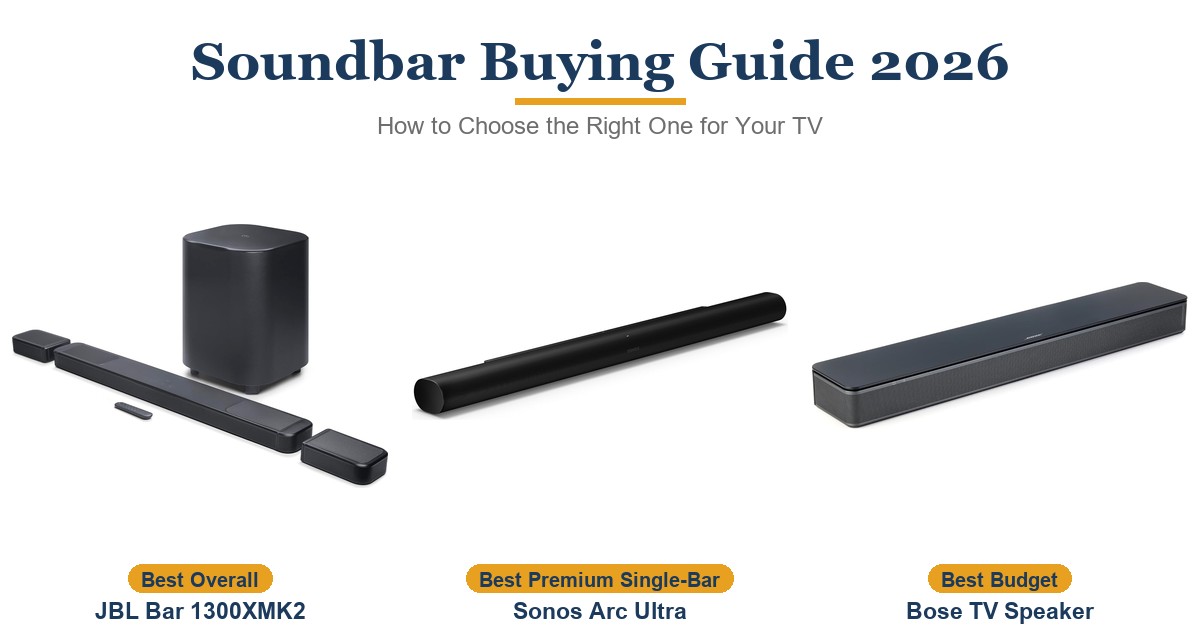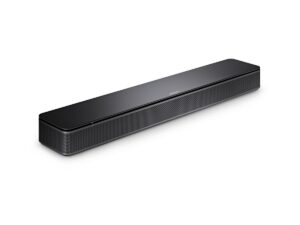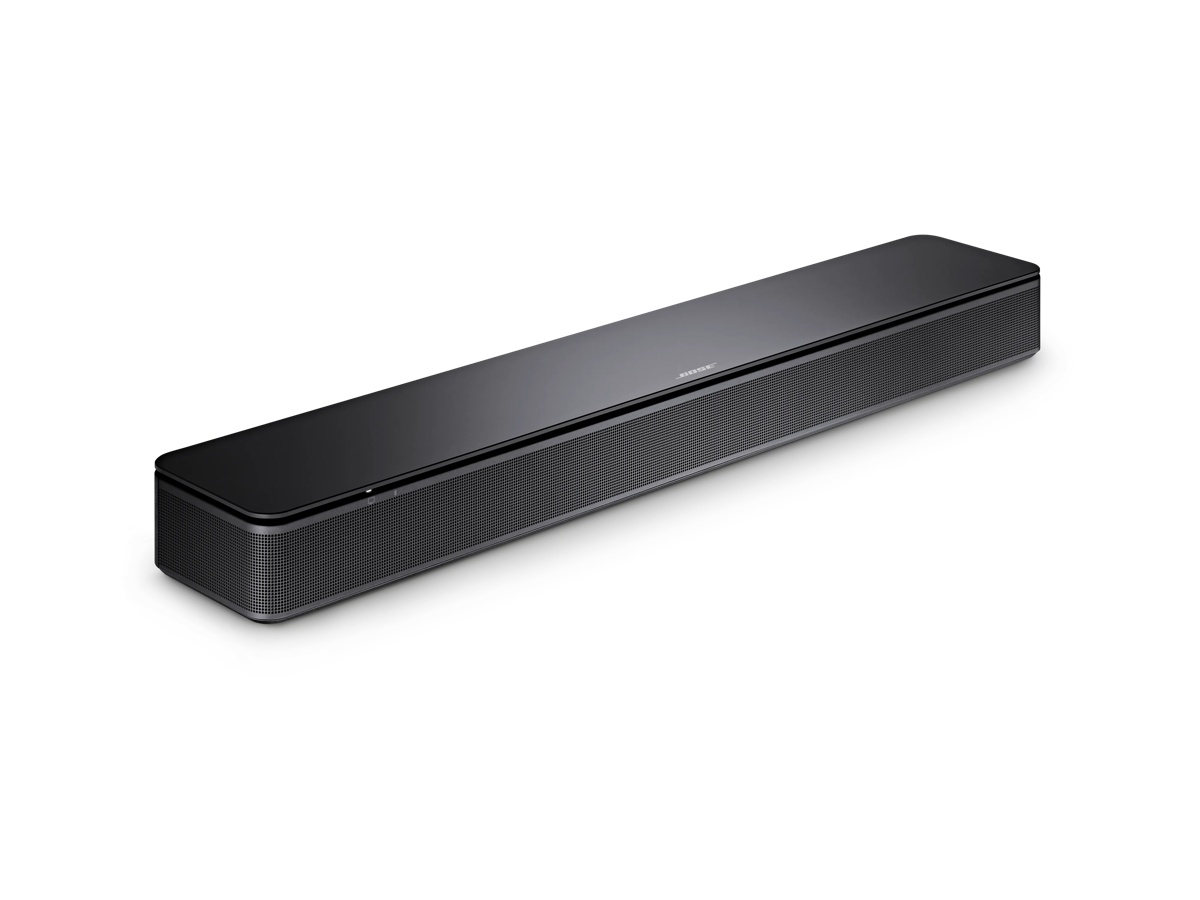
The Bose TV Speaker is for buyers whose main complaint is unclear dialogue, not missing surround sound. Dialogue mode and remote-only setup make it the simplest bar in this comparison to get running, and the price undercuts every Atmos-capable rival here by hundreds of dollars. It skips Dolby Atmos, height channels, and app control entirely, which is where the JBL Bar 1300XMK2 and Sonos Arc Ultra pull ahead for movie-focused buyers.
Pros
- Dialogue mode noticeably clarifies speech, and it can stay on permanently
- Genuine plug-and-play setup with no app or account required
- Priced well below every Atmos-capable bar in this comparison
Cons
- No Dolby Atmos or height channels, stereo only
- No app, Wi-Fi, or multi-room grouping
- No included or optional subwoofer for deeper bass
As an Amazon Associate I earn from qualifying purchases. Disclosure
Overview
Most TV owners don’t want a home theater project — they want the dialogue to stop sounding muffled without buying a receiver, running speaker wire, or learning a new app. The Bose TV Speaker is built around exactly that problem: one slim bar, one cable to the TV, a small remote, and nothing else to configure. It’s sold in the US through Amazon, Best Buy, and Bose’s own site, with a $279 list price that Amazon and Bose both discount to around $199 on a regular basis.
Where JBL’s Bar 1300XMK2 and Sonos’ Arc Ultra chase Dolby Atmos and multi-channel surround, the Bose TV Speaker skips all of it — no app, no Wi-Fi, no height channels — and instead focuses entirely on making speech easier to understand, which Bose’s own market research has long pointed to as the single biggest complaint TV owners have about built-in speakers.
Key Specifications
| Channel Configuration | Stereo (2 angled full-range drivers), no subwoofer or height channels |
| Dimensions | 23.5″ W x 2.2″ H x 4.1″ D |
| Connectivity | HDMI-ARC (cable sold separately), optical (cable included), 3.5mm aux, Bluetooth |
| Controls | Included remote only — volume, Dialogue mode, Bass boost, Bluetooth pairing |
| Companion App | None — no Wi-Fi, no multi-room, no EQ app |
| Audio Formats | Stereo PCM and Dolby Digital via optical/ARC — no Dolby Atmos or DTS decoding |
Bose TV Speaker Sound Quality & Dialogue Clarity
Reviewed.com’s testing singled out Dialogue mode as the standout feature — it analyzes the audio in real time to push vocal frequencies forward, and unlike some rivals’ dialogue-enhancement modes, Bose lets it stay on permanently (“persistent”) instead of requiring a button press every time the source changes. TechGearLab’s lab notes describe the output as surprisingly full and warm for a bar this thin, helped by a Bass boost button on the remote when a scene needs more low end.
What the Bose TV Speaker doesn’t do is scale up: it’s a 2-channel stereo design with no Atmos decoding and no height channels, so action-movie overhead effects and multi-channel game audio come through flattened compared to the Sonos Arc Ultra or JBL Bar 1300XMK2. For dialogue-heavy content — news, talk shows, most streaming TV — reviewers consistently rate it well above the price point; for movie night surround immersion, it’s not built for that job.
Setup & Remote Controls
There’s no app to download and no account to create — Digital Trends’ review calls this out as the product’s core appeal, plugging in via HDMI-ARC or the included optical cable and being fully functional within minutes. The included remote covers every available function: volume, Dialogue mode toggle, Bass boost, and Bluetooth pairing, with no controls on the bar itself.
The tradeoff for that simplicity is control depth — there’s no room calibration, no multi-speaker grouping, and no way to fine-tune EQ beyond the single Bass button, which is where Sonos’ TruePlay-tuned Arc Ultra and JBL’s app-controlled Bar 1300XMK2 pull ahead for anyone who wants to tweak the sound.
Connectivity & Compatibility
HDMI-ARC covers most modern TVs (the HDMI cable itself isn’t included, only optical), and the bundled optical cable is the fallback for TVs without ARC support. Bluetooth streaming works for music or podcasts independent of the TV, controlled from the same remote with a dedicated pairing button.
There’s no Wi-Fi radio in the Bose TV Speaker at all, which rules out AirPlay, Chromecast, and any multi-room grouping with other Bose or third-party speakers — a deliberate simplicity tradeoff rather than an oversight, since the entire product exists to avoid app-based setup.
How Does It Stack Up Against the Competition?
Against Atmos-capable bars built for movie immersion, the Bose TV Speaker’s case rests on price and true plug-and-play simplicity rather than channel count or surround performance.
| Feature | Bose TV Speaker | JBL Bar 1300XMK2 | Sonos Arc Ultra | Samsung HW-Q600C |
|---|---|---|---|---|
| Price (USD) | $279 | $1,199.99 | $1,099 | $297 |
| Channels | 2.0 stereo | 11.1.4 | 9.1.4 | 3.1.2 |
| Dolby Atmos | No | Yes | Yes | Yes |
| Companion App Required | No — remote only | Optional, recommended | Yes, for setup | Optional |
| Included Subwoofer | No | Built-in | Built-in | Wireless, included |
| TTP Review | This review ↑ | Read our review → | Read our review → | — |
Prices change frequently — always verify current pricing before purchasing.
Is the Bose TV Speaker Worth It?
For anyone whose only real complaint is “I can’t understand what people are saying,” the Bose TV Speaker solves that problem about as directly as a soundbar can — Dialogue mode is genuinely effective, setup takes minutes with no app, and the price undercuts every Atmos-capable bar in this comparison by a wide margin.
Buyers who want real surround sound, Dolby Atmos height effects, or a subwoofer for movie night should look at the JBL Bar 1300XMK2 or Sonos Arc Ultra instead — the Bose TV Speaker is a stereo speaker upgrade, not a home theater system, and it doesn’t pretend otherwise.