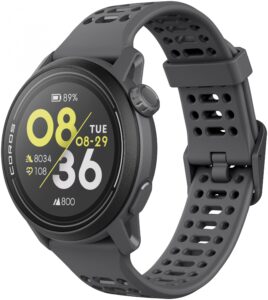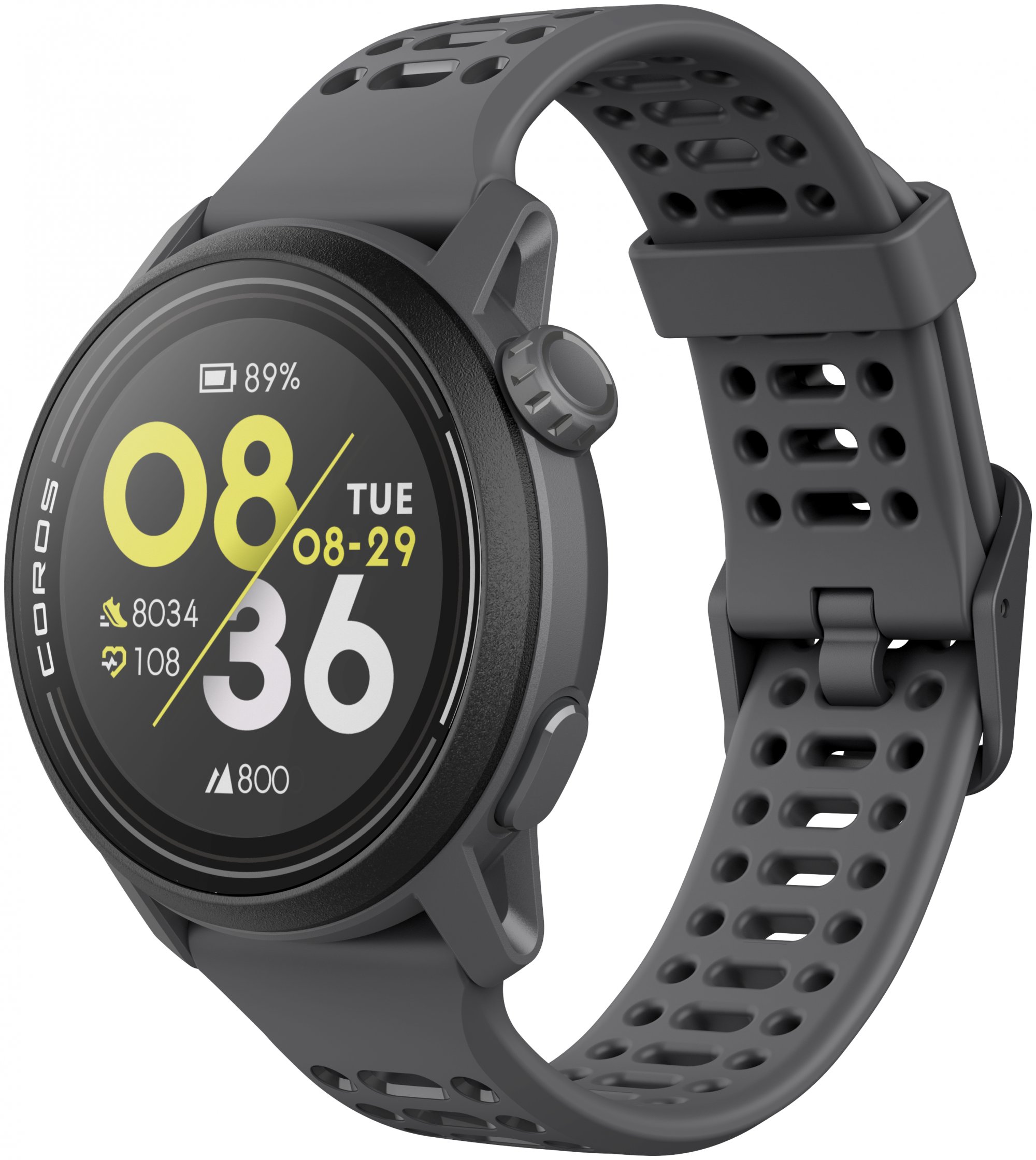
The COROS PACE 3 is the top pick for budget-conscious runners and triathletes who need dual-frequency GPS accuracy and marathon-length battery life in a sub-40g package. At $199 it offers 38 hours of GPS runtime and ±0.14-mile tracking accuracy — performance that rivals watches costing twice as much. The 4GB MP3 music storage and 35+ sport modes add genuine versatility for multi-sport athletes. The trade-offs are a dim backlight in low light, no streaming music integration, and training analytics that lag behind Garmin's ecosystem in depth and VO2 Max accuracy.
Pros
- Dual-frequency GPS with 5 satellite systems
- 38-hour GPS battery — best in class under $250
- Ultralight at 39g (silicone) or 30g (nylon)
- 35+ sport modes including triathlon and open-water swim
- 4GB onboard MP3 music storage
- SpO2 + sleep tracking + wear detection
Cons
- No Spotify or streaming music — MP3 files only
- Training analytics (VO2 Max, load) less reliable than Garmin Connect
- Dim backlight — MIP display underperforms in low light
- Breadcrumb navigation only — no full offline maps
As an Amazon Associate I earn from qualifying purchases. Disclosure
Overview
The COROS PACE 3 is the ultralight GPS sport watch built for serious runners, triathletes, and multi-sport athletes who want flagship-level GPS accuracy and battery life without the flagship price tag. Available on Amazon.com, it targets the crowded sub-$250 sport watch segment with a compelling combination of dual-frequency GPS, 38-hour GPS battery life, and a featherweight 39g silicone-band build that disappears on the wrist during long training sessions.
Launched in late 2023 and updated to $199 following COROS’s November 2025 price adjustment, the PACE 3 sharpened its value case considerably. It replaces the PACE 2’s single-band GPS with a redesigned dual-frequency chipset covering five satellite systems (GPS, GLONASS, Galileo, BeiDou, QZSS), and adds WiFi connectivity, music playback via 4GB of onboard storage, SpO2 monitoring, and over 35 sport modes — all while maintaining the MIP always-on display that gives it a significant battery advantage over AMOLED-equipped rivals.
Key Specifications
| Weight | 39g (silicone band) / 30g (nylon band) |
| Display | 1.2-inch MIP transflective always-on touchscreen, 240×240 |
| Battery — GPS Mode | 38 hours (standard GPS) / 15 hours (multi-band dual-freq) |
| Battery — Smartwatch | 17 days daily use |
| GPS Systems | Dual-frequency (L1+L5); GPS, GLONASS, Galileo, BeiDou, QZSS |
| Heart Rate | Optical HR + SpO2 (blood oxygen); wear detection |
| Water Resistance | 5 ATM (50 metres) |
| Sport Modes | 35+ including run, trail run, track, triathlon, open-water swim, cycling, skiing, hiking |
| Music Storage | 4GB (MP3 playback via Bluetooth headphones) |
| Connectivity | Bluetooth + WiFi |
| Navigation | Breadcrumb trail + turn-by-turn alerts; barometric altimeter + compass |
| Price (USD) | $199.00 (last Amazon price, Oct 13, 2026) |
COROS PACE 3 GPS Accuracy & Tracking
The PACE 3’s dual-frequency GPS chipset is the headline upgrade over its predecessor, and independent testing confirms it delivers. In OutdoorGearLab’s evaluation, the PACE 3 recorded GPS accuracy of ±0.14 miles across hill terrain — a strong result that held up particularly well in technical environments where single-band watches typically struggle. DC Rainmaker’s testing found the PACE 3 “stuck the landing the best” in dense urban canyon sections compared to competing models in its class, with forest and trail tracking performing consistently well throughout.
The watch supports five satellite systems simultaneously and offers a dedicated “All Systems + Dual FREQ” mode for maximum precision in challenging conditions — useful for city runners navigating high-rise corridors or trail runners in deep valleys. The barometric altimeter handles elevation data independently of GPS, which improves accuracy for climbers and hikers. Breadcrumb navigation with turn-by-turn alerts covers the basics for trail exploration, though runners who rely heavily on full offline maps will find the navigation suite more limited than step-up options like the COROS APEX 2 or Garmin Fenix 8.
Battery Life & Recharge
Battery performance is where the PACE 3 most decisively outperforms rivals at its price point. The MIP (Memory-in-Pixel) transflective display consumes a fraction of the power required by AMOLED screens, enabling 38 hours of continuous GPS tracking and 17 days of daily smartwatch use — figures that OutdoorGearLab’s real-world testing found accurately reflected in use. By comparison, AMOLED watches at similar prices typically deliver 13–20 hours of GPS battery. For ultramarathon runners or multi-day adventure athletes, the PACE 3’s UltraMax GPS mode extends battery further still, making it a credible tool for events where charging is not an option.
The tradeoff is display vibrancy: the MIP screen excels in direct sunlight and outdoor use but underperforms in low-light conditions compared to AMOLED alternatives. OutdoorGearLab noted the backlight as one of the weaker points of the hardware. Charging is handled via COROS’s proprietary magnetic USB clip, reaching a full charge in under two hours — a practical turnaround for athletes on tight training schedules.
Comfort & Wearability
At 39g with the silicone band (30g with nylon), the PACE 3 is genuinely ultralight by sport watch standards. OutdoorGearLab’s reviewers described it as “barely noticeable on wrist” during extended use — a meaningful consideration for 24/7 wear, overnight sleep tracking, and marathon-distance events where any added wrist weight becomes apparent over hours. The 1.2-inch case diameter fits a wide range of wrist sizes, and the slim 11.7mm profile reduces snag risk under gear and wetsuits.
The silicone band is soft and flexible for everyday wear, though the double-sided strap clasp received criticism from OutdoorGearLab reviewers as slightly inconvenient compared to standard single-pin buckle designs. The nylon band option resolves this and shaves nearly 10g from the total weight — a worthwhile upgrade for runners who prioritize feel. Overall build quality uses plastic construction throughout, which keeps weight low but contributes to a less premium tactile impression than metal-cased competitors. However, OutdoorGearLab found it “robust and durable” in practical use despite the material choice.
App & Training Features
The COROS app provides route building, trail exploration, and a full health metrics suite covering sleep stages, steps, heart rate trends, and SpO2. VO2 Max estimation, race time prediction, and training load analysis are available, with predictions accessible through the app rather than displayed on the watch face itself. The app interface is considered easy to use by running publication Running.Reviews, and it syncs with external platforms for users who consolidate data across services.
DC Rainmaker’s in-depth testing noted some limitations worth understanding: training load calculations ran noticeably higher than competitor devices for identical workouts, and VO2 Max estimations showed inaccuracies in their testing. The optical heart rate sensor performed accurately in many scenarios — OutdoorGearLab measured a mean deviation of ±1.54 BPM compared to a Polar H10 chest strap, rating it “one of the most accurate heart rate readings” in its class — but DC Rainmaker’s longer runs revealed occasional spikes during intensity transitions. Athletes making critical training decisions from physiological metrics should be aware of these limitations and consider pairing the watch with a chest strap for maximum accuracy during hard sessions. The COROS app lacks streaming music integration (Spotify, Apple Music), so users must manually load MP3 files onto the watch’s 4GB storage via computer.
How Does It Stack Up Against the Competition?
The PACE 3 sits in a competitive sub-$250 sport watch segment. Here’s how it compares to the main alternatives.
| Feature | COROS PACE 3 | Garmin Forerunner 165 | Polar Pacer Pro | Suunto Race |
|---|---|---|---|---|
| Price (USD) | $199.00 (last Amazon price, Oct 13, 2026) | $197.94 | $183.38 | $399.00 |
| Weight | 39g (silicone) | ~47g | ~36g | ~74g |
| GPS Battery | 38 hours | ~19 hours | ~35 hours | ~40 hours |
| Display | MIP (always-on) | AMOLED | MIP | AMOLED |
| Dual-Freq GPS | Yes | No | No | Yes |
| Music Storage | 4GB (MP3) | 4GB (Music model) | None | None |
| Streaming Music | No | Yes (Music model) | No | No |
| Sport Modes | 35+ | 20+ | 130+ | 95+ |
| TTP Review | This review ↑ | Read our review → | — | — |
| Amazon | View on Amazon | View on Amazon | View on Amazon | View on Amazon |
Prices change frequently — always verify current pricing before purchasing.
Is the COROS PACE 3 Worth It?
At $199, the COROS PACE 3 delivers more GPS accuracy and battery life than any other watch in its price range — full stop. Dual-frequency GPS, 38-hour GPS runtime, 17-day smartwatch battery, and a 39g weight make it the clear choice for serious runners, triathletes, and outdoor athletes who want reliable tracking for long events without constant recharging. It’s an especially strong fit for marathon runners, ultrarunners, and multi-sport athletes who treat battery life and GPS integrity as non-negotiable requirements.
Athletes who prioritize a vivid display, Spotify integration, or advanced training coaching should look at the Garmin Forerunner 165 (AMOLED, Spotify, ~$250) or step up to the Polar Pacer Pro (~$300) for built-in running power metrics. The COROS PACE 3’s training analytics — while improving — still lag behind Garmin’s Connect ecosystem in depth and reliability, and DC Rainmaker’s testing flagged VO2 Max estimation accuracy as an area of continued weakness. If the watch face you’ll stare at during training matters as much as the GPS chip underneath it, the AMOLED alternatives are worth the premium.