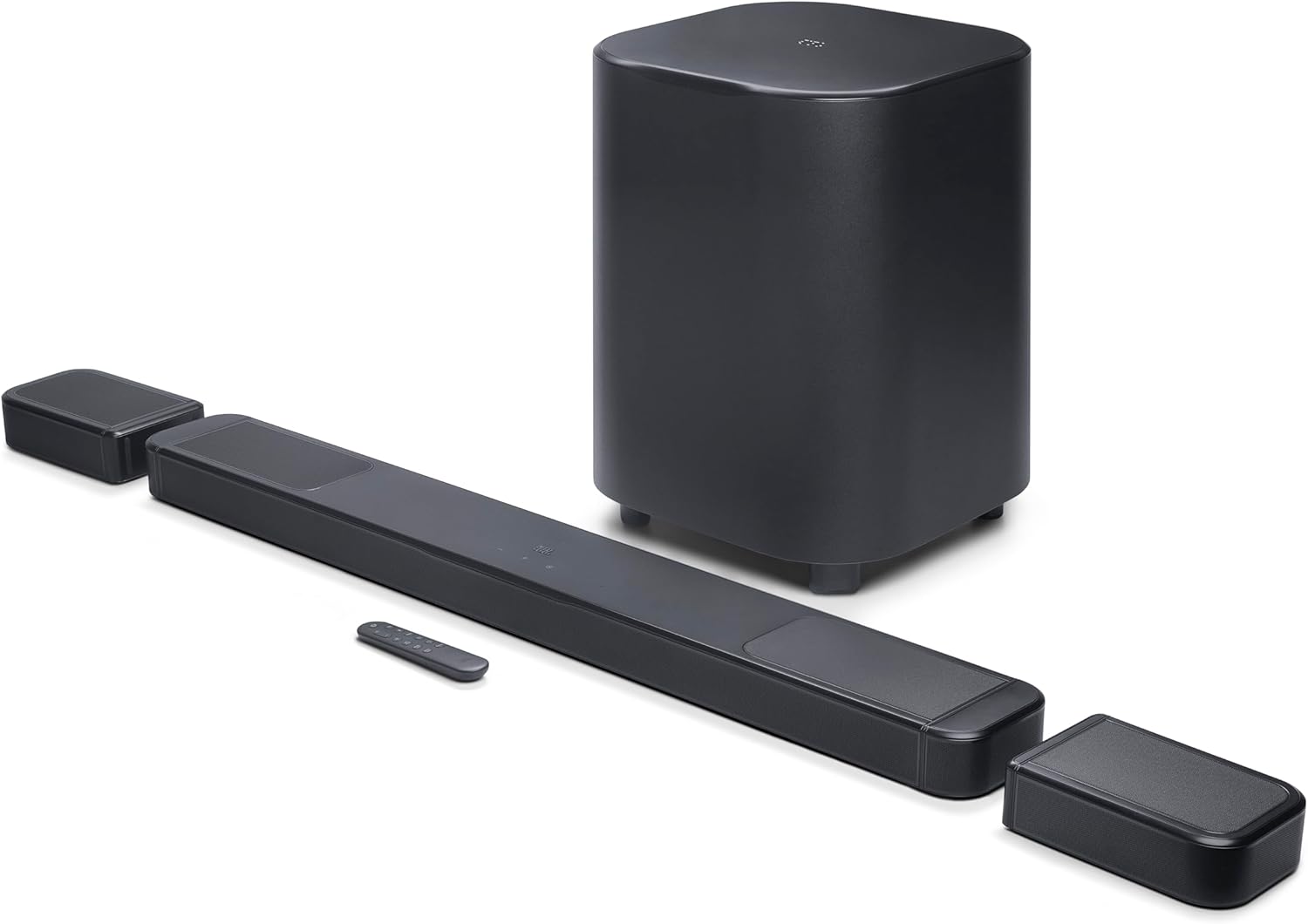
Buy it if movies come first and you want genuine surround and height effects without running speaker wire: its lift-off rears and up-firing drivers produce Atmos that testers count among the most immersive from any soundbar system. Clear dialogue and three HDMI inputs make it easy to live with every day, and the rears double as Bluetooth speakers. The trade-off is gaming, with no 4K 120Hz passthrough and higher latency than Samsung's HW-Q990H, so console players who route games through the bar are better served by the Samsung.
Pros
- Convincing Dolby Atmos with genuine height channels
- Clear dialogue and a smart PureVoice mode
- Lift-off battery rears double as Bluetooth speakers
- Night Listening plays through the rears only
- Three HDMI inputs plus eARC
Cons
- No 4K 120Hz passthrough for gaming
- Latency higher than Samsung's flagship
- Wide bar and large subwoofer need space
- Rears must be docked or USB-C powered to recharge
As an Amazon Associate I earn from qualifying purchases. Disclosure
Overview
Real surround sound usually means running speaker wire to the back of the room. The JBL Bar 1300XMK2 gets around that: the two ends of the soundbar lift off and become battery-powered rear speakers, and a wireless subwoofer and up-firing drivers complete an 11.1.4-channel Dolby Atmos system. It is JBL’s flagship soundbar system, aimed at movie fans with a big TV and room on the floor for a subwoofer.
Those rear speakers also double as portable Bluetooth speakers and a late-night listening setup, which goes beyond what rival systems’ rears do. One detail matters for US buyers: the XMK2 sold here comes with a single 12-inch, 300W subwoofer (1,570W for the whole system), while the Bar 1300MK2 sold in the UK and elsewhere uses a dual 8-inch subwoofer and is rated at 2,470W. Several of the published reviews tested that international version, so their findings on the bar and rear speakers apply here, but their bass impressions describe a different subwoofer.
Key Specifications
| Price (USD) | $1,399.95 |
| Channels | 11.1.4 |
| Total power (JBL, max. at 1% THD) | 1,570W (soundbar 950W, surrounds 2 x 160W, subwoofer 300W) |
| Soundbar drivers | 8 racetrack drivers, 7 x 1-inch tweeters, 4 x 3-inch up-firing drivers |
| Detachable surround speakers (each) | 2 racetrack drivers, 1 x 2-inch full-range driver, 1 x 3-inch up-firing driver; battery rated for up to 10 hours |
| Subwoofer | Wireless, one 12-inch driver |
| HDMI | 3 inputs, 1 eARC output; HDR10+ and Dolby Vision passthrough |
| Other inputs | Optical, Bluetooth, USB (playback on the US version) |
| Frequency response | 33Hz – 20kHz (-6dB) |
| Soundbar size | 40.6 x 2.3 x 5.4 in (55.3 in wide with the surrounds attached) |
| Subwoofer size | 15 x 19 x 15 in |
| Weight | Soundbar 13 lb, surrounds 2.8 lb each, subwoofer 34 lb |
JBL Bar 1300XMK2 Dolby Atmos and Surround Performance
Atmos is the main reason to buy it. The reviews describe a wide, room-filling soundfield with effects placed precisely around the listener, and the bar, subwoofer and rear speakers working as one system rather than sounding like add-ons. Volume makes a difference for some testers: What Hi-Fi found the system came together best played at least moderately loud, with the rears sounding too bright on Atmos music at middling levels, while Expert Reviews’ tester felt immersed without pushing the volume, and Tom’s Guide would have liked a touch more width from the rears. Expert Reviews called it “the most immersive multi-speaker soundbar system on the market right now,” though RTINGS puts its surround and Atmos performance level with Samsung’s flagship systems.
Height effects are good rather than magical. Tom’s Guide heard the jets in Top Gun: Maverick race overhead “as if I were truly outside,” while TechRadar found the same flyover believable but less tangible than real ceiling speakers, since the system relies on up-firing drivers. The channel count, at least, is genuine: when What Hi-Fi asked how 11.1.4 adds up, JBL confirmed that the bar plays five channels and each detachable speaker plays three, every one with its own drivers.
Bass is where the US model needs its own evidence. RTINGS, which lists it as the XMK2, describes a balanced tuning that suits all kinds of content, with a little extra boom that makes explosions land, and found more thump and rumble on sounds like kick drums than from the all-in-one Sonos Arc Ultra. The floor-shaking bass in the reviews of the international model came from its dual 8-inch subwoofer, so treat those impressions as a guide to the system, not a verdict on the 12-inch sub in the US box.
Dialogue and Sound Controls
Dialogue holds up even in loud scenes. The reviews agree that voices stay clear over heavy bass and busy mixes, and RTINGS rates its center channel as superb, with Movie mode moving voices a little forward without making them shouty. For mixes where speech does get buried, there’s PureVoice 2.0, which JBL says steps in only when dialogue needs help; in What Hi-Fi’s listening it lifted commentary just slightly over crowd noise, without adding harsh brightness.
The JBL One app holds the rest of the tuning: a seven-band EQ, room calibration, Standard, Music and Movie modes plus a Smart mode that switches between them by source, and separate levels for the subwoofer and surrounds. Calibration plays test tones with the rear speakers in place to tune the sound to your room. What Hi-Fi’s complaints are that calibration can’t be switched off once it has run, so you can’t compare the sound with and without it, and that the app’s instructions for where to put the rears during calibration are confusing; it recommends following JBL’s online manual instead.
The Detachable Surround Speakers
The lift-off rears are what set this system apart. Each runs on a built-in battery that JBL rates for up to 10 hours, depending on content and volume, recharges when docked on the bar and can also run from USB-C power if you leave them at the back of the room. Off the bar, each works as a Bluetooth speaker, alone or as a stereo pair, and Broadcast mode sends the TV’s sound to them so you can follow a show from the kitchen. What Hi-Fi says it knows of no other system whose wireless rears are this versatile.
Night Listening is the most useful extra. It mutes the bar and subwoofer and plays everything through the two detached speakers, which you can set close to your seat, so late viewing doesn’t shake the house. Expert Reviews’ tester made it a nightly habit and found the pair inaudible by the other side of the bedroom door.
Battery life draws mixed views. Expert Reviews’ tester would have liked slightly longer battery life, finding it hard to remember to dock the rears every couple of nights (a lapse the tester put down to their own memory), while TechRadar found the 10-hour rating plenty for a day of watching. With the ends attached, the bar is 55.3 inches wide, and testers suggest a TV of 65 inches or more.
Connections, Gaming and Setup
Connections are generous: three HDMI inputs plus the eARC link to the TV, with HDR10+ and Dolby Vision passthrough, an optical input, Bluetooth, Wi-Fi and Ethernet. Streaming covers AirPlay, Google Cast, Spotify Connect and Tidal Connect, and the US version can also play music from a USB drive.
Gaming is the weak spot. None of the HDMI inputs pass 4K at 120Hz, so a console routed through the bar is held to 60Hz, and TechRadar notes there’s no auto low latency mode either. RTINGS adds that latency could be lower on every input type, and in its comparison Samsung’s HW-Q990H has the edge on both latency and passthrough. With a free HDMI 2.1 port on the TV, this matters far less: plug the console into the TV and let eARC carry the sound to the bar.
Setup is simple: power the bar and subwoofer, connect the bar to the TV’s eARC port, and the pieces are already paired, with the app walking you through Wi-Fi and calibration. Plan floor space for the subwoofer, which measures 15 x 19 x 15 inches and weighs 34 pounds.
How Does It Stack Up Against the Competition?
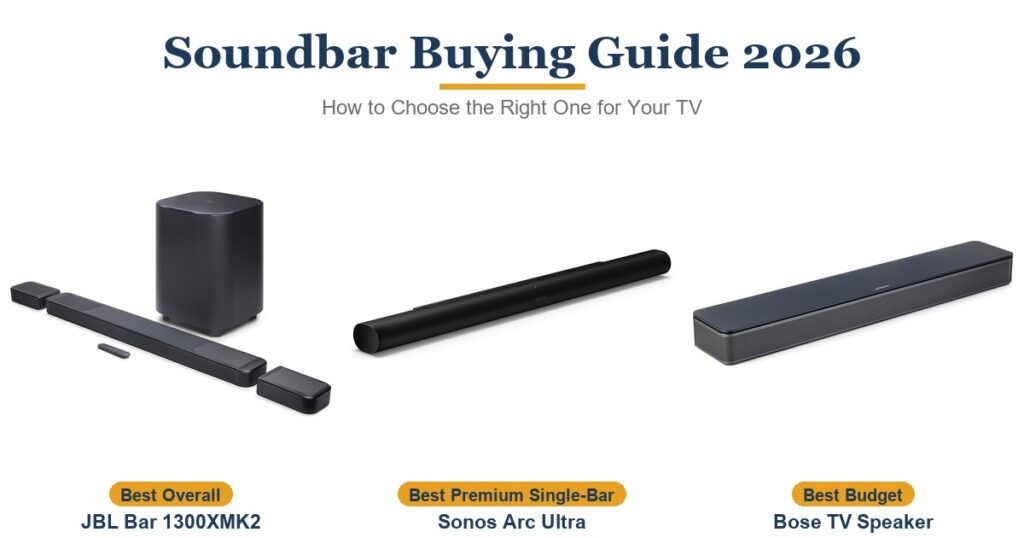
Samsung’s HW-Q990H and LG’s S95AR are the other big systems with a subwoofer and rear speakers in the box, while Sonos’ Arc Ultra puts everything into one bar and sells the subwoofer and rears separately.
| Feature | JBL Bar 1300XMK2 | Samsung HW-Q990H | LG S95AR | Sonos Arc Ultra |
|---|---|---|---|---|
| Price (USD) | $1,399.95 | $1,497.99 | $1,402.02 | $1,099.00 |
| Channels (maker) | 11.1.4 | 11.1.4 | 9.1.5 | 9.1.4 |
| In the box | Bar, subwoofer, 2 detachable battery surrounds | Bar, subwoofer, 2 rear speakers | Bar, subwoofer, 2 rear speakers | Bar only (subwoofer and rears sold separately) |
| HDMI inputs | 3, plus eARC | 2, plus eARC | 1, plus eARC | None (eARC only) |
| 4K 120Hz passthrough | No (4K 60Hz) | Yes | Yes | No HDMI input |
| DTS:X | Yes | Yes | Yes | No |
| Soundbar width (maker) | 40.6 in (55.3 in with surrounds attached) | 48.5 in | 49.2 in | 46.4 in |
| TTP Review | This review ↑ | — | — | Read our review → |
| Amazon | View on Amazon | View on Amazon | View on Amazon | View on Amazon |
Prices change frequently — always verify current pricing before purchasing.
JBL Bar 1300XMK2: Worth It for Wire-Free Movie-Night Surround
Picture the room it suits: a 65-inch or larger TV, a sofa with space behind or beside it for two small speakers, and a household that watches more films than it plays fast shooters. There it delivers real surround and height effects without a receiver or a single speaker cable, and the rears keep earning their place after the film as Bluetooth speakers or a quiet late-night setup. Renters, and anyone who can’t run wires to the back of the room, get the most from that design.
Gamers who route a console through the soundbar should look at Samsung’s HW-Q990H, which RTINGS rates ahead on latency and passthrough; RTINGS sees the JBL as the better value for buyers who won’t use the system for gaming or don’t mind adjusting AV sync by hand. If floor space is tight, the Sonos Arc Ultra takes up much less room but has no subwoofer or rears in the box, and RTINGS found the JBL far more immersive. LG’s S95AR is the one to weigh with an LG TV, since it is designed around LG’s TV features.

Sources
- JBL — Bar 1300XMK2 Official Product Specifications
- JBL Bar 1300XMK2 — Amazon Product Listing
- RTINGS — JBL Bar 1300XMK2 Soundbar Review
- Tom’s Guide — JBL Bar 1300XMK2 Review
- TechRadar — JBL Bar 1300MK2 Review
- What Hi-Fi — JBL Bar 1300Mk2 Review
- Expert Reviews — JBL Bar 1300 MkII Review
- Samsung — HW-Q990H Specifications Sheet
- LG — S95AR Soundbar Specifications
- TechRadar — LG S95AR Soundbar Review
- Sonos — Arc Ultra Tech Specs
Reader Poll
What would you use the JBL's detachable rear speakers for most?
Help Our Editors Know What Matters to You
Explore on Amazon →