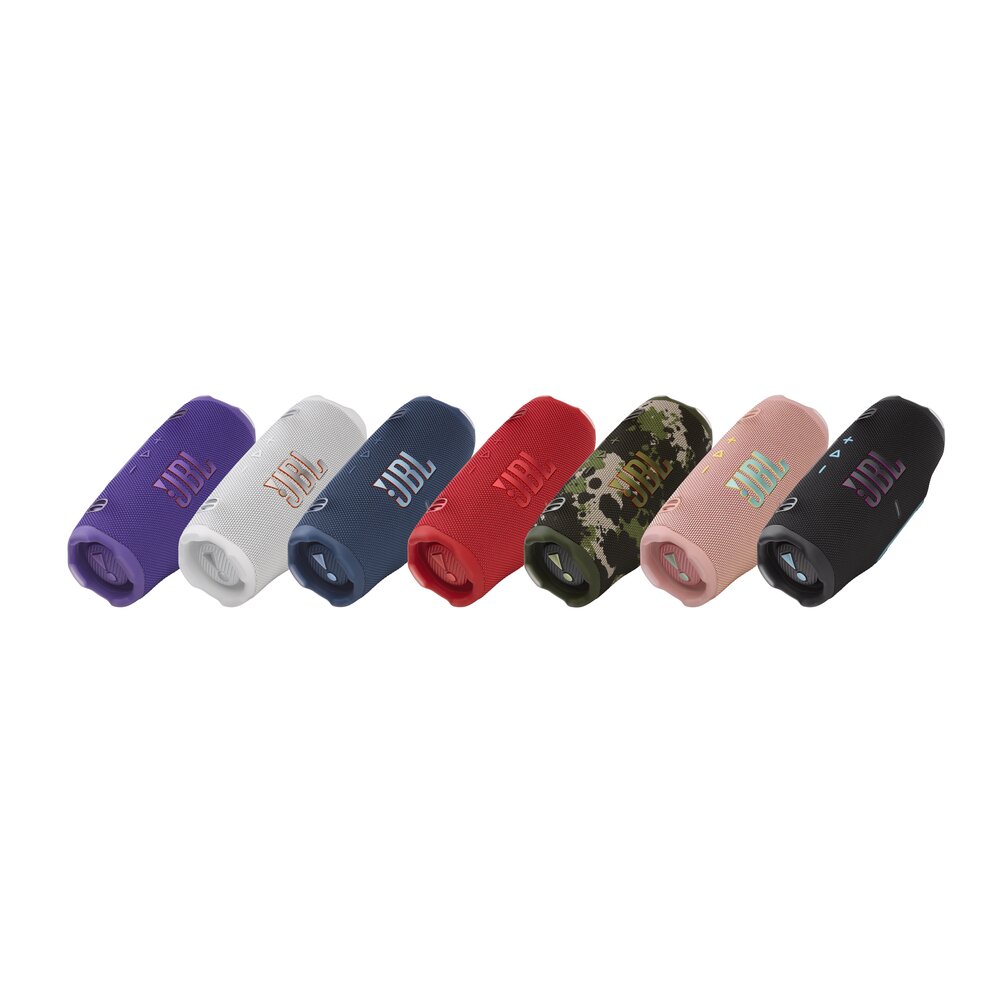
The Charge 6 is the speaker to buy if you want one for the kitchen, the backyard and the beach: it sounds full and clear for its size, shrugs off dust, water and drops, and its 7-band EQ lets you tune it. At loud volume it can run closer to 13 hours than the rated 24, which matters mainly for all-day sessions outdoors. If runtime comes first, Bose's SoundLink Plus lasted longer in SoundGuys' battery test.
Pros
- Full, punchy sound with clear vocals
- IP68 dust and water rating, drop-proof build
- 7-band EQ in the JBL Portable app
- Lossless audio over USB-C
- Charges a phone from its battery
- Detachable carry strap
Cons
- About 13 hours at loud volume in SoundGuys' test, well short of the rated 24
- Loses some energy at background volume
- No microphone, and no pairing with older Party Boost speakers
- No USB-C cable in the box
As an Amazon Associate I earn from qualifying purchases. Disclosure
Overview
The JBL Charge 6 is the size up from JBL’s Flip 7: loud enough to fill a room and handle casual outdoor listening, small enough to carry by its strap in one hand. The idea is one speaker that moves between the kitchen counter, the backyard and the beach, and that doubles as a battery pack for a phone.
It replaces the long-running Charge 5 with a set of practical upgrades rather than a redesign. The dust and water rating climbs from IP67 to IP68, a detachable handle strap makes it far easier to carry, JBL’s Auracast pairing replaces the older Party Boost system, and a USB-C cable can now carry lossless audio from a phone or laptop. JBL also raised the rated battery life from 20 to 24 hours.
Key Specifications
| Drivers | 53 x 93 mm woofer, 20 mm tweeter |
| Output power | 30W RMS (woofer) + 15W RMS (tweeter) |
| Frequency response | 56 Hz – 20 kHz (-6 dB) |
| Battery | 34 Wh; rated up to 24 hours, plus 4 hours with Playtime Boost |
| Charge time | 3 hours (USB-C, cable not included) |
| Water and dust rating | IP68 (1.5 m for 30 minutes) |
| Bluetooth | 5.4, Auracast multi-speaker pairing |
| Dimensions | 228.8 x 98.5 x 94 mm (9.0 x 3.88 x 3.7 in) |
| Weight | 0.96 kg (2.11 lb) without handle, 0.99 kg (2.18 lb) with it |
| Price (USD) | $149.95 (last Amazon price, Sep 27, 2026) |
JBL Charge 6 Sound Quality
For a single mono speaker, the Charge 6 sounds bigger and more grown-up than its size suggests. A 53 x 93 mm woofer and a 20 mm tweeter share 45W of amplification, and the result is deep, punchy bass that doesn’t swamp the midrange: vocals come through with body and the treble stays crisp. What Hi-Fi? made it one of its 2025 Award winners. Tom’s Guide called it one of the best Bluetooth speakers under $200 when it reviewed it in June 2025.
There are limits. RTINGS found it short on the deepest bass rumble and not loud enough for large open spaces, though it copes with casual outdoor listening; its tests also note that it compresses audio at maximum volume and plays stereo tracks in mono unless you pair a second speaker. At the other end of the dial, it loses some of its energy when you turn it down to background levels, so it suits music you actually want to hear more than quiet listening in the corner.
SoundGuys heard a default tuning that leans warm and slightly dark, and found that nudging a couple of treble bands in the app restores the sparkle. In SoundGuys’ MDAQS scoring, which uses HEAD acoustics’ algorithm and is designed mainly for stereo speakers, the Charge 6 got 2.7 overall against 3.4 for Sony’s ULT Field 3, also a mono speaker; SoundGuys calls the Charge 6’s results typical for a Bluetooth speaker and advises taking them with a grain of salt. Connect a phone or computer with a USB-C cable and the Charge 6 plays lossless audio up to 24-bit/96kHz, which adds detail and dynamics over Bluetooth; you hold the play button while plugging in to switch modes.
Battery Life and Charging
JBL rates the 34 Wh battery for up to 24 hours, plus four more with Playtime Boost, a mode that saves power by cutting the bass and makes music sound noticeably lighter. SoundGuys notes that JBL’s figure comes from testing at 50 percent volume, and its own test at a party-level 80 dB from one metre measured 13 hours and 15 minutes; RTINGS recorded around 14 hours, or 19 with Playtime Boost on. Tom’s Guide’s reviewer, by contrast, found that high volume and special features cut only about three to four hours from the rating, so runtime depends heavily on how loud you play it.
That is still a full day out for most people, and RTINGS calls it excellent battery life. A full recharge takes about three hours, and JBL says a 10-minute top-up adds 150 minutes of playback.
The USB-C port works both ways, so the Charge 6 can top up a phone or other small device from its own battery, which eats into its playtime; JBL says the power bank doesn’t support charging a laptop. A built-in warning sounds if the charging port detects water or salt, and JBL says not to charge the speaker until it is dry and clean.
Durability and Water Resistance
The IP68 rating means the Charge 6 is dustproof and rated to survive submersion in up to 1.5 m of water for 30 minutes, and JBL rates it drop-proof from one metre, even onto concrete. Thicker rubber bumpers now guard the passive radiators at each end, and the fabric cover is made from recycled material.
SoundGuys also points to a small change that matters on picnic tables: the Charge 5’s thin silicone strips are gone, replaced by a wider, flatter base that keeps the speaker from rolling off uneven surfaces.
Size and Carrying
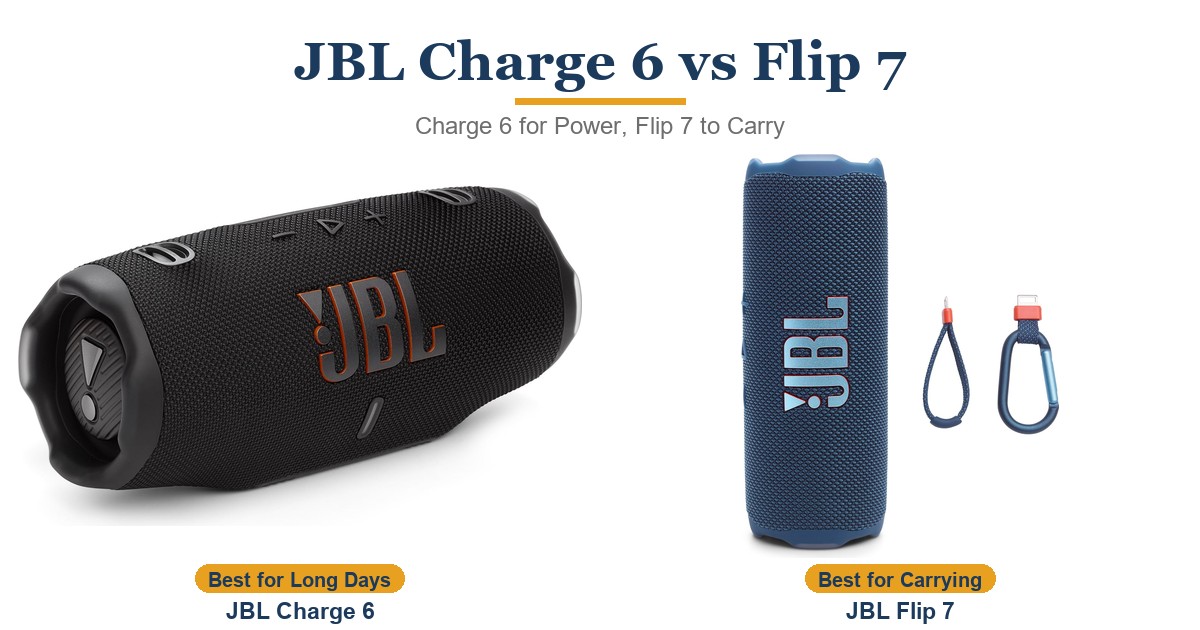
At 0.96 kg without its strap, the Charge 6 is a one-hand carry rather than a pocket speaker. Tom’s Guide found it heavier than most handheld speakers, including the Beats Pill. The new detachable strap can be set up as a traditional carry handle or a carrying loop, and it makes the speaker noticeably easier to carry. If you mainly carry a speaker in a backpack, the Flip 7 weighs 560 g and gives up battery life and bass to get there.
App, Auracast and USB-C Audio
The free JBL Portable app adds a customizable 7-band EQ and a handful of presets, a big step from the Charge 5’s 3-band EQ, plus the Playtime Boost switch and firmware updates. Auracast lets you stereo-pair two Charge 6 speakers or link several Auracast-equipped JBL speakers to play the same music, either from the app or by tapping the Auracast button on each.
The catch with Auracast is that it doesn’t talk to the older Party Boost system, so a Charge 6 can’t link up with a Charge 5 or other earlier JBL speakers. There is also no microphone, so it can’t take calls or work with a voice assistant, no 3.5 mm aux input (the USB-C port handles wired audio instead), and no USB-C cable in the box.
How Does It Stack Up Against the Competition?
The Charge 6’s main rivals are mid-size outdoor speakers from Bose, Sony and Anker’s Soundcore brand, with JBL’s own Flip 7 as the smaller step down.
| Feature | JBL Charge 6 | Bose SoundLink Plus | Sony ULT Field 3 | Soundcore Boom 2 | JBL Flip 7 |
|---|---|---|---|---|---|
| Price (USD) | $149.95 (last Amazon price, Sep 27, 2026) | $269.00 | $208.00 (last Amazon price, Oct 19, 2026) | $99.99 | $109.95 (last Amazon price, Oct 6, 2026) |
| Rated battery (maker) | Up to 24 hr (28 with Playtime Boost) | Up to 20 hr | Up to 24 hr | Up to 24 hr | Up to 14 hr |
| Water and dust rating | IP68 | IP67 | IP67 | IPX7 (no dust rating) | IP68 |
| Weight | 0.96 kg (2.1 lb) | 1.53 kg (3.4 lb) | 1.2 kg (2.6 lb) | 1.67 kg (3.7 lb) | 0.56 kg (1.2 lb) |
| Drivers | Woofer + tweeter, mono | Woofer + tweeter, mono | Woofer + tweeter, mono | Subwoofer + 2 tweeters | Woofer + tweeter, mono |
| App EQ | 7-band | 3-band | 7-band | 9-band | 7-band |
| Microphone for calls | No | No | Yes | Not listed | No |
| TTP Review | This review ↑ | — | — | — | Read our review → |
| Amazon | View on Amazon | View on Amazon | View on Amazon | View on Amazon | View on Amazon |
Prices change frequently — always verify current pricing before purchasing.
JBL Charge 6: Worth It for Rugged, Full-Sounding Outdoor Play
The Charge 6 earns its place if your speaker lives a mixed life: dinner music in the kitchen on a weeknight, then a cooler-side spot at the lake on Saturday, with a phone that might need a top-up by the afternoon. It is tough enough to leave in the sand, it sounds full and balanced rather than boomy, and the 7-band EQ lets you shape it to your taste. Charge 5 owners who are happy with theirs can wait; the upgrades are real, but the old speaker still holds up.
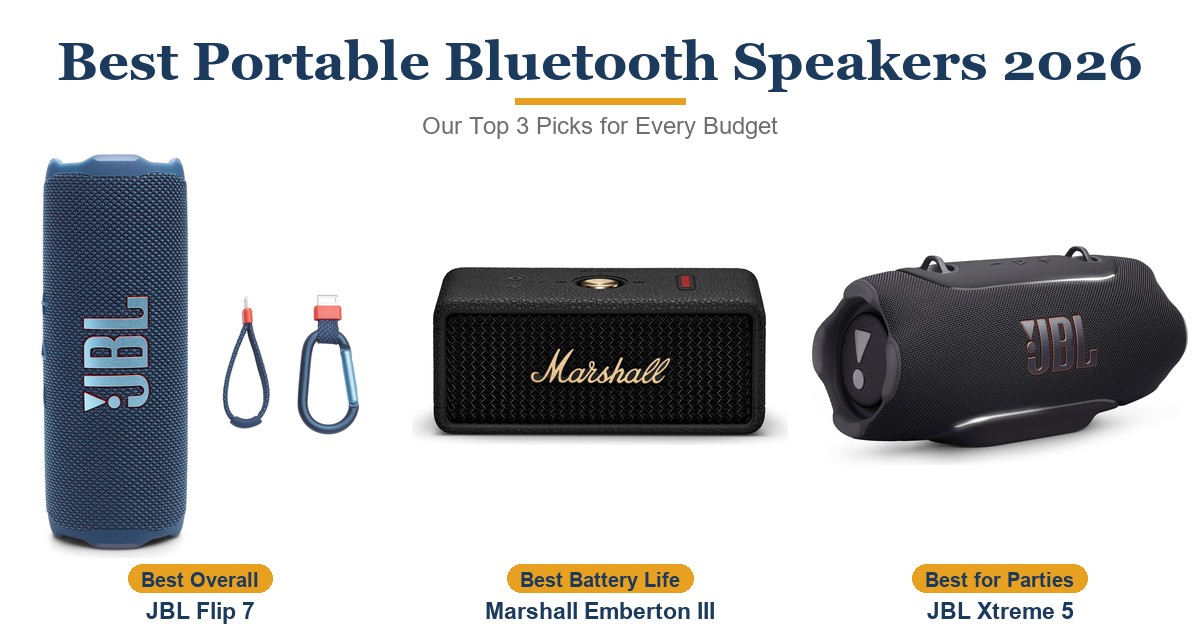
Look elsewhere if one feature outranks everything else. For the longest runtime, the Bose SoundLink Plus ran 20 hours and 55 minutes in SoundGuys’ 80 dB test, though it has only a 3-band EQ and no USB audio, and SoundGuys would still pick the JBL unless the Bose is on sale. If you want to take calls on your speaker, Sony’s ULT Field 3 has a microphone and a one-button bass boost, at the cost of a lower IP67 rating. On a tight budget, the Soundcore Boom 2 brings plenty of bass and volume, but TechRadar found its mids and highs less crisp, especially at louder volumes, while Trusted Reviews heard solid clarity in the high end; it also has no dust rating. And if you’d rather carry less, the Flip 7 keeps the same app and IP68 build in a much smaller body.
Sources
- JBL — JBL Charge 6 product page
- JBL — JBL Charge 6 quick start guide and tech specs (PDF)
- JBL Charge 6 — Amazon Product Listing
- What Hi-Fi? — JBL Charge 6 review
- Tom’s Guide — JBL Charge 6 review
- TechRadar — JBL Charge 6 review
- SoundGuys — JBL Charge 6 review
- SoundGuys — I tested the battery life of JBL’s Charge 6 and Flip 7
- RTINGS — JBL Charge 6 Speaker Review
- SoundGuys — Bose SoundLink Plus vs JBL Charge 6
- SoundGuys — Sony ULT Field 3 vs JBL Charge 6
- SoundGuys — JBL Flip 7 vs JBL Charge 6
- SoundGuys — Bose SoundLink Plus review
- SoundGuys — Sony ULT Field 3 review
- Sony — ULT Field 3 product page
- SoundGuys — JBL Charge 6 alternatives
- TechRadar — Anker Soundcore Boom 2 review
- Trusted Reviews — Soundcore Boom 2 review
- SoundGuys — JBL Flip 7 review
Reader Poll
How long do you usually play a portable speaker in one go?
Help Our Editors Know What Matters to You
Explore on Amazon →