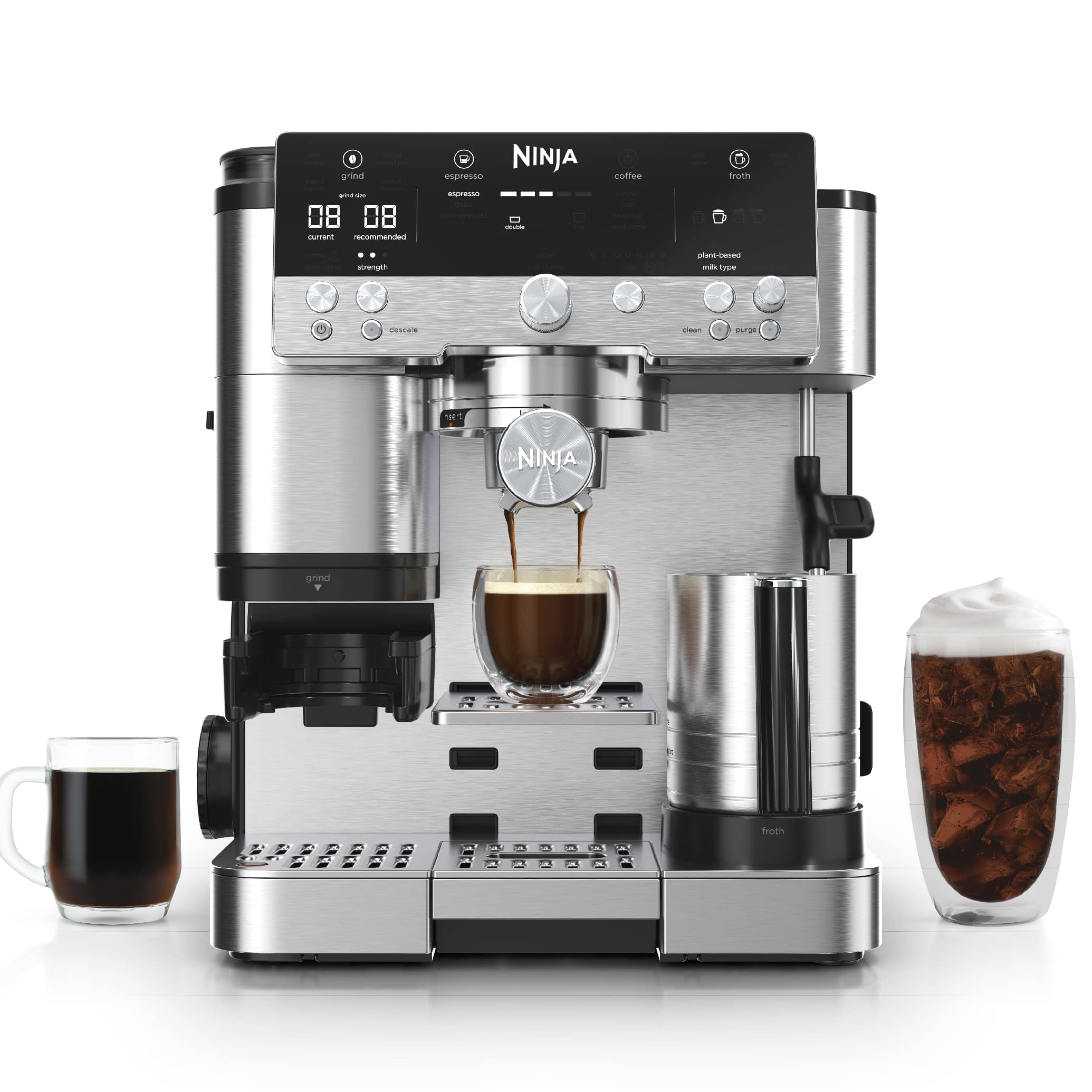
The Luxe Café Premier is the espresso machine to buy if you want lattes, iced coffee and cold brew without learning to dial in a grinder or steam milk by hand. Its grind suggestions and hands-free frothing do the hard parts for you, and it brews drip coffee and a quick cold brew as well. It has no hot water outlet, so Americano drinkers need a kettle. If you can spend more, Ninja's Luxe Café Pro is the better machine in the main tests; if you want espresso as a craft, the Breville Barista Express gives you more room to grow.
Pros
- Grind suggestions and shot timing guide beginners
- Hands-free milk frothing, hot or cold
- Brews drip coffee and quick cold brew
- Consistent double shots with little effort
- On-board storage for every accessory
Cons
- No hot water outlet on the US model
- No single-shot basket included
- Lower ceiling for skilled home baristas
As an Amazon Associate I earn from qualifying purchases. Disclosure
Overview
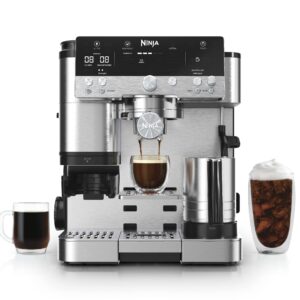
Most espresso machines with a built-in grinder leave you to work out grind size, dose and milk texture by trial and error. Ninja’s first espresso machine, the Luxe Café Premier (ES601), does most of that work for you. It recommends a grind setting for each drink, checks the dose on a built-in scale, times every shot and froths milk hands-free. The same portafilter also brews drip coffee and cold brew, so one machine covers lattes, a morning mug and iced drinks.
That guidance is the main difference from the Breville and De’Longhi machines it competes with. Tom’s Guide called it the best beginner-friendly espresso machine its reviewer has tested. CoffeeGeek logged 233 shots on its test bench and gave it 88.5 out of 100 and its Best in Class award for entry-level espresso systems. The main trade-off is a lower ceiling for skilled home baristas.
Key Specifications
| Model | ES601 (stainless steel) |
| Price (USD) | $599.00 |
| Drinks | Espresso (double, quad, cold-pressed), drip coffee (classic, rich, over ice), cold brew |
| Grinder | Conical burr, 25 grind settings |
| Dosing | Built-in scale (weight-based dosing) |
| Filter baskets included | Double and Luxe (for quad shots and coffee) |
| Milk system | Hands-free steam and whisk, hot or cold froth, dairy or plant-based settings |
| Coffee sizes | 6 to 18 oz |
| Water tank | 70 oz, removable |
| Power | 1,650 W, 120 V |
| Dimensions | 12.99 x 13.39 x 14.57 in (L x W x H) |
| Cord length | 43 in |
| Warranty | 1 year limited |
Ninja Luxe Café Premier Espresso Quality
The shots are consistent enough that you can drink them straight. The double shots come out rich, with a full layer of crema, and repeat from one morning to the next. The machine works to a fixed recipe: CoffeeGeek measured roughly 18 g of coffee in and about 45 g of espresso out, a 1:2.5 ratio, and the menu offers tighter 1:2 or looser 1:3 ratios. The dose itself can’t be changed, which keeps beginners away from the variable that ruins most early shots.
How far you can push it depends on your skill. CoffeeGeek’s best shots, scored 3.5 to 3.75 on its five-star scale, came after it overrode the first grind suggestion, moved down to setting 4 and picked a hotter brew temperature (one of three). Its view is that a Barista Express gives more back to a practiced home barista, whereas the Ninja gets most people to a very good espresso with little effort. Warm-up is short: CoffeeGeek describes a roughly 30 to 45 second preheat after the first grind of the day, and later shots start sooner.
Ninja includes a double basket and the deep Luxe basket, but no single basket, so every espresso starts as a double or a quad. Most lattes and cappuccinos use a double anyway; for a smaller dose of caffeine, the Luxe Café Pro adds a single basket.
Barista Assist, Dosing and Tamping
Barista Assist is the reason to buy this machine over a manual one. Pick a drink and the display tells you which basket to load and which grind setting to use. After the shot, it compares the extraction time to its target and suggests going finer or coarser for the next one. Each click finer on the grind dial briefly runs the motor to clear out grounds from the old setting, so the next shot isn’t ground unevenly. The machine won’t grind without its dosing funnel on the portafilter, and you tamp through the funnel with the included tamper.
A new bag of beans can take a few doses to settle. CoffeeGeek’s testing suggests Ninja’s grind-by-weight is really a grind timer that the scale corrects after each dose, so the amount drifts back on target rather than being weighed live; once dialed in, it holds well enough. Its suggestions can also overshoot with fresh specialty coffee, swinging from a fast shot to a choked one and back; CoffeeGeek notes the feature can be switched off in the advanced menu. For a beginner, that guidance is still the easiest way to learn how grind size changes a shot.
Setup starts with a water hardness strip, and the machine adjusts its brewing to the result. TechRadar had its first espresso ready in just over 20 minutes. If you want espresso and lighter-roast drip from one machine, plan on a single bean: Tom’s Guide found changing beans a bit complicated, because the old beans have to be cleared from the hopper and grinder and the machine then recalibrates.
Hands-Free Milk Frothing and Cold Foam
Milk drinks need no technique. Choose dairy or plant-based milk and a foam level, set the marked jug on its magnetic base around the steam wand and press start. Steam and a small spinning whisk at the bottom of the jug texture the milk together, and lifting the jug off sets off an automatic purge of the wand. CoffeeGeek singles out Queue Milk: press brew and then start the milk, and the machine steams as soon as the shot ends.
The results depend on the milk and the setting. Tom’s Guide got the milk it wanted every time, while TechRadar’s presets almost always made good microfoam from 2% milk but did less well with oat milk. CoffeeGeek found the presets lean toward stiff, dense foam and run hot, often reaching 75°C (167°F); it recommends the Low temperature setting in the advanced menu for sweeter milk, and found the medium foam level pourable enough for basic latte art. Anyone who wants full control can switch to a hidden manual steam mode.
Cold foam splits the testers. CoffeeGeek came to love it, saying no other machine it has tested makes ice-cold, densely foamed milk like this. Tom’s Guide used it for caramel macchiatos it rated better than coffee-shop ones. TechRadar couldn’t get cold foam from its 2% or oat milk and put that down to the setting needing heavy cream, though CoffeeGeek and Tom’s Guide made it with milk. Noise is another split: Tom’s Guide found frothing quiet, while CoffeeGeek heard a high-pitched screech at the start of hot frothing before it settles down.
Drip Coffee, Cold Brew and Quad Shots
Swap in the Luxe basket and the same machine brews coffee in classic, rich, over-ice and cold brew styles, in sizes from 6 to 18 oz. TechRadar’s hot coffee and cold brew turned out well with minimal effort, though it found the four coffee settings a bit gimmicky. Don’t expect pour-over quality: Tom’s Guide found the drip falls short of a dedicated grinder and brewer but is enough for most coffee drinkers, and CoffeeGeek pitches these modes at people moving up from pod machines rather than pour-over fans. CoffeeGeek found the suggested grind for hot coffee too coarse and got a better cup a few steps finer, and noted that these modes leave a wet puck that needs rinsing rather than a quick knock.
Of the two cold coffee settings, CoffeeGeek prefers cold brew to brew-over-ice: instead of brewing hot onto ice, the machine pulses cool water from the tank through the grounds, and CoffeeGeek describes a smooth, low-acid cup that comes closer to cold brew than iced coffee. Others were less sure: Tasting Table found it less deep than cold brew steeped for hours, though less acidic than iced coffee, and TechRadar couldn’t taste a difference between the cold brew and over-ice settings. The Luxe basket also pulls a quad shot of about 100 ml for a travel mug. CoffeeGeek found it drinkable but less balanced than a double.
Design, Storage and Upkeep
The accessories have a home on the machine: a swing-out compartment on the right holds the spare basket and cleaning tools, and the left side stores the tamper and funnel. At 14.57 in tall it fits under most kitchen cabinets. The 70 oz tank sits at the back and has no built-in water filter. There is no hot water outlet on the US model, so an Americano or a cup of tea means boiling a kettle.
How often you refill depends on what you make. Tom’s Guide and TechRadar refilled the tank only a couple of times a week, while CoffeeGeek found the machine thirsty, with frequent auto-purges of the steam wand that fill the drip tray quickly. Ninja sells a knock box separately, and the drip tray has an indicator that shows when it’s full.
How Does It Stack Up Against the Competition?
The table sets it against Breville’s Barista Express, the machine Ninja targeted, De’Longhi’s La Specialista Arte Evo, which also brews cold brew, and Breville’s Barista Express Impress, which adds assisted dosing and tamping.
| Feature | Ninja Luxe Café Premier | Breville Barista Express | De’Longhi La Specialista Arte Evo | Breville Barista Express Impress |
|---|---|---|---|---|
| Price (USD) | $599.00 | Deal $499.95 until Nov 9 | $589.99 | $799.95 |
| Grinder | Conical burr, 25 settings | Conical burr, 16 settings | Conical burr, 8 settings | Conical burr, 25 settings |
| Dosing | Built-in scale sets the next dose | Dose control on the grinder | Single or double dose | Corrects the next dose from the last one |
| Tamping | Tamper used through a dosing funnel | Integrated tamper, dosing funnel | Tamper, dosing and tamping guide | Assisted tamping (22 lb) |
| Milk frothing | Hands-free, hot or cold foam | Manual steam wand | Manual steam wand | Manual steam wand |
| Hot water outlet | No | Yes | Yes | Yes |
| TTP Review | This review ↑ | Read our review → | — | — |
| Amazon | View on Amazon | View on Amazon | View on Amazon | View on Amazon |
Prices change frequently — always verify current pricing before purchasing.
Ninja Luxe Café Premier: Worth It for Easy Lattes, Iced Drinks and Cold Brew
Buy it if you want café drinks at home without first learning to dial in a grinder or steam milk by hand. The Breville and De’Longhi machines here all leave milk to a manual wand; the Ninja froths hands-free, brews drip coffee and cold brew too, and prompts you through each step. It suits a household where one person wants a flat white, another wants iced coffee, and nobody wants to measure. CoffeeGeek’s verdict was that nothing else on the market offered this level of technology and cup quality at the price it tested, and as of November 2026 it costs less than the Barista Express Impress on Amazon.
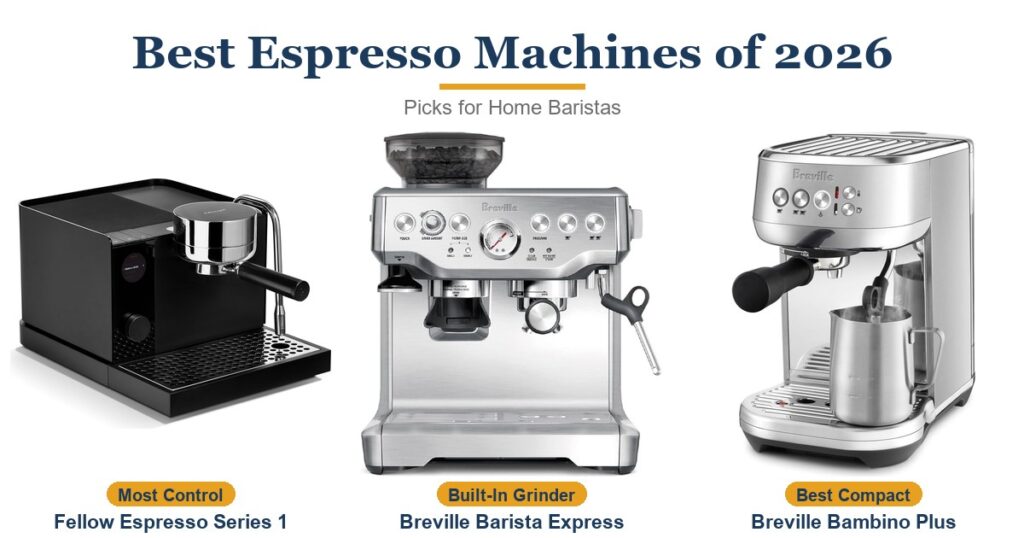
Look elsewhere if you want espresso as a hobby. CoffeeGeek’s advice is to buy the Barista Express if you want to learn the craft and enjoy the manual ritual, since its ceiling is higher in practiced hands and it takes standard 54mm accessories. For assisted tamping built into the machine, Breville’s Barista Express Impress presses each dose at a constant 22 lb. De’Longhi’s La Specialista Arte Evo suits anyone who wants to learn manual steaming, and a US distributor’s spec sheet lists a 3-year warranty for it against Ninja’s one year. If you can spend more, look at the Luxe Café Pro, listed at $749.95 against $599.00 for the Premier on Amazon in November 2026. It adds a hot water dispenser, a single basket and a tamping lever, and CoffeeGeek thinks it is likely worth the extra for daily Americano drinkers or anyone who wants a simpler tamp. Tom’s Guide calls the Pro the better machine and the Premier the better value.
Sources
- Ninja — Luxe Café Premier Espresso Machine (ES601)
- Ninja Luxe Café Premier — Amazon Product Listing
- CoffeeGeek — Ninja Luxe Café Premier Full Review
- Tom’s Guide — Ninja Luxe Café coffee maker review
- Tom’s Guide — Ninja Luxe Café vs Ninja Luxe Café Pro
- Tom’s Guide — Ninja Luxe Café vs Breville Barista Express
- TechRadar — Ninja Luxe Café review
- Breville — the Barista Express (BES870)
- Breville — Barista Express Instruction Book
- Breville — the Barista Express Impress (BES876)
- Breville — Barista Express Impress Instruction Book
- Tasting Table — Review: The Ninja Luxe Café Premier Series Is A Must-Have For Novice Home Baristas
- TechRadar — De’Longhi La Specialista Arte Evo review
- De’Longhi La Specialista Arte Evo spec sheet (HOD Digital) — EC9255M product spec sheet
Reader Poll
What would you make most often on the Luxe Café Premier?
Help Our Editors Know What Matters to You
Explore on Amazon →