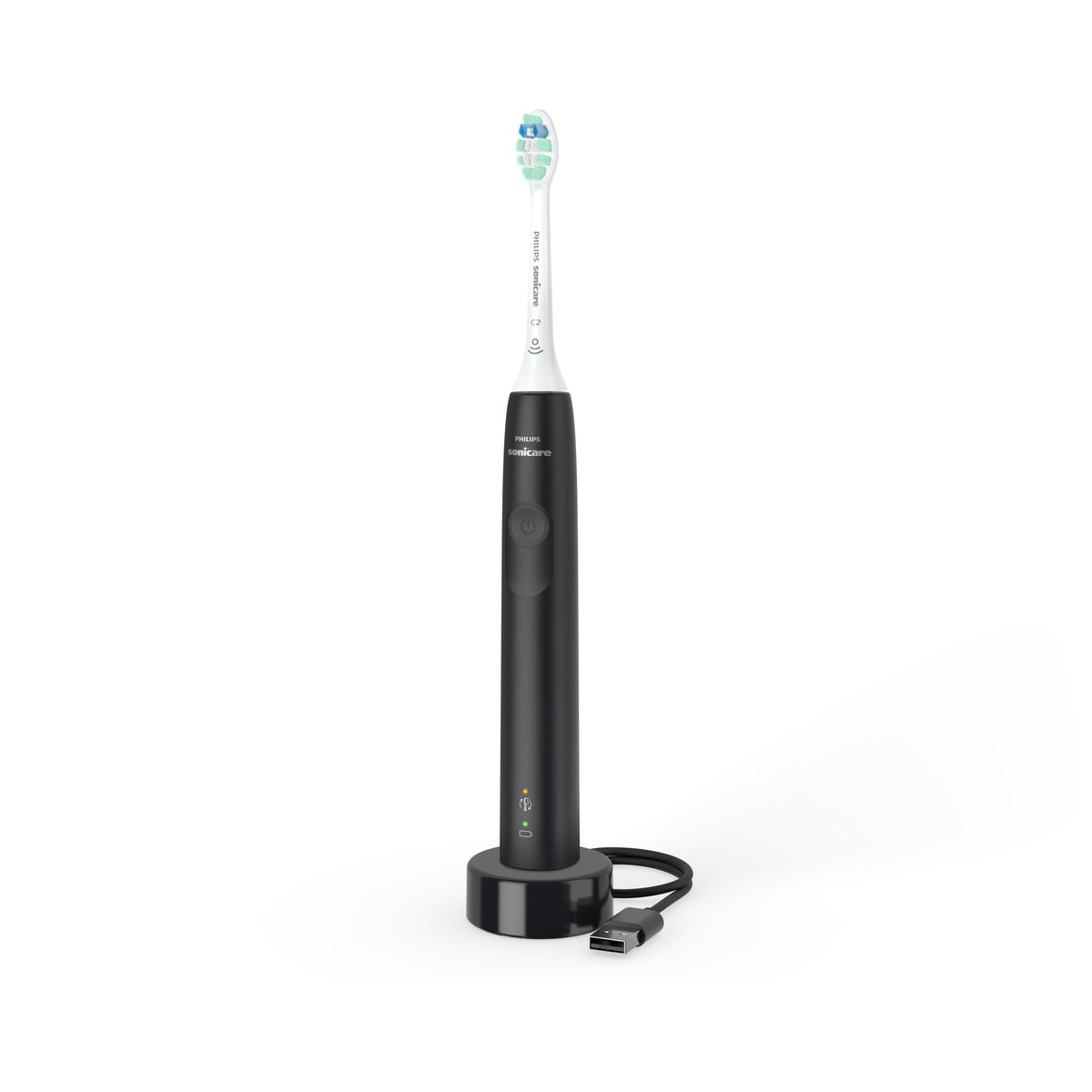
The Sonicare 4100 is a smart first electric toothbrush, or a no-fuss upgrade, for anyone who wants the brush to coach a full two-minute clean without apps or extra modes. Its pressure alert comes through the handle where you can feel it, and testers got more than two weeks per charge. The trade-off is upkeep: as of November 2026, Sonicare's replacement heads cost about twice as much as Oral-B's standard heads, so the Oral-B Pro 1000 costs less to run.
Pros
- Pressure alert you feel through the handle
- Two-minute timer, 30-second pacer and auto shut-off
- Battery beat its 14-day rating in every test
- BrushSync reminds you when to change the head
- Runs quieter than the Oral-B Pro 1000
Cons
- Replacement heads cost about twice Oral-B's standard heads (Nov 2026)
- No light shows which intensity is on
- USB stand with no wall adapter or travel case
As an Amazon Associate I earn from qualifying purchases. Disclosure
Overview
At $39.96 on Amazon in November 2026, the Philips Sonicare 4100 covers what dentists ask of an electric toothbrush: it times two full minutes, nudges you on every 30 seconds and warns you when you press too hard. A reminder tells you when the head is worn out, too. Several leading testers put it at or near the top of the category. Electric Teeth rates it the best electric toothbrush all things considered, and CNN Underscored names it its best electric toothbrush. Wirecutter makes it the runner-up to the Oral-B Pro 1000, as its pick for anyone who wants a quieter, vibrating brush.
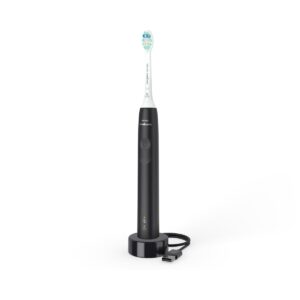
Its strength is how little it asks of you. One button runs one cleaning mode at two intensities, and the brush tells you when to move on, when you are pressing too hard and when the head is worn out. This review covers the HX3681 model that Amazon sells as the 4100 (HX3681/24 in black). Philips’ US store also lists a different rechargeable model, the HX4031, with three intensities.
Key Specifications
| Price (USD) | $29.99 |
| Model | HX3681/24 (black) |
| Brushing action | Sonic, 31,000 bristle movements per minute (maker-stated) |
| Modes | 1 Clean mode, 2 intensities (high, low) |
| Timer | 2-minute SmarTimer with 30-second QuadPacer |
| Pressure sensor | Yes, vibrates the handle |
| Brush-head reminder | BrushSync replacement reminder |
| Battery | Lithium-ion, rated 14 days |
| In the box | Handle, 1 C2 Optimal Plaque Control head, USB charging stand |
| Weight | 97 g / 3.4 oz with head (Electric Teeth); 94.4 g (TechGearLab’s measurement) |
| Warranty | 2-year limited |
Philips Sonicare 4100 Cleaning Performance
The testers who put it through plaque tests came away impressed. Electric Teeth gave it full marks for cleaning after its plaque-disclosing tests. TechGearLab found the compact head removed nearly every trace of plaque, leaving a tiny amount that a few more seconds would have cleared. TechGearLab scored its cleaning 7.9 out of 10, below the 8.9 it gave the older ProtectiveClean 4100. Its overall score of 80 is lower than our rating, which gives more weight to the three other testers who rank the 4100 first or second.
The motor is tuned below Sonicare’s premium handles, some of which make 62,000 movements to the 4100’s 31,000. By Electric Teeth’s account, people already used to a Sonicare might feel a slightly gentler brush, yet its tester still finished every session with a deep clean feeling. Power, the site adds, is only one part of getting teeth clean.
The type of brush matters a little, too. Clinical research gives oscillating-rotating brushes, the round-head kind Oral-B makes, a small edge in removing plaque and reducing gum inflammation. In daily use the difference is slight, and brushing technique and time count for more.
Brush head: it ships with a C2 Optimal Plaque Control head, and it takes Philips’ push-on Sonicare heads, so you can switch styles later. Wirecutter found Sonicare heads narrower than the Pro 1000’s round heads, which can make the 4100 a better fit for smaller mouths. Electric Teeth’s tester found the opposite: Oral-B’s small round head was easier to move around the back teeth.
Timer, Pacer and Pressure Sensor
The guidance features are where the 4100 earns its reputation. The timer starts when you press the button, the brush pauses every 30 seconds to move you to the next quarter of your mouth, and it switches itself off at two minutes. The Oral-B Pro 1000 keeps running until you stop it.
The pressure sensor reduces the vibrations and changes how the handle buzzes when you press too hard, so you feel the warning rather than having to spot a light. In Electric Teeth’s head-to-head, this alert was much more noticeable than the Pro 1000’s, which it found nearly impossible to notice. That makes the 4100 a good teacher for heavy-handed brushers moving from a manual brush.
BrushSync works through a chip in the supplied head. After the equivalent of three months of use, a light on the handle comes on and the handle vibrates to tell you to change the head. Electric Teeth found the amber light small and not easy to see, so the vibration is the more useful part. New users also get EasyStart, which builds the power up gradually over the first 14 brushings.
Comfort, Noise and Controls
One button does everything: press once to start, and press twice quickly to change intensity. Nothing on the handle shows which of the two intensities is on, though Electric Teeth found them easy to tell apart by sound and feel. The 4100 also runs noticeably quieter than Oral-B’s oscillating Pro 1000, which gives off a more mechanical whir.
The slim handle has a matte finish and no rubber grips, which makes it easy to wipe clean. You can use it in the shower, since the handle is water resistant. TechGearLab rated it 8.4 out of 10 for comfort and praised the small head for reaching every corner of the mouth. Wirecutter’s testers were less comfortable with it: even on low, they felt the vibrations through the whole brush, and the rigid plastic back of the head could knock against opposing teeth.
Battery, Charging and Running Costs
Philips rates the battery at 14 days, and every test we found beat that. Wirecutter averaged 16 days of twice-daily brushing. Electric Teeth got 17 days on high and 41 on low, and TechGearLab measured 49.5 days. Electric Teeth adds that it perhaps falls marginally behind the three to four weeks it sees as the industry average.
Charging is simple but minimal. The small stand has a hardwired USB cable and no wall adapter in the box: you supply your own USB plug or, Wirecutter notes, ask Philips customer service for a free one. Expect up to a day on the stand for a full charge. Electric Teeth notes the stand supports 100-240 volts. There is no travel case in the box.
The ongoing cost is the 4100’s weak spot: as of November 2026, Sonicare’s replacement heads typically cost about twice as much as Oral-B’s standard heads, partly because of the BrushSync chip in each by Electric Teeth’s account, and that site’s three-year estimate favours the Pro 1000.
How Does It Stack Up Against the Competition?
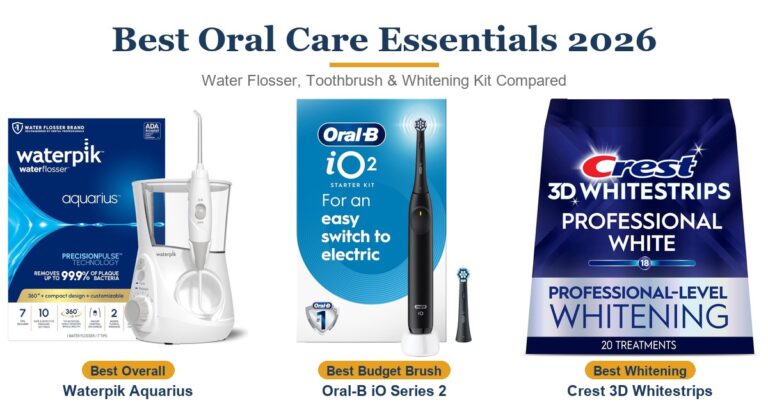
The 4100’s closest rivals are Wirecutter’s top pick, the oscillating Oral-B Pro 1000, Oral-B’s entry iO model, and Philips’ own step-down 1100, which drops the pressure sensor.
| Feature | Philips Sonicare 4100 | Oral-B Pro 1000 | Oral-B iO Series 2 | Philips Sonicare 1100 |
|---|---|---|---|---|
| Price (USD) | $29.99 | $49.94 | $48.73 (Nov 10) | $19.96 |
| Brushing action | Sonic | Oscillating-rotating | Round head with micro-vibrations | Sonic |
| Modes / intensities | 1 mode, 2 intensities | 3 modes | 3 modes | 1 intensity |
| Pressure sensor | Yes, handle vibration | Yes, slows the brush | Yes, red light | No |
| Brush-head replacement reminder | Yes (BrushSync) | No (fading bristles) | No | No |
| Battery life (Electric Teeth test) | 17 days (high) | 10.5 days | 37 days | 17 days |
| Warranty | 2 years | 2 years | 2 years | 2 years |
| TTP Review | This review ↑ | — | Read our review → | — |
| Amazon | View on Amazon | View on Amazon | View on Amazon | View on Amazon |
Prices change frequently — always verify current pricing before purchasing.
The Pro 1000 is the strongest alternative. It has three modes including a sensitive one, and the clinical evidence leans slightly toward its oscillating action. The 4100 answers with a pressure alert you can feel, a longer battery and quieter running. Electric Teeth calls the contest close and picks the 4100, just. The iO Series 2 lasted 37 days in Electric Teeth’s battery test, more than twice the 4100’s high-setting result, and starts on a gentle super-sensitive mode. Electric Teeth found its pressure-sensor light hard to see, though, and its iO heads cost even more than Sonicare’s in that site’s price checks. The Sonicare 1100 matches the 4100’s battery and timer and, as of November 2026, sells for about half the price on Amazon. It has a single intensity, though, and no pressure sensor or replacement reminder.
Philips Sonicare 4100: Worth It for Simple, Well-Guided Brushing
The 4100 makes the most sense for someone switching from a manual brush or replacing a worn-out electric one who wants the brush to do the coaching. The timer and pacer keep each session to a full two minutes, EasyStart eases you in, and the pressure alert comes through the handle where you can’t miss it. A battery that beats its two-week rating and a USB stand also make it easy to pack for a trip. As of November 2026 it costs less on Amazon than the Oral-B Pro 1000, and three of the four testers we read rank it first or second among the brushes they tried.
If the lowest cost over several years matters most, the Oral-B Pro 1000 is the better buy, since Oral-B’s standard heads cost about half as much. If you want more days between charges than the 4100 gives on its high setting (Electric Teeth got 37 days from the iO2 against 17), or extra-gentle modes for sensitive gums, the Oral-B iO Series 2 is the better fit. If you brush lightly and want to spend as little as possible, the Sonicare 1100 keeps the timer and battery and drops the pressure sensor.
Sources
- Philips — Sonicare 4100 Series HX3681/24 Specifications
- Philips — Sonicare 4000 Rechargeable Toothbrush HX4031
- Philips Sonicare 4100 — Amazon Product Listing
- Electric Teeth — Philips Sonicare 4100 Series review
- Electric Teeth — Oral-B Pro 1000 vs Philips Sonicare 4100 Series
- Electric Teeth — Oral-B iO2 review
- TechGearLab — Philips Sonicare 4100 Review
- Wirecutter — The Best Electric Toothbrushes
- CNN Underscored — The Best Electric Toothbrushes
- Oral-B — iO Series 2 Starter Kit
- Philips — Sonicare 1100 Series HX3641/02
Reader Poll
Sonicare 4100 or Oral-B Pro 1000: what would decide it for you?
Help Our Editors Know What Matters to You
Explore on Amazon →