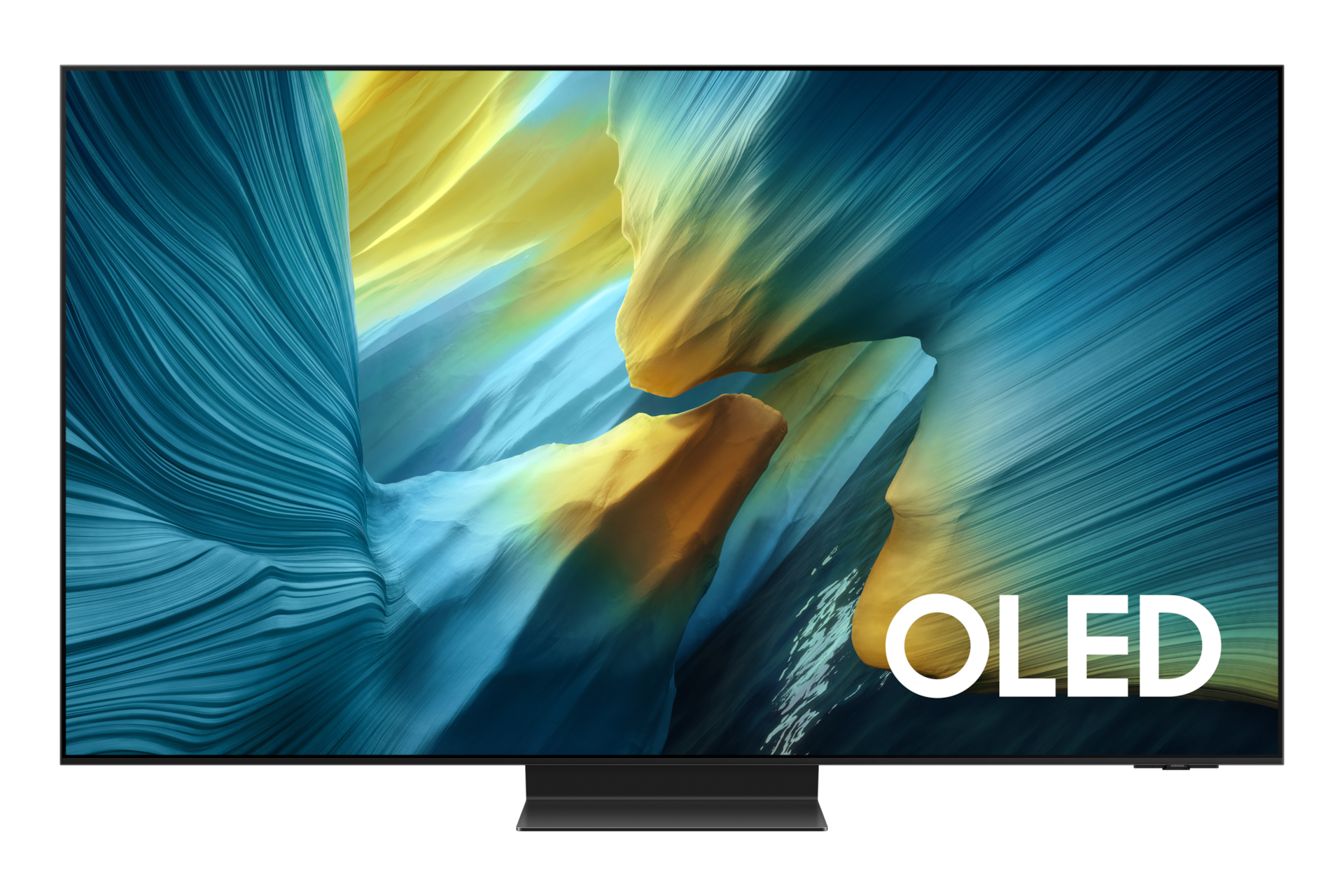
The Samsung S95F is built for buyers chasing a bright, usable-in-daylight OLED picture in the 55-inch class — TechRadar named it TV of the Year, and its Glare-Free 2.0 coating plus roughly 2,130-2,135 nits of measured HDR brightness back that up. Gamers get a genuine assist too, with 165Hz refresh and four full-bandwidth HDMI 2.1 ports delivering some of the lowest input lag TechRadar has measured on any current TV. The trade-off is format support: Samsung skips Dolby Vision in favor of HDR10+, so part of what makes this panel special won't show up on every title in a typical streaming library.
Pros
- Among the brightest OLEDs tested at ~2,130 nits peak HDR
- Effective Glare-Free 2.0 anti-reflective coating
- 165Hz refresh with 4 full-bandwidth HDMI 2.1 ports
- Q-Symphony extends audio to compatible soundbars
- New NQ4 AI Gen3 Vision AI features
Cons
- No Dolby Vision support, HDR10+ only
- Tizen app ecosystem lags Google TV rivals
- No DTS audio pass-through
As an Amazon Associate I earn from qualifying purchases. Disclosure
Overview
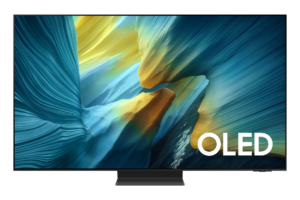
A year after Samsung’s S95F launched at $2,299.99, Amazon has settled into selling the 55-inch model for closer to $1,700 — and that discount is what turns TechRadar’s reigning TV of the Year into an easy recommendation instead of just an impressive one. The 55-inch QN55S95FAFXZA pairs a QD-OLED panel with Samsung’s second-generation Glare-Free coating, aimed squarely at living rooms too bright for a typical OLED to look its best in.
Brightness is the headline generational leap: independent lab testing puts the 55-inch S95F well ahead of LG’s mid-range C6 and Sony’s Bravia 8 on raw HDR nits, and Samsung has closed the refresh-rate gap too, pushing all four HDMI ports to a genuine 165Hz. The one place Samsung still trails the field is format support — Dolby Vision remains absent from its entire OLED lineup, this TV included.
Key Specifications
| Screen Size | 55″ (137.9cm Class) |
| Panel Type | QD-OLED with Glare-Free 2.0 coating |
| Resolution | 4K UHD (3840×2160) |
| Refresh Rate | 165Hz (Motion Xcelerator), VRR / FreeSync Premium Pro |
| Processor | NQ4 AI Gen3 |
| HDR Formats | HDR10+, HLG, HDR10 (no Dolby Vision) |
| Peak HDR Brightness (measured) | approx. 2,130 nits, per TechRadar’s 55-inch testing |
| Audio | 70W 4.2.2-channel, Dolby Atmos, OTS+, Q-Symphony |
| HDMI Ports | 4x HDMI 2.1, full bandwidth |
| Smart Platform | Tizen OS with Samsung Vision AI |
| Weight (without stand) | approx. 41.7 lbs (18.9kg) |
| Price (USD) | $1,797.95 (last Amazon price, Oct 12, 2026) |
Samsung S95F OLED TV Display & Brightness
TechRadar’s own bench testing of the 55-inch S95F measured roughly 2,132 nits of peak HDR brightness in Filmmaker Mode and 2,135 nits in Standard mode on a 10% HDR white window — well above the panel’s mid-range Samsung siblings and, per the same outlet’s testing, well above LG’s C6 and Sony’s Bravia 8 in this review’s own comparison table below. That headroom is what earned the S95F TechRadar’s TV of the Year award: paired with Samsung’s Glare-Free 2.0 anti-reflective coating, it’s one of the few 55-inch OLEDs that stays watchable with the blinds open, traditionally the format’s biggest disadvantage against Mini-LED and QLED sets.
Context matters here, though. RTINGS’ own current “Best TVs” ranking has since moved its top overall pick to Samsung’s newer S95H, and LG’s step-up G5 actually edges the S95F out in Filmmaker Mode (TechRadar measured it at roughly 2,268 nits) while falling behind in Standard mode (about 1,850 nits). In other words, the S95F is no longer the single brightest OLED tested anywhere — it’s one of a small handful of 2025-2026 panels clustered at the top, and at its current discounted price it’s the cheapest way into that cluster.
Gaming Performance & Refresh Rate
All four HDMI ports run full-bandwidth HDMI 2.1, and the panel itself hits a native 165Hz — tied with LG’s C6 for the fastest refresh rate this review compares it against. TechRadar measured input lag at roughly 9.5ms in Game Mode at 4K/60Hz, among the lowest figures the outlet has recorded for any current OLED, and the panel supports VRR through both AMD FreeSync Premium Pro and Nvidia G-Sync for PC gamers running variable frame rates.
The trade-off shows up in format support rather than raw speed. Samsung’s entire 2025-2026 OLED lineup skips Dolby Vision in favor of HDR10+, so a PS5 or Xbox library mastered in Dolby Vision won’t get the dynamic per-scene metadata the panel is otherwise fast enough to render. Both comparison-table rivals below, LG’s C6 and Sony’s Bravia 8, support Dolby Vision alongside HDR10 — a real consideration for anyone whose game and streaming library leans on it.
Audio & Smart Features
Samsung built a 70W 4.2.2-channel Dolby Atmos array directly into the S95F, backed by Object Tracking Sound+ to move dialogue and effects around the screen, and Active Voice Amplifier to keep speech legible over background noise without a manual EQ pass. Q-Symphony lets the built-in speakers work alongside a compatible Samsung soundbar instead of switching off entirely, and the Tizen OS smart platform runs on Samsung Vision AI, Samsung’s on-device processing layer for upscaling, scene optimization, and voice control.
It’s a genuinely strong built-in system, but it isn’t the standout on this particular comparison list. Tom’s Guide has singled out Sony’s Bravia 8 specifically for its Acoustic Surface Audio+ design, which turns the panel itself into part of the speaker array — a design Tom’s Guide rates among the best built-in TV sound available, ahead of what any conventional down-firing or side-firing array, Samsung’s included, can match from inside a TV chassis this thin.
How Does It Stack Up Against the Competition?
All four TVs below are 55-inch models with current researched pricing — here’s how the S95F’s brightness and gaming specs compare against three of its closest current rivals.
| Feature | Samsung S95F OLED TV | LG C6 OLED TV | Sony Bravia 8 OLED TV | LG G5 OLED |
|---|---|---|---|---|
| Price (USD) | $1,797.95 (last Amazon price, Oct 12, 2026) | $1,160.89 (55") | $1,398.95 (55 inches) | $1,799.96 |
| Panel Type | QD-OLED | WOLED evo | WOLED | WOLED evo (MLA) |
| Peak HDR Brightness (measured) | ~2,130 nits | ~1,400 nits | ~820 nits | ~2,270 nits |
| Refresh Rate | 165Hz | 165Hz | 120Hz | 165Hz |
| Dolby Vision | No (HDR10+ only) | Yes | Yes | Yes |
| TTP Review | This review ↑ | Read our review → | Read our review → | — |
| Amazon | View on Amazon | View on Amazon | View on Amazon | View on Amazon |
Prices change frequently — always verify current pricing before purchasing.
Is the Samsung S95F OLED TV Worth It?
At its current discounted price, the S95F is an easy recommendation for a bright, sunlit living room where a typical OLED washes out — and for gamers who want a 165Hz panel with some of the lowest input lag TechRadar has measured on any current TV, console or PC. It undercuts LG’s step-up G5 on price while giving up only a little brightness in one measurement mode and none in the other, and it beats LG’s C6 on brightness by a wide margin for a few hundred dollars more.
Anyone whose Netflix or Disney+ queue leans heavily on Dolby Vision-mastered titles, or who games on a console library that specifically calls out Dolby Vision support, should look at the C6 or Bravia 8 instead — both match or beat the S95F’s price while adding the format Samsung’s entire OLED lineup still skips. And if built-in sound quality matters more than screen brightness, Sony’s Bravia 8 is the one TV on this list reviewers keep singling out for that reason specifically.
Sources
- Samsung — Official 55″ S95F OLED TV Specifications
- Samsung S95F OLED TV (55″) — Amazon Product Listing
- TechRadar — Samsung S95F Review (Measured Brightness & Input Lag)
- TechRadar — The Samsung S95F Is Our TV of the Year
- RTINGS — The Best TVs of 2026
- TechRadar — LG G5 Review (Measured Brightness)
- Tom’s Guide — Sony Bravia 8 OLED TV Review