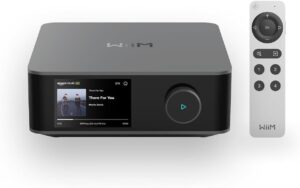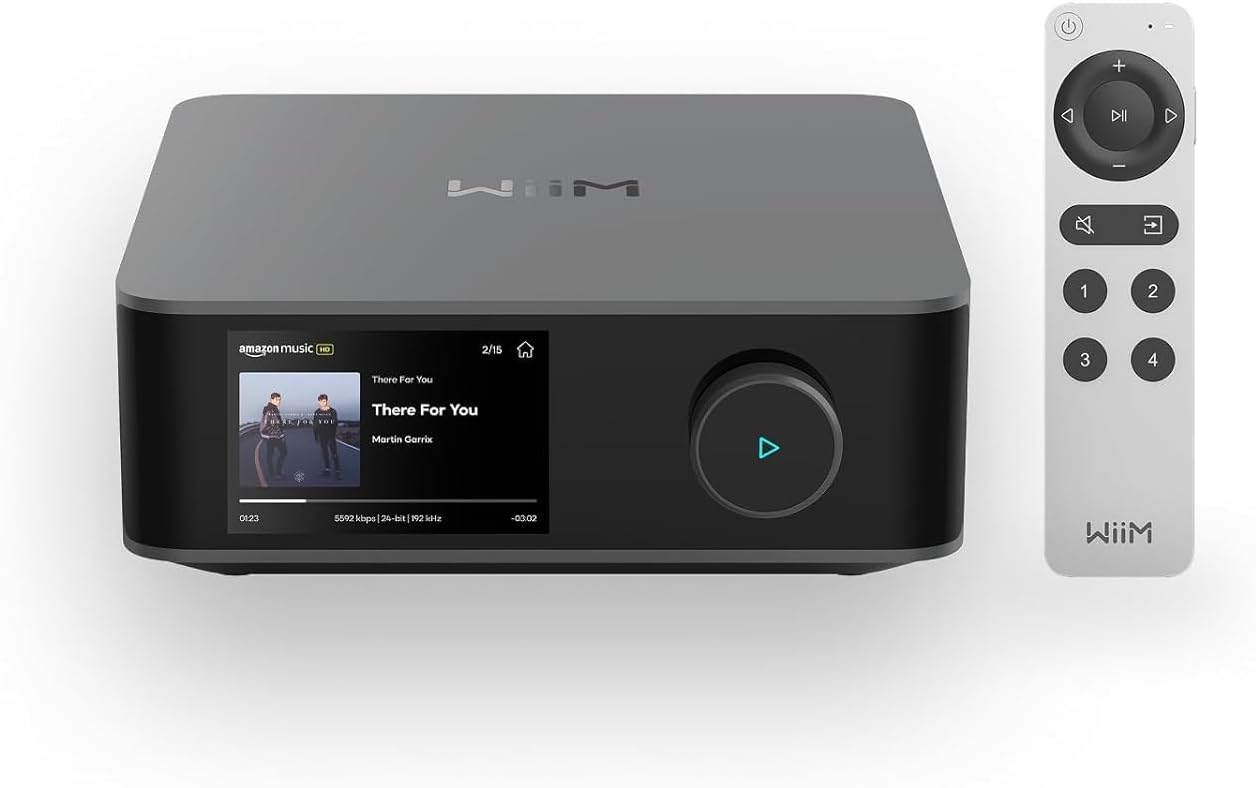
The WiiM Amp Ultra is aimed at anyone with passive speakers who wants a genuine 100W amplifier without stepping up to a full receiver. Its ESS SABRE DAC and dual TI TPA3255 amp chips deliver clarity and power headroom that What Hi-Fi and Android Central both singled out as standout for the price. A 3.5-inch touchscreen and broad streaming support — Chromecast, Spotify Connect, TIDAL Connect, and Roon Ready — round it out. The trade-off is AirPlay 2: it's missing entirely, so Apple-centric households are better served elsewhere.
Pros
- 100W per channel (200W at 4Ω) with real headroom for demanding speakers
- ESS ES9039Q2M SABRE DAC and dual TI TPA3255 amp chips for audiophile-grade clarity
- 3.5-inch touchscreen for on-unit source switching and album art
- Wi-Fi 6, Bluetooth 5.3, Roon Ready, Chromecast, and Spotify/TIDAL/Amazon Music built in
- Undercuts the similarly-powered Sonos Amp by a meaningful margin
Cons
- No AirPlay 2 support — a dealbreaker for Apple-centric households
- HDMI ARC only (not eARC) and no coaxial digital input
As an Amazon Associate I earn from qualifying purchases. Disclosure
Overview
WiiM built its name on inexpensive streaming boxes that turned any stereo into a multi-room system, and the Amp Ultra pushes that idea into full amplifier territory. At $529, it pairs a 100-watt-per-channel Class D amp with the DAC and app control WiiM’s smaller streamers are known for, aimed at anyone with a pair of passive bookshelf or floorstanding speakers and no interest in adding a separate receiver.
The jump from WiiM’s entry-level Amp Pro is in raw power and componentry: two TI TPA3255 chips instead of one, an upgraded ESS ES9039Q2M SABRE DAC, and six op-amps in the analog stage. That positions the Amp Ultra as a direct rival to the Sonos Amp, at roughly $120 less.
Key Specifications
| Amplifier | Class D, dual TI TPA3255 chips |
| Power Output | 100W/channel @ 8Ω, 200W/channel @ 4Ω |
| DAC | ESS ES9039Q2M SABRE, up to 24-bit/192kHz |
| Display | 3.5-inch glass-covered touchscreen |
| Wireless | Wi-Fi 6 (6E-upgradable), Bluetooth 5.3 with LE Audio |
| Wired Inputs | RCA line-in, optical digital in, HDMI ARC, Ethernet |
| Streaming Support | Chromecast, Spotify Connect, TIDAL Connect, Amazon Music, Roon Ready |
| Dimensions / Weight | 7.87 x 8.3 x 3 in / 5.4 lbs |
| Price (USD) | $549.00 |
WiiM Amp Ultra Sound Quality & Power
What Hi-Fi’s review of the Amp Ultra praised its clarity and its power headroom, noting the amp stayed composed even when pushed hard into demanding speaker loads — a direct result of the dual TPA3255 chips and the SABRE DAC handling the digital-to-analog conversion. The one knock in that same review was that the sound leaned toward accurate rather than exciting, a fair trade-off for an amp built around measurement-driven engineering rather than a house sound.
Part of that consistency comes from WiiM’s Post-Filter Feedback design, which continuously compensates for changes in speaker impedance rather than assuming a fixed load. Android Central’s review of the Amp Ultra called it “in a league of its own” at the price, specifically citing how evenly it drove speakers that would make cheaper Class D amps sound thin or strained.
Streaming, App & Touchscreen Control
The 3.5-inch touchscreen on top handles source switching, volume, and album art directly on the unit, which matters for anyone who doesn’t want to reach for a phone every time they change inputs. The WiiM Home app extends that control with Spotify Connect, TIDAL Connect, Amazon Music, Qobuz, and Roon Ready support, plus Chromecast and Alexa Cast for casting from whatever app is already open.
The gap both What Hi-Fi and Android Central flagged is AirPlay 2 — it’s absent, which rules the Amp Ultra out for anyone whose listening habits run through Apple’s ecosystem. For Spotify, TIDAL, or Roon-based households, the open protocol list is broad enough that the omission barely registers.
Connectivity & Multi-Room Compatibility
Wi-Fi 6 and Bluetooth 5.3 cover the wireless side, while the wired inputs are more modest: one optical digital in, no coaxial digital input, RCA line-in, and an HDMI ARC port (not eARC) for pulling audio from a TV. For a unit built primarily around streaming rather than a full home-theater hub, that’s a reasonable set — it just won’t satisfy anyone patching in older digital sources over coax.
Multi-room works through WiiM’s own ecosystem alongside Chromecast-based grouping, so pairing an Amp Ultra with other WiiM streamers around the house is straightforward. It’s not the closed, plug-and-play simplicity of Sonos’s app, but it doesn’t lock buyers into WiiM hardware exclusively the way Sonos does with its own lineup.
How Does It Stack Up Against the Competition?
Here’s how the Amp Ultra compares with the amp it most directly competes against, its own cheaper sibling, and a step-up audiophile alternative.
| Feature | WiiM Amp Ultra | WiiM Amp Pro | Sonos Amp | Cambridge Audio Evo 75 |
|---|---|---|---|---|
| Price (USD) | $549.00 | $399.00 | $799.00 | $2,250.00 |
| Power @ 8Ω | 100W/ch | 60W/ch | 125W/ch | 75W/ch |
| DAC | ESS ES9039Q2M | ESS ES9038Q2M | Built-in (undisclosed) | ESS Sabre ES9016K2M |
| Touchscreen | Yes, 3.5-inch | No | No | No |
| AirPlay 2 | No | No | Yes | Yes |
| TTP Review | This review ↑ | — | — | — |
| Amazon | View on Amazon | View on Amazon | View on Amazon | View on Amazon |
Prices change frequently — always verify current pricing before purchasing.
Is the WiiM Amp Ultra Worth It?
For anyone with a pair of passive speakers and no patience for a separate streamer-plus-receiver setup, the Amp Ultra covers more ground than its price suggests — real power, a legitimate DAC, and a touchscreen most amps at this level skip entirely. It undercuts the Sonos Amp by over $100 while offering more raw wattage and a broader set of open streaming protocols.
Households built around Apple Music and AirPlay should look at the Sonos Amp instead, since that gap doesn’t close here. Anyone chasing a genuine step up in sound quality regardless of cost has the Cambridge Audio Evo 75 to consider, and buyers who don’t need 100 watts can save $150 with WiiM’s own Amp Pro.