Buy the FridgePower if you want a fridge backup you set up once and then forget: it sits on or beside the fridge, and when testers cut the power, their fridges kept running without a flicker. Its 2,016Wh battery covers about a day or more for an efficient modern fridge, and expansion batteries stretch that to several days. The trade-off is flexibility, with just two AC outlets and no USB ports. If a power station on the floor is fine, Anker's SOLIX S2000 used less power at idle and ran more efficiently in The Solar Lab's tests.
Pros
- 10 ms switchover; test fridges kept running
- About 3 inches deep; fits on the fridge, a wall or in a cabinet
- Expands to 8,064Wh with three BlueCell 200 batteries
- Outage alerts and storm pre-charging in the app
- 5-year warranty in the US
Cons
- Only two AC outlets and no USB ports
- Fan audible while charging
- Idle draw unclear: 16.8W in one test, 5-8W in another (BLUETTI says 4W)
- Heavy (43.43 lb) to lift onto a fridge
As an Amazon Associate I earn from qualifying purchases. Disclosure
Overview
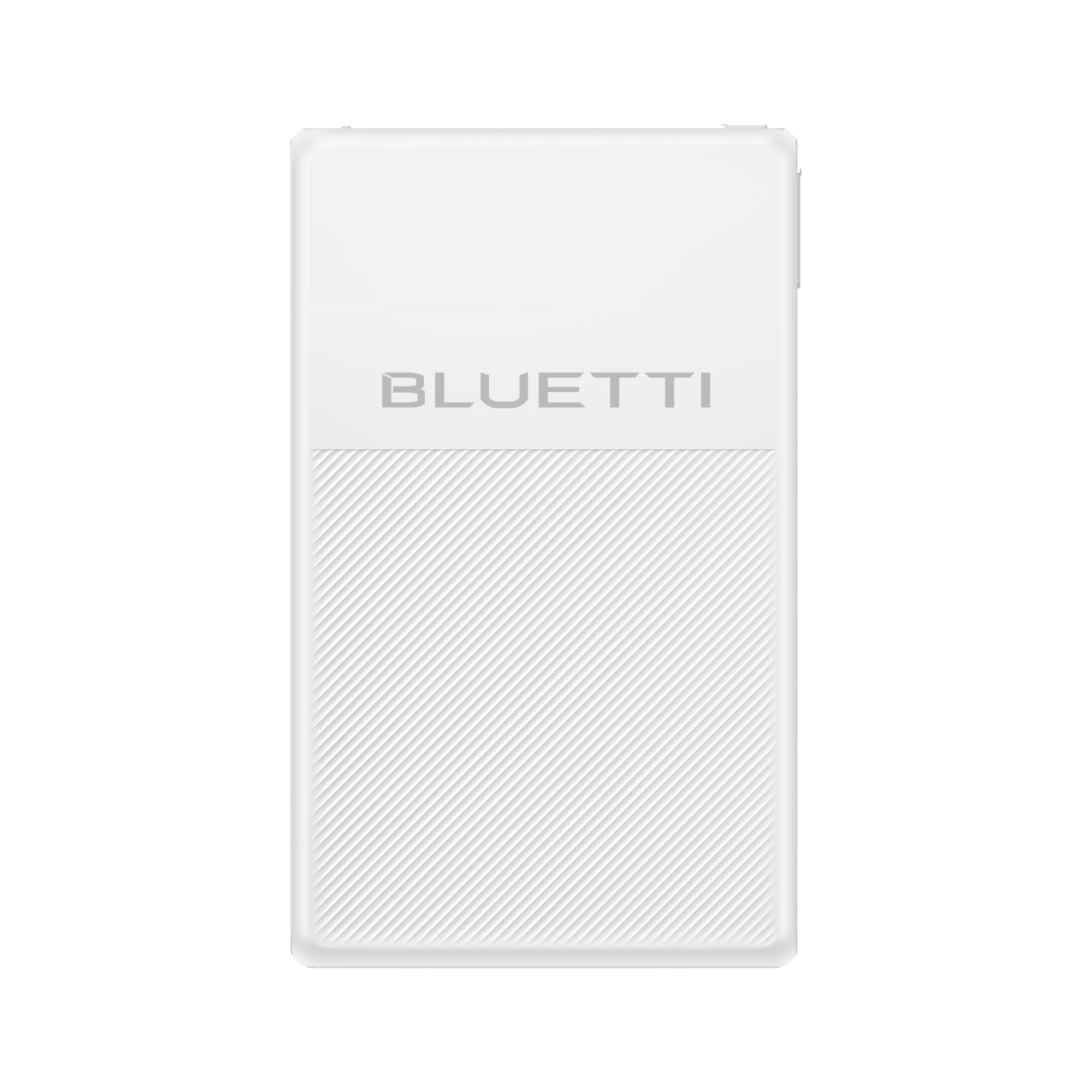
A fridge full of food is what you stand to lose in a long power cut, and most portable power stations are bulky boxes you have to haul out and plug the fridge into once the lights are already off. The BLUETTI FridgePower works the other way round: it stays plugged in between the wall and the fridge all the time, passes grid power straight through, and switches the fridge to its 2,016Wh LiFePO4 battery within 10 ms when the grid drops.
Unlike a regular portable power station, it is built around its shape and its one job. It is a flat slab about 3 inches thick that sits on top of the fridge, hangs on a wall bracket or lies in a cabinet, and BLUETTI keeps the outlet count deliberately short. In exchange you get a fridge-first feature set: outage alerts on your phone, charging ahead of forecast storms, and room to add up to three expansion batteries for 8,064Wh in total.
Key Specifications
| Price (USD) | $949.00 (last Amazon price, Oct 19, 2026) |
| Battery | 2,016Wh LiFePO4 (19.2 V, 105 Ah) |
| AC output (120 V model) | 1,800W continuous, 3,600W surge, 120 V |
| Outlets | 2 AC outlets; no USB or DC outputs |
| UPS switchover | 10 ms or less |
| AC charging (120 V model) | 1,440W max |
| Solar input | 1,000W max, 12-60 V, 20 A (XT60; cable sold separately) |
| Expansion | Up to 3 BlueCell 200 batteries, 8,064Wh max |
| Idle draw (BLUETTI’s figure) | 4W |
| Noise (BLUETTI’s figure) | 50 dB max; about 30 dB in Silent charging mode |
| Dimensions | 22.83 x 13.78 x 3.07 in (580 x 350 x 78 mm) |
| Weight | 43.43 lb (19.7 kg) |
| Charging temperature | 32°F to 104°F (0°C to 40°C) |
| Connectivity | Wi-Fi (2.4 GHz) and Bluetooth; Alexa, Google Home, Home Assistant |
| Warranty (US) | 5 years (60 months) |
BLUETTI FridgePower Fridge Backup Performance
The switchover: this is the part that has to work, and it did in all three hands-on tests that cut the power. Cutting the mains left the test fridges running without a visible flicker or a hiccup, so a fridge with a digital panel shouldn’t reset or need attention after an outage. ESS News found the fast switch also stopped its fridge from setting off its own power-loss alarm, which needs button presses to clear. When the grid is up, power passes straight through to the fridge rather than through the battery, so the cells aren’t cycled every day.
Runtime: BLUETTI’s own estimate is about 21.6 hours for a typical modern fridge, and independent tests suggest a day or a little more for an efficient one: The Solar Lab measured several home fridges at around 1,300Wh a day, which works out to roughly a day to a day and a half on this battery. Even an old, inefficient fridge-freezer should get a few hours, in Trusted Reviews’ view. A modern fridge that draws little between compressor cycles does much better; ESS News saw 20-40 W on average from its already-cold fridge, and the app then estimated 48.6 hours of backup. Each BlueCell 200 adds another 2,016Wh, so with three of them a single fridge has several days of cover.
Usable energy: Trusted Reviews drained a full charge on its UK unit at a steady 1,000W and got 1,696Wh out, and 1,558Wh at the full 1,800W, which it worked out as a best-case round-trip efficiency of 84.3%; The Solar Lab measured about 81% on a US unit. Expect roughly four-fifths of the 2,016Wh rating to reach the fridge.
Idle draw, where the tests disagree: BLUETTI quotes 4W, ESS News measured about 5W in pass-through mode and 8W in active UPS mode, and The Solar Lab measured around 16.8W. Both tests were of units sent before the product went on sale. The gap matters during a long outage, because whatever the unit uses itself comes out of the fridge’s share of the battery.
Slim Design and Placement
At 3.07 inches deep it fits where no boxy power station can: on top of the fridge, upright on the included wall bracket beside it, or flat in a cabinet. The box also has leveling feet and a handle strap. Testers who used it on top of a fridge liked how little it intruded once it was in place.
Getting it there is the hard part. It weighs 43.43 lb, and lifting it on and off a fridge is a careful, heavy job. Plan the space before adding a battery. The expansion cable fits only one way round, with the main unit on the left and the BlueCell on the right, so the battery needs room beside the FridgePower; under a kitchen peninsula, TechRadar ended up stacking the pair with the BlueCell upside down to make the cable reach. Whether stacking is fine is unclear: The Solar Lab says the expansion batteries aren’t meant to go on top of it, while the manual’s installation section gives only clearance distances and doesn’t address stacking. The Solar Lab also found the shell’s plastic thinner than on most power stations and the unit more fragile than boxier designs, which matters less for something you set up once, though Digital Reviews Network rated its build quality highly.
Noise and light: the cooling fan is audible while it charges, though TechRadar found it quieter than the fridge compressors and unobtrusive once the battery was full. Trusted Reviews heard the fan, which wasn’t loud, cycle on and off through the day even under a light load; it bothered the reviewer from across the living room, though the reviewer’s partner barely noticed it. The five green battery LEDs on the front are bright, and two testers found no working way to dim them from the app.
Outlets, Charging and Expansion
Two AC outlets and nothing else is the deliberate trade-off here: no USB port for a phone during an outage (the BlueCell 200 has one USB-C port), no DC output, and no screen beyond the LEDs, with BLUETTI’s Display 1 magnetic screen sold as an optional extra. The output itself has headroom: 1,800W continuous covers a fridge and a second load such as a freezer, a router or a sump pump, and BLUETTI says an optional Power Lifting mode lets heating appliances rated up to 3,000W, such as a hair dryer, run, though the unit still delivers only 1,800W to them.
North American units charge from the wall at up to 1,440W, a cap set by North American household circuits, and The Solar Lab timed a full charge from empty at about 1 hour and 48 minutes. Solar input goes up to 1,000W through an XT60 port, and wall plus solar together reach 2,200W, but the solar cable is sold separately and only the main unit takes solar, so expansion batteries charge through it. A full system is three BlueCell 200 batteries for 8,064Wh, the most of any unit in the table below.
App and Smart Modes
The BLUETTI app sends a push notification when the grid drops, when the battery runs low and when charging finishes, and it can watch the local forecast and fill the battery before a storm. It also works with Alexa, Google Home and Home Assistant. You can cap the charge level (ESS News set 80% to protect the cells), and the unit asks for a full maintenance cycle every three months to keep the cells balanced; BLUETTI rates them for 4,000 cycles to 80% capacity.
The time-of-use modes, which charge off-peak and run the fridge from the battery during peak hours, need care. In Trusted Reviews’ 48-hour test, its Time Control mode kept drawing around 60W from the grid even during peak hours, so it saved less than expected, and a battery drained by peak-hour use leaves less backup if an outage comes late in the day. TechRadar found the app stable and easy enough to navigate, while ESS News found it busy and in need of some trial and error to find settings. Digital Reviews Network found the manual thin on the Time Control and Custom charging settings. BLUETTI’s manual also warns that the UPS is not meant for servers or workstations that need a high-performance UPS.
How Does It Stack Up Against the Competition?
The FridgePower’s rivals are 2kWh portable power stations that can also sit on a fridge circuit with a 10 ms switchover; the measured rows come from The Solar Lab’s own review of each unit.
| Feature | BLUETTI FridgePower | Anker SOLIX S2000 | Anker SOLIX C2000 Gen 2 | EcoFlow DELTA 3 Max |
|---|---|---|---|---|
| Price (USD) | $949.00 (last Amazon price, Oct 19, 2026) | $699.99 | Deal $899.98 until Oct 28 | $899.00 |
| Capacity | 2,016Wh | 2,010Wh | 2,048Wh | 2,048Wh |
| AC output (rated / peak) | 1,800W / 3,600W | 1,500W / 3,000W | 2,400W / 4,000W | 2,400W / 4,800W |
| UPS switchover | 10 ms | 10 ms | 10 ms | 10 ms |
| Efficiency (The Solar Lab test) | 81% | 91% | 89% | 79% |
| Idle draw, AC on (The Solar Lab test) | 16.8W | 6W | 18W | 27W |
| Full wall recharge (The Solar Lab test) | About 1 hr 48 min | About 1 hr 47 min | About 88 min | 68 min |
| AC outlets | 2 (no USB) | 5 | 5, plus a TT-30 RV outlet | 4 |
| Max capacity with expansion | 8,064Wh | Not expandable | Up to 4kWh | Not expandable |
| Size | 22.83 x 13.78 x 3.07 in | 8.2 x 11.1 x 12.7 in | 18.1 x 9.8 x 10.1 in | 19.4 x 9.4 x 12.0 in |
| Weight | 43.43 lb | 35.7 lb | 41.7 lb | 44.8 lb |
| Warranty (US) | 5 years | 5 years | 5 years | Up to 5 years (3 standard + 2 with app registration) |
| Amazon | View on Amazon | View on Amazon | View on Amazon | View on Amazon |
Prices change frequently — always verify current pricing before purchasing.
BLUETTI FridgePower: Worth It for Hands-Off Fridge Backup
Buy the FridgePower if the point is to install a fridge backup once and stop thinking about it. It can live on top of the fridge or on the wall beside it, where a 2kWh power station would otherwise sit on the floor with a cord across the kitchen, and it is the only unit in the table that grows past 4kWh, to 8,064Wh with three BlueCell 200 batteries, for areas where outages run for days. It also suits renters, since it needs no electrician or rewiring.
If a box on the floor is fine, look at the Anker SOLIX S2000 first: it sold for $679.99 on Amazon in October 2026 against the FridgePower’s usual $899 that month, and in The Solar Lab’s tests it was more efficient and used about a third of the power at idle, which means more of the battery goes to the fridge. If you also want one box for camping, phones and power tools, the Anker SOLIX C2000 Gen 2 is the better all-rounder, with five AC outlets, USB ports and an RV outlet; it is the alternative Trusted Reviews would choose where space allows.

Sources
- BLUETTI — FridgePower Official Product Page
- BLUETTI — FridgePower User Manual V2.0 (Specifications)
- BLUETTI — Product Warranty Period
- BLUETTI FridgePower — Amazon Product Listing
- TechRadar — BLUETTI FridgePower review
- Trusted Reviews — Bluetti FridgePower Review
- ESS News — Bluetti FridgePower review
- The Solar Lab — Bluetti FridgePower Review
- Digital Reviews Network — Bluetti FridgePower review
- Anker — SOLIX S2000 Product Page
- The Solar Lab — Anker SOLIX S2000 Review
- Anker — SOLIX C2000 Gen 2 Product Page
- Anker — SOLIX C2000 Gen 2 Overview
- The Solar Lab — Anker SOLIX C2000 Gen 2 Review
- EcoFlow — DELTA 3 Max Product Page and Specs
- The Solar Lab — EcoFlow DELTA 3 Max Review
Reader Poll
Besides the fridge, what would you plug into a FridgePower during an outage?
Help Our Editors Know What Matters to You
Explore on Amazon →