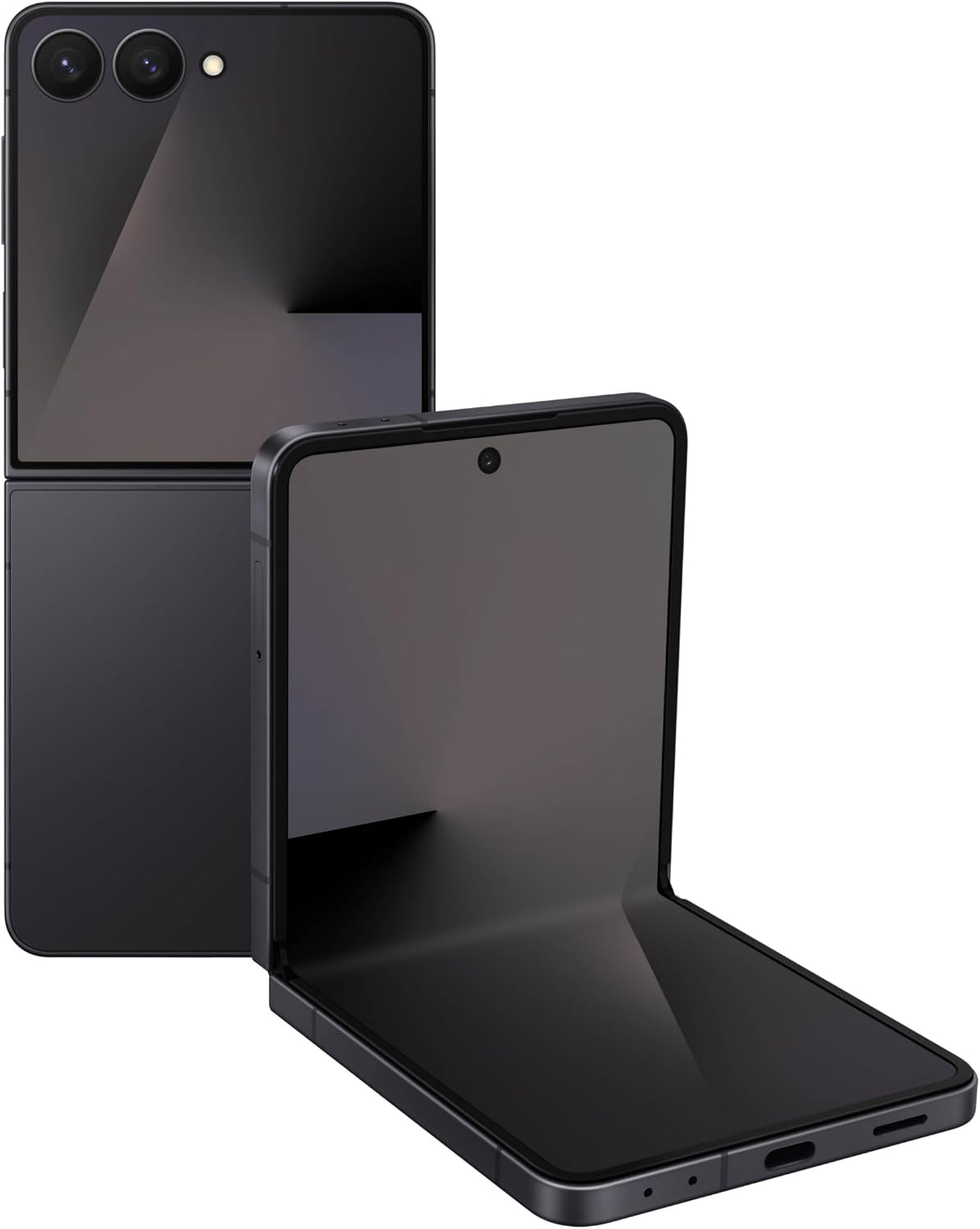
The Galaxy Z Flip7 is worth buying when it costs clearly less than the Flip8: it folds to a pocket-sized square, its edge-to-edge 4.1-inch cover screen handles messages and camera framing without opening it, and Samsung backs it with seven years of updates. Its battery life trails Motorola's Razr Ultra and charging is slow, which matters most to heavy users. At Amazon's October 2026 prices, the faster Flip8 is the better buy.
Pros
- Edge-to-edge 4.1-inch cover screen
- Thin, light and solidly built
- Detailed 50MP main camera with hands-free shooting modes
- Feature-rich One UI with Samsung DeX
- Seven years of OS and security updates
Cons
- Battery life trails the Razr Ultra, and charging is slow
- No telephoto camera
- Cover screen needs an add-on for most apps
- IP48 rating isn't sealed against fine dust
As an Amazon Associate I earn from qualifying purchases. Disclosure
Overview
Samsung’s Galaxy Z Flip7 folds a 6.9-inch phone in half, and it is the Flip where Samsung finally ran the cover screen edge to edge across the whole top half. Closed, that 4.1-inch screen is big enough to answer messages, check a map or frame a selfie with the main camera; open, the 21:9 shape feels like an ordinary phone. It went on sale in July 2025, and Samsung still lists it on its US store.
Its successor is what changed the buying decision. The Galaxy Z Flip8 went on sale in August 2026 with the same screen sizes, cameras and 4,300 mAh battery, adding a much faster Snapdragon chip and a slightly thinner and lighter body. That makes the Flip7 a very similar phone whose value depends on how far below the Flip8 it sells.
Key Specifications
| Price (USD) | $1,299.99 (Nov 9) |
| Main display | 6.9-inch Dynamic AMOLED 2X, 2520 x 1080, 1-120Hz |
| Cover display | 4.1-inch Super AMOLED, 948 x 1048, 120Hz |
| Size folded | 75.2 x 85.5 x 13.7 mm |
| Size unfolded | 75.2 x 166.7 x 6.5 mm |
| Weight | 188 g |
| Processor | Samsung Exynos 2500 |
| Memory and storage | 12GB RAM with 256GB or 512GB |
| Rear cameras | 50MP main (f/1.8), 12MP ultrawide (f/2.2) |
| Selfie camera | 10MP (f/2.2) |
| Battery | 4,300 mAh |
| Charging | 25W wired, 15W wireless, 4.5W reverse wireless |
| Water and dust rating | IP48 |
| Software | Ships with Android 16 and One UI 8; seven years of OS and security updates |
Samsung Galaxy Z Flip7 Design and Build
Slimness is the Flip7’s strongest suit. It measures 6.5 mm open and 13.7 mm closed, thinner both ways than the Flip6, and weighs 188 g. It also grew a little wider to fit the 21:9 main screen, which makes it feel more like a regular phone when open. The Armor Aluminum frame and Gorilla Glass Victus 2 on the front and back feel solid in the hand, and the hinge holds at a wide range of angles, so you can stand the phone on a table for hands-free photos and video from across the room.
A few habits come with that slim build. With so little room between the two halves, it is awkward to open one-handed. The crease is still visible at some angles, particularly under direct light, though it rarely registers in daily use. And two reviewers picked up scuffs on the back glass within their first week, so a case is worth buying on day one.
Water protection is solid, rated for submersion in up to 1.5 m (5 feet) of fresh water for 30 minutes. Dust protection is not: the IP48 rating only covers solid particles larger than 1 mm, so the phone isn’t sealed against fine dust.
Cover Screen and Main Display
The 4.1-inch cover screen is the main reason to choose this Flip. It wraps around the cameras with very thin bezels and refreshes at up to 120Hz, where the Flip6’s 3.4-inch cover panel was stuck at 60Hz. Replying to messages, reading notifications and framing selfies with the main cameras all work without opening the phone.
The software holds it back. Out of the box only a handful of apps, such as Maps, YouTube, Netflix and Messages, run on the cover screen alongside Samsung’s widgets; for anything else you need the MultiStar module from Samsung’s Good Lock suite, and TechRadar found the switch to enable apps on the cover tucked away in a Labs menu. On a Motorola Razr, by contrast, TechRadar notes that an open app simply carries on to the cover screen when you close the phone.
Inside, the 6.9-inch main screen is sharp, though testers differ on brightness. Tom’s Guide measured a 1,989-nit peak; GSMArena recorded a little under 1,500 nits with adaptive brightness on, the same as the Flip6 in its test; and What Hi-Fi found it quite dim for films even with extra brightness enabled. Samsung rates the Flip7 and Flip8 screens at the same 2,600-nit peak, but Tom’s Guide measured the Flip8 brighter, at 2,150 nits. The main screen supports HDR10+ but not Dolby Vision.
Cameras
The camera hardware carries over from the Flip6: a 50MP main camera and a 12MP ultrawide, with no telephoto. In daylight the main camera takes detailed photos with natural colour, and GSMArena found its 2x crop solid enough for portraits and close-ups.
What sets the Flip7 apart is how you shoot. You can frame selfies on the cover screen using the main camera, prop the half-open phone on a table as its own tripod, and use Pro Video controls with Log recording. Those flex modes are part of why Tom’s Guide calls it the best camera phone for creators.
The weak spots are reach and the ultrawide in the dark. Without a telephoto, distant subjects lose detail quickly, which TechRadar’s reviewer noticed when trying to photograph a child playing sports. The ultrawide has no autofocus, so close subjects come out soft, and GSMArena found its night shots can look mushy in darker areas when viewed at full size; the main camera holds good detail in low light. Video reaches 4K at 60fps on all three cameras, though GSMArena found electronic stabilization works only up to 4K at 30fps. Reviewers split on the Motorola comparison: BGR found the 2025 Razr Ultra’s photos brighter and a bit more detailed, while Tom’s Guide found the Flip7 ahead in its shootouts, particularly at 10x zoom.
Battery Life and Charging
Battery is the Flip7’s main weakness, even though it improved on the Flip6. The 4,300 mAh cell lasted 12 hours and 24 minutes in Tom’s Guide’s web-surfing test, up from 11 hours and 1 minute for the Flip6 but short of the 15 hours and 42 minutes it recorded for the 2025 Razr Ultra. GSMArena measured about three hours more video and web-browsing time than the Flip6, for an Active Use Score of 11:52h.
Most reviewers got through a full day comfortably with moderate use, but heavy days left less margin: TechRadar needed a top-up before bed on camera-testing days, and Tom’s Guide’s phone usually slipped into power-saving mode around bedtime.
Charging is slow. The 25W wired charging reached 46% in 30 minutes in GSMArena’s test, which took 91 minutes to fill the battery; Tom’s Guide’s test reached 55% in the same time. Wireless charging tops out at 15W. There are no magnets built in for Qi2 accessories, so magnetic chargers and accessories need a case with a magnetic ring. The Flip8 keeps the same battery capacity and 25W charging, and it lasted under half an hour longer in Tom’s Guide’s test.
Performance and Software
The Exynos 2500, Samsung’s own chip, handles everyday use and games without stutter but trails Snapdragon-powered rivals. Tom’s Guide’s Geekbench 6 scores of 2,286 single-core and 8,079 multi-core sat behind the 2025 Razr Ultra’s. In TechRadar’s lab tests, it lost every benchmark to the Galaxy S25’s Snapdragon 8 Elite. It also throttles under long, heavy loads, with a 46% stability rating in GSMArena’s CPU throttling test, though that beat both the Flip6 and the 2025 Razr Ultra in the same test. The Flip8’s Snapdragon 8 Elite Gen 5 is its biggest upgrade, with a multi-core Geekbench 6 score of 11,215 in Tom’s Guide’s test.
Software is the Flip7’s other strength. One UI 8 on Android 16 is among the most feature-rich versions of Android, with split-screen multitasking, Gemini Live and, new to the Flip line, Samsung DeX for a desktop-style view on an external monitor. Samsung promises seven years of OS upgrades and security updates. The cost is complexity: TechRadar found features hidden behind extra steps and the Galaxy AI tools not fully baked.
How Does It Stack Up Against the Competition?
The Galaxy Z Flip8 is the obvious comparison now that it has replaced the Flip7. TechRadar suggested two alternatives at launch, Motorola’s Razr Ultra and the non-folding Galaxy S25 Plus, which the Galaxy S26+ has since succeeded; the Razr Ultra is covered in the text.
| Feature | Samsung Galaxy Z Flip7 | Samsung Galaxy Z Flip8 | Samsung Galaxy S26+ |
|---|---|---|---|
| Price (USD) | $1,299.99 (512GB) (Nov 9) | $1,249.99 (512GB) | $949.99 (256GB) |
| Main screen | 6.9-inch, folding | 6.9-inch, folding | 6.7-inch (not a foldable) |
| Cover screen | 4.1-inch | 4.1-inch | None |
| Weight | 188 g | 180 g | 190 g |
| Battery capacity | 4,300 mAh | 4,300 mAh | 4,900 mAh |
| Rear cameras | 50MP wide, 12MP ultrawide | 50MP wide, 12MP ultrawide | 50MP wide, 12MP ultrawide, 10MP 3x telephoto |
| Processor | Exynos 2500 | Snapdragon 8 Elite Gen 5 for Galaxy | Exynos 2600 |
| Water and dust rating | IP48 | IP48 | IP68 |
| TTP Review | This review ↑ | Read our review → | — |
| Amazon | View on Amazon | View on Amazon | View on Amazon |
Prices change frequently — always verify current pricing before purchasing.
Samsung Galaxy Z Flip7: Worth It for Its Cover Screen and Slim Build
The Flip7 suits someone who wants a phone that closes to a pocket-sized square yet still handles quick jobs from the outside: messages, maps and camera framing. The Flip8 does the same jobs with the same screen sizes, cameras and battery capacity, so the Flip7 is a sensible buy whenever it costs clearly less than its successor. If you already own one, the newer phone adds little beyond speed and a slightly lighter body; Tom’s Guide’s verdict calls the Flip8 “merely iterative” and hard to justify as an upgrade.
At Amazon’s October 2026 prices, though, the Flip8 is the better buy: its 512GB model was $1,249.99 on Amazon in October 2026, against $1,299.99 for the 512GB Flip7 at its last regular Amazon price (October 13, 2026), and it adds the faster chip. If battery life matters most, Motorola’s Razr Ultra 2026 posted a 16:20 (hours:minutes) runtime in Tom’s Guide’s battery test, ahead of both Samsung flips, though it cost $1,499.99 on Amazon in October 2026. And if you don’t need a folding phone, the Galaxy S26+ adds a 3x telephoto, a 4,900 mAh battery and IP68 dust and water protection for $1,198.99 (256GB) on Amazon in October 2026.
Sources
- Samsung — Galaxy Z Flip7 product page
- Samsung — Galaxy Z Flip8 product page
- Samsung — Galaxy S26 and S26+ product page
- Samsung Galaxy Z Flip7 — Amazon Product Listing
- GSMArena — Samsung Galaxy Z Flip7 review: design
- GSMArena — Samsung Galaxy Z Flip7 review: lab tests
- GSMArena — Samsung Galaxy Z Flip7 review: software and performance
- GSMArena — Samsung Galaxy Z Flip7 review: camera
- GSMArena — Samsung Galaxy Z Flip7 review: verdict
- Tom’s Guide — Samsung Galaxy Z Flip 7 review
- Tom’s Guide — I lived with the Galaxy Z Flip 7 for 8 months
- Tom’s Guide — Samsung Galaxy Z Flip 8 review
- TechRadar — Samsung Galaxy Z Flip 7 review
- BGR — Samsung Galaxy Z Flip 7 review
- 91mobiles — Samsung Galaxy Z Flip7 review
- What Hi-Fi? — Samsung Galaxy Z Flip 7 review
- Android Central — Samsung Galaxy Z Flip 8 vs. Galaxy Z Flip 7
- iGeeksBlog — Samsung Galaxy Z Flip8 vs. Galaxy Z Flip7
- MySmartPrice — Samsung Galaxy Z Flip8 vs Galaxy Z Flip7
Reader Poll
What would make you choose a flip phone over a regular one?
Help Our Editors Know What Matters to You
Explore on Amazon →