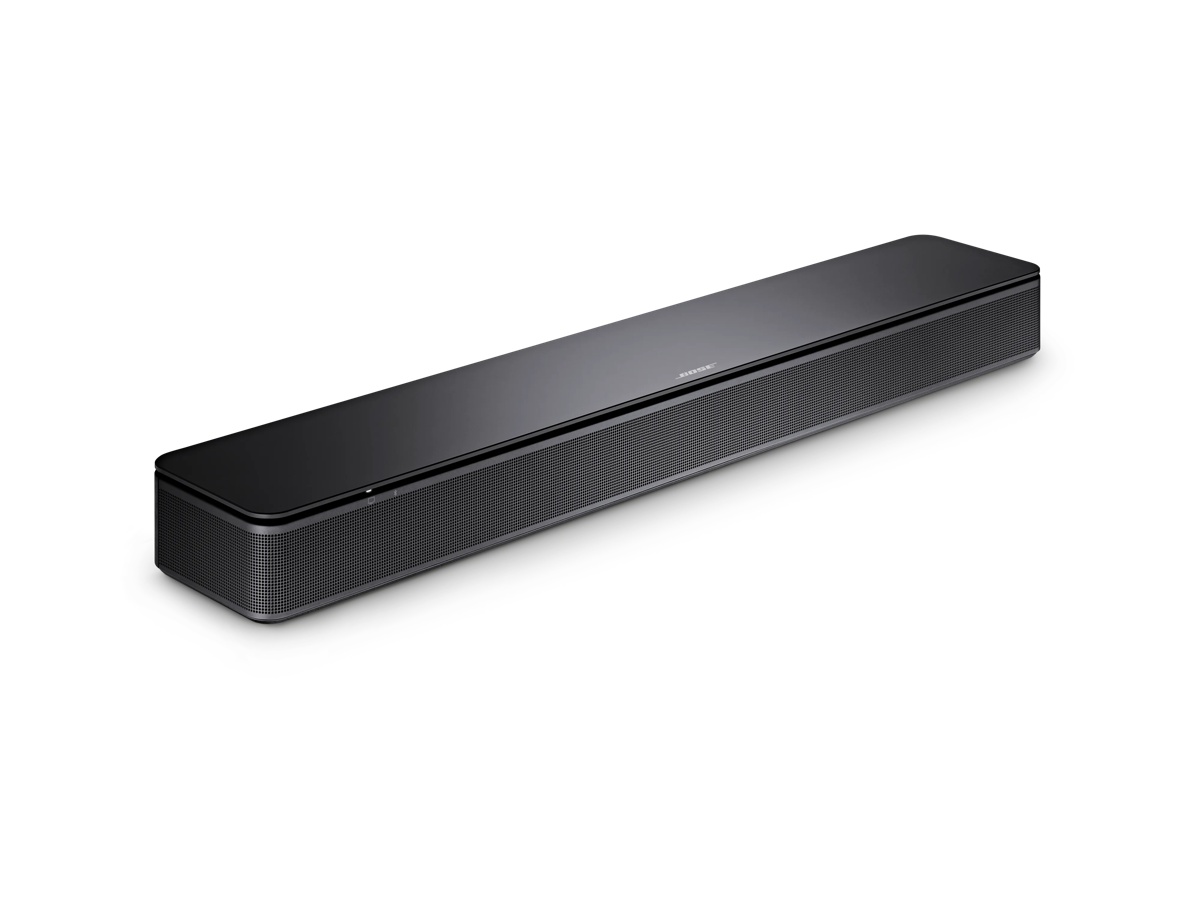
Buy the Bose TV Speaker if your TV buries dialogue in a bedroom, den or smaller living room and you want a fix that takes one cable and no app: Dialogue mode makes voices easier to follow, and most testers found more bass than a 23-inch bar suggests. The trade-offs are how little you can adjust, since bass is the only tone control and there is no Dolby Atmos, and a regular price testers call steep, so it's best bought on sale; at full price the Sonos Ray and JBL Bar 300MK2 offer more features. Bose's TV Speaker (2nd Gen) keeps the same simple formula with an HDMI cable in the box, so if the two cost about the same, take the newer one.
Pros
- Dialogue mode makes voices easier to follow
- Most testers found more bass than its size suggests
- One-cable setup over HDMI ARC or optical
- Your TV remote runs it over HDMI-CEC
- Adds a Bose Bass Module by wire
Cons
- Bass is the only tone control: no app or EQ
- Pricey for what it does at its regular price
- No Dolby Atmos, and no HDMI cable in the box
- Can sound strained at high volume in big rooms
As an Amazon Associate I earn from qualifying purchases. Disclosure
Overview
The Bose TV Speaker has one job: making the voices on your TV easier to follow. Bose launched it in 2020 as a compact 23-inch bar, with a pair of angled full-range drivers, a center tweeter between them and a Dialogue mode button on the remote, and it connects to your TV with a single cable. That focus is the point, because flat TVs can bury dialogue under the music and effects.
Its appeal is how little it asks of you. There is no app, no Wi-Fi setup and no menu to learn: plug it in, and your TV remote can run it over HDMI. That simplicity is also its limit, and in 2026 Bose added a second option, the TV Speaker (2nd Gen), while keeping this original on sale. So this review covers what the original does well, where it falls short, and when it still makes more sense than its successor.
Key Specifications
| Price (USD) | Deal $199.00 until Dec 16 |
| Drivers | Two angled full-range drivers plus a center tweeter |
| Dimensions | 23.38 x 2.21 x 4.02 in (W x H x D) |
| Weight | 4.34 lb |
| TV connections | HDMI ARC (with HDMI-CEC), optical, 3.5 mm analog input |
| In the box | Soundbar, remote with battery, optical cable, power cord (no HDMI cable) |
| Wireless | Bluetooth 4.2, range up to 30 ft |
| App / Wi-Fi | None |
| Sound controls | Bass level and Dialogue mode on the remote |
| Expansion | Wired Bose Bass Module 500 or 700 (cable sold separately); no surround speakers |
| Warranty | 1-year Bose limited warranty |
Bose TV Speaker Dialogue and TV Sound
Voices are where this bar earns its place. Its mids are smooth and even, which is the range speech lives in, so dialogue sits clearly in front of the TV’s own speakers before you touch a single setting. The angled drivers also give a wider spread than a TV’s built-in speakers, though nothing here is surround: the drivers fire forward, and there is no virtual surround mode to fake height or rear effects. Reviewed found it held every line of dialogue clearly even at low volume, where its tester’s own TV speakers had left them riding the volume button between scenes. TechRadar was more reserved: speech came through clearer than a small TV manages, but in busy action scenes it found dialogue wasn’t always well separated from the effects.
Dialogue mode is the one sound mode it offers. Bose says it analyzes what you’re watching, separates the voices from the rest of the soundtrack and raises them, and you can set it to stay on rather than re-enabling it each time. Testers disagree on how far to lean on it. Digital Trends found it delivered cleaner, more intelligible speech without the harsh, brittle sound some dialogue modes produce. TechRadar found it helped in those busy scenes, but left movies sounding less balanced, and saw it as more useful for podcasts than for a film night. A fair reading: leave it on for news, talk shows and quiet dramas, and try it both ways for movies.
Bass, Volume and Music
For a bar this size, the low end is the surprise. There is no built-in subwoofer, yet it produces more bass than its slim 2-inch-tall cabinet suggests. In RTINGS’ comparison, it also reaches deeper bass than the Sonos Ray. Soundbarfindr’s frequency-response measurement was the exception: like many bars this size, it found the TV Speaker short of low bass. None of the testers got the floor-shaking rumble of a bar with a dedicated subwoofer. The bass button splits opinion: Digital Trends got plenty of low end with it turned all the way up, while Soundbarfindr found its five steps made little real difference to that shortfall.
How loud it goes is the other split. Digital Trends found it could fill even a big room with virtually no distortion, while RTINGS found it doesn’t get very loud and may not suit large or crowded rooms. Other testers also found it loud for its size, though some heard compression and distortion near the top of its range. The safe conclusion is the one most of them share: it is at its best in bedrooms, dens and smaller living rooms.
Music divides testers. Digital Trends found streaming over Bluetooth sounded very good. Reviewed went further, finding that the full-range drivers came into their own with music, with vocals full of detail even if the bass never pounds. TechRadar was less impressed: a track it played lacked cohesion, and the bass boost turned boomy on music. Soundbarfindr, for its part, missed the low bass that EDM needs.
Setup, Connections and Controls
Setup takes one cable. Bose includes an optical cable; HDMI ARC needs a cable you supply, which several reviewers found an odd omission for a product sold on simplicity. HDMI ARC’s advantage is control: HDMI-CEC lets your TV remote turn the bar on and off and set its volume. Digital Trends points out the cost: the bar has no HDMI input of its own, so it takes up one of the TV’s HDMI ports while carrying no audio format the optical link can’t, and Digital Trends suggests you may be better off with optical if you can. Reviewed prefers HDMI ARC for the TV-remote control. On optical, you use the small included remote, or teach the bar the volume and mute buttons of the remote you already own.
The trade-off for that simplicity is control. There are no buttons on the bar itself and no app, so everything runs through the remote’s volume, mute, bass, Bluetooth, TV input and Dialogue buttons. Bass is the only tone control, with no treble or EQ adjustment and none of the ADAPTiQ room calibration found on higher-end Bose bars such as the Smart Ultra Soundbar. Reviewed missed separate sound settings for music, movies and sports, while Digital Trends found the default tuning balanced enough that it doubted it would use more controls anyway. If you just want TV voices clearer, you may never miss them.
Bluetooth 4.2 handles music from a phone or tablet at up to 30 feet, and the bar can join a Bose smart speaker or soundbar through Bose’s SimpleSync. Unlike Bose’s smart soundbars, it can’t pair with Bose wireless headphones for private late-night listening. For more bass later, it connects by wire to Bose’s Bass Module 500 or 700, but it doesn’t support surround speakers. Wall mounting needs Bose’s separate bracket, and the bar carries Bose’s 1-year limited warranty.
Bose TV Speaker or the New 2nd Gen?
Bose launched the TV Speaker (2nd Gen) in 2026 and still sells this original model. The new one keeps the same basic formula: a compact bar of nearly identical size, angled left and right speakers with a center tweeter Bose describes as dedicated to speech, Dialogue mode, HDMI ARC, optical and Bluetooth. The visible changes are softer, rounded edges and an HDMI cable in the box instead of an optical one. Bose also claims improved acoustic performance and clarity, but we found no independent test of the 2nd Gen yet, so treat that as the maker’s claim until reviewers compare the two.
That makes the choice mostly about price. On October 6, 2026, a limited-time Amazon deal had the original at $199.00, the same price a third-party seller was asking for the 2nd Gen that day, while the original’s regular Amazon price in October 2026 was $279.00. Whenever the two cost about the same, the 2nd Gen is the easier pick: it is newer, adds Bluetooth 5.1 and includes the HDMI cable most buyers will want. The original makes sense when it costs clearly less than the 2nd Gen, since the core of what makes either one useful, clearer voices from one cable, is already here.
How Does It Stack Up Against the Competition?
The TV Speaker’s closest rivals take different routes: Bose’s own successor keeps the simple formula, the Sonos Ray swaps HDMI and Bluetooth for Wi-Fi and an app, and the much wider JBL Bar 300MK2 adds Dolby Atmos and an HDMI input.
| Feature | Bose TV Speaker | Bose TV Speaker (2nd Gen) | Sonos Ray | JBL Bar 300MK2 |
|---|---|---|---|---|
| Price (USD) | Deal $199.00 until Dec 16 | $254.99 | $219.00 (Oct 13) | $449.95 |
| Drivers | 2 angled full-range + center tweeter | 2 angled speakers + center tweeter | 2 tweeters + 2 midwoofers | 5 racetrack drivers + 4 tweeters (5.0) |
| Dolby Atmos | No | No (Bose lists Dolby Digital only) | No | Yes, plus DTS Virtual:X |
| TV connection | HDMI ARC or optical | HDMI ARC or optical | Optical only | HDMI eARC (plus 1 HDMI input) or optical |
| Cable in the box | Optical | HDMI | Optical | HDMI |
| App and Wi-Fi | No | No | Yes (Sonos app, AirPlay 2) | Yes (JBL One app) |
| Bluetooth | Yes (4.2) | Yes (5.1) | No | Yes (5.3) |
| Width | 23.38 in | 23.465 in | 21.93 in | 37 in |
| Weight | 4.34 lb | 4.409 lb | 4.19 lb | 6.5 lb |
| Amazon | View on Amazon | View on Amazon | View on Amazon | View on Amazon |
Prices change frequently — always verify current pricing before purchasing.
Bose TV Speaker: Worth It for Clearer Dialogue in Small Rooms
The TV Speaker is the right buy for a bedroom TV, a den or a small living room where you keep reaching for the volume button to catch what people are saying. Its low profile keeps it from blocking the bottom of the screen, it works with the remote you already use, and asks nothing of you after the first cable. It’s an easy upgrade for anyone who’d rather not deal with an app or a Wi-Fi password. Reviewers broadly agree it is pricey for how little it adds beyond that, and TechRadar’s verdict was that it “falls a little flat in the value department”, so it is easiest to justify on sale, or when it costs clearly less than the 2nd Gen.
At its regular price, the rivals deserve a look. The Sonos Ray is the closest alternative for the same buyer: What Hi-Fi? calls it one of the best budget soundbars, particularly if clear dialogue is your priority, and it adds Wi-Fi streaming, AirPlay 2 and app-based tuning, but it needs an optical port and gives up HDMI and Bluetooth. If you want a bigger sound with height effects, the JBL Bar 300MK2 brings Dolby Atmos, an HDMI input for a streaming box or console and an app with an equalizer, and What Hi-Fi? found its sound weighty and room-filling, though at 37 inches wide it needs far more space.
Sources
- Bose — TV Speaker Official Product Page and Specifications
- Bose — TV Speaker (2nd Gen) Official Product Page
- Bose TV Speaker — Amazon Product Listing
- Reviewed — Bose TV Speaker Review: Soundbar, simplified
- Digital Trends — Bose TV Speaker Review
- TechRadar — I tried this Amazon best-selling soundbar from Bose
- RTINGS — Bose TV Speaker Review
- Soundbarfindr — Bose TV Speaker in review
- What Hi-Fi? — Which Bose soundbar should you buy?
- The Gadgeteer — Bose TV Speaker (2nd Gen)
- Gear Patrol — Bose Quietly Upgraded Its Affordable Soundbar
- Sonos — Ray Official Product Page
- What Hi-Fi? — Sonos Ray Review
- Bose — TV Speaker (2nd Gen) Product Specifications
- What Hi-Fi? — JBL Bar 300MK2 Review
- JBL — Bar 300MK2 Spec Sheet
Reader Poll
What would you most want from a small TV soundbar?
Help Our Editors Know What Matters to You
Explore on Amazon →