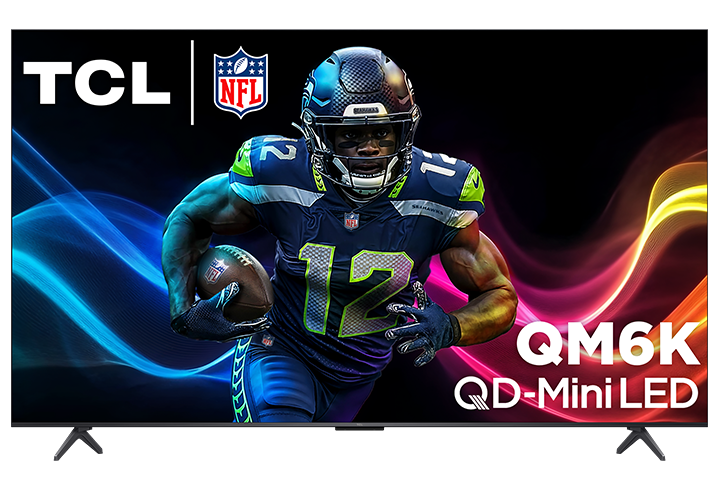
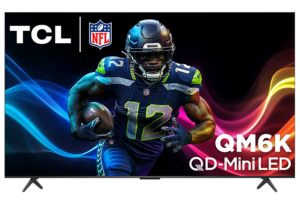
The TCL QM6K is for buyers leaving a basic LED set who want mini-LED contrast and Google TV without paying for a 2026 step-up model, provided they can find one in Canada at or under its Canadian launch price. TechRadar found its Halo Control keeps blooming around bright objects to a minimum, and HDR support covers Dolby Vision IQ and HDR10+. The trade-offs are some glare in bright rooms, built-in sound that calls for a soundbar, and input lag that trails faster rivals.
Pros
- Halo Control keeps blooming low
- 144Hz panel with FreeSync Premium Pro
- Dolby Vision IQ and HDR10+ support
- Accurate color in Filmmaker mode
- Google TV is easy to use
Cons
- Reflections in bright rooms
- Input lag trails faster rivals
- Thin bass and boxy built-in sound
- Hard to find in stock in Canada
As an Amazon Associate I earn from qualifying purchases. Disclosure
Overview
The TCL QM6K went up for pre-order in Canada in April 2025, when the 65-inch model was priced at $1,099 CAD. What you get is a 4K QD-Mini LED TV: an LCD panel lit by a dense grid of small LEDs that dim in zones, with quantum-dot color, a 144Hz panel and Google TV built in. It makes the most sense for someone replacing a basic LED set who wants better contrast and real HDR without paying flagship money.
The catch in Canada is stock. On October 1, 2026, the 65-inch QM6K’s Amazon.ca listing showed it as currently unavailable, and TCL Canada’s own store listed it as sold out, so this review judges it against that launch price. If you can find one, the case for it is Halo Control, TCL’s set of LED-chip, lens and dimming-algorithm changes meant to stop bright objects from glowing into the dark areas around them. After a month with the 65-inch set, TechRadar reported that it works as advertised and rated the QM6K better at suppressing blooming than other budget mini-LED TVs.
Key Specifications
| Price (CAD) | $1,099 (65") |
| Model | 65QM6K |
| Viewable Screen Size | 64.6 inches |
| Backlight | QD-Mini LED with quantum-dot (QLED) color |
| Local Dimming | Up to 500 zones (TCL’s figure for the series) |
| Resolution | 4K UHD (3840 x 2160) |
| Refresh Rate | 144Hz panel; VRR up to 144Hz |
| HDR Formats | Dolby Vision, Dolby Vision IQ, HDR10, HDR10+, HLG |
| Speakers | Onkyo 2.1, 40W (2 x 10W + 20W) |
| Smart Platform | Google TV |
| HDMI | 4 ports (two HDMI 2.1; one eARC) |
| Wi-Fi | Wi-Fi 5 (802.11ac) |
| Wall Mount | VESA 300 x 300 |
| Warranty | 1-year limited |
TCL QM6K Picture Quality and Brightness
Contrast is where this set earns its keep. In TechRadar’s testing, the backlight shut down far enough in dark areas that black looked genuinely black, where a cheaper LED TV might show a dark gray, and Halo Control kept bright objects from spilling into dark backgrounds. HDR is a strength too, with support for Dolby Vision, Dolby Vision IQ, HDR10+, HDR10 and HLG. Dolby Vision IQ tunes the picture to the light level in the room, which TechRadar appreciated in its brightly lit setup.
Brightness is where the two main reviews part ways. TechRadar’s benchmarks put HDR peak brightness at 559.8 nits in Filmmaker mode and 695.5 nits in Standard mode, and called that “about average for a budget mini-LED TV.” Tom’s Guide, testing the 55-inch model, measured 688 nits in SDR and rated it brighter than most TVs at its price, though it found HDR only modestly brighter than SDR. It isn’t too dim for everyday viewing, but glare and reflections do show up in bright light, and Tom’s Guide notes that only the 85-inch and larger sizes get a matte anti-glare finish. At 65 inches, where the set faces matters.
Color is accurate if you choose the right mode. Tom’s Guide was most impressed in Filmmaker mode, and it fell back on Movie mode when Filmmaker wasn’t offered, after other presets turned a sports field an unnatural green. TechRadar measured 94.7% coverage of the UHDA-P3 color space and 71.2% of BT.2020, average results by its standards, while describing colors in real viewing as clear and vibrant. Besides brightness, its other picture complaint was slight vignetting, a darkening in the screen’s corners that it couldn’t see head-on but could from a little off to the side.
Gaming and Motion
TCL rates the panel at a native 144Hz (TechRadar’s review describes it as 120Hz native with VRR up to 144Hz), and two of the four HDMI ports are HDMI 2.1 with 4K 144Hz support. Tom’s Guide notes the other two are HDMI 2.0 and top out at 60Hz, so only two devices get the fast inputs. The set adds AMD FreeSync Premium Pro, an automatic game mode (ALLM) and a Game Accelerator mode that raises the refresh rate further at 1080p. TechRadar liked that the TV switched into game mode as soon as its PS5 powered on, and used the Game Master overlay to change settings without leaving a game.
Input lag is the weak spot. TechRadar reports 13.1ms and said that wasn’t the best it had seen but didn’t affect its PS5 sessions; Tom’s Guide recorded the same figure and called it sluggish next to most competitors. For most console players that’s an acceptable trade. If fast competitive shooters are your main use, Tom’s Guide measured 9.4ms on the 75-inch QM7L.
Built-In Sound
Audio comes from a 40W Onkyo 2.1 system, two 10W speakers plus a 20W subwoofer, with Dolby Atmos and DTS Virtual:X processing. TechRadar heard clear highs and easily understood dialogue, but also a noticeable dip in the midrange that made everything sound boxy, and only a hint of bass from the subwoofer. Tom’s Guide was kinder, calling the sound a step above mediocre and surprisingly full, though light on low end and occasionally tinny on dialogue.
A soundbar is the usual fix. Tom’s Guide said it could probably have lived with the built-in speakers in its smaller office but not in a bigger family room. Budget for one if this TV is going into your main living space.
Google TV, Remote and Setup
Google TV runs the show, and it’s pleasant to use. TechRadar liked that most tiles on the home screen open the show or film itself rather than just the app, found the settings menus easy to navigate despite the number of options, and judged Google TV less crowded with ads than an Amazon Fire TV stick. TechRadar also points to the far-field microphone built into the TV, which answers “Hey Google” when the remote isn’t in reach.
The backlit voice remote has a couple of quirks. It has no dedicated play/pause button, and the Google Assistant button sits front and center with Home moved off to one side, which had Tom’s Guide pressing it by accident. Setup is simple: the stand is a pair of feet that Tom’s Guide fitted on its own, and wall mounting only means removing two screws to expose the 300 x 300 VESA holes. TechRadar found the side-facing ports on the back easy to reach. Wi-Fi is the older Wi-Fi 5 standard.
How Does It Stack Up Against the Competition?
Judged at its $1,099 CAD launch price, the QM6K costs more than Hisense’s 2026 65U68SF and less than the 2026 Hisense U7SG and TCL QM7L, whose makers quote up to 3,000 nits of peak brightness.
| Feature | TCL QM6K | TCL QM7L | Hisense U7 (65U7SG) | Hisense U68SF (65U68SF) |
|---|---|---|---|---|
| Price (CAD) | $1,099 (65") | $1,698 (65") | $1,498 (65") | $898 (65") |
| Model Year | 2025 | 2026 | 2026 | 2026 |
| Backlight | QD-Mini LED | SQD-Mini LED | Mini-LED, full-array local dimming | Mini-LED, full-array local dimming (260 zones) |
| Maker’s Peak Brightness Claim | No figure given | Up to 3,000 nits | Up to 3,000 nits | Up to 1,000 nits |
| Native Refresh Rate | 144Hz | 144Hz | 165Hz | 144Hz |
| Smart Platform | Google TV | Google TV | Google TV | Fire TV |
| Built-In Audio | Onkyo 2.1, 40W | Audio by Bang & Olufsen | 2.1.2, 50W, tuned by Devialet | 2.1, 40W, built-in subwoofer |
Prices change frequently — always verify current pricing before purchasing.
Is the TCL QM6K Worth It?
Buy it if you can find one at or under its launch price, you’re moving up from a basic LED TV, and you want Google TV without fuss for a mix of streaming, sports and movies. Its best trait, keeping halos down around bright objects, pays off most in dark-room movie watching, and at that price there’s room left for the soundbar it needs. The two main reviews disagree on how its brightness compares with rivals, but neither found it lacking for normal viewing, so a room where you can control the light suits it well. If it stays out of stock, all three rivals in the table above were in stock on Amazon.ca on October 1, 2026.
Look elsewhere if your TV faces big windows or you play competitively. The Hisense U7SG costs more but adds a 165Hz panel and an anti-glare screen treatment, and Hisense quotes up to 3,000 nits. The TCL QM7L sits higher still on Amazon.ca, but TCL quotes the same peak figure and up to 2,100+ dimming zones on its largest size, and Tom’s Guide’s 75-inch test found lower input lag than the QM6K managed. If you’d rather have Fire TV and Alexa, or want a cheaper set you can buy now, Hisense’s 2026 65U68SF adds a low-reflection matte screen, though Hisense lists 260 dimming zones against TCL’s up-to-500 figure for the QM6K series, and we didn’t find an independent review of the 65U68SF to say how well it controls halos.
Sources
- TCL — QM6K Series Product Page and Specifications
- TCL 65-inch QM6K — Amazon.ca Product Listing
- TechRadar — TCL QM6K TV Review
- Tom’s Guide — TCL QM6K Mini-LED TV Review
- Tom’s Guide — TCL QM7L Review
- TCL — 65-inch QM7L Product Page
- Hisense — 65-inch U7 Series (65U7SG) Product Page
- Hisense — U7SG Spec Sheet
- TCL Canada — 65-inch QM6K (65QM6K) Product Page
- The Canadian Techie — TCL QM7K and QM6K Canadian Pre-Orders and Pricing
- Hisense Canada — 65-inch U68SF (65U68SF) Product Page