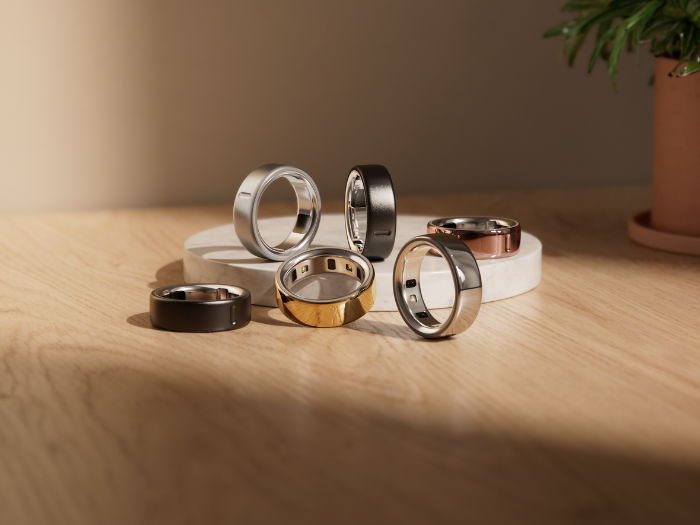
If better sleep and recovery are why you want a wearable, the Oura Ring 4 is an easy ring to recommend: its sleep data came out a little ahead of the Samsung Galaxy Ring's in NBC Select's week-long comparison, and the app turns it into advice you can act on. It runs the same software as the newer Ring 5 but comes in more sizes, and lasted about five to eight days per charge in testing. The main trade-off is the membership, without which the app shows little beyond three daily scores. If you'd rather skip an ongoing fee, the RingConn Gen 3, or the Samsung Galaxy Ring on Android, fits better.
Pros
- Sleep data NBC Select found a bit more accurate than the Galaxy Ring's
- Flat, all-titanium design built for 24/7 wear
- Sizes 4 to 15, more than the Ring 5
- Clear app with Readiness, stress and cycle insights
- About five to eight days per charge in testing
Cons
- Most data needs a paid membership
- Workout detection and step counts split testers
- Bulkier than the Oura Ring 5 and Galaxy Ring
- No charging case in the box
As an Amazon Associate I earn from qualifying purchases. Disclosure
Overview
Most of what makes the Oura Ring 4 worth wearing happens while you sleep. With no screen, it works in the background: LED, temperature and motion sensors inside a titanium band track your pulse, HRV and movement around the clock, along with blood oxygen and skin temperature trends. The Oura app turns those readings into daily Sleep, Readiness and Activity scores, with longer-term views of stress, heart health and cycles. It pairs with iPhone and Android phones and comes in sizes 4 through 15.
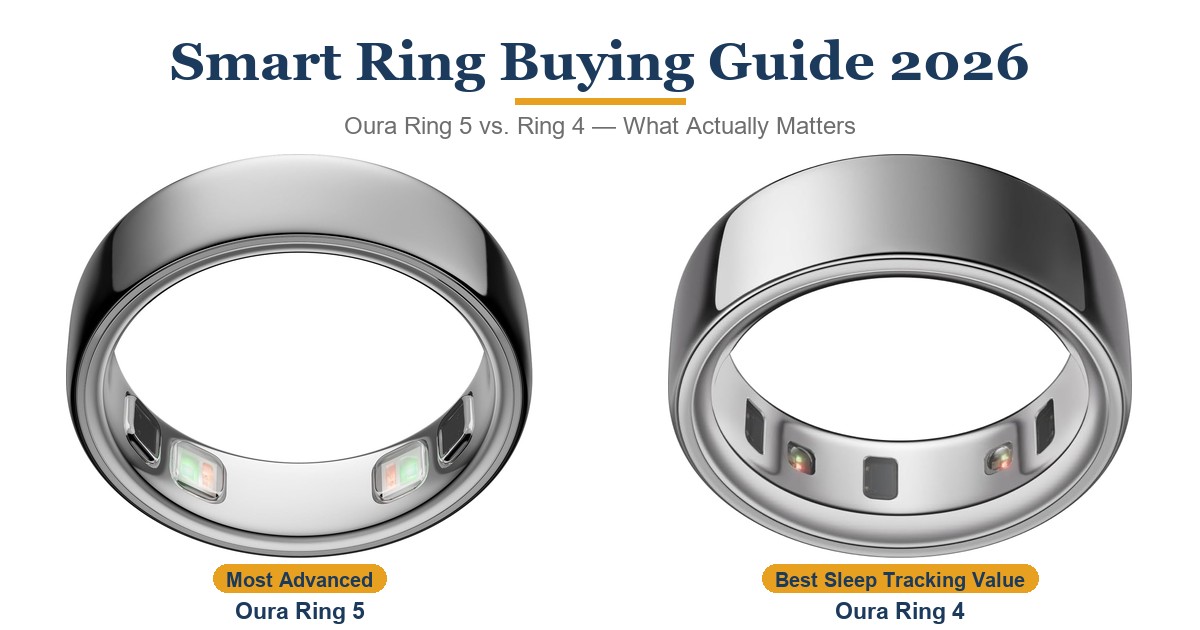
Against the Gen 3 it replaced, the Ring 4 dropped the sensor bumps on the inside for flat, recessed sensors, went to titanium inside and out, and moved to a “Smart Sensing” system that picks the clearest of 18 light paths through your finger, up from 8. Oura has since launched the Ring 5, a smaller ring running the same software, and still sells the Ring 4 alongside it. That makes the real question for most buyers which of the two to get, and for a sleep-first buyer the Ring 4 holds up well.
Key Specifications
| Price (USD) | $349.00 |
| Sensors | Red, green and infrared LEDs; digital temperature sensor; accelerometer |
| Rated battery life | 5 to 8 days, depending on size and use |
| Charging time | 20 to 80 minutes, depending on battery level |
| Sizes | 4 to 15 (Oura sizing, no half sizes) |
| Width / thickness | 7.9 mm / 2.88 mm |
| Weight | 3.3 to 5.2 g, depending on size |
| Materials | Titanium on the inner and outer surfaces |
| Water resistance | 100 m (328 ft) |
| On-ring data storage | Up to 7 days |
| Phones | iOS and Android |
| Oura Membership | $5.99 a month or $69.99 a year (Oura’s price, October 2026); first month free for new members |
| In the box | Ring, size-specific charging dock, USB-C cable |
| Warranty | 1 year against manufacturing defects; batteries (a consumable part), scratches and dents not covered |
Oura Ring 4 Sleep and Recovery Tracking
Each morning the app breaks the night down into time to fall asleep, time in each sleep stage, restfulness, heart rate, HRV, breathing and blood oxygen, and gives you a Sleep score plus a Readiness score for the day ahead. Against the Samsung Galaxy Ring it came out a little ahead. NBC Select’s tester wore both, plus an Apple Watch Series 11, for a week and found the Oura’s sleep data the most accurate of the three, “a bit more accurate” than the Galaxy Ring’s; the Galaxy Ring kept turning restless tossing into short wake-ups and recorded nothing for an hour the tester spent awake in the night.
Not every comparison is that one-sided. Wareable wore both rings at once for weeks and still rated the Galaxy Ring’s sleep accuracy good next to Oura’s, even as it gave Oura the overall edge for accuracy and insights. DC Rainmaker, reviewing the Ring 5 on the same software in 2026, goes further and argues that other wearables have now caught up with Oura on core sleep stats. Live Science, after four months with the Ring 4, was blunter: “it is the best sleep tracker we have tested.”
The flat sensors matter here. Smart Sensing switches to whichever light path reads best, so the ring doesn’t need to sit perfectly straight. On the Gen 3 that Tom’s Guide’s tester used before, readings dropped out when the ring twisted too far out of position; the Ring 4 left fewer holes in the sleep and stress records. The temperature sensor also pays off when you get sick: NBC Select’s tester saw the app pick up a raised temperature, ask how they felt, and suggest Rest Mode, which pauses activity goals while you recover.
It isn’t flawless. Android Central’s tester found it often logged a little less sleep than a Pixel Watch 3, though the rest of the night’s data lined up closely. One limit showed up on every device NBC Select tried, the Oura among them: an early-morning hour its tester spent awake but motionless, rocking a baby in a glider chair, was scored as sleep.
Activity and Workout Tracking
The Ring 4 can recognise up to 40 kinds of workouts by itself and borrow your phone’s GPS for outdoor sessions, since it has none of its own. How well that works depends on who you ask. Over one busy weekend, Wired’s tester had the Oura auto-track six hikes, all correctly, where a Garmin Fenix 8 caught three. Other testers found it notices that you’re moving but can be well off on what you’re doing. Live Science’s ring once filed a quick shower as a dance session and confused cycling with running, and fixing entries like that by hand was, in Live Science’s words, “quite time-consuming, and even downright annoying in the long term.” Yoga split testers, too. TechRadar’s ring recognised it once told yoga was a regular workout, while NBC Select’s never logged yoga or strength sessions. NBC’s tester also saw auto-logged runs come with poor GPS data at times, and starting a workout by hand in the app usually gave acceptable stats.
Step counts split testers the same way. Tom’s Guide’s tester saw counts up to 1,000 steps off an Apple Watch Series 10 on some days, and Android Central found the Galaxy Ring’s step tracking far more accurate than the Oura’s. NBC Select, by contrast, found its daily steps accurate.
For live pace, heart-rate zones and route maps during a run, a GPS running watch is the better tool; the ring has no screen to glance at and leans on your phone for location. If you’re weighing the two, our Oura Ring 4 vs Garmin Forerunner 165 comparison covers that choice.
Battery, Fit and Durability
Oura rates the battery at 5 to 8 days, with bigger sizes lasting longer, and the ring charges in 20 to 80 minutes on its dock, depending on how low it is. Real-world results mostly fell within that range. With several workouts in the mix, a size 10 lasted five and a half days for TechRadar; Tom’s Guide’s went six days before needing a top-up; and in Live Science’s long test the eight-day claim largely held, with no drop after nearly five months. In Wareable’s three charge cycles the best it managed was five days, with every health feature on. DC Rainmaker observes that “most of the time Oura rings seem to slowly lose their battery life,” a pattern Live Science’s long test didn’t show, and Oura’s warranty treats the battery as a consumable part it doesn’t cover. Charging needs its dock and a USB-C cable; there’s no charging case like the ones the Galaxy Ring and RingConn Gen 3 come with.
The recessed sensors make it more comfortable than the bumpy Gen 3, and some testers say they forgot they had it on, in bed included. Not everyone agrees. Wareable preferred the slimmer Galaxy Ring on the finger. Live Science’s testers called the Ring 4 “significantly heavier and chunkier than most other smart rings”; months into the test they still found it “particularly disruptive when exercising or clenching a fist.” That bulk is the Ring 5’s main advantage, at 40% less volume. The Ring 4 answers with a wider size range, 4 to 15, where the Ring 5 stops at 6 to 13. Oura’s sizes differ slightly from standard ring sizes, so it recommends wearing the sizing kit for 24 hours, sleep included, and taking the smaller size if you’re between two.
The titanium shell holds up. Live Science says its ring, worn to the gym and into the sea, “has never succumbed to accidental damage” over its long test. Oura rates it water resistant to 100 m (328 ft), fine for showers, saunas and ice baths but not scuba diving. Expect light scratches, though: Oura calls minor scratches from everyday wear normal and leaves them out of its one-year warranty, and testers found faint marks on theirs after regular wear.
The App and the Membership
The app is one of the best parts of owning it. It sorts everything into three tabs: Today for the day’s scores, Vitals for the detail behind them, and My Health for longer trends such as Cardiovascular Age, Resilience and daytime stress. A Timeline lets you tag things like alcohol, yoga or a night away from home so you can see what moves your scores, and Oura Advisor, an AI assistant, answers questions about your own data. Cycle tracking is a strength. Period predictions proved accurate for testers, and for Wired, rings like Oura’s were “the only devices” that “consistently caught” the drop in body temperature before a period. The catch, per NBC Select, is that the best results need you to log each day of your cycle by hand. Oura also connects to more than 40 other apps.
Almost all of that sits behind Oura Membership, which Oura prices at $5.99 a month or $69.99 a year (October 2026), with the first month free for new members. Without it, the ring still works, but the app shows little more than your daily Sleep, Readiness and Activity scores; you can still export your data. Over two years the yearly plan adds about $140 to what you pay for the ring. The membership belongs to your account, not the ring, so it carries over if you later move to a newer Oura. TechRadar, which otherwise rated it highly, docked it half a point on value for the ongoing fee.
How Does It Stack Up Against the Competition?
The Ring 5 is Oura’s own smaller alternative on the same software.
| Feature | Oura Ring 4 | Oura Ring 5 | Samsung Galaxy Ring | RingConn Gen 3 |
|---|---|---|---|---|
| Price (USD) | $349.00 | $399.00 | $395.00 | $349.00 |
| Membership for full data | $5.99/month or $69.99/year | $5.99/month or $69.99/year | None | None |
| Rated battery (maker) | 5-8 days | 6-9 days | Up to 7 days (6 on sizes 5-11) | Up to 14 days |
| Sizes | 4-15 | 6-13 | 5-15 | 6-15 |
| Thickness | 2.88 mm | 2.28 mm | 2.6 mm | 2.3 mm |
| Weight (by size) | 3.3-5.2 g | From 2 g | 2.3-3.3 g | 2.5-3.5 g |
| Phones | iOS and Android | iOS and Android | Android 11 or later only | iOS 17 or later, Android 10 or later |
| Charger in the box | Charging dock | Charging dock (case sold separately) | Charging case | Wireless charging case |
| TTP Review | This review ↑ | Read our review → | — | — |
| Amazon | View on Amazon | View on Amazon | View on Amazon | View on Amazon |
Ring prices are for size 8, and Amazon prices some sizes differently. Prices change frequently — always verify current pricing before purchasing.
Oura Ring 4: Worth It for Sleep Tracking You Can Trust
Choose the Ring 4 over the Oura Ring 5 (see our Oura Ring 5 review) if your size is 4, 5, 14 or 15, which the Ring 5 doesn’t come in, or if you’d value up to a week of readings stored on the ring rather than three days, useful when you go days without syncing to your phone. Everything else you’d use day to day is shared: Oura says the Ring 5 runs the same features with a membership, and in DC Rainmaker’s review of the Ring 5, size is nearly the whole story: the new software features it launched with reached recent Oura rings as well. Oura does claim accuracy gains from the Ring 5’s brighter sensors, 12% for nighttime HRV and up to 19% for workouts, as DC Rainmaker reports, though he calls the HRV gain “very difficult to notice.” As of October 2026 the Ring 4 is also the cheaper of the two on Amazon. Pay up for the Ring 5 only if a slimmer ring on your finger matters more than those points.
Prefer no plan at all? Then the choice comes down to your phone. On Android, and especially a Samsung phone, the Galaxy Ring needs no plan, comes with a charging case and is slimmer on the finger; Wareable rated its sleep tracking good against Oura’s, though Android Central found it far behind on workout tracking. It won’t pair with an iPhone. The RingConn Gen 3 also has no plan and works with both platforms, with up to 14 days of rated battery and vibration alerts. And if your main goal is training for races, a GPS running watch will serve you better than any ring.

Sources
- Oura — Oura Ring 4 Product Page and Tech Specifications
- Oura — Discover Oura Ring 5 (Oura Ring 5 vs. Oura Ring 4)
- Oura — Oura Membership
- Oura — Warranty FAQs
- Oura Ring 4 — Amazon Product Listing
- TechRadar — Oura Ring 4 review
- Live Science — Oura Ring Gen 4 review after four months of testing
- Wired — Oura Ring 4 Review
- Tom’s Guide — Oura Ring 4 review
- NBC Select — Oura Ring 4 Review
- Android Central — Oura Ring 4 vs. Samsung Galaxy Ring
- Wareable — Oura Ring 4 vs Samsung Galaxy Ring
- DC Rainmaker — Oura Ring 5 In-Depth Review
- DC Rainmaker — Oura Announces Oura 4: What’s Actually Changed
- Oura — Oura Ring 5 Product Page
- Samsung — Galaxy Ring
- Samsung — Galaxy Ring Specifications
- RingConn — RingConn Gen 3
Reader Poll
Which would decide your smart ring choice?
Help Our Editors Know What Matters to You
Explore on Amazon →