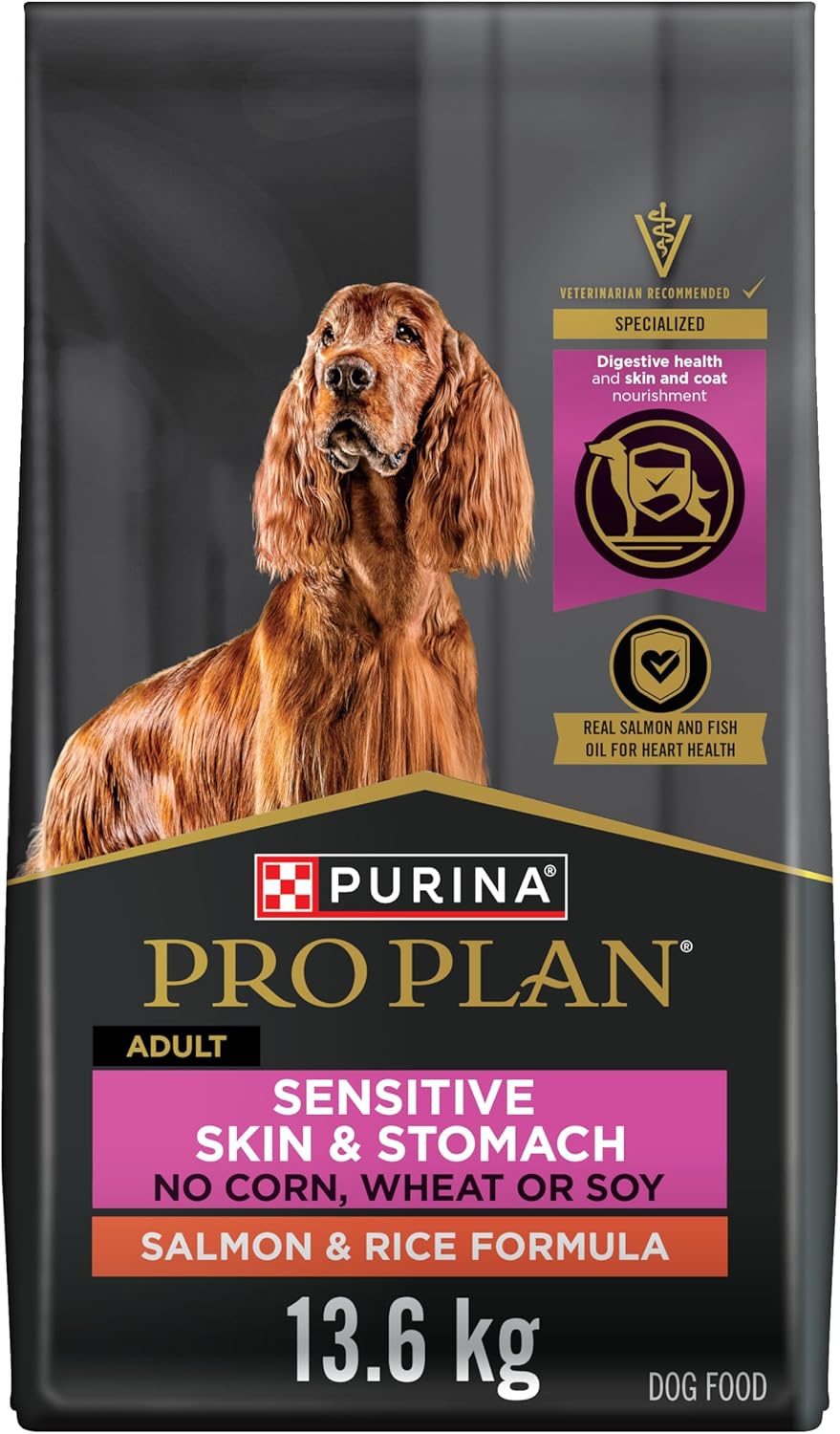
Purina Pro Plan Sensitive Skin & Stomach Salmon & Rice Formula is built for adult dogs with a garden-variety sensitive stomach or mild skin irritation, not a diagnosed food allergy, and it's stocked on Amazon.ca under the same name Canadian pet owners would find in a local pet store. Real salmon as the first ingredient and the addition of live probiotics alongside prebiotic fiber set it apart from cheaper sensitive-stomach kibble, backed by a steady stream of owner reports on firmer stools and shinier coats. The trade-off is price — it costs meaningfully more than Purina's own Purina ONE Sensitive Skin & Stomach line, which skips the added probiotics.
Pros
- Real salmon is the first ingredient
- Added live probiotics plus prebiotic fiber
- No corn, wheat, or soy
- Multiple bag sizes from 4 to 40 lb
- Widely available with strong retailer review volume
Cons
- Costs more than Purina's own budget sensitive-stomach line
- Not a substitute for a vet-prescribed elimination diet
- No grain-free formula in this specific line
Overview
A dog with a sensitive stomach can turn grocery-run kibble shopping into a months-long guessing game — soft stools, itchy skin, or a coat that never quite looks right no matter what’s in the bowl. Purina Pro Plan Sensitive Skin & Stomach Dog Food is aimed squarely at that problem: the Salmon & Rice Formula’s 30-pound bag runs about $104.49 CAD and is sold on Amazon.com and Amazon.ca, positioned as an everyday, non-prescription option rather than a specialty veterinary diet.
Real salmon leads the ingredient list, and Purina paired prebiotic fiber with live probiotics (Bacillus subtilis) to support gut bacteria directly — a step beyond the omega-6-rich sunflower oil most sensitive-skin formulas already lean on. The recipe also skips corn, wheat, and soy entirely, three ingredients some dogs react to even when a vet hasn’t pinned down a specific allergy. The same Salmon & Rice formula is stocked on Amazon.ca for Canadian owners under the same Purina Pro Plan Sensitive Skin & Stomach name.
Key Specifications
| Brand | Purina Pro Plan |
| Formula | Sensitive Skin & Stomach, Salmon & Rice |
| Bag Size Reviewed | 30 lb (also sold in 16, 24, and 40 lb) |
| Life Stage | Adult |
| Crude Protein (min) | 26% |
| Crude Fat (min) | 16% |
| Crude Fiber (max) | 4.0% |
| Key Ingredients | Salmon, rice, oat meal, prebiotic fiber, live probiotics (Bacillus subtilis) |
| Made In | United States |
| Price (30 lb bag) | $104.49 CAD |
Purina Pro Plan Sensitive Skin & Stomach Dog Food Ingredients & Nutrition
Salmon sits at the top of the ingredient panel, followed by rice, barley, and oat meal — carbohydrate sources chosen for being easier on digestion than corn or wheat, which the formula skips entirely. Fat source: sunflower oil, chosen specifically for its omega-6 content rather than as a cheap calorie filler. According to Purina’s own product documentation, the recipe is manufactured to meet AAFCO nutrient profiles for adult dog maintenance, and the 26% minimum protein / 16% minimum fat split lands in a fairly typical range for an adult maintenance formula — not a high-performance or weight-management outlier in either direction.
The bigger shift is the addition of live probiotics (Bacillus subtilis) alongside the prebiotic fiber Purina’s sensitive-stomach line has used for years. Prebiotic fiber feeds the beneficial bacteria already living in a dog’s gut; live probiotics add bacteria directly. Pairing both in one formula is a relatively recent move for a mainstream, non-prescription kibble at this price point, and it’s the main thing that separates this bag from Purina’s own cheaper Purina ONE sensitive-stomach line, which uses prebiotic fiber but no added live probiotics.
Digestive Health & Sensitive Stomach Support
Purina markets this formula as “highly digestible,” a claim tied directly to the rice-and-oat-meal base and the prebiotic/probiotic combination rather than to any single miracle ingredient. That’s a reasonable, if unglamorous, approach — sensitive stomachs in dogs are usually managed by removing likely irritants (corn, wheat, soy, low-quality fillers) and supporting gut bacteria, not by adding a single “cure-all” additive.
Chewy and Walmart customer reviews for this formula repeatedly describe firmer stools and calmer digestion within the first few weeks of switching, with several owners specifically noting their vet recommended the Sensitive Skin & Stomach line after ruling out a food allergy as the cause. That said, it’s worth being clear about scope: this is an over-the-counter maintenance diet, not a prescription elimination diet, and a dog with a diagnosed food allergy — as opposed to a garden-variety sensitive stomach — will typically need a vet-directed hydrolyzed-protein or novel-protein prescription food instead.
Skin & Coat Results
The skin-and-coat half of the formula leans on omega-6 fatty acids from sunflower oil plus vitamin E, a combination aimed at reducing the dry, flaky skin and dull coat that often accompany a dog’s digestive issues. It’s a supportive measure rather than a treatment for a diagnosed skin condition — dogs with allergic dermatitis, hot spots, or a parasite-driven skin problem need that underlying issue addressed first.
Within that scope, the owner-reported results are consistent: multiple Chewy and Walmart reviewers describe visibly shinier coats and less scratching within one to two months, including a few accounts of dogs previously dealing with ear infections or watery eyes settling down after the switch. As with any diet change, results vary by dog, and a coat that doesn’t improve within 8-12 weeks is a signal to loop in a vet rather than keep waiting it out.
How Does It Stack Up Against the Competition?
Purina Pro Plan sits in the middle of the sensitive-stomach dog food field — pricier than Purina’s own budget line, cheaper than Hill’s Science Diet, and the only one of the four with added live probiotics.
| Feature | Purina Pro Plan Sensitive Skin & Stomach | Hill’s Science Diet Sensitive Stomach & Skin | Blue Buffalo Basics Limited Ingredient | Purina ONE Sensitive Skin & Stomach |
|---|---|---|---|---|
| Price (CAD) | $104.49 CAD | approx. $128 CAD | approx. $99 CAD | approx. $71 CAD |
| Bag Size Tested | 30 lb | 30 lb | 24 lb | 31.1 lb |
| Protein Source | Salmon (1st ingredient) | Chicken | Turkey | Salmon or chicken (varies by SKU) |
| Live Probiotics Added | Yes (Bacillus subtilis) | No | No | No |
| Grain-Free Option | No (rice/oat-based) | No | Yes | No |
Prices change frequently — always verify current pricing before purchasing.
Is the Purina Pro Plan Sensitive Skin & Stomach Dog Food Worth It?
For a dog with a garden-variety sensitive stomach or mildly irritated skin — not a diagnosed food allergy — this is a solid, non-prescription first thing to try. Real salmon as the first ingredient, the corn/wheat/soy-free recipe, and the added live probiotics put it a step ahead of most mainstream sensitive-stomach kibble at a similar price, and the volume of consistent owner reports on firmer stools and shinier coats backs that up.
The trade-off is mostly about where it sits on price: it costs noticeably more than Purina’s own Purina ONE Sensitive Skin & Stomach line, which uses the same prebiotic-fiber approach without the added probiotics, and a dog with a genuinely diagnosed allergy will still need a vet-prescribed elimination diet rather than an over-the-counter formula like this one.
Check the latest price for Purina Pro Plan Sensitive Skin & Stomach Dog Food
Sources
- Purina — Official Pro Plan Sensitive Skin & Stomach Product Page
- Purina Pro Plan Sensitive Skin & Stomach Dog Food — Amazon.ca Product Listing
- Chewy — Hill’s Science Diet Sensitive Stomach & Skin Product Listing
- Walmart — Blue Buffalo Basics Limited Ingredient Product Listing
- Chewy — Purina ONE Sensitive Stomach, Skin & Coat Product Listing