How Air Fryers Actually Work: A Small Oven, Not a Fryer
There’s no oil bath inside an air fryer, just a heating element, a fan and a basket. Here’s how moving air makes a crust, how it measured up against deep frying and a full oven in lab tests, and why crowding works against it.
Sources
Cook’s Illustrated, America’s Test Kitchen, a Journal of Food Science study, Which?, BBC Science Focus, Science Meets Food and Philips.
What You’ll Understand
- What actually sits inside the plastic shell
- The steam layer that keeps oven food soft, and how a fan removes it
- Why air needs more time than oil to do the same job
- Why basket width, single layers and shaking matter so much
- Where the energy saving over a full oven comes from, and where it stops
The name suggests oil, but nothing in an air fryer fries anything. Strip off the plastic shell and you find the parts of an ordinary convection oven: a heating element, a fan and a box to hold the food. The crunch it is known for comes from where those parts sit and how hard the fan works, and once you see the mechanism, the odd rules that come with the appliance (one layer, shake halfway, don’t trust the quart rating) stop looking like superstition.
A Convection Oven, Shrunk and Sped Up
A Dutch inventor built the first one in the early 2000s, and Philips began selling it as the Airfryer in 2010. Inside are three working parts: a perforated basket for the food, an electric element near the top, and a fan that keeps the element’s heat on the move. Food cooks two ways at once: radiant heat from the element above, and convection from air that keeps moving across every surface. In a basket model the air reaches the food from below as well as from the sides and top, because the basket has openings in its floor and walls. Philips gives its drawer a starfish-shaped floor and credits it with spreading the air for more even cooking.
A wall oven with a convection setting has the same parts, so the difference is one of degree: its fan pushes air through a much bigger cavity, and that air generally circulates more slowly around the food. Cook’s Illustrated adds that classic convection ovens “are designed more to encourage even cooking than quick crisping.” The small cavity also means there is less to heat, so an air fryer warms up quickly, while a full-size convection oven typically takes much longer.
The fan drives air past the heating element and around the basket, so it reaches the food from underneath through the perforated floor as well as from the sides and above.
Why Moving Air Makes a Crust: The Steam Blanket
Crispness is mostly a drying problem. A raw potato or a chicken thigh is full of water, and its surface has to dry out before it can heat well past water’s boiling point and start to brown. Hot oil is very good at this. Food dropped into a fryer gives up its surface moisture almost at once, which is the burst of bubbles you hear, and the dried outside then climbs to browning temperatures.
Still air is much worse at it. In an oven, Cook’s Illustrated explains, the vapor coming off the food “tends to stay close, forming a thin layer of water vapor around each piece of food that insulates it and slows down further evaporation.” A fan is the fix: “Moving air continually strips that insulating vapor layer away from the food, allowing the surface to dry faster, heat up faster, and crisp and brown more evenly.” That is the entire trick, and every convection oven uses it; the air fryer simply pushes it hard in a small space. BBC Science Focus adds that, with the airflow this fast, the Maillard reaction behind a golden crust “starts sooner in an air fryer than it does in a conventional oven.”
Air Is a Weaker Cooking Medium Than Oil
Moving air narrows the gap with oil but doesn’t close it. Litre for litre, most frying oils hold more heat than air and hand it to food more readily. An air fryer makes up part of that shortfall with speed, driving its air hard across the food, and it still cooks more slowly. A 2015 study in the Journal of Food Science measured how slow. Cooking potato strips at 180°C (356°F) in a deep fryer and in a 1,300-watt Philips Airfryer, the researchers took each batch to the same moisture level and found the colour came out similar, but the air-fried batch needed about 21 minutes against 9 for the deep fryer.
The payoff was oil. The same study measured 1.12 grams of oil per 100 grams of the fries’ dry, fat-free matter after air frying, against 5.63 grams after deep frying: about a fifth as much. The fries still differed significantly in texture and in a trained panel’s sensory scores. The panel scored crispness about the same, but found the air-fried fries’ skin tougher and their mouthfeel drier. The crusts behaved differently too: as the fries cooled, the air-fried crust shrank, which the deep-fried one barely did. The researchers’ most likely explanation: oil fills the gaps in a deep-fried crust, while in an air-fried one those gaps hold steam, which condenses as the fry cools and lets the crust sink. The two crusts were built differently as well, thick and dry on the deep-fried strips, where the oil drove the water out fast, and thinner and more even on the air-fried ones, which dried more gradually. America’s Test Kitchen’s air fryer reviews see a gap the panel didn’t: after years of testing, it says even the best models “can’t achieve the perfect golden crispiness that deep frying offers, but some come impressively close.”
Why Crowding and Shaking Matter So Much
Because the whole method depends on air reaching each surface, anything that blocks the airflow cuts into the result. Food piled two deep keeps the air off the pieces underneath, and in Philips’ own account it is air reaching every surface that stops fries from steaming. Hence the two standard habits: spread food in a single layer with gaps around it, and shake or turn small pieces partway through so the hidden sides get their turn in the airflow.
Shaking helps but doesn’t guarantee an even batch. Which? stirred or shook its chips halfway through and still got a mix: some at the bottom of the air fryer undercooked, others done perfectly, while its oven batch was uneven too. The maker of that air fryer advises filling the basket only halfway, with 500 grams of chips at most, which caps how much one batch can hold. In America’s Test Kitchen’s reviews a wide floor beat a tall chamber, and the quart figure on the box said little about how much a model could really cook in one go. Its oven-style models did badly whenever food was split across racks: whatever sat on the lower level was shielded by the rack above, so the two levels didn’t cook alike.
Where the Energy Saving Comes From, and Where It Stops
A small, enclosed cavity is cheaper to bring up to temperature than a full oven. Which? cooked the same foods in a Morphy Richards air fryer and a Bosch built-in fan oven, counting preheating in both. The air fryer used 0.287 kWh for two to three portions of frozen chips against the oven’s 0.863 kWh, roughly a third of the energy, and 0.54 kWh for a roast chicken against 1.157 kWh, a little under half. Since the oven had a fan too, this was a contest of box sizes, not of moving air against still air. Morphy Richards rates its basket at 3 litres and Bosch its oven at 66; Which?’s own review of the Bosch lists 41 litres of usable space.
| Which? lab test, preheating included | Morphy Richards 480003 air fryer | Bosch Serie 2 HHF113BR0B fan oven |
|---|---|---|
| Cooking space, maker’s figure (Which? lists the Bosch’s usable volume as 41 litres) | 3 litres | 66 litres |
| 320 g frozen chips | 0.287 kWh, 23 min | 0.863 kWh, 33 min |
| 1.3-1.4 kg roast chicken | 0.54 kWh, 53 min | 1.157 kWh, 76 min |
| One jacket potato, about 200 g | 0.392 kWh, 48 min | 1.084 kWh, 68 min |
| Three-egg sponge cake (made smaller to fit the air fryer) | 0.223 kWh, 33 min | 0.71 kWh, 56 min |
The catch is capacity. For a big meal, Which? notes, the oven may still be the cheaper option: once food has to go through the basket in several batches the saving shrinks fast, and a roast dinner can use the spare oven space for its sides. Which? could fit only a small bird, about 1.3 kg.
What This Means When You’re Buying
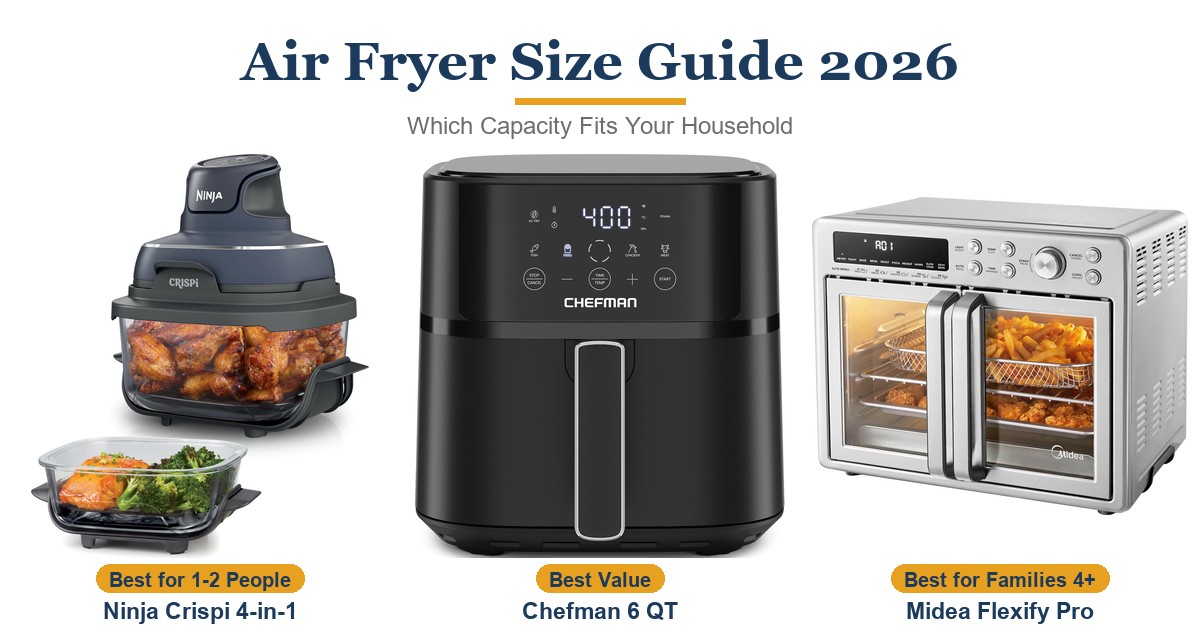
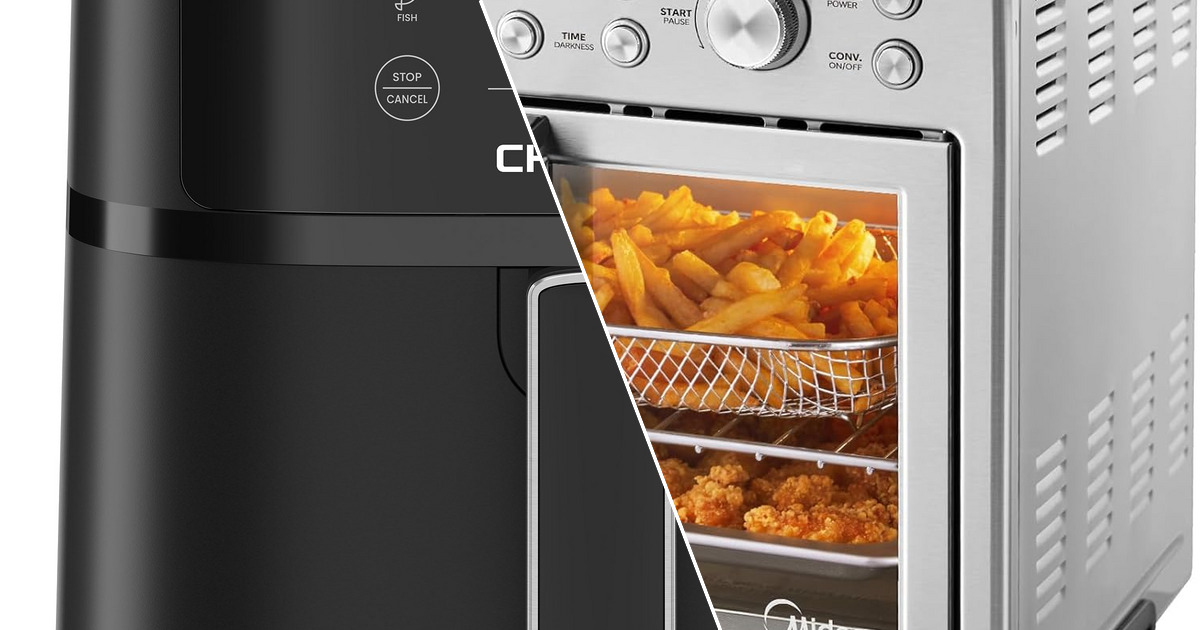
The floor area food can sit on in one layer tells you more than the quart rating on the box, so size the basket to your usual portion. A basket or drawer design suits the shaking that small pieces need. For a bigger household, pick a wide drawer over an oven-style model, which in America’s Test Kitchen’s reviews was bulkier without holding much extra. The two guides below work through both decisions with real current models.
As an Amazon Associate I earn from qualifying purchases. Disclosure
Not the focus of this piece, but if you’re shopping: search basket air fryers on Amazon →search basket air fryers on Amazon.ca →
Sources
- Cook’s Illustrated — What Exactly Is Air Frying? Ask Paul
- America’s Test Kitchen — The Best Air Fryers of 2026
- Journal of Food Science (Teruel et al., 2015) — A Comparative Study of the Characteristics of French Fries Produced by Deep Fat Frying and Air Frying (accepted manuscript, University of Reading)
- Which? — Air Fryer vs Oven: Energy Usage, Costs and Cooking Results Compared
- Which? — Bosch Serie 2 HHF113BR0B Review
- Bosch — Series 2 Built-in Oven HHF113BR0B Spec Sheet
- Morphy Richards — Manual 3 Litre Air Fryer (480003)
- BBC Science Focus — How Do Air Fryers Work?
- Science Meets Food (IFT Student Association) — The Science Behind Air Fryers
- Philips — Viva Collection Airfryer HD9220
- Philips Domestic Appliances — How Does an Air Fryer Work?