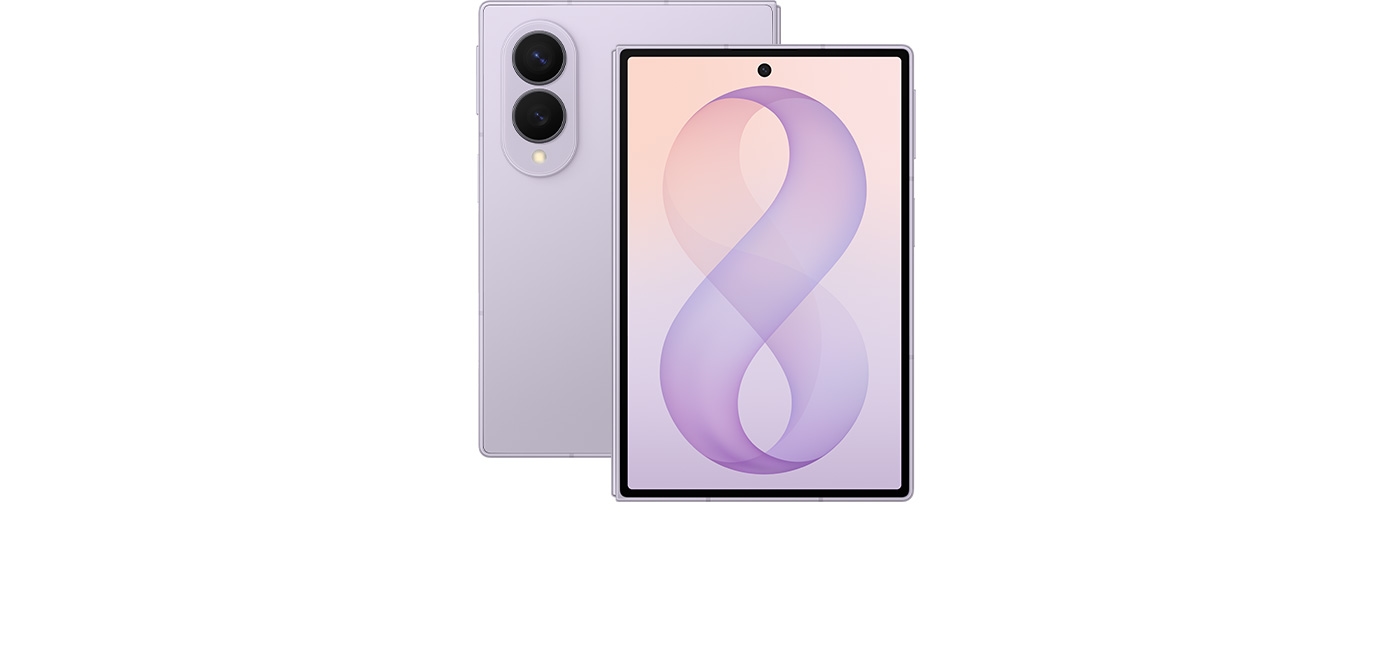
Buy the Galaxy Z Fold8 if you want a foldable that carries like a normal phone: at 201 g it's the lightest book-style foldable yet, and its wide cover screen is comfortable to type on. Opened, the 4:3 inner screen makes video, reading and split-screen apps feel roomy, backed by fast performance, all-day battery life and seven years of updates. The trade-off is reach: with no telephoto lens, photos soften past about 4x, so keen photographers will be happier with the Fold8 Ultra.
Pros
- Lightest book-style foldable, at 201 g
- Phone-shaped cover screen that's easy to type on
- 4:3 inner screen with thinner black bars for video
- Fast performance and all-day battery life
- Seven years of Android and security updates
Cons
- No telephoto lens; photos soften past about 4x
- IP48: water-resistant but not dust-rated
- No S Pen support or Flex Mode
- Loses some speed in long gaming sessions
As an Amazon Associate I earn from qualifying purchases. Disclosure
Overview
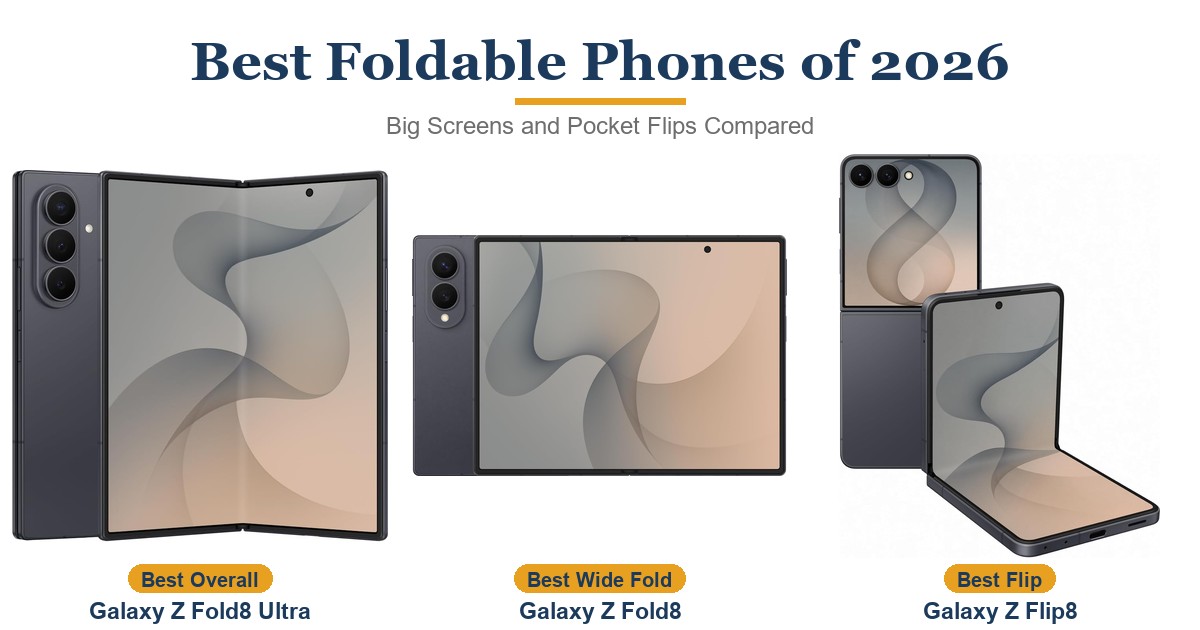
Every earlier Galaxy Z Fold asked you to carry a tall, narrow slab that opens into a small tablet. The Samsung Galaxy Z Fold8 goes the other way: folded, it is short and wide, close to a passport in size, with a 5.5-inch cover screen shaped like an ordinary phone, and opened it becomes a 7.6-inch screen in a 4:3 shape that suits video and reading. At 201 g it is the lightest book-style foldable so far, and Amazon sells the 256GB Graphite model for $1,699.99 (October 2026).
If you own a Fold7 and want the same tall shape with newer parts, look at the Galaxy Z Fold8 Ultra and its 8-inch inner screen instead: despite the name, the Fold8 is a different, wider phone rather than the Fold7’s direct upgrade. Tom’s Guide gave it an Editor’s Choice award and named it the best Android foldable for most people.
Key Specifications
| Price (USD) | $1,699.99 |
| Inner screen | 7.6-inch Dynamic LTPO AMOLED 2X, 4:3, 1-120Hz |
| Cover screen | 5.5-inch Dynamic LTPO AMOLED 2X, 10:16, 1-120Hz |
| Processor | Snapdragon 8 Elite Gen 5 for Galaxy |
| Memory and storage | 12GB with 256GB or 512GB; 16GB with 1TB |
| Rear cameras | 50MP wide, 50MP ultrawide |
| Selfie cameras | 10MP (cover screen), 10MP (inner screen) |
| Battery | 4,800 mAh (Samsung rates up to 26 hours of video playback) |
| Charging | 45W wired (rated), 20W wireless, reverse wireless |
| Size folded | 123.9 x 81.9 x 9.7 mm |
| Size open | 161.4 x 123.9 x 4.5 mm |
| Weight | 201 g (7.1 oz) |
| Water and dust rating | IP48 |
| Software | Android 17 with One UI 9; seven years of OS and security updates |
| S Pen | Not supported |
Samsung Galaxy Z Fold8 Design and Displays
The shape is the reason to buy it. Folded, the Fold8 measures 123.9 x 81.9 x 9.7 mm, small enough to slip into a front pocket, and the cover screen’s 10:16 proportions mean most apps and the keyboard look much as they would on a regular phone rather than squeezed into a narrow strip, though tall vertical video and Instagram Stories can show black bars at the sides. Two-thumb typing has plenty of room. One-handed reach split the testers: Tom’s Guide found reaching across the wide screen can be a stretch and Android Authority had to shuffle its grip to reach the corners (not necessarily worse, it said, than on a large regular phone), while Digital Trends’ reviewer could reach across it with a thumb.
Open it and the 7.6-inch inner screen is a 4:3 panel. A widescreen film isn’t much bigger than on a regular Fold, but the black bars above and below are far thinner, so the picture fills more of the panel, and older 4:3 TV shows fill it completely. Turned to portrait, it reads like a page, which suits ebooks, PDFs and long articles. What Hi-Fi? scored its picture five out of five and called it the most compelling folding phone it has tested, though it found skin tones can look slightly rosy and some shadow detail is lost in dark scenes.
Samsung’s new Flex Titanium display layer makes the crease less visible than on earlier Folds, and the anti-reflective coating cuts glare outdoors. It isn’t gone: you can still feel a dip when you run a finger across it, and Android Authority found it easier to spot from an angle after a week of use, although the screen felt just as smooth as on the first day. The hinge opens with less effort than the Fold7’s, but the off-centre camera bump makes the phone wobble when you tap it on a table.
Performance and Battery Life
Everyday speed isn’t a concern. Inside is the same Snapdragon chip as the Galaxy S26 Ultra’s, and testers saw instant app launches, smooth play in demanding games and no lag with three apps open on the inner screen. Tom’s Guide’s lab numbers even put it ahead of Apple’s iPhone 17 Pro Max for multi-core Geekbench and 3DMark graphics.
The thin body sets the limit under sustained load. Android Authority’s GPU stress tests held 46 to 49% of peak performance and Digital Trends’ 20-loop 3DMark run held 54%, so long gaming sessions lose some frame rate while the phone keeps its temperature in check. In practice Digital Trends saw demanding games hold a locked 60 fps for about the first quarter-hour before settling in the upper 50s, and it gets warm near the hinge without ever getting uncomfortably hot.
Battery life is good rather than class-leading. The 4,800 mAh battery, up from 4,400 mAh on the Fold7, lasted 12 hours 19 minutes in Tom’s Guide’s 5G web-surfing test, nearly an hour and a half longer than the Fold7, and more than 12 hours 59 minutes in Digital Trends’ mixed-use loop. The tests don’t agree on the rivals: Tom’s Guide had the Fold8 Ultra (14:33) and Motorola Razr Fold (14:44) lasting longer, while Android Authority’s benchmark had the Fold8 ahead of the Razr Fold in most workloads and well ahead of the Pixel 11 Pro Fold, though last year’s Fold7 beat it in most of that test. Day to day, it should last a full day in most use; Android Authority’s reviewer got just under two days while spending most of the time on the cover screen.
Charging moves up to 45W wired, from 25W on the Fold7, plus 20W wireless. Tom’s Guide measured 70% in 30 minutes and Digital Trends 61%, and Android Authority timed a full charge from 2% at 67 minutes, with power peaking at about 38W rather than the rated 45W. The magnets for Qi2 chargers aren’t built in, so a magnetic charger needs a case with magnets.
Cameras
The rear pair is a 50MP main camera and a 50MP ultrawide. The main camera takes detailed, contrasty daylight shots with Samsung’s slightly saturated colour, though fine textures such as foliage can look over-processed. In Tom’s Guide’s side-by-side, its night shots came out brighter and crisper than the Fold7’s. The ultrawide is a big step up from the Fold7’s 12MP lens, and video runs up to 8K at 30 fps or 4K at 120 fps, with steady footage when panning.
There is no telephoto lens, so anything past 1x is a crop of the main sensor: 2x holds up well and 4x is fine for social posts, but detail falls apart beyond that, and Tom’s Guide’s 10x shots were visibly blurrier than the Fold8 Ultra’s.
Selfies come from two 10MP cameras, one on each screen, but the better option is to unfold the phone and shoot with the rear cameras, using the cover screen as a viewfinder.
Durability, Software and Missing Features
The frame is Samsung’s Armor Aluminum, with Gorilla Glass Victus 2 on the back and Gorilla Glass Ceramic 3 over the cover screen. The weak spot is the IP48 rating. Samsung rates it for submersion in up to 1.5 metres of fresh water for up to 30 minutes, but the 4 only covers solid objects larger than a millimetre, so fine sand and dust aren’t covered. That puts it behind the IP68 Pixel 11 Pro Fold and iPhone Duo, and testers would keep it away from the beach.
Two features are missing. There is no S Pen support, and there is no Flex Mode: the hinge doesn’t hold the phone half-open like a mini laptop, a feature Samsung kept for the Fold8 Ultra. Testers missed it for propping the phone up to watch video, and Tom’s Guide also wanted it for quick video calls.
Software is a strength. Starting from Android 17 and One UI 9, Samsung promises seven years of OS and security updates, a long support window for a phone at this price. On the inner screen you can split three apps and float more windows on top, and plugging into a monitor brings up DeX, a desktop layout for keyboard and mouse. Now Nudge, which suggests a related app to open in split view, worked well for Tom’s Guide (a calendar popped up when a text mentioned dinner plans), although Android Authority’s reviewer never saw it appear. Some apps still aren’t laid out for the wide screen; Tom’s Guide singled out Slack, Reddit and X.
How Does It Stack Up Against the Competition?
The Fold8’s rivals are the other big-screen foldables, Google’s Pixel 11 Pro Fold and Apple’s similarly wide iPhone Duo, plus Samsung’s non-folding Galaxy S26 Ultra for buyers still deciding whether they need a folding screen at all. Samsung’s own Fold8 Ultra ($1,889.99 on Amazon, October 2026) is the step-up within the same family, with a bigger 8-inch screen, a 200MP main camera and Flex Mode.
| Feature | Samsung Galaxy Z Fold8 | Google Pixel 11 Pro Fold | Apple iPhone Duo | Samsung Galaxy S26 Ultra |
|---|---|---|---|---|
| Price (USD) | $1,699.99 (256GB) | Deal $1,649.00 (256GB) until Nov 8 | $1,999.00 (256GB) | $1,144.22 (256GB) |
| Inner screen | 7.6-inch | 8-inch | 7.6-inch | None (not a foldable) |
| Outer screen | 5.5-inch | 6.5-inch | 5.4-inch | 6.9-inch |
| Weight | 201 g | 239 g | 254 g | 214 g |
| Thickness (folded / open) | 9.7 mm / 4.5 mm | 10.1 mm / 5 mm | 11.3 mm / 5.2 mm | 7.9 mm (does not fold) |
| Rear cameras | 50MP wide, 50MP ultrawide | 48MP wide, 10.5MP ultrawide, 10.8MP 5x telephoto | 48MP main, 48MP ultrawide | 200MP wide, 50MP ultrawide, 50MP 5x and 10MP 3x telephoto |
| Battery capacity | 4,800 mAh | 4,806 mAh (typical) | Not published by Apple | 5,000 mAh |
| Water and dust rating | IP48 | IP68 | IP68 | IP68 |
| Processor | Snapdragon 8 Elite Gen 5 for Galaxy | Google Tensor G6 | Apple A20 Pro | Snapdragon 8 Elite Gen 5 for Galaxy |
| TTP Review | This review ↑ | Read our review → | — | Read our review → |
| Amazon | View on Amazon | View on Amazon | — | View on Amazon |
Prices change frequently — always verify current pricing before purchasing.
Samsung Galaxy Z Fold8: Worth It for a Foldable You’ll Actually Carry
If you’ve avoided foldables because they felt like carrying a remote control, this is the one to try. It behaves like a normal, pocketable phone for most of the day, opens into a screen that is genuinely better for video, reading and side-by-side apps, and its speed, battery life and seven-year update promise cover the long stretch you’d want to keep a phone this expensive.
Look elsewhere if your photos often need reach, such as concerts, kids’ sports or wildlife: the Fold8 Ultra adds a 3x telephoto and a bigger 8-inch screen, and the Pixel 11 Pro Fold pairs a 5x telephoto with IP68 dust protection. If a stylus, MagSafe charging and IP68 in the same wide shape matter more, the iPhone Duo has all three for $1,999 at Apple (October 2026), though MacRumors reported that Apple’s online store was quoting late-January delivery for new orders on October 16, 2026.
Sources
- Samsung — Galaxy Z Fold8 Official Product Page
- Samsung Galaxy Z Fold8 — Amazon Product Listing
- Tom’s Guide — Samsung Galaxy Z Fold 8 review
- What Hi-Fi? — Samsung Galaxy Z Fold 8 review
- Android Authority — Samsung Galaxy Z Fold 8 review
- Android Authority — What to expect from the Galaxy Z Fold 8’s crease after a week
- Digital Trends — Samsung Galaxy Z Fold 8 review
- HotHardware — Samsung Galaxy Z Fold8 And Fold8 Ultra Review
- SamMobile — Galaxy Z Fold 8 vs Fold 8 Ultra: Which one actually replaces your Fold 7
- Finder — Samsung Galaxy Z Fold 8 review
- Tom’s Guide — Is the Galaxy Z Fold 8’s crease really that good?
- Tom’s Guide — iPhone Duo vs Samsung Galaxy Z Fold 8
- MacRumors — iPhone Duo pre-order wait times
- Samsung — Galaxy Z Fold8 Ultra Official Product Page
- Samsung — Galaxy S26 Ultra Official Product Page
- Google — Pixel 11 Pro Fold Tech Specs
- Google Canada — Pixel 11 Pro Fold Tech Specs
- Apple — iPhone Duo Technical Specifications
- Apple — Buy iPhone Duo
Reader Poll
Which Galaxy Z Fold8 trade-off would bother you most?
Help Our Editors Know What Matters to You
Explore on Amazon →