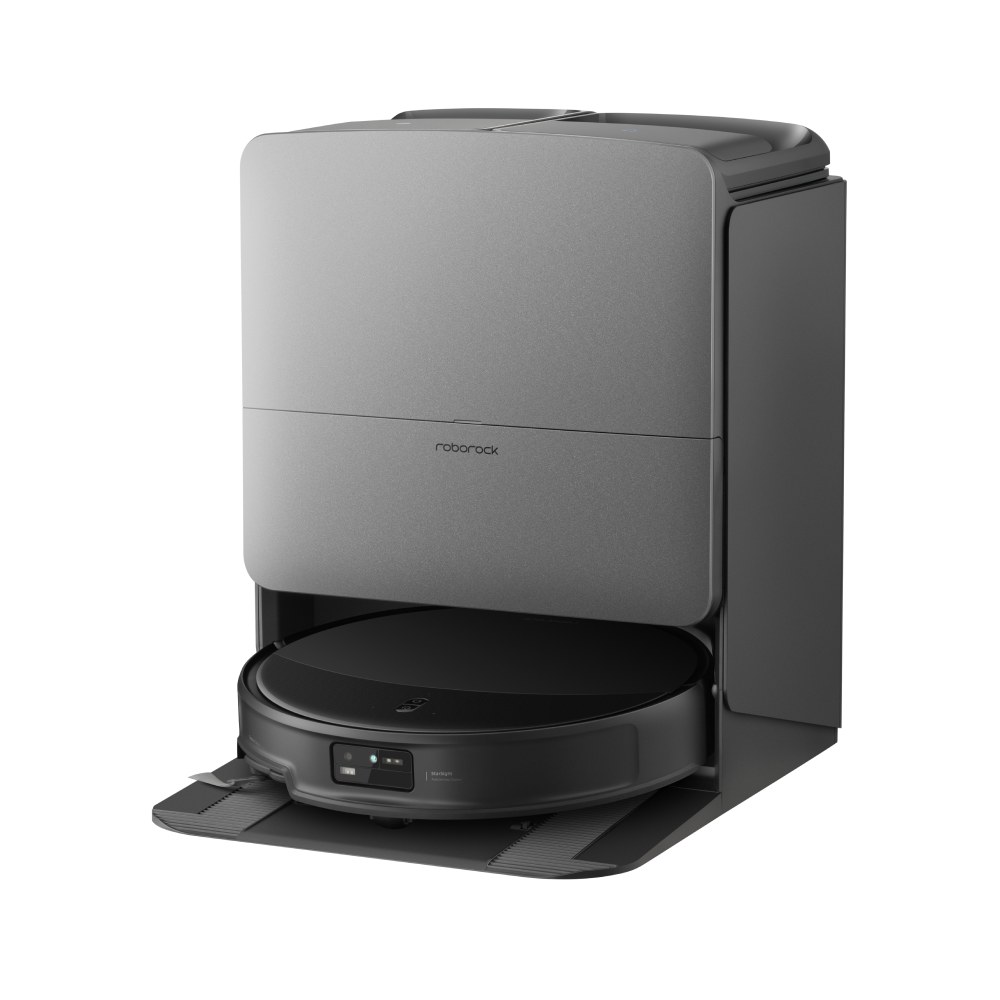
The Roborock Saros 20 is the robot to buy for a Canadian home with carpet, pet hair and tall door sills: it pulls embedded grit and flattened hair out of carpet better than average in lab tests, largely keeps hair off its brush and climbs thresholds that stop most rivals, with Dreame's X60 Max Ultra Complete its closest match on carpet and pet hair. Its mopping is close behind, and the dock handles nearly all the upkeep. Its quirks show in cluttered rooms, where cords, loose threads and tight furniture gaps can trip it up. If sticky spills are your main job, a self-rinsing roller mop such as the eufy Omni S2's fits better.
Pros
- Embedded carpet grit well above average, pet hair above average in lab tests
- Split main brush largely resists hair wrap
- Record threshold climbing in Vacuum Wars' test
- 79.8 mm (3.14-inch) body slips under low furniture
- Strong mopping with boiling-water pad washing
- Dock handles nearly all the upkeep
Cons
- Clutter can still catch it out: cords, loose threads and tight furniture gaps
- Very sticky spills such as honey can take more than one pass
- Small 260 mL onboard bin
As an Amazon Associate I earn from qualifying purchases. Disclosure
Overview
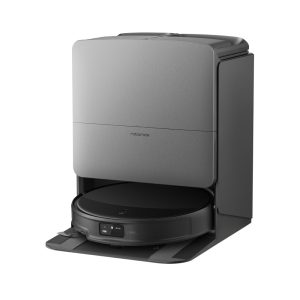
Thick rugs, tall door sills and low sofas are what strand most robot vacuums, and the Roborock Saros 20 is designed around all three. Its body stands 79.8 mm (3.14 inches) tall with no laser turret on top, and legs on its AdaptiLift chassis lift it over stacked thresholds up to 8.8 cm (3.46 inches) by Roborock’s rating. The same chassis raises the robot to clean carpet with pile up to 3 cm (1.18 inches). It is Roborock’s flagship robot vacuum and mop, sold with a dock that empties its bin, washes its two spinning mop pads in 100°C (212°F) water and dries them, and Amazon sells it in the US and Canada.
It replaces the Saros 10R, which it closely resembles, and Amazon.ca sells the same model as the US store. The changes are under the shell: suction has almost doubled to a rated 36,000Pa, and the climbing chassis more than doubles the 10R’s step height. The mop pads now press down with up to 13 N, and the dock washes with boiling water and dries its dust bag as well as the pads. Roborock Canada’s own store sells it with 30-day returns and a 1-year warranty that is valid only in Canada.
Built from 21 sources, including 11 independent reviewers such as Vacuum Wars, TechRadar and Vacuum Chef. Here’s where they agree, and where they don’t.
Where the reviews agree
- It vacuums hard floors and carpet very well, including pet hair pressed deep into the pile.
- Its split main brush largely keeps long hair from wrapping around it.
- The slim body slides under low sofas and beds that stop taller robots.
Where they split
- Mopping: Vacuum Wars scored its stain removal well above average and Gizmodo called it excellent, while Notebookcheck and BGR rate robots with roller mops higher.
Key Specifications
| Model | Roborock Saros 20 |
| Robot size | 350 x 353 x 79.8 mm |
| Weight (robot and dock) | 15.9 kg (35.03 lb) |
| Rated suction | 36,000Pa |
| Threshold climbing (rated) | 4.5 cm single sill; 8.8 cm double-layer (4.5 cm + 4.3 cm) |
| Carpet lift | Chassis rises for pile up to 3 cm |
| Navigation and avoidance | StarSight 2.0: 3D time-of-flight sensors and an RGB camera; 300+ obstacle types |
| Brushes | DuoDivide split main brush; extending FlexiArm side brush |
| Mopping | Two spinning pads, up to 13 N of pressure; one extends; pads stay in the dock for vacuum-only runs |
| Battery | 6,400mAh |
| Dock | Auto-empty into a bag; 100°C mop washing; 55°C drying of pads and dust bag; detergent dosing; 4 L clean and 3.5 L dirty water tanks |
| Smart home | Matter, Alexa, Google Home and Siri Shortcuts; built-in “Hello Rocky” voice control |
| Warranty | 1 year, valid in Canada (Roborock Canada store) |
| Price (CAD) | Deal $1,499.99 until Nov 30 |
Roborock Saros 20 Vacuuming and Pet Hair
Vacuuming is the Saros 20’s strongest suit, especially with pet hair ground into carpet. The lab numbers back that up: in Vacuum Wars’ tests, 88% of flattened pet hair and 89% of embedded sand came out of medium-pile carpet, against averages of 82% and 78%. TechRadar rubbed a fistful of dog hair into its living-room carpet and saw four passes all but clear it, a result its reviewer says usually takes a manual vacuum.
Fine dust is the closest it comes to a weak spot, and results differ. Vacuum Chef found it slightly less effective with fine sand on carpet than with larger debris, and Tech Advisor saw some flour stay in mid-pile carpet even at top suction, a lapse it judged minor next to other robots. Other testers left little or no sand behind.
The 36,000Pa rating doesn’t stand out on the bench: two labs measured suction pressure below their averages, yet both found its real-world pickup strong.
Hair stays off the brush. The DuoDivide main brush is split in the middle to steer hair into the bin. Vacuum Wars measured no hair wrap at all in its long-hair test, against a 26% average, while Vacuum Chef still saw a little at the brush ends, less than on most rollers it has tested. The extending side brush reaches well into corners and along walls. The onboard bin is small at about 260 mL, so in homes with heavy shedding it can fill before the robot returns to empty.
Mopping and the Hot-Water Dock
Mopping comes close to the vacuuming. Two pads spin at 200 RPM and press down with up to 13 N, and one swings out to reach along baseboards. Vacuum Wars calls it a big step forward for Roborock in its tests, scoring it 116 on dried coffee stains against a 94 average while leaving less excess water behind than average, which it says can help prevent streaks.
Very sticky spills can need help. TechRadar needed a cloth to finish smeared honey after two passes, and Tech Advisor still felt some stickiness after a deep-clean pass had lifted the visible dried sauce. With re-mopping and deep cleaning switched on, Expert Reviews saw dried ketchup and coffee scrubbed away without a trace. Spinning pads are rinsed only back at the dock, so they can spread a spill around before then; robots with a roller mop that rinses itself as it cleans avoid that better.
Edges get most of the attention they need. In Gizmodo’s dried barbecue sauce test, the spots near the wall were the only ones to survive the first pass, and a second run still left a trace of one; its reviewer suspects the extended pad presses less firmly.
The dock is where the hands-off promise holds up best. It washes the pads in 100°C (212°F) water, dries them and its own dust bag with 55°C (131°F) air, empties the robot into a bag, doses detergent and leaves the mop pads behind when the robot goes out only to vacuum. Over about a month, TechRadar’s only chores were filling the clean tank and emptying the dirty one, and the 4-litre clean and 3.5-litre dirty tanks keep those trips occasional. A dock bag can last up to about 65 days.
Navigation, Obstacles and Thresholds
Day to day, it maps a home quickly and steers around most clutter. 3D sensors at the front and rear handle navigation, with an RGB camera at the front to recognize objects, and Roborock says the system identifies over 300 types of obstacle. Without a turret’s all-round view it turns now and then to get its bearings, which Notebookcheck found costs some cleaning time, and its coverage speed is about average rather than quick.
Lab counts put it a little above average: Vacuum Wars saw it avoid 17 of 24 obstacles against a 16 average, and Vacuum Chef scored it 71% overall, near-flawless on hard floors but weaker with cables and small toys on carpet. Expert Reviews goes further, calling its avoidance the best of any robot it has tested after it became the first to steer around a fake pet mess.
Clutter can still catch it out: in Gizmodo’s apartment it wedged itself between a couch and a coffee table while the owner was away and ran its battery flat. Tech Advisor’s unit pulled cat-toy strings and curtain threads into its brush and got caught between furniture legs, finishing a clean without trouble only a handful of times in two weeks.
Other homes had a much smoother run: TechRadar and iPhone in Canada each used it for weeks without it getting lost or needing a rescue.
Thresholds are where it stands apart. Roborock rates the chassis for single sills up to 4.5 cm (1.77 inches) and stacked ones up to 8.8 cm (3.46 inches). In Vacuum Wars’ single-step test it cleared 57 mm (2.24 inches) after some repositioning, a record for the outlet and higher than Roborock’s own rating, though the outlet can’t promise it will manage that every time. In homes it crossed double-layer transitions and chunky hall-to-living-room sills, sometimes only after a few tries and a run-up rather than a smooth lift.
The same chassis raises the robot to hover over rugs with pile up to 3 cm (1.18 inches), a mode Roborock says is switched on in the app. Expert Reviews found it cleaned extra-fluffy bath mats and left them flat and in place, where most robots push them around or ruck them up.
Battery, App and Voice Control
Battery results split, and the dock covers for it either way. Vacuum Wars estimates about 96 m² (1,038 square feet) per charge, a little below its average, while Vacuum Chef’s runs beat its average even at maximum suction on carpet and set its record at about 1,100 m² (11,840 square feet) on low power. A full charge takes about two and a half hours, and on a big job the robot returns to recharge and then finishes on its own.
The Roborock app is one of the deepest around: room-by-room suction and water settings, no-go and no-mop zones, multi-floor maps, remote driving, a camera for checking on pets, and AI-planned cleaning called SmartPlan. That depth cuts both ways. TechRadar finds it can get overwhelming for newcomers, and Tech Advisor found scheduling buried in the settings and set to run only once by default.
It answers to “Hello Rocky” without a smart speaker and works with Alexa, Google Home, Siri Shortcuts and Matter, though the voice assistant sometimes wakes up during ordinary conversation. It is quiet for its power, quiet enough to hold a conversation or watch TV while it runs. Roborock Canada’s store lists a 1-year warranty, valid only in Canada.
How Does It Stack Up Against the Competition?
Each of these rivals has a dock that empties, refills and washes its mop; the Dreame matches the Saros 20’s slim, climbing design, while the eufy and Narwal use roller-style mops.
| Feature | Roborock Saros 20 | Dreame X60 Max Ultra Complete | eufy Omni S2 | Narwal Flow 2 |
|---|---|---|---|---|
| Price (CAD) | Deal $1,499.99 until Nov 30 | $2,399.99 | Deal $1,799.98 until Nov 18 | $1,999.99 |
| Rated suction | 36,000Pa | 35,000Pa | 30,000Pa | 31,000Pa |
| Robot height | 79.8 mm | 79.5 mm (sensor retracted) | 98 mm | 95 mm |
| Rated threshold climbing (double step) | 8.8 cm | 8.8 cm | 4.2 cm | 4 cm |
| Mop type | Two spinning pads | Two spinning pads | Self-cleaning roller mop | Heated track mop |
| TTP Review | This review ↑ | Read our review → | — | — |
| Amazon | View on Amazon | View on Amazon | View on Amazon | View on Amazon |
Prices change frequently — always verify current pricing before purchasing.
Roborock Saros 20: Worth It for Carpets, Pets and Tall Thresholds
Buy it for a home with carpet, a shedding pet and door sills or rugs that strand other robots. Over several weeks on hardwood, bathroom tile and area rugs, iPhone in Canada never had to rescue it, and it got over every threshold in that home, double-layer transition included. It pulls embedded grit and flattened hair out of carpet better than the average robot in lab tests, and the dock handles nearly all the upkeep. If you already own a Saros 10 or 10R, the changes are real but incremental, and the taller threshold climbing is the main reason to upgrade.
The Dreame X60 Max Ultra Complete is its closest match, and Vacuum Wars ran both through the same tests. The Dreame matched its 89% carpet deep clean, lifted 100% of flattened pet hair to its 88% and avoided 22 of 24 obstacles to its 17, so look there if avoidance tops your list. The Saros 20 climbed higher (57 mm to 51 mm), covered more floor per charge and scored better on mopping once leftover water was counted. If sticky kitchen spills are the main job, a robot whose roller or track mop rinses itself as it cleans, such as the eufy Omni S2 or Narwal Flow 2, keeps a dirty pad off the floor. And if you don’t specifically need its obstacle avoidance and threshold climbing, Expert Reviews says the Tapo RV50 and Eufy C28 offer around 90% of its capability for half the price.

Sources
- Roborock — Saros 20 product page and specifications
- Roborock Saros 20 — Amazon.ca Product Listing
- Vacuum Wars — Roborock Saros 20 Robot Vacuum Review
- TechRadar — Roborock Saros 20 review
- Vacuum Chef — Roborock Saros 20 Review
- Gizmodo — Roborock Saros 20 Review
- Expert Reviews — Roborock Saros 20 review
- Tech Advisor — Roborock Saros 20 Robot Vacuum Review
- Notebookcheck — Roborock Saros 20 review
- BGR — Roborock Saros 20 Robot Vacuum Review
- iPhone in Canada — Roborock Saros 20 Review (Canada)
- CGMagazine — Roborock Saros 20 Robot Vacuum Review
- T3 — Roborock Saros 20 review
- Vacuum Wars — Dreame X60 Max Ultra Complete Review
- Dreame — X60 Max Ultra Complete product page
- eufy — Robot Vacuum S2 product page
- eufy — Robot Vacuum Omni S2 specifications (Canada)
- Narwal — Flow 2 product page
- Roborock Canada — Saros 20 product page
- Dreame Canada — X60 Max Ultra Complete product page
- Narwal Canada — Flow 2 product page
Reader Poll
What would decide a robot like the Saros 20 for your home?
Help Our Editors Know What Matters to You
Explore on Amazon →