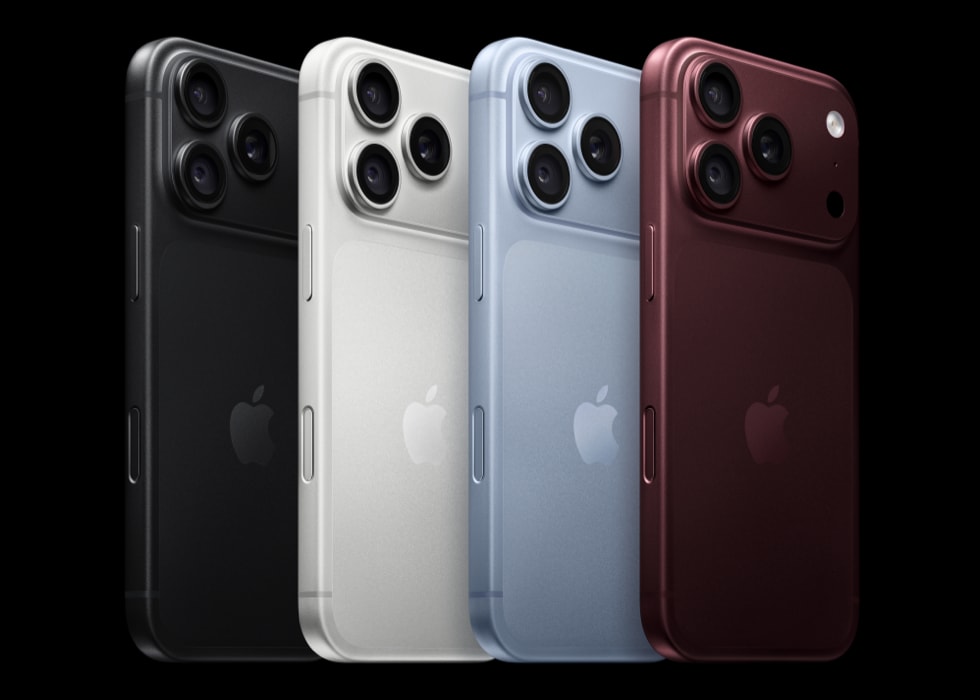
The iPhone 18 Pro Max pairs Apple's first 2-nanometer chip with a variable-aperture main camera, the biggest camera-hardware change on an iPhone in years. Apple rates battery life at up to 45 hours of video playback, a 15 percent increase over the iPhone 17 Pro Max, and it starts at $1,899 CAD once it reaches Amazon.ca. The A20 Pro's Neural Engine also roughly doubles on-device AI throughput for the new Siri AI beta. Tom's Guide's own real-world testing found the actual battery-life gain over the 17 Pro Max is far smaller than that rated figure, and the phone is now the heaviest non-folding iPhone Apple has made.
Pros
- First 2-nanometer iPhone chip (A20 Pro)
- Variable-aperture main camera (f/1.48-f/4)
- Longest Apple-rated battery life yet (45 hours)
- Second-gen vapor chamber, up to 40% better cooling (Apple-rated)
- Faster 60W wired charging
Cons
- Heaviest non-folding iPhone Apple has shipped
- Real-world battery gain smaller than Apple's rated figure, per Tom's Guide
- Not yet listed on Amazon.ca
As an Amazon Associate I earn from qualifying purchases. Disclosure
Overview
Apple’s September 9 event framed the iPhone 18 Pro Max around one number: up to 45 hours of video playback, the longest battery life Apple has ever quoted for an iPhone. The phone isn’t on sale yet — Apple opened Canadian pre-orders on September 12 at a starting price of $1,899 CAD for the 256GB model, ahead of a September 18 launch, and as of this writing it has no listing on Amazon.ca. iPhoneinCanada.ca reported Burgundy and Glacier units showing September 18 delivery across every storage tier during the pre-order window. This First Look covers what Apple, MacRumors, Tom’s Guide, and TechRadar have confirmed so far, ahead of a full TTP review once it reaches Amazon.ca.
This generation breaks from a routine spec bump on two fronts: the A20 Pro chip, Apple’s first iPhone processor built on a 2-nanometer process, and a variable-aperture main camera — a first for any iPhone. Both are genuine engineering changes rather than incremental tuning, which is why early coverage has focused less on the yearly refresh cycle and more on what the new hardware actually changes in daily use.
Key Specifications
| Chip | A20 Pro (2nm) — 6-core CPU, 7-core GPU, Dual 16-core Neural Engine |
| Display | 6.9-inch Super Retina XDR, 2868 x 1320 (460 ppi), ProMotion up to 120Hz, up to 3,000 nits peak outdoor brightness |
| Main Camera | 48MP Fusion Main with variable aperture (f/1.48 to f/4) |
| Battery (Apple-rated) | Up to 45 hours video playback, up to 40 hours streamed video, up to 30 hours typical use |
| Charging | 60W wired fast charging (0-50% in approx. 15 minutes with a compatible USB-C PD 3.1 adapter) |
| Cooling | Second-generation vapor chamber, up to 40% better heat dissipation vs. iPhone 17 Pro (Apple-rated) |
| Storage / RAM | 256GB, 512GB, 1TB, or 2TB / 12GB RAM |
| Weight & Dimensions | 249g; 163.4 x 78 x 8.75mm |
| Build | Aluminum unibody (85% recycled aluminum), Ceramic Shield 2 front, Ceramic Shield back |
| Colors | Black, Silver, Glacier, Burgundy |
| Software | iOS 27 with Apple Intelligence and Siri AI (beta) |
iPhone 18 Pro Max A20 Pro Performance
According to Apple’s own announcement, the A20 Pro’s new 6-core CPU and 7-core GPU deliver up to 40 percent faster sustained graphics performance than the A19 Pro, and the Dual 16-core Neural Engine roughly doubles the on-device AI throughput of last year’s chip alongside a 50 percent increase in memory bandwidth. It’s the first iPhone chip built on a 2-nanometer process, a manufacturing jump TSMC has been working toward for several product cycles.
MacRumors’ coverage of the announcement noted that the bigger neural engine isn’t just a spec-sheet number — Apple is leaning on it to run more of Apple Intelligence and the new Siri AI beta directly on the device rather than routing requests to a server, which is also why this generation ships with iOS 27 rather than an incremental point release. Independent benchmark results from a broader set of outlets weren’t available at the time of this First Look.
Camera System & Variable Aperture
The 48MP Fusion Main camera’s headline feature is a mechanical variable aperture that moves between f/1.48 and f/4 using six laser-cut blades, adjusting automatically for the lighting and depth-of-field a shot calls for. Tom’s Guide’s explainer on the feature described the wide f/1.48 setting as flooding the sensor with enough light to suppress noise and let the shutter fire faster in dim conditions, while the narrower f/4 setting closes the blades down for shots — a family group photo was the outlet’s own example — where uniform sharpness across the frame matters more than a shallow background blur.
In Tom’s Guide’s hands-on impressions, the practical payoff showed up mainly in Night mode: brighter starting exposures meant shorter shutter times, which cuts down the handheld micro-jitter that blurs low-light shots on phones with a fixed aperture. TechRadar’s early coverage of the same feature focused on the creative-control angle — a photographer can now choose depth of field deliberately rather than relying entirely on computational post-processing to fake it, useful for anyone shooting through a Canadian winter’s low-light stretches.
Battery Life & Charging
Apple’s quoted figures — up to 45 hours of video playback, 40 hours of streamed video, and 30 hours of typical use — represent a 15 percent increase over the iPhone 17 Pro Max’s 39-hour video-playback rating, according to Apple’s own announcement. MacRumors’ review of regulatory filings put the new cell at 5,391 mAh, up from the 17 Pro Max’s 4,823 mAh.
Tom’s Guide’s own lab test tells a more modest story: the iPhone 18 Pro Max averaged 18 hours and 27 minutes of real-world use, only 33 minutes — about 3 percent — longer than the iPhone 17 Pro Max managed in the same test. That’s a meaningfully smaller gap than Apple’s 15 percent claim, and worth weighing against the marketing number rather than in place of it. Charging is faster this generation too: with a 60W-capable USB-C adapter supporting Power Delivery 3.1’s Adjustable Voltage Supply, Apple says the phone reaches 50 percent in about 15 minutes, roughly a third quicker than the previous Pro generation, and that five minutes on the cable is enough for about seven hours of video playback.
Design, Weight & Durability
The iPhone 18 Pro Max keeps the same 163.4 x 78 x 8.75mm footprint as the iPhone 17 Pro Max despite pre-launch rumors of a thicker body, but it picked up 16 grams in the process, landing at 249g. Per reporting on Apple’s own published specifications, that makes it the heaviest non-folding iPhone Apple has shipped, edging past the iPhone 14 Pro Max’s 240g. The aluminum unibody design carries over from the iPhone 17 Pro generation, now made from 85 percent recycled aluminum with a new rear finish, rather than a ground-up redesign.
Ceramic Shield 2 covers the front display and the standard Ceramic Shield protects the back glass, matching Apple’s usual pattern of reserving the newer shield generation for the side facing the ground in a drop. The color lineup — Black, Silver, Glacier, and Burgundy — replaces last year’s Cosmic Orange and Deep Blue options entirely rather than adding to them.
Apple says both new Pro models also use a second-generation vapor chamber that improves heat dissipation by up to 40 percent compared with the iPhone 17 Pro line — a claim that, like the performance figures above, comes from Apple’s own materials rather than a published third-party thermal test. The Dynamic Island shrinks this year too: Gizmodo’s hands-on coverage described the cutout as almost half the size of the previous generation’s, freeing up more usable screen space at the top of the display.
How It Compares to the iPhone 18 Pro
The two Pro models share almost everything under the hood — the real differences come down to size, battery, and storage headroom. See our iPhone 18 Pro First Look for Canada for the smaller model’s full rundown.
| Feature | iPhone 18 Pro Max | iPhone 18 Pro |
|---|---|---|
| Display | 6.9-inch | 6.3-inch |
| Chip | A20 Pro (2nm) | A20 Pro (2nm) |
| Rated video playback | 45 hours | 36 hours |
| Max storage | 2TB | 2TB |
iPhone 18 Pro Max vs iPhone 17 Pro Max: What’s Different
| Spec | iPhone 18 Pro Max | iPhone 17 Pro Max |
| Chip | A20 Pro (2nm), 7-core GPU | A19 Pro (3nm), 6-core GPU |
| Main Camera Aperture | Variable, f/1.48-f/4 | Fixed, f/1.78 |
| Battery Rating | 5,391 mAh / up to 45 hrs video | 4,823 mAh / up to 39 hrs video |
| Weight | 249g | 233g |
| Wired Charging | 60W, 0-50% in approx. 15 min | Prior-generation speed, approx. 33% slower to 50% |
| Cooling | 2nd-gen vapor chamber | 1st-gen vapor chamber |
| Max Storage | 2TB | 2TB (unchanged) |
The real changes are the chip’s move to 2nm and the switch from a fixed to a variable-aperture main camera — the battery and charging gains are meaningful but, per Tom’s Guide’s real-world test above, smaller in practice than Apple’s rated figures suggest.
How Does It Stack Up Against the Flagship Competition?
The iPhone 18 Pro Max launches into a Canadian market that already has Samsung’s and Google’s current flagships on shelves — here’s how the confirmed specs and Canadian pricing compare.
| Feature | iPhone 18 Pro Max | Samsung Galaxy S26 Ultra | Google Pixel 10 Pro |
|---|---|---|---|
| Price (CAD) | $1,899 | $1,899 | $1,349 |
| Chip | A20 Pro (2nm) | Snapdragon 8 Elite Gen 5 for Galaxy | Google Tensor G5 |
| Main Camera | 48MP, variable f/1.48-f/4 | 200MP, f/1.4 | 50MP |
| Battery | 5,391 mAh | 5,000 mAh | 4,870 mAh |
| Wired Charging | 60W | 60W | 30W |
Prices and specs reflect each manufacturer’s official Canadian pricing and are subject to change before general availability.
Is the iPhone 18 Pro Max Worth Waiting For?
Anyone currently on an iPhone 16 Pro Max or earlier has a straightforward enough case here — a 2nm chip and a genuinely new camera mechanism aren’t yearly-refresh territory, and at $1,899 CAD it’s priced the same as the Galaxy S26 Ultra. The harder call is for iPhone 17 Pro Max owners: the camera and chip gains are real, but Tom’s Guide’s own battery test found the day-to-day improvement is far smaller than Apple’s rated numbers suggest, and the phone is measurably heavier in the hand. That group should hold off on a same-day purchase decision and wait for a wider set of independent battery and camera tests to confirm whether Tom’s Guide’s early numbers hold up across more units and use patterns.
Once it reaches Amazon.ca, the follow-up review worth watching for is how the variable-aperture camera performs outside the demo scenarios Apple and early reviewers have shown so far — indoor sports, moving subjects, and the kind of casual snapshots most buyers actually take — plus whether the price gap to the Pixel 10 Pro’s $1,349 CAD starting point feels justified once Canadian retailers have real units on shelves.
Sources
- Apple Newsroom — iPhone 18 Pro and iPhone 18 Pro Max Announcement
- Apple — iPhone 18 Pro and iPhone 18 Pro Max Technical Specifications
- MacRumors — Apple Reveals iPhone 18 Pro and iPhone 18 Pro Max Battery Capacities
- Tom’s Guide — iPhone 18 Pro Max and 18 Pro Battery Life Tested
- Tom’s Guide — iPhone 18 Pro and Pro Max Variable Aperture Camera Explained
- Gizmodo — iPhone 18 Pro and 18 Pro Max Hands-On
- iPhoneinCanada.ca — iPhone 18 Pro and iPhone 18 Pro Max Pre-Orders Now Live in Canada
- Apple Support — iPhone 17 Pro Max Tech Specs