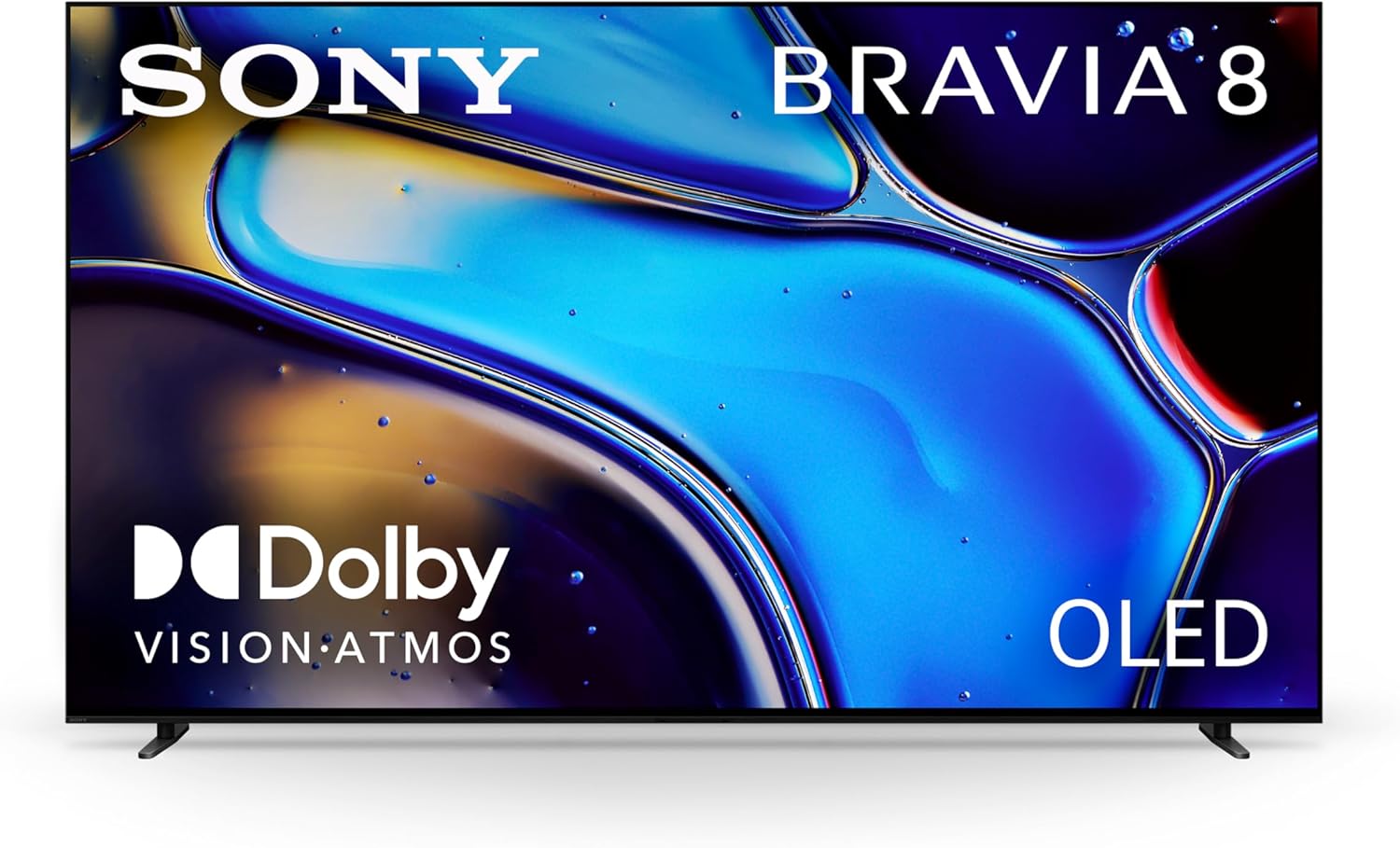
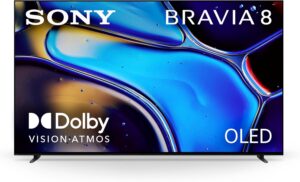
The Sony Bravia 8 pairs a WOLED panel with Acoustic Surface Audio+, a panel-driven speaker system reviewers single out as some of the best sound built into any TV, at a price on Amazon.ca that undercuts Samsung's QD-OLED S95F and LG's C6 by hundreds of dollars. Cognitive Processor XR and Google TV round out a set built more for movie nights and PS5 gaming with console-specific tuning than for spec-sheet bragging rights. Its 120Hz refresh ceiling and lower peak brightness than Samsung's and TCL's panels are the real compromise for Canadian buyers weighing that price and sound advantage.
Pros
- Acoustic Surface Audio+ delivers sound reviewers call some of the best built into any TV
- Cognitive Processor XR and a WOLED panel produce deep, per-pixel OLED contrast
- PS5-tuned gaming features plus low input lag suit console and PC gaming
- Google TV brings a broad app library and Chromecast built in
- Priced well below Samsung's S95F and LG's C6 at review time
Cons
- Peak HDR brightness trails Samsung's QD-OLED S95F and even TCL's Mini-LED QM6K
- 120Hz native refresh is lower than the 165Hz ceiling on some 2026 rivals
- Uses the standard WOLED panel, not the QD-OLED tech in Sony's own step-up Bravia 8 II
As an Amazon Associate I earn from qualifying purchases. Disclosure
Overview
Sony’s Bravia 8 OLED sits in the value tier of the company’s current TV lineup, one step below the newer QD-OLED-equipped Bravia 8 II, and its price has dropped well below its original launch figure since debuting in 2024. It ships in 55-, 65-, and 77-inch sizes; the 55-inch K-55XR80 reviewed here for Canadian shoppers is currently listed at $2,099.99 CAD on Amazon.ca, down from an original launch price near $3,499 CAD.
The real differentiator isn’t on the spec sheet: Sony’s Acoustic Surface Audio+ system turns the panel itself into part of the speaker array, and it’s the reason reviewers keep singling out this particular set for its sound rather than its brightness numbers. That trade-off — strong audio and OLED contrast over the highest peak-brightness figures in its class — shapes most of what follows.
Key Specifications
| Screen Size (this review) | 55 inches (K-55XR80) — also available in 65″ and 77″ |
| Panel Type | WOLED, 8 million self-lit pixels |
| Processor | Cognitive Processor XR |
| Refresh Rate | 120Hz native, VRR support |
| HDR Formats | Dolby Vision, HDR10 |
| Audio | Acoustic Surface Audio+, 50W 2.1-channel (2 actuators, 2 tweeters, 1 subwoofer) |
| Ports | 4x HDMI 2.1 (4K/120Hz, VRR, ALLM) |
| Smart Platform | Google TV |
| Price (CAD) | $2,098 |
Sony Bravia 8 OLED TV Picture Quality & Brightness
The Bravia 8 pairs a standard WOLED panel with Sony’s Cognitive Processor XR, which Sony’s own spec sheet describes as analyzing multiple picture elements — color, contrast, detail — together rather than individually, aiming to replicate how a viewer’s eye reads a scene. XR Contrast Booster 15 handles the panel’s per-pixel blacks and highlight detail, while XR Triluminos Pro widens color and keeps skin tones natural. RTINGS’ testing found the set to be a strong overall performer for mixed viewing, and What Hi-Fi’s review called it an improvement over Sony’s outgoing A80L.
Brightness is where the trade-off shows up. Measurements from RTINGS put the panel around 1,000 to 1,700 nits in HDR depending on picture mode, well short of the roughly 2,300 nits Samsung’s QD-OLED S95F reaches, and behind the zone-dependent peaks TCL’s Mini-LED QM6K can hit in its brightest zones. For a dark or moderately lit room the Bravia 8’s contrast and black levels hold up fine; buyers who watch in bright daylight rooms will notice the brightness gap against Samsung’s panel more than most other differences on this list.
Gaming Performance & Refresh Rate
All four HDMI ports run full-bandwidth HDMI 2.1, supporting 4K at up to 120Hz with VRR and ALLM. Independent input-lag testing has clocked the set at roughly 8.5ms at 4K/120Hz and about 16.5ms at 4K/60Hz — both comfortably inside the range competitive gamers look for. The 120Hz refresh ceiling is the one gaming spec where 2026 rivals have pulled ahead: LG’s C6 and Samsung’s S95F both now run up to 165Hz, a real edge for anyone with a PC graphics card that can push frame rates that high.
Sony’s console-side tuning partly offsets that gap. The Bravia 8 carries “Perfect for PlayStation 5” features including Auto HDR Tone Mapping and Auto Genre Picture Mode, which switch picture settings automatically based on what’s running rather than requiring a manual mode change — a genuine convenience for PS5 owners that neither LG nor Samsung replicates in quite the same integrated way.
Sound Quality & Acoustic Surface Audio+
This is the set’s clearest advantage. Acoustic Surface Audio+ uses two actuators embedded behind the panel to turn the screen itself into part of the speaker system, backed by two tweeters and a subwoofer in a 50W 2.1-channel array. Tom’s Guide’s review called the results “industry leading,” noting that no other current integrated TV audio system matches the clarity Sony’s approach delivers across dialogue, bass, and vocal performance — even at higher volumes.
That’s a genuine differentiator against LG’s and Samsung’s 2026 OLEDs, which rely on more conventional built-in speaker arrays rather than a panel-as-driver design. It won’t replace a real soundbar or home theater setup for anyone chasing reference-level bass, but out of the box, it’s a stronger starting point than most TVs in this price range offer.
Smart Features & Google TV
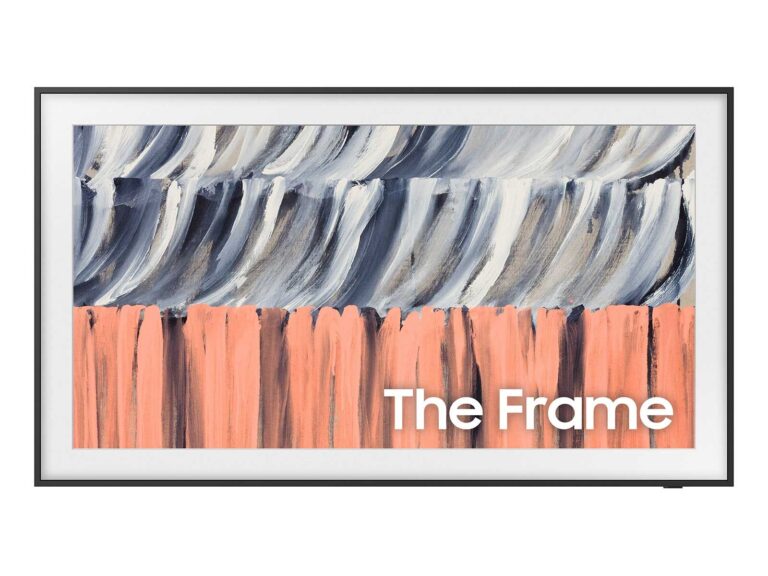
The Bravia 8 runs Google TV, which brings a broad app catalog, Chromecast built in, and Google Assistant voice control — a wider software ecosystem than Samsung’s Tizen-based Vision AI platform, which Samsung’s own product materials acknowledge trails Google TV’s app selection and search experience. Casting from a phone and navigating recommendations both feel familiar to anyone who has used an Android TV or Chromecast device before.
Real-world sentiment backs up the testing: owners of the U.S. 65-inch model are broadly positive rather than effusive, about what you’d expect from a TV that trades outright brightness for sound and value.
How Does It Stack Up Against the Competition?
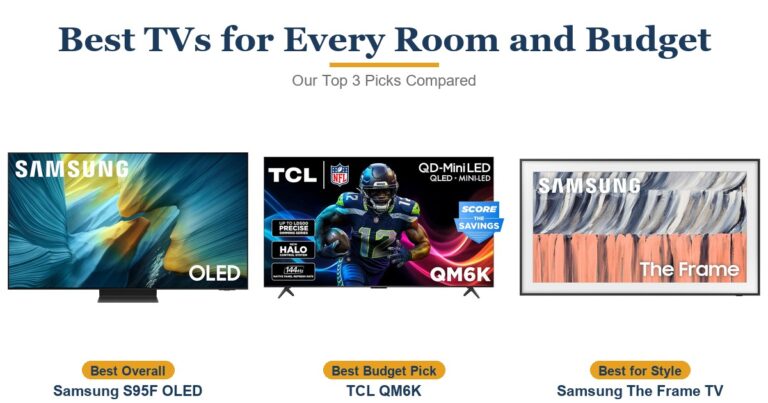
Here’s how the Bravia 8 compares to two pricier 2026 OLEDs and one budget Mini-LED alternative.
| Feature | Sony Bravia 8 | Samsung S95F | LG C6 OLED | TCL QM6K |
|---|---|---|---|---|
| Price (CAD) | $2,098 | $2,999 | $2,499 (65") | $1,099 |
| Panel | WOLED | QD-OLED | WOLED evo | QD-Mini LED |
| Peak HDR Brightness | ~1,000-1,700 nits (mode-dependent) | ~2,300 nits | ~1,300 nits | ~1,500 nits (zone-dependent) |
| Refresh Rate | 120Hz | 165Hz | 165Hz | up to 144Hz |
| Smart Platform | Google TV | Vision AI / Tizen | webOS 26 | Google TV |
| TTP Review | This review ↑ | Read our review → | Read our review → | Read our review → |
Prices change frequently — always verify current pricing before purchasing.
Is the Sony Bravia 8 OLED TV Worth It?
The Bravia 8 makes the most sense for buyers who want real OLED contrast and standout built-in sound without paying QD-OLED flagship prices — especially anyone who’d rather skip a soundbar purchase entirely and lean on Acoustic Surface Audio+ instead. PS5 owners get an added edge from Sony’s console-specific picture tuning that neither LG nor Samsung fully replicates.
Buyers chasing the single brightest picture for a sunlit living room should look at Samsung’s S95F instead, and anyone who wants the newest 165Hz refresh ceiling for high-frame-rate PC gaming is better served by the S95F or LG’s C6. Truly budget-focused shoppers who value raw brightness over OLED’s per-pixel contrast may also want to weigh TCL’s QM6K, which costs hundreds less.
Check the latest price for Sony Bravia 8 OLED TV
Check Current Price on Amazon.caReader Poll
Sony traded some peak brightness for standout built-in sound on the Bravia 8 — which would you prioritize?
Help Our Editors Know What Matters to You
Explore on Amazon →