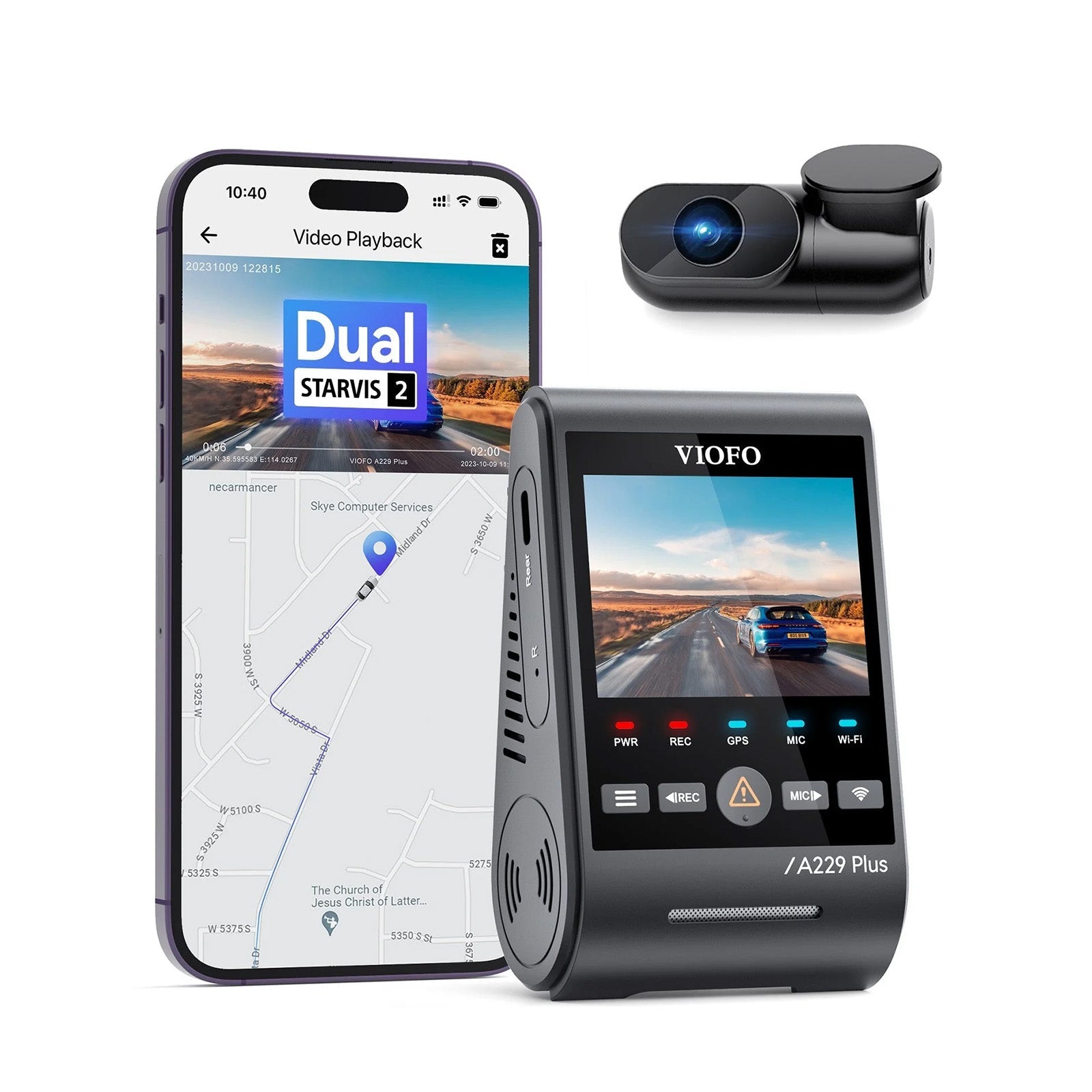
The A229 Plus is a strong pick if you care about what happens behind the car as much as ahead: its rear camera uses the same 2K STARVIS 2 sensor as the front, where kits such as REDTIGER's F7NP and 70mai's M800 fit a 1080p one. Buffered parking mode, GPS and an easy app make it a complete kit once hardwired, and its supercapacitor suits a car parked outside in winter, within VIOFO's -20°C rating. Its night footage is less consistent, and the voice commands have no French option. Drivers who want 4K up front should look at ROVE's R2-4K Dual Pro, which pairs a 4K front camera with the same 2K rear sensor, or VIOFO's A229 Pro, both on Amazon.ca.
Pros
- Rear camera uses the same 2K STARVIS 2 sensor as the front
- Detailed, colorful daytime footage
- Buffered parking mode plus time-lapse and low-bitrate options
- Built-in GPS, 5GHz Wi-Fi and an easy app
- Supercapacitor instead of a battery
Cons
- Night footage judged anywhere from very detailed to average
- Parking modes need a hardwire kit, sold separately; no microSD card included
- Adhesive mounts can't swivel or be easily repositioned
- No French voice commands
As an Amazon Associate I earn from qualifying purchases. Disclosure
Overview
Look at the back window first. The VIOFO A229 Plus fits its rear camera with the same 2K Sony STARVIS 2 sensor as the front one, where many rivals pair a sharp front camera with a 1080p one on the back window, so through a clear rear window, a car that hits you from behind gets recorded in nearly the same detail as the road ahead. Add HDR on both cameras, built-in GPS, 5GHz Wi-Fi and buffered parking mode, and it covers everything most drivers want from a dash cam without paying for 4K.
It is the 2K member of VIOFO’s A229 family. The A229 Pro, released at the same time and still sold alongside it, swaps in a 4K front camera, and the Plus also comes in front-only and three-camera versions with an infrared cabin camera. This review covers the two-camera kit, sold on Amazon.ca. Two details matter more in Canada than in the US: VIOFO rates the camera to operate down to -20°C, so in deeper cold it is running below its rated range, and VIOFO lists its voice commands in English, Chinese, Russian and Japanese, with no French option.
Key Specifications
| Price (CAD) | $349.99 |
| Cameras | Front and rear (an infrared cabin camera can be added) |
| Video resolution | Front 2K (1440p) at up to 60fps; rear 2K (1440p) at 30fps |
| Image sensors | Sony STARVIS 2 IMX675 (5MP), front and rear |
| Lenses | Front F1.8, 140° field of view; rear F1.9, 160° |
| HDR | Front and rear |
| Screen | 2.4-inch |
| Connectivity | 2.4GHz and 5GHz Wi-Fi, built-in GPS, Bluetooth (for VIOFO’s optional remote) |
| Parking modes | Buffered auto event detection, time-lapse, low bitrate (need the HK4 hardwire kit, sold separately) |
| Storage | microSD card up to 512GB (not included) |
| Power backup | Supercapacitor (no battery) |
| Operating temperature | -20°C to 65°C (-4°F to 149°F) |
| Size | Front 99 x 58 x 46 mm (3.9 x 2.3 x 1.8 in); rear 6.7 x 3.4 x 2.8 cm (2.64 x 1.33 x 1.1 in) |
| Warranty | 18 months (12, plus 6 when registered online) |
VIOFO A229 Plus Video Quality
In daylight the A229 Plus records the kind of footage that settles an insurance claim: colorful, sharp and well balanced. Automoblog could read license plates from dozens of yards away in daytime clips, without touching the settings or fitting a filter. PCWorld, testing the three-camera version, found the rear captures almost as good as the front, with little fish-eye distortion and oncoming headlights handled without much flare. That rear camera is the point of this kit: the same 5MP sensor front and back means the plate of a car that rear-ends you should be nearly as legible as the one ahead. Tinted rear glass changes that: Wirecutter, testing the A229 Pro, which uses the same rear camera, found the rear footage dim through tinted windows, and raising the exposure in the app helps by day but hurts the picture once it’s dark, a limit it says isn’t specific to VIOFO.
After dark the verdicts split: PCWorld called its night captures very detailed and Digital Camera World found the footage clear, while DashCamTalk rated the rear camera’s night video only average and Automoblog judged its nighttime video passable, in line with most dash cams it has tested. Expect usable evidence once the light goes rather than the standout clarity it delivers by day.
VIOFO lets the front camera record at up to 60fps in this two-camera kit, which helps with fast-moving traffic; the three-camera tests ran it at 30fps. At 30fps, DashCamTalk reports average bitrates of 29 Mbps for the front camera and 24 Mbps for the rear, and credits the front camera’s high bitrate for its very good daytime video. VIOFO’s optional polarizing filter cuts windshield glare for more saturated daytime colors; PCWorld noted it costs a little brightness in low light. Each 2K camera wrote about 150MB of video a minute in PCWorld’s test, so it recommends a card of at least 256GB to hold most of a day’s driving.
Parking Mode, Power and Heat
Once it’s wired in, parking coverage is a strength. Plan on VIOFO’s HK4 hardwire kit (sold separately), which runs to the fuse box, or a dash cam battery pack: without constant power, none of the parking features work. With it, you choose between buffered event recording, which saves the seconds before a bump along with the moments after, and two continuous options, time-lapse and low bitrate, that can stretch a card across a whole night.
Instead of a battery, the camera has a supercapacitor, which tolerates heat and cold better than a lithium battery; VIOFO rates the camera to operate from -20°C to 65°C (-4°F to 149°F), so on mornings colder than -20°C it is outside that rating. PCWorld found the supercapacitor keeps the camera running for 3 to 5 seconds after power cuts out, long enough to close the open video files but not to keep recording. DashCamTalk also found the Plus runs cooler than its 4K sibling, the A229 Pro, which it expects should help reliability. A built-in G-sensor locks the current clip on an impact so it isn’t recorded over.
Setup, App and Voice Control
Installation is simple, with one catch about placement. The front and rear cameras stick to static films on the glass, so they come off later without leaving residue, but the adhesive mounts can’t be swiveled sideways or easily repositioned once stuck. Line them up before pressing them on. Digital Camera World, setting up its first dash cam, found running the cables the only real hassle and recommends the hardwire kit, which it says solves the problem.
Day to day it runs itself. The VIOFO app on iOS and Android gives a live view for aiming the cameras, quick downloads over 5GHz Wi-Fi and access to every setting, and testers found it straightforward. There are also voice commands (DashCamTalk counts 10) for tasks such as locking a clip or taking a photo, which VIOFO lists in English, Chinese, Russian and Japanese. Automoblog often had to repeat commands before the camera followed them. As for which ones matter, DashCamTalk considers Lock Video the only command most drivers will use regularly. A Bluetooth remote, sold separately, gives a one-press alternative.
Budget for a microSD card, since none comes in the box. VIOFO’s warranty runs 18 months: 12 months, plus 6 more if the camera is registered online.
How Does It Stack Up Against the Competition?
These front-and-rear kits are the ones most likely to be on the same shortlist: ROVE’s dual-STARVIS 2 Pro kit, REDTIGER’s budget 4K kit and 70mai’s compact, screenless M800.
| Feature | VIOFO A229 Plus | ROVE R2-4K Dual Pro | REDTIGER F7NP | 70mai M800 |
|---|---|---|---|---|
| Price (CAD) | $349.99 | $385.34 (last Amazon price, Oct 15, 2026) | Deal $152.99 until Oct 25 | $199.99 |
| Front / rear recording | 2K (1440p) / 2K (1440p) | 4K / 2K (1440p) | 4K / 1080p | 4K / 1080p |
| Image sensors | Sony STARVIS 2 IMX675 front and rear | Sony STARVIS 2 IMX678 front, IMX675 rear | STARVIS 2 front (rear sensor not listed) | Sony STARVIS 2 IMX678 front, IMX662 rear |
| Field of view (front / rear) | 140° / 160° | 150° / 140° | 170° / 140° | 140° / 130° |
| Screen | 2.4-inch | 3-inch | 3.18-inch | None |
| Storage | microSD up to 512GB, card not included | microSD up to 1TB, 128GB card included | microSD, 128GB card included | 128GB built in, no card slot |
| Amazon | View on Amazon | View on Amazon | View on Amazon | View on Amazon |
Prices change frequently — always verify current pricing before purchasing.
VIOFO A229 Plus: Worth It for Sharp 2K Evidence Behind You
For Canadian drivers, the A229 Plus is worth buying for the same reason as in the US: through a clear rear window, its matched 2K cameras give the rear view nearly the same detail as the front (tinted glass dims it, a limit not specific to VIOFO), and once hardwired, buffered parking mode keeps watch with the moments before an impact included. A car parked outside through the winter is where its supercapacitor helps, since it tolerates cold better than a lithium battery, though VIOFO’s rating stops at -20°C. French-speaking drivers should know the voice commands have no French option; the buttons, the app and VIOFO’s Bluetooth remote do the same jobs. Night footage is the one area where it is merely competitive, and a rideshare driver who needs the cabin covered too should buy the three-camera version, which adds an infrared interior camera.
Shop elsewhere if you want 4K up front. ROVE’s R2-4K Dual Pro uses the same 2K IMX675 sensor in its rear camera, adds a 4K front camera and includes a 128GB card, a polarizing filter and a suction mount that lifts off the glass, a better fit if you move the camera between cars; the Plus’s rear camera sees wider, at 160° against 140°. REDTIGER’s F7NP is the budget route to a 4K front camera, with a 1080p rear one. The 70mai M800 drops the screen for a pocket-size body and 128GB of built-in storage. Within VIOFO’s line, the A229 Pro, Wirecutter’s best overall dash cam, is the step up for a 4K front camera with the same body, app and parking modes.

Sources
- VIOFO — A229 Plus 2CH Official Product Specifications
- VIOFO A229 Plus — Amazon.ca Product Listing
- PCWorld — Viofo A229 Plus 3ch review
- Automoblog — Viofo A229 Plus Review
- DashCamTalk — VIOFO A229 Plus
- Digital Camera World — Viofo A229 Plus dashcam review
- BlackboxMyCar — VIOFO A229 Plus Duo In-Depth Review
- Wirecutter — The Best Dash Cam
- ROVE — R2-4K Dual Pro Product Page
- TechRadar — Rove R2-4K Dual Pro Dash Cam review
- REDTIGER — F7NP Product Page
- 70mai — Dash Cam 4K M800 Product Page
- The Smart Home Hookup — Best Dashcams After Testing 13 Models
- DashCamTalk — 70mai 4K M800 Testing / Review
Reader Poll
What would you most want a front-and-rear dash cam to catch?
Help Our Editors Know What Matters to You
Explore on Amazon →