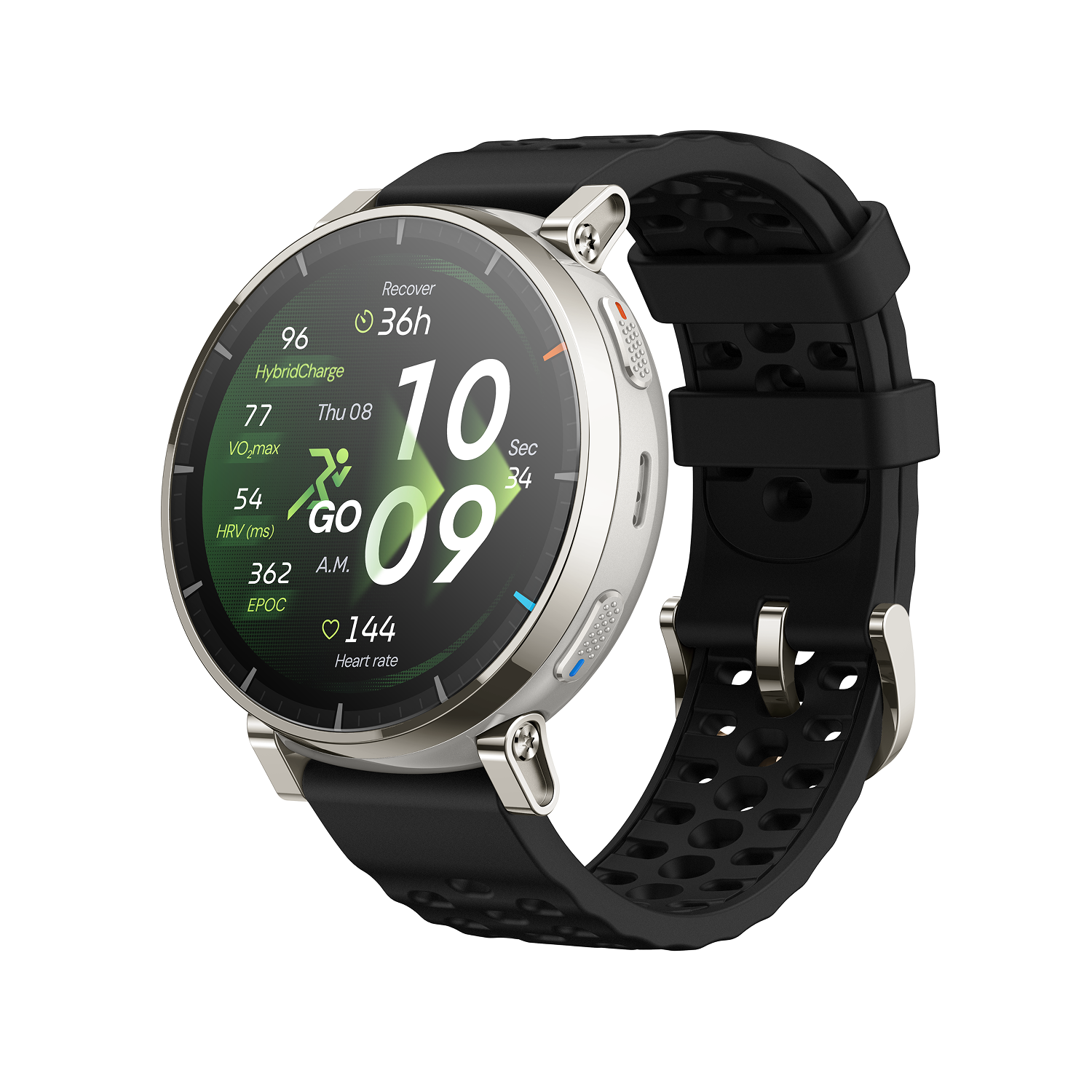
A smart first running watch for anyone training toward a first race, on iPhone or Android: adaptive plans, guided workouts and form metrics come with no subscription. Sapphire glass, a steel frame and offline maps give it a build and feature list usually saved for flagship watches. Its single-band GPS is less precise on difficult routes, so runners who want the most accurate distance are better served by the COROS PACE 4.
Pros
- Adaptive plans and guided workouts for new runners
- Sapphire glass and stainless steel frame
- Offline maps with turn-by-turn navigation
- Accurate sleep tracking
- No subscription for training or recovery data
- Works with iPhone and Android
Cons
- Single-band GPS is less precise on some routes
- Wrist heart rate slips in hard intervals
- Zepp app store is small next to Apple's or Google's
- Charging cable not included
As an Amazon Associate I earn from qualifying purchases. Disclosure
Overview
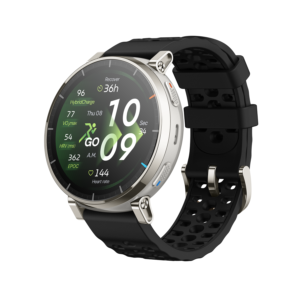
Sapphire glass, offline maps and running metrics such as a lactate threshold estimate are usually saved for flagship watches, which is what makes the Amazfit Active 3 Premium interesting. Launched in February 2026, it is a GPS running watch built for people training toward their first 5K, 10K or half marathon, and it pairs with both iPhone and Android phones. Amazfit aims it squarely at new and entry-level runners, and Live Science calls it one of the best entry-level running watches it has tested. Tom’s Guide goes further, ranking it the best smartwatch overall in its current roundup.
Despite the name, there is no regular Active 3 to step up from: the Premium is the only model in the range. Against last year’s Active 2, it moves to a larger 45 mm stainless steel case with sapphire glass as standard, four physical buttons instead of two and a brighter 3,000-nit screen. It also gains the running tools of Amazfit’s higher-tier watches, including running power, ground contact time and a lactate threshold estimate.
Key Specifications
| Price (USD) | $169.99 |
| Display | 1.32-inch AMOLED, 466 x 466, up to 3,000 nits peak |
| Screen cover | Sapphire glass |
| Case | 45 x 45 x 11 mm, stainless steel frame, 4 buttons |
| Weight | 38 g (without strap) |
| Water resistance | 5 ATM |
| Rated battery life | Up to 12 days typical, 7 days heavy, 4 days always-on display |
| Rated GPS battery life | Up to 24 hours (76 hours in power saving mode) |
| Positioning | Five satellite systems, single frequency |
| Sensors | BioTracker optical heart rate (5PD + 2LED), barometric altimeter, compass, gyroscope, temperature |
| Storage | 4 GB |
| Works with | Android 7.0 and above, iOS 14.0 and above (Zepp app) |
| In the box | Watch with silicone strap, magnetic charging base (no cable) |
Amazfit Active 3 Premium Running and GPS Accuracy
For everyday runs and hikes, the tracking held up in testing. Live Science used it on two day-long hikes through dense woodland and on runs around a local park, and found its location estimates accurate enough to make it a reliable workout companion.
The trade-off is the positioning chip. The watch uses single-band GPS rather than the dual-frequency systems on Amazfit’s T-Rex and Cheetah watches or on the COROS PACE 4. Wareable ran it against a dual-band running watch and found distance occasionally lacked precision and average pace was sometimes a bit off, though most runs tracked well. It matters most on routes where GPS signals already struggle.
Heart rate follows the same pattern. Live Science compared it with a Polar H9 chest strap, a Whoop MG and an Oura Ring 4 and found the readings reflected the intensity and training load of its workouts, but precision dropped above about 150 bpm. Other testers saw the optical sensor struggle in intervals and hard efforts too. The workaround is simple: the watch pairs with Bluetooth chest straps, and Wareable connected Garmin and Polar monitors without trouble. Live Science also found it tended to undercount steps and upper-body movement, such as the stroke rate on a rowing machine.
Training Plans and Running Metrics
This is where the Active 3 Premium earns its keep for newer runners. Zepp Coach builds adaptive plans for 5K, 10K, half and full marathon races, and a library of built-in workouts introduces staple sessions such as tempo runs and fartleks, complete with warm-ups and cool-downs. Wareable liked that the workouts show clearly on the watch whether you are hitting your target pace.
The metrics go further than most watches at this price: running power, ground contact time, posture, a lactate threshold estimate, VO2 max, training load and running gear mileage. The Zepp app explains each stat in plain language, along with what you should be aiming for, though Wareable felt the post-run insights, such as VO2 max and training load, may still need more context for beginners. Workouts sync to Strava, TrainingPeaks and Runna, so you can follow a plan built elsewhere. The analysis has limits: The Run Testers found it is mainly restricted to training load, VO2 max and recovery advice, so data-hungry runners will find less to dig into than on a Garmin.
It also covers more than running. There are 170+ sport modes, including HYROX race and training modes, and the strength mode recognizes 25 exercises automatically. Wareable found its lap and rep tracking in the pool and on the rowing machine comparable to leading trackers, while Live Science found it didn’t seem to pick up certain strength exercises.
Sleep and Recovery Tracking
Sleep tracking drew consistent praise. Tom’s Guide rates it as accurate as Amazfit’s Helio Strap, catching even the brief wake-ups its tester forgot. Wareable wore it alongside an Oura Ring 4 and saw similar figures for sleep duration and deep and REM sleep, although the watch often took about 20 minutes longer to register falling asleep and waking up.
Recovery is summed up in Amazfit’s readiness scores. BioCharge and HybridCharge combine sleep, heart rate variability, stress and recent training to suggest whether to push or rest. TechRadar found HybridCharge read its tired days well, and points out that this kind of score used to need a paid subscription with other brands; here it is included, with no subscription for workout or recovery data in the Zepp app. None of its health features is regulatory-approved, and Amazfit says the watch and Zepp app are not medical devices.
Display, Build and Battery Life
The build is the clearest step above its price. Its stainless steel frame helps here too: Live Science found it the more durable choice over Amazfit’s own Active Max, which uses an aluminum bezel. The 3,000-nit AMOLED stayed readable in direct sunlight in testing, though Live Science found it seemed to collect more fingerprints than other running watches it has tested. At 38 g without the strap, testers found it light and comfortable enough to sleep in. Tom’s Guide’s tester, told by Amazfit that it was designed mostly with women in mind, wanted more color options than the three on offer.
Amazfit rates the battery at up to 12 days of typical use, and testers got a little less: about 10 days in two reviews, while Tom’s Guide’s unit was down to 6% after 8 days of heavy testing. In a month of everyday wear afterward, the same tester reported up to, and sometimes over, 12 days per charge. GPS use drains it faster: in its most accurate mode, Wareable measured an average drop of 5-6% per hour of running, short of the 24-hour rating, though Wareable was still confident it would last a week of running or a marathon. The charging base takes a USB-C cable, which is not included in the box.
Smartwatch Features and the Zepp App
Wareable found it handles the basics well: notifications, music controls, weather, Bluetooth calls with clear sound through its speaker, and a morning summary. Its 4 GB of storage holds offline maps and your own music, though Wareable found syncing a large music library slow, and Amazfit says third-party music apps such as Spotify can’t be installed on the watch, though it controls music playing on your phone. Contactless payment through Zepp Pay depends on your region, and the Zepp app store doesn’t match Apple’s or Google’s.
The Zepp app itself is much improved: slicker than it used to be, easy to set up and friendly to beginners. Amazfit lists automatic recognition for eight workout types, including outdoor running, treadmill and walking, but two reviewers got no prompt to start a workout, so be ready to press start yourself.
How Does It Stack Up Against the Competition?
Testers weigh it against the entry-level running watches from Garmin and COROS, plus Amazfit’s own bigger Active Max. As of November 2026, the Active 3 Premium costs less on Amazon than the Garmin and COROS watches, while the Active Max sells at about the same price.
| Feature | Amazfit Active 3 Premium | Garmin Forerunner 170 | COROS PACE 4 | Amazfit Active Max |
|---|---|---|---|---|
| Price (USD) | $169.99 | $289.99 | $249.00 | $169.99 |
| Display | 1.32-inch AMOLED | 1.2-inch AMOLED | 1.2-inch AMOLED | 1.5-inch AMOLED |
| Controls | Touchscreen + 4 buttons | Touchscreen + 5 buttons | Touchscreen + dial and 2 buttons | Touchscreen + 2 buttons |
| Rated battery (smartwatch use) | Up to 12 days | Up to 10 days | Up to 19 days | Up to 25 days |
| Rated GPS battery | Up to 24 hours | Up to 20 hours (GPS only) | Up to 41 hours (All Systems) | Up to 64 hours |
| TTP Review | This review ↑ | Read our review → | Read our review → | — |
| Amazon | View on Amazon | View on Amazon | View on Amazon | View on Amazon |
Prices change frequently — always verify current pricing before purchasing.
Amazfit Active 3 Premium: Worth It as a First Running Watch
Buy it if you are building toward your first race and want plans, guided workouts and form metrics that explain themselves, on a sapphire-glass watch that works with any phone. It suits road runners and gym-goers who mix running with strength or HYROX sessions, and anyone who wants sleep and recovery tracking without a subscription. TechRadar gave it a perfect value score, and Live Science found it suitable for more experienced runners too. If you mostly run intervals, add a chest strap rather than trusting the wrist sensor.
Look elsewhere if accuracy matters more than features. The COROS PACE 4 has dual-frequency GPS and much longer rated GPS battery life, and The Run Testers calls it the better all-round running watch if you can spend a little more. Garmin’s Forerunner 170 adds Garmin Pay on every edition and five physical buttons. If you would rather have a bigger screen and the longest rated battery, Amazfit’s Active Max costs about the same, though Live Science found it the less durable of the two.
Sources
- Amazfit — Active 3 Premium Official Product Specifications
- Amazfit Active 3 Premium — Amazon Product Listing
- Live Science — Amazfit Active 3 Premium review
- Wareable — Amazfit Active 3 Premium review: Sapphire on a shoestring
- TechRadar — Amazfit Active 3 Premium review
- Tom’s Guide — Amazfit Active 3 Premium review
- Tom’s Guide — I tested the Amazfit Active 3 Premium for a month
- Tom’s Guide — The best smartwatches
- The Run Testers — Amazfit Active 3 Premium review
- the5krunner — Amazfit Active 3 Premium specs, features and battery life
- DC Rainmaker — Garmin Forerunner 70 vs Forerunner 170 comparison
- COROS — PACE 4
- the5krunner — COROS Pace 4 review
- Amazfit — Active Max Official Product Specifications
Reader Poll
What would make you pick a running watch over a regular smartwatch?
Help Our Editors Know What Matters to You
Explore on Amazon →