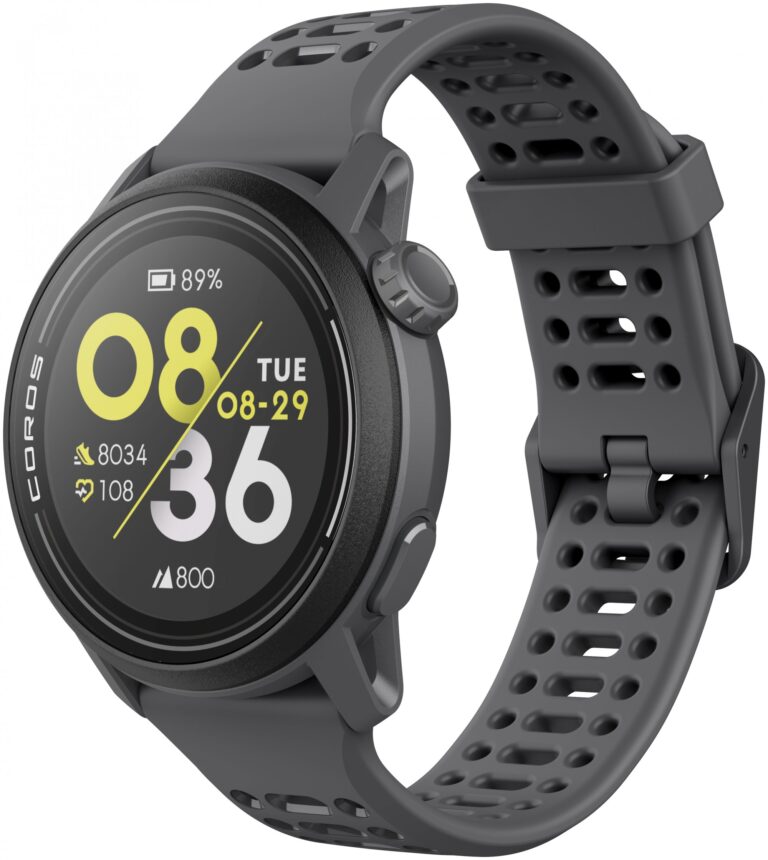
Buy the PACE 4 if you want a light running or triathlon watch you can trust on the route and rarely need to charge. Its dual-band GPS kept pace with Garmin's flagship Forerunner 970 in side-by-side tests, and COROS rates it at 19 days of daily use. The trade-off is the everyday smartwatch layer, with no contactless payments or music streaming, so the Garmin Forerunner 170 fits better if you want those on your wrist.
Pros
- Dual-band GPS that matched a Garmin flagship in tests
- Rated for 19 days of daily use and 41 hours of GPS
- Light at 32 g with the nylon band
- Full triathlon and multisport mode
- Offline maps since a September 2026 update
Cons
- No contactless payments or music streaming
- Heart rate less reliable in cycling and gym sessions
- 4GB of storage limits how much map area fits
- Mineral glass lens is likelier to scratch than sapphire
As an Amazon Associate I earn from qualifying purchases. Disclosure
Overview
Most runners want three things from a watch: a route track they can trust, a battery that lasts the week and a weight they forget about. The COROS PACE 4, launched in November 2025 as the latest entry-level model in COROS’s PACE line, covers all three with dual-band GPS, a rating of 19 days of daily use and 32 g on the nylon band.
Against the PACE 3, the big change is the screen: a 1.2-inch AMOLED touchscreen in place of the old memory-in-pixel panel, with what COROS calls 164% higher resolution. COROS also rates it for 16 more hours of all-systems GPS than the PACE 3, and it adds a microphone for voice notes, an action button and, since a September 2026 software update, offline maps. Its training tools are the same set COROS puts on its higher-end APEX 4 and PACE Pro.
Key Specifications
| Price (USD) | $249.00 |
| Display | 1.2-inch AMOLED touchscreen, 390 x 390 pixels, mineral glass |
| Case | 43.4 x 43.4 x 11.8 mm (excluding the heart-rate sensor), fibre-reinforced polymer |
| Weight | 32 g with nylon band, 40 g with silicone band |
| Battery, daily use | Up to 19 days (6 days with always-on display) |
| Battery, GPS | 41 hours all-systems, 31 hours dual-frequency |
| Satellite systems | GPS, GLONASS, Galileo, BeiDou, QZSS; dual-frequency |
| Sensors | Optical heart rate, pulse oximeter, barometric altimeter, compass, gyroscope, thermometer, microphone |
| Storage | 4GB |
| Connectivity | Bluetooth and Wi-Fi; no ANT+, no NFC |
| Water rating | 5 ATM |
| Charging | COROS USB-C adapter (USB-C cable not included) |
| Warranty | 2 years from activation (bands 180 days from purchase) |
| Released | November 2025 |
COROS PACE 4 GPS Accuracy
This is the PACE 4’s strongest point. It tracks on two frequencies across five satellite systems, a mode that can improve reliability among tall buildings and under dense tree cover, and Wareable notes COROS turns it on by default, where on other watches you often have to switch it on yourself. Live Science measured a 0.2% distance gap against Garmin’s flagship Forerunner 970 over 25 km (15.5 miles). Android Central’s runs of about 13 and 19 km (8 and 12 miles) came out 24 m and 60 m short of the same Garmin.
It holds up in difficult places too. the5krunner, which has run the same GPS test route on almost every watch it has reviewed for a decade, calls it one of the most accurate sports watches it has tested, although the PACE 3 edged it on that route. Tom’s Guide got a pretty accurate track through the Canary Wharf section of the London Marathon, a stretch that is notoriously hard on watches.
Tom’s Guide ran it beside the Forerunner 170 on a parkrun and a 16 km (10-mile) forest run, and beside the Forerunner 70 in a 10K race. Both Garmins track on a single frequency at best, yet distances, pace and tracks came out almost identical. In Tom’s Guide’s testing so far, dual-band hasn’t made a big difference; its advantage is meant to show in the hardest places, such as among tall buildings.
Heart Rate Tracking
Heart rate is good for steady running and less consistent elsewhere. On steady runs it tracks closely: Android Central’s 19 km (12-mile) run matched a chest strap’s 171 bpm average.
The first minutes of a run are where testers split. Tom’s Guide found the PACE 4 often read high for a few minutes before locking on, while Live Science found it largely avoided that early-run problem but saw occasional too-high peaks on long runs. In Tom’s Guide’s head-to-head, the Forerunner 170 matched a chest strap more closely than the PACE 4, which had some erroneous spikes.
In other workouts and harder efforts it slips further. Wareable’s spin class logged a 155 bpm peak when the true figure was in the high 170s. On hill repeats and on rides beyond two hours, the5krunner saw it under-read. For interval-heavy training or cycling, the5krunner recommends a chest strap, which pairs over Bluetooth.
Battery Life and Charging
On COROS’s ratings it lasts the longest of the watches here: 19 days between charges in daily use (6 with the screen always on), and 31 hours of dual-frequency GPS tracking (24 with the screen always on), or 41 hours in the all-systems mode. Both rivals in our table are rated shorter: Garmin lists the Forerunner 170 at 10 days and 14 hours of all-systems GPS, and Suunto rates the Run 2 at 10 days and 24 hours of dual-band GPS.
Real use lands a little under the ratings. Wareable’s watch dropped from 100% to 29% in eight days that included about 100 km of runs, which projects to around 11.5 days, and Live Science got just under two weeks with a fairly heavy load of run tracking and a few gym sessions. With the screen always on and a run every day, Tom’s Guide gets about five days, against three to four from the Forerunner 170 used the same way. Measured drain in dual-frequency mode ran from about 4% an hour (DC Rainmaker) to 6% (Live Science).
It charges through a small COROS adapter that takes any USB-C cable, but the cable isn’t in the box and the older PACE 3 charger doesn’t fit. Treeline Review notes COROS will send a free cable on request.
Training Tools, Maps and Everyday Features
The training side is unusually complete for an entry watch: training load and recovery time, a race predictor, VO2 max estimates, running power and personalized marathon plans, with free multi-week plans from 5K to marathon in the COROS app. It is also a full triathlon watch with a multisport mode, which Tom’s Guide notes Garmin leaves off both the Forerunner 170 and the Forerunner 70, and it reads Bluetooth power meters on the bike.
Garmin still does more with the data. Its Forerunners add a Training Readiness score that the PACE 4 lacks, and Live Science points out that COROS offers no adaptive day-to-day workout suggestions. The training load figure on the watch also still resets every Monday, which doesn’t reflect how recovery works.
Maps arrived late, which is why reviews from before September 2026 say it has none. At launch it could only follow a route as a breadcrumb line; since a September 2026 software update it shows downloadable offline maps with street and trail names and points of interest. Storage is the limit: of the 4GB on board, only 1.71GB was available to use when Wareable tested it, so you pick the regions you need. By the5krunner’s count, a UK and Ireland map takes about 0.5GB. The Forerunner 170 has no onboard maps at all.
What it lacks is the everyday smartwatch layer: no contactless payments, no music streaming services and no app store. Music plays only from MP3 files you copy onto the watch, through Bluetooth headphones.
The microphone records location-tagged voice pins mid-run and a spoken note after it, which the app transcribes, but there is no speaker for calls. Live Science found recording a voice note clunky, at a long press, a turn of the dial and three more button presses. Garmin’s watch interface is also more polished and more customizable than COROS’s.
Fit, Screen and Controls
At 40 g with the silicone band (32 g with nylon) and 11.8 mm thick, it is comfortable enough to wear around the clock, including overnight for sleep tracking. The shell, buttons and dial are plastic, and the lens is mineral glass rather than Gorilla Glass or sapphire, so it is likely to scratch more easily than those, though the testers who mention it hadn’t scratched theirs during testing.
Outdoors it is readable in bright sun: DC Rainmaker ran on the default Standard setting without trouble, while Wareable found that battery-saving default conservative and the High and Max settings noticeably brighter. The screen’s 1,500-nit peak sits below the Suunto Run 2’s 2,000 nits. Controls are a digital dial, a back button, an action button and the touchscreen, and Tom’s Guide found the dial easy to trigger by accident, preferring Garmin’s five buttons.
Water resistance is 5 ATM, fine for pool and open-water swims but not for diving.
How Does It Stack Up Against the Competition?
The Garmin Forerunner 170 is Garmin’s current watch at this tier, the successor to the Forerunner 165 that launch reviews compared the PACE 4 with, and Tom’s Guide tested the two head to head. The Suunto Run 2 is Suunto’s current running watch, with dual-band GPS and offline maps as standard.
| Feature | COROS PACE 4 | Garmin Forerunner 170 | Suunto Run 2 |
|---|---|---|---|
| Price (USD) | $249.00 | $299.99 | $349.00 (4GB) |
| Display | 1.2-inch AMOLED | 1.2-inch AMOLED | 1.32-inch AMOLED |
| Satellite tracking | Dual-frequency, all systems | All systems, single-frequency | Dual-band (L1 + L5), all systems |
| Rated GPS battery, most accurate mode | 31 hours (dual-frequency) | 14 hours (all systems) | 24 hours (dual-band) |
| Rated smartwatch battery | Up to 19 days | Up to 10 days | Up to 10 days |
| Offline maps | Yes (added September 2026) | No | Yes |
| Music on the watch | MP3 files, no streaming services | No (Forerunner 170 Music only) | MP3 files, no streaming services |
| Contactless payments | No | Yes (Garmin Pay) | No |
| TTP Review | This review ↑ | Read our review → | — |
| Amazon | View on Amazon | View on Amazon | View on Amazon |
Prices change frequently — always verify current pricing before purchasing.
COROS PACE 4: Worth It for Long Battery Life and Accurate GPS
Buy it if you run or train for triathlons and want a watch that stays out of the way: it tracks routes accurately, covers swim, bike and run in one activity, and is rated to outlast both its Garmin and Suunto rivals on a charge. As of October 2026 it also costs less than both rivals in the table. Garmin tends to discount its Forerunners in big sales while COROS usually doesn’t, so the gap can narrow or flip during sale events. Tom’s Guide’s tester, after a full marathon training block with it, would lean towards it over the Forerunner 170 for the saving.
Look elsewhere if your watch doubles as your wallet or music player: the Forerunner 170 adds Garmin Pay, Training Readiness and a more polished interface, and its Music edition stores Spotify playlists. Garmin’s entry Forerunner 70 is the other close call Tom’s Guide weighed it against, with better training analysis but no triathlon mode or open-water swimming. Runners who lean on maps or want steadier heart rate can step up to the Suunto Run 2, whose heart rate the5krunner measured within a 1 bpm bias across eight test sessions. It also has a steel bezel, Gorilla Glass, a larger 2,000-nit screen and a 64GB option for bigger map regions.

Sources
- COROS — COROS PACE 4 Product Page
- COROS — COROS Warranty Policy
- COROS PACE 4 — Amazon Product Listing
- the5krunner — COROS Pace 4 In-Depth Review
- the5krunner — COROS Pace 4: Release Date, Size, Dimensions and Specs
- the5krunner — Coros vs Garmin: Pace 4 adds maps
- DC Rainmaker — COROS Pace 4 In-Depth Review
- Live Science — Coros Pace 4 review
- Wareable — Coros Pace 4 review
- Android Central — I tested the COROS PACE 4
- Tom’s Guide — Garmin Forerunner 170 vs Coros Pace 4
- Tom’s Guide — Garmin Forerunner 70 vs Coros Pace 4
- Treeline Review — COROS PACE 4 watch review
- Garmin — Forerunner 170 Series Owner’s Manual
- the5krunner — Garmin Forerunner 170 Specs
- Suunto — Suunto Run 2
- the5krunner — Suunto Run 2: Release Date, Price, Specs and Battery
Reader Poll
Would the PACE 4's missing contactless payments and music streaming put you off?
Help Our Editors Know What Matters to You
Explore on Amazon →