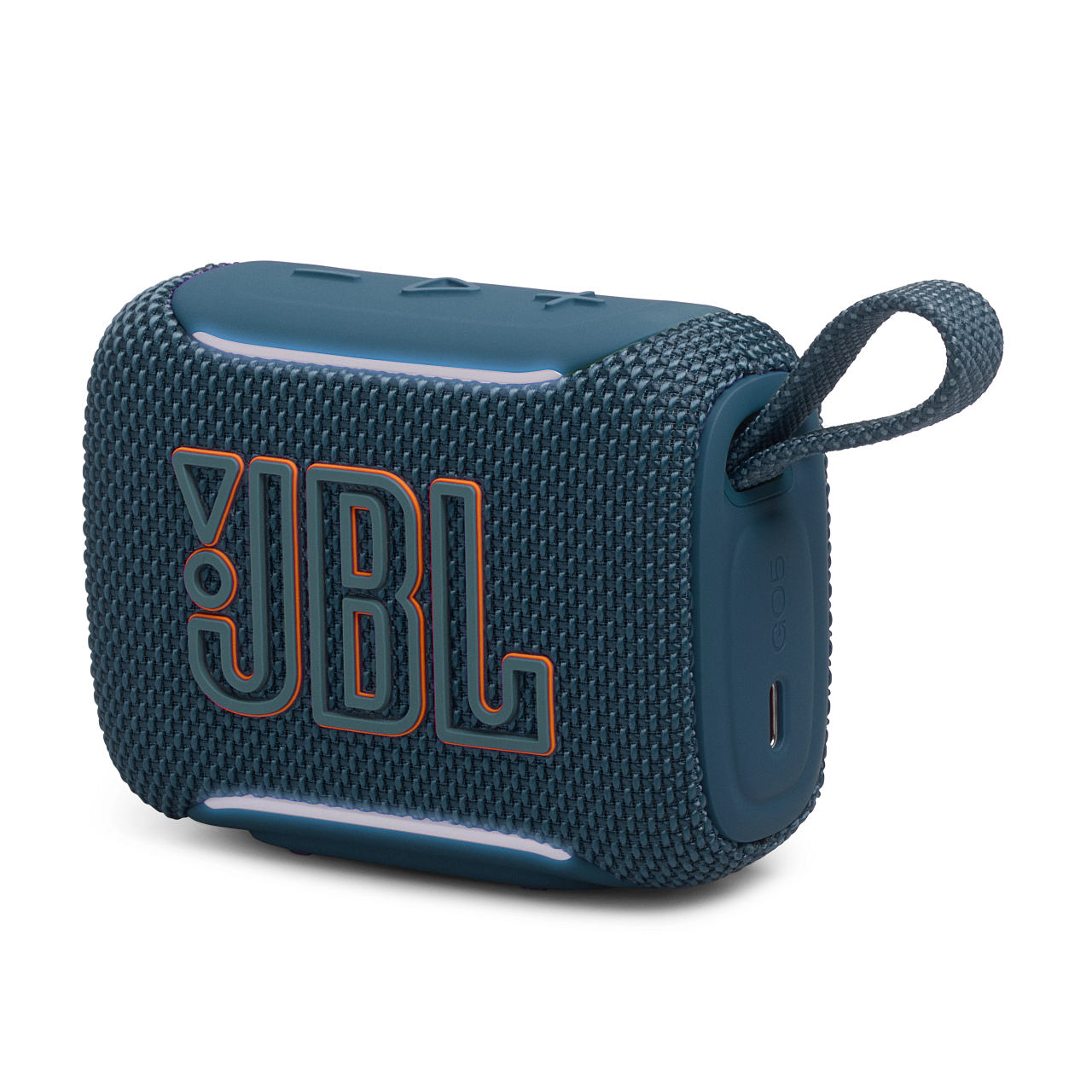
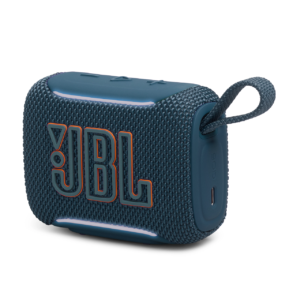
The Go 5 is the speaker to buy when it has to fit in a pocket and shrug off a dunk: it sounds fuller and clearer than its size suggests, and the IP68, drop-proof shell is made for showers, bike rides and beaches. Tapping two together with AirTouch makes an instant stereo pair. The trade-off is stamina, at about eight hours per charge where rivals such as Tribit's StormBox Micro 3 are rated for far longer, so pick that Tribit if your speaker has to last a long weekend away from a charger.
Pros
- Full, clear sound for its size
- IP68 waterproof and dustproof, drop-proof build
- Palm-sized at 230 g with a carry loop
- AirTouch stereo pairing and Auracast
- 7-band custom EQ in the JBL Portable app
- Lossless USB-C audio input
Cons
- Shorter battery than rivals: 8 hours rated
- No deep bass, and too quiet for big gatherings
- No built-in microphone for calls
- Light color can't be changed; no USB-C cable in the box
As an Amazon Associate I earn from qualifying purchases. Disclosure
Overview
A phone speaker in the shower or on a picnic blanket sounds thin; the JBL Go 5 is the fix that still fits in a jacket pocket. It’s the smallest speaker in JBL’s portable range, only slightly bigger than a pack of cards, with a loop to hang it from a bag and a shell that shrugs off water and dust. What Hi-Fi? called it a “no-brainer” among budget Bluetooth speakers. TechRadar’s reviewer went further, naming it the small speaker they’d pick as the best in its class right now.
This fifth generation, released in April 2026, keeps the Go 4’s 45 mm driver but raises output from 4.2W to 4.8W, moves up to an IP68 rating, and adds Bluetooth 6.0 with the LC3 codec, AirTouch stereo pairing and two strips of ambient lighting on the front. It was $39.95 on Amazon in October 2026.
Key Specifications
| Price (USD) | $39.95 |
| Output power | 4.8W RMS |
| Driver | One 45 mm (1.75 in) full-range driver |
| Frequency response | 87 Hz – 20 kHz (-6 dB) |
| Battery | Li-ion 3.85 Wh; 8 hours rated playtime, plus Playtime Boost |
| Charging | USB-C, 3 hours (no cable in the box) |
| Bluetooth | 6.0; SBC, AAC and LC3 |
| Water and dust | IP68, drop-proof |
| Size | 10.1 x 7.74 x 4.3 cm (3.98 x 3.05 x 1.7 in) |
| Weight | 230 g (0.51 lb) |
| Extras | AirTouch stereo pairing, Auracast, USB-C audio input, ambient edge lighting |
JBL Go 5 Sound Quality
For a speaker this size, it sounds remarkably complete. Next to the Go 4 it is fuller, with more depth in the bass, and pushed harder it stays clean rather than tinny. The bass stays in proportion too, so a busy rock track keeps its punch without turning to mud.
How big a step that is from the Go 4 depends on who you ask: TechRadar heard a significant sonic improvement, while SoundGuys found it “not a night-and-day sound difference from the Go 4.” Against other small speakers, What Hi-Fi? set it beside Tribit’s StormBox Micro 3 and found the JBL often outshines the Tribit, with better rhythmic and dynamic handling, though TechRadar found the larger Tribit packs more low-end power.
The limits are the ones you’d expect from a single 45 mm driver. There’s no deep, rumbling bass, and testers split on volume: Tom’s Guide found it very loud for its size and RTINGS reasonably loud for its size, while TechRadar found it can’t get especially loud; RTINGS adds that it won’t do for larger outdoor gatherings. Either way it is built for a bathroom, a desk or a few friends rather than a crowd. TechRadar also heard a bit of compression at top volume. Because the driver faces forward, RTINGS found the sound uneven across listening angles, so point it at where people are sitting.
A USB-C cable turns it into a wired speaker, too. What Hi-Fi? tested 24-bit/48kHz lossless playback this way and found music a touch clearer and more detailed than over Bluetooth. Over Bluetooth, JBL lists SBC, AAC and LC3 support.
Waterproofing, Durability and Size
The IP68 rating means the Go 5 is fully dustproof and survives 30 minutes under 1.5 m of water, so a pool, a beach or a shower shelf is fair game. JBL also calls it drop-proof without giving a height; Tom’s Guide dropped it from about 2 m onto a wooden floor and it was unscathed. After three months as a TechRadar editor’s shower speaker, it had come through drops and dunkings, including a fall out of a window.
It is a little larger and heavier than the Go 4, though not enough to notice in daily use: 230 g (0.51 lb) and about the footprint of a palm. A fixed carry loop hooks over a finger, a bag strap or a bike, and rubber feet keep it steady on a flat surface. JBL leaves the USB-C charging cable out of the box.
Battery Life and Charging
JBL rates the Go 5 for 8 hours of playback, and Playtime Boost in the app stretches that to about 10 by cutting back the bass, which leaves music thinner, so it’s a setting for when you’re about to run out. In real use it does a little better than JBL’s figure: two independent battery tests each got about nine hours of playback, one of them at about half volume. A full recharge over USB-C takes 3 hours.
That’s enough for a day at the beach, but the rivals in the table below are rated for 12 to 24 hours, so this is the one to recharge most often. How you use it matters: a speaker switched on only for a shower or a morning routine lasts far longer between charges, and the TechRadar editor who used it that way found it went weeks without a top-up.
App, Stereo Pairing and Lighting
The free JBL Portable app adds presets such as JBL Signature, Chill and Energetic, plus a 7-band custom EQ, up from the Go 4’s 5 bands. The app also handles firmware updates, Playtime Boost and the lighting.
AirTouch is the clever new trick: tap two Go 5 speakers together and they instantly form a left and right stereo pair, no menus needed. It worked reliably for the testers who tried it, and sync has improved too: What Hi-Fi? no longer heard a noticeable delay between the two speakers, a complaint it had made about the Go 4’s stereo mode. For bigger groups, Auracast links it with other compatible JBL speakers, such as the Clip 5 and Flip 7.
The ambient lights offer four effects (Bounce, Loop, Switch and Freeze), but you can’t change their color in the app. SoundGuys also confirms it has no built-in microphone, so it can’t double as a speakerphone for calls.
How Does It Stack Up Against the Competition?
Tribit’s StormBox Micro 3 is the strap-mounted rival with a microphone and phone charging, Anker’s Soundcore Select 4 Go keeps things simple, and JBL’s own Clip 5 adds an integrated carabiner as the step-up in the family.
| Feature | JBL Go 5 | Tribit StormBox Micro 3 | Soundcore Select 4 Go | JBL Clip 5 |
|---|---|---|---|---|
| Price (USD) | $39.95 | $59.99 | $22.99 | $49.95 |
| Output power | 4.8W | 13W | 5W | 7W |
| Rated playtime (maker) | 8 hr (about 10 with Playtime Boost) | Up to 24 hr | Up to 20 hr | Up to 12 hr (15 with Playtime Boost) |
| Water and dust rating | IP68 | IP68 | IP67 | IP67 |
| Weight | 230 g (0.51 lb) | 330 g (0.7 lb) | 265 g (0.58 lb) | 285 g (0.63 lb) |
| Bluetooth | 6.0 | 6.0 | 5.4 | 5.3 |
| How it attaches | Fixed carry loop | Strap plus magnetic base | Carry loop | Integrated carabiner |
| Amazon | View on Amazon | View on Amazon | View on Amazon | View on Amazon |
Prices change frequently — always verify current pricing before purchasing.
JBL Go 5: Worth It for Big Sound That Fits in a Pocket
Buy it for the places a bigger speaker never goes: the shower shelf, a bike’s handlebar bag, a beach towel, a desk at work. It sounds clearly better than a phone, survives water and drops, and weighs less than any rival in the table. Two of them tapped together make a stereo pair, which is the easiest way to get a wider sound from something this small. Go 4 owners get a split answer: TechRadar thinks the better sound justifies upgrading, while SoundGuys sees not much reason to upgrade.
Look elsewhere if you’ll go days between charges: the Tribit StormBox Micro 3 is rated for up to 24 hours and adds a microphone and phone charging; What Hi-Fi? preferred the JBL’s sound overall, while TechRadar found more low-end power in the Tribit. The Soundcore Select 4 Go is the pick for a tight budget, giving up IP68 and Bluetooth 6.0. For a garden party or a larger group, a bigger speaker such as the JBL Flip 7 is much more powerful.
Sources
- JBL — JBL Go 5 Specifications
- JBL Go 5 — Amazon Product Listing
- What Hi-Fi? — JBL Go 5 review
- TechRadar — JBL Go 5 review: the best tiny Bluetooth speaker
- TechRadar — After 3 months of using it as my shower speaker, the JBL Go 5 is now my favorite little Bluetooth speaker
- Tom’s Guide — JBL Go 5 review
- SoundGuys — JBL Go 5 review: Small upgrades, same ultra-portable appeal
- SoundGuys — JBL Go 5 vs Go 4
- RTINGS — JBL Go 5 Speaker Review
- What Hi-Fi? — Tribit Stormbox Micro 3 review
- Tom’s Guide — Tribit StormBox Micro 3 review
- WiFiHiFi — Tribit Launches StormBox Micro 3 Portable Speaker
- Notebookcheck — Anker Soundcore Select 4 Go launch
- SoundGuys — Soundcore Select 4 Go review
- TechGearLab — Soundcore Select 4 Go Review
- JBL — JBL Clip 5 Specifications
Reader Poll
Where would your JBL Go 5 spend most of its time?
Help Our Editors Know What Matters to You
Explore on Amazon →