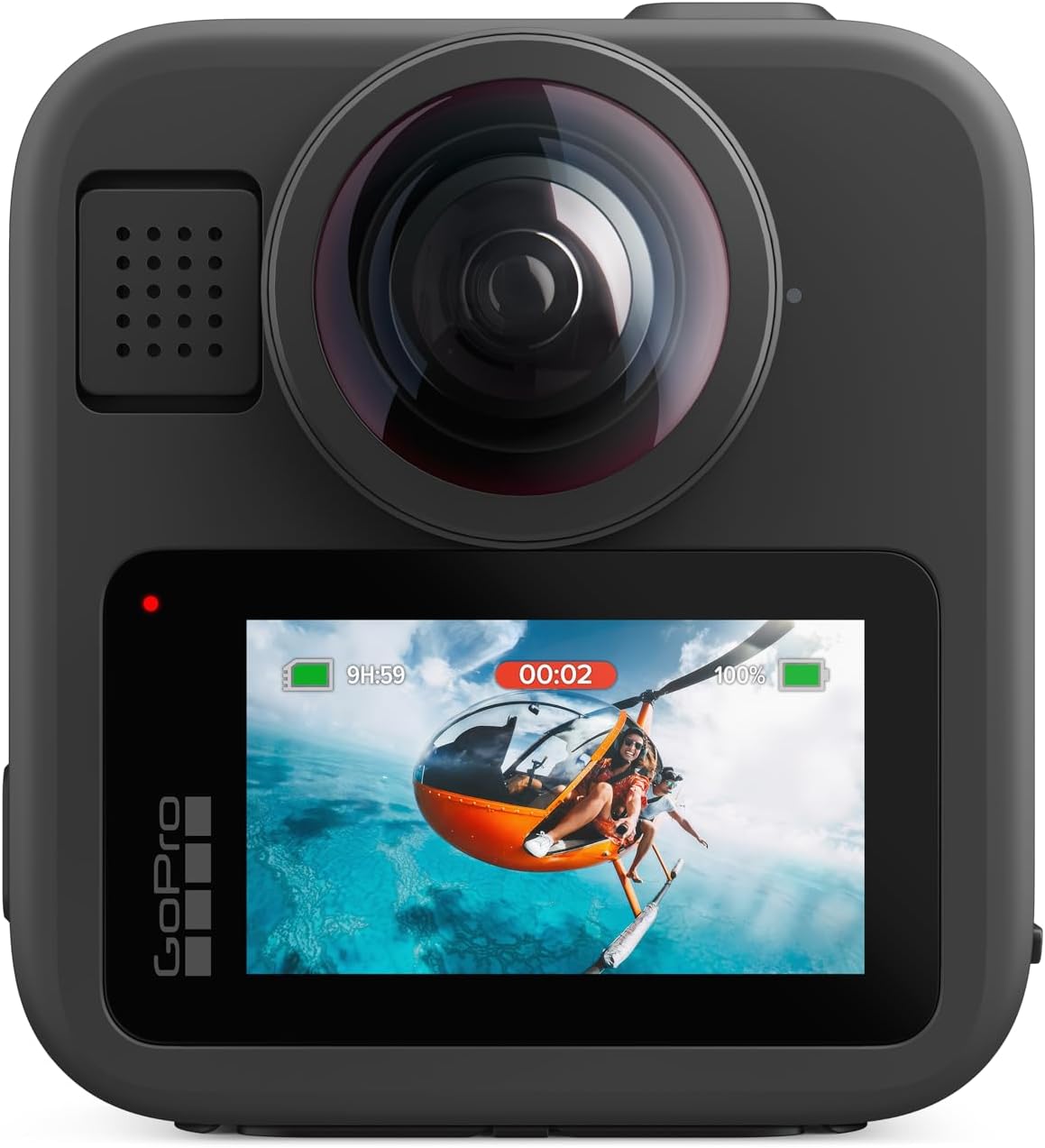
Buy the GoPro MAX2 if you film rides, ski runs, hikes or trips in daylight and want a 360° camera that mounts like any other GoPro. Its daylight 8K footage is detailed and true to life, its stabilization is excellent, and its lenses twist off by hand, so a scratched lens is a quick swap rather than a repair. The trade-off is low light: dusk and indoor footage turns noisy and smeary, so if you often film after dark, the Insta360 X5 is the better choice.
Pros
- Detailed, true-to-life 8K video in daylight
- Lenses twist off and swap by hand
- Three built-in mounting systems
- Excellent stabilization and stitching
- Built-in GPS
Cons
- Noisy, smeary footage in low light
- Can overheat in long 8K takes in still air
- Waterproof to only 5 m without a case
- Quik's automatic editing trails Insta360's app
As an Amazon Associate I earn from qualifying purchases. Disclosure
Overview
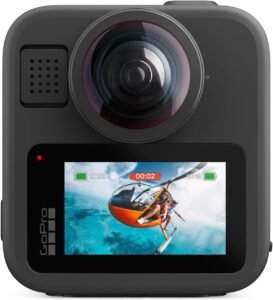
Cyclists, skiers, hikers and travelers who would rather choose the angle after the ride than aim a camera during it are who the GoPro MAX2 is for. It records 8K 360° video at up to 30fps, switches to single-lens 4K at up to 60fps when you want an ordinary action-camera clip, and fits the GoPro mounts many people already own.
This is GoPro’s first new 360° camera since the original MAX of 2019, and it launched in September 2025 with three things its main rivals don’t all offer: lenses you twist off and replace by hand, built-in GPS, and three mounting systems in one body. Firmware has kept improving it. A June 2026 update raised the top bitrate to 200Mbps in 8K 360° and 4K single-lens video and brought 10-bit color and GP-Log to every time-lapse mode.
Key Specifications
| Sensors and lenses | Two 1/2.3-inch CMOS sensors, f/1.8 lenses |
| 360° video | 8K at 30/25/24fps; 5.6K at up to 60fps; 4K at up to 100fps |
| Single-lens video | 4K at up to 60fps |
| 360° photos | 29.5MP (7680 x 3840) |
| Color and bitrate | 10-bit color, GP-Log; up to 200Mbps (June 2026 firmware) |
| Screen | 1.82-inch touchscreen |
| Waterproof | 5 m (16 ft) without a case |
| Battery | Removable 1,960mAh Enduro battery (7.63Wh) |
| Microphones | Six |
| Location | Built-in GPS |
| Storage | microSD card (no built-in storage) |
| Mounting | Folding GoPro fingers, 1/4-20 thread, magnetic latch |
| Dimensions (H x W x D) | 69.7 x 64.0 x 48.7 mm |
| Weight | 195 g |
| Price (USD) | $299.00 |
GoPro MAX2 Video Quality, Day and Night
In good light, the footage is the reason to buy it. GoPro calls its 8K “true 8K”, meaning, it says, that every pixel counted actually records the image, while rivals reach 8K by counting unused or overlapping pixels or by upscaling. Testers found the daylight results detailed, with true-to-life color and little of the heavy processing some rivals apply. TechRadar’s September 2025 review rated its image quality in ideal conditions the best of the small 360° cameras then on sale. Cycling Weekly, comparing it with the Insta360 X5, found its detail fractionally better when zooming in.
Not every test agrees on sharpness. DroneXL compared reframed 8K footage side by side and found the X5 and the DJI Osmo 360 sharper, though in single-lens mode the MAX2 held comparable or slightly more detail than both. Our reading: in daylight it is at least the equal of the X5 and Osmo 360 it was tested against, and its color looks less processed than Insta360’s or DJI’s.
Low light is where it falls well short of its rivals, and every test we saved that covers it says so. Its two 1/2.3-inch sensors are much smaller than the 1/1.28-inch pair in the Insta360 X5 or the 1/1.1-inch pairs in the DJI Osmo 360 and Insta360 X6, and it has no dedicated mode for dim scenes like Insta360’s PureVideo or DJI’s SuperNight. Cycling Weekly’s judgment of its twilight footage was blunt: “it’s just plain bad.” The June 2026 firmware extended GoPro’s Blur Reduction to single-lens video to cut motion blur in dim light, but it doesn’t change the sensors. Time-lapses of the sky are the exception, as SlashGear found its starlapses still look great.
Stabilization and Stitching
Smooth footage is a GoPro strength, and the MAX2 keeps it: testers found its stabilization handles rough roads and trails without visible shake, and 360° Horizon Lock keeps the horizon level however the camera turns. Engadget’s reviewer rode with it on a selfie stick resting loosely on a bike’s handlebars, over uneven ground and potholes, and still got impressively smooth footage.
Most testers also found the join between its two lenses very hard to spot, and the selfie stick disappears from the shot to give the floating, drone-like view 360° cameras are known for. Engadget did sometimes notice the stitch, as a slight wobble or a break in street markings, which it calls a fact of life with current 360° cameras. GoPro recommends a pole at least 24 inches long so the camera can stitch it out of the picture.
Mounting, Lenses and Build
No other camera in the table mounts as easily. The MAX2 has folding GoPro mounting fingers, a standard 1/4-20 tripod thread and GoPro’s magnetic latch in one body, and GoPro says it works with more than 35 mounts and accessories. Its short, squat shape also sits steadier on a helmet or handlebar than a taller camera: Cycling Weekly saw less wobble in its footage than from the X5 over rough roads.
Lenses: both lenses twist off by hand, so a scratched or cracked one is a quick swap in the field. The Insta360 X5’s replaceable lenses need a tool, and a damaged lens on the DJI Osmo 360 means sending the camera to DJI. Each lens gets its own hard snap-on cap, so you can keep the rear lens covered while filming in single-lens mode, though SlashGear found the small caps slower to remove in a hurry and easy to lose.
Build: testers found the body tough enough for the knocks of extreme sports. It is waterproof to only 5 m (16 ft) without a case, though, less than its rivals manage: Insta360 rates the X5 to 15 m and the X6 to 20 m, and DJI rates the Osmo 360 to 10 m. TechRadar’s tester also saw condensation form inside a lens when moving from indoors to outdoors, which hurt image quality until he removed the lens and wiped it; he suspects the removable-lens design. Built-in GPS, which TechRadar notes the X5 and Osmo 360 lack, tags footage with its location without a phone. Cycling Weekly found in January 2026, though, that the GPS data overlays Quik offers for the Hero 13 Black weren’t yet available for the MAX2.
Battery Life and Heat
The MAX2 runs on a removable 1,960mAh Enduro battery, which is designed to last longer in the cold, and Cycling Weekly reports GoPro’s usable range as -10 to 35°C. GoPro gives no battery-life figure, TechRadar notes, and the tests disagree on how it compares with the X5. TechRadar’s test recorded just over an hour of 8K/30fps footage outdoors, against about 90 minutes from the X5’s larger 2400mAh battery. Tom’s Guide’s fixed-conditions stress test found the two level, at 73 minutes for the MAX2 and 72 for the X5 at 8K/30fps, with neither overheating. In mixed use, Engadget’s reviewer carried it through a six-hour day out, shot about 30 minutes of footage and still had about 15% left.
Heat can cut long takes short. TechRadar and Expert Reviews each saw it shut itself down from heat at about 30 minutes of continuous 8K recording, TechRadar’s test indoors at room temperature. DroneXL’s desk test, with no air movement, stopped it at 25 minutes. The rivals ran longer in those tests: DroneXL’s Osmo 360 went more than twice as long and its X5 recorded until the battery ran out, while TechRadar’s X5 lasted 47 minutes before its own heat shutdown. Moving air changes the picture: TechRadar got longer recordings outdoors on a chilly day, and DroneXL had no overheating in real-world use. For a ride or a run it rarely matters; for a long static shot indoors, drop to 5.6K, which TechRadar ran for almost 58 minutes.
Audio, App and Editing
Audio: six built-in microphones record directional sound, and the camera can pair with AirPods and other Bluetooth earbuds or microphones for narration. Testers split on the results. SlashGear found it recorded a clear voice with natural ambient sound on a windy day, while DroneXL found its built-in audio more muffled than the X5’s and Osmo 360’s, and TechRadar found its wind reduction couldn’t do much once the wind picked up.
Editing: GoPro’s Quik phone app reframes 360° clips with keyframes, follows a subject with AI tracking and exports flat videos in different aspect ratios. Testers rate it capable and straightforward for social clips, but its automatic AI editing is less refined than Insta360’s app, which does more of the work for beginners. On a computer, the GoPro Player app is basic, and SlashGear found it frustrating on Windows; plug-ins for Adobe Premiere and DaVinci Resolve are the route for serious editing. GoPro’s Premium subscription adds unlimited cloud storage and damaged-camera replacement, and in November 2026 GoPro’s US store included the first year free with a camera bought there, then $59.99 a year. Without it, Expert Reviews found direct Wi-Fi transfers to a phone frustratingly slow.
How Does It Stack Up Against the Competition?
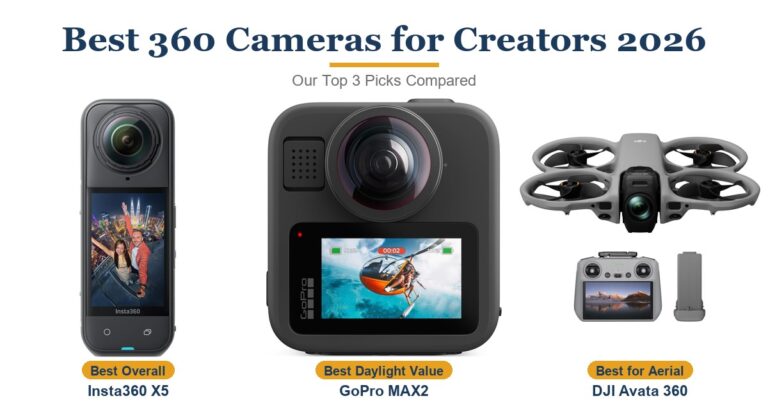
The MAX2 against the 360° cameras testers compare it with: Insta360’s X5 and newer X6, and DJI’s Osmo 360.
| Feature | GoPro MAX2 | Insta360 X5 | DJI Osmo 360 | Insta360 X6 |
|---|---|---|---|---|
| Price (USD) | $299.00 | $549.99 | $404.77 (Standard Combo) | $699.99 |
| Sensors | Two 1/2.3-inch | Two 1/1.28-inch | Two 1/1.1-inch | Two 1/1.1-inch |
| Top 8K 360° frame rate | 8K/30fps | 8K/30fps | 8K/50fps | 8K/50fps |
| Dedicated low-light mode | None | PureVideo | SuperNight | PureVideo |
| Waterproof without a case | 5 m | 15 m | 10 m | 20 m |
| Built-in storage | None (microSD) | None (microSD) | 128GB (105GB usable) | 47GB |
| Replaceable lenses | Yes, by hand | Yes, with a tool | No (DJI service) | Yes (Replaceable Lenses 2.0) |
| Weight | 195 g | 200 g | 183 g | 196 g |
| TTP Review | This review ↑ | Read our review → | — | Read our review → |
| Amazon | View on Amazon | View on Amazon | View on Amazon | View on Amazon |
Prices change frequently — always verify current pricing before purchasing.
GoPro MAX2: Worth It for Daylight Action on GoPro Mounts
If you film rides, ski runs, hikes or trips mostly in daylight, and especially if a drawer of GoPro mounts already waits for it, the MAX2 is the 360° camera to buy. Its daylight footage holds its own against the X5 and Osmo 360, it sits steadier on a helmet or handlebar, and a scraped lens costs you a replacement lens rather than a repair trip. As of November 2026 it also costs less than every other camera in the table, which makes it the value pick for daytime filming.
Look elsewhere if you often film at dusk, indoors or after dark: the Insta360 X5 keeps low-light footage far cleaner, lasted longer on a charge in TechRadar’s test and is waterproof to 15 m. The DJI Osmo 360 also does better in dim scenes and stores footage on 105GB of built-in space. It lasted more than twice as long in DroneXL’s overheating test, but a damaged lens on it means a trip to DJI; its newer Osmo 360 II isn’t launching in the US for now, TechRadar reports. The Insta360 X6 is the step up, with larger sensors, 8K at 50fps and Insta360’s lab rating of 140 minutes of 8K/30fps recording in its Endurance mode.
Sources
- GoPro — MAX2 Product Page
- GoPro — MAX2 Firmware Update News Release (June 2026)
- Clifton Cameras — GoPro MAX2 Specification Sheet
- GoPro MAX2 — Amazon Product Listing
- TechRadar — GoPro Max 2 review
- TechRadar — GoPro Max 2 vs Insta360 X5
- TechRadar — DJI Osmo 360 II review
- Engadget — GoPro Max 2 review
- Cycling Weekly — GoPro MAX2 Review
- SlashGear — GoPro Max 2 Review
- Expert Reviews — GoPro Max 2 review
- Tom’s Guide — Insta360 X6 review
- DroneXL — GoPro Max 2 vs DJI Osmo 360 vs Insta360 X5
- Insta360 — X5 Product Page
- Insta360 — X6 Product Page
- DJI — Osmo 360 Specs
Reader Poll
When do you do most of your filming?
Help Our Editors Know What Matters to You
Explore on Amazon →