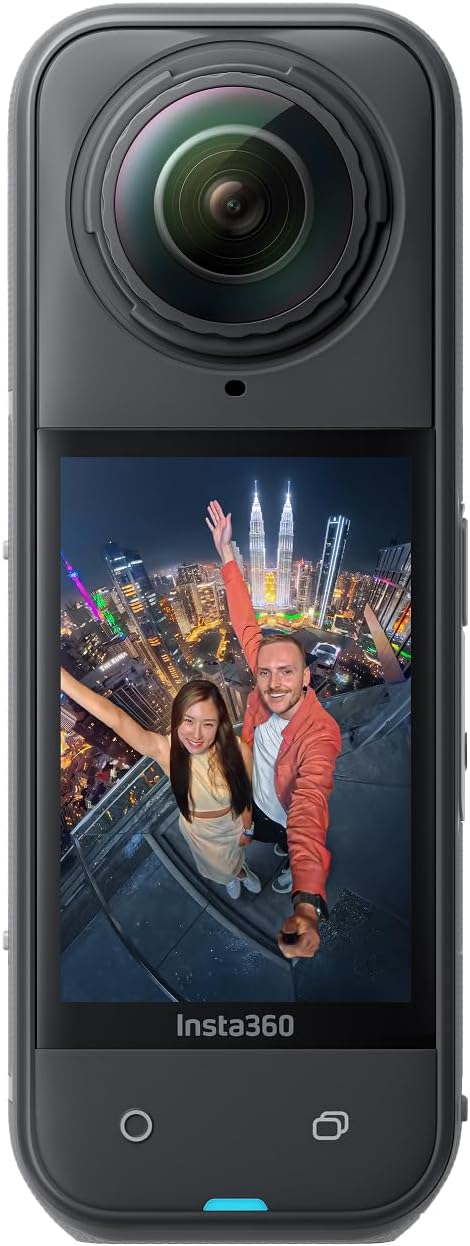
Buy the Insta360 X5 if you want clean low-light 360 footage for its price and Insta360's mature editing app. Its replaceable lenses and 15 m (49 ft) waterproofing let you take it off-road or into a lake. The trade-off is heat, which can shut it down during a long 8K recording, so plan shorter takes or drop to 5.7K. If your budget stretches, the Insta360 X6 is the better camera at night.
Pros
- Clean low-light 360 video with PureVideo
- Mature editing app with strong AI auto-edits
- User-replaceable lenses
- Waterproof to 15 m (49 ft) without a case
- Fast charging (Insta360 rates 80% in 20 minutes)
Cons
- Can overheat during long continuous 8K recording
- No built-in storage; needs a microSD card
- 8K video tops out at 30fps
As an Amazon Associate I earn from qualifying purchases. Disclosure
Overview
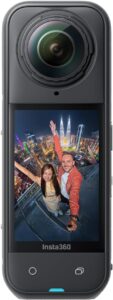
A 360 camera lets you film first and pick the angle later, and the Insta360 X5 brought a big step up in low light over the X4 it replaced. Its two lenses record the whole sphere around you in 8K, so a single clip from a bike ride, ski run or hike can be reframed into normal widescreen or vertical video in the Insta360 app. It launched in April 2025, and as of October 2026 it sells on Amazon for $549.99, while Insta360’s newer X6 is $699.99.
Against the X4, the X5 brought larger 1/1.28-inch sensors (up from 1/2-inch), a PureVideo mode for low light, a built-in wind guard and lenses you can swap out yourself when one gets scratched, plus waterproofing to 15 m (49 ft). Since August 2026 the X6 has been Insta360’s flagship, and the maker now describes the X5 as its “Best value 360 camera”. So the question this review answers is not whether the X5 is the best 360 camera, but whether it is still the one to buy alongside the X6, DJI’s Osmo 360 and GoPro’s MAX2.
Key Specifications
| Price (USD) | $549.99 |
| Sensors | Two 1/1.28-inch sensors |
| 360 video | 8K (7680 x 3840) at up to 30fps; 5.7K at up to 60fps |
| Single-lens video | 4K at up to 60fps |
| 360 photos | About 72MP (11904 x 5952) |
| Battery | 2,400 mAh, removable |
| Rated run time (lab) | 93 min at 8K/30fps; up to 208 min at 5.7K/24fps in Endurance Mode |
| Charging | 80% in 20 min, 100% in 35 min (30W USB-C PD charger) |
| Waterproofing | 15 m (49 ft) without a case; 60 m (197 ft) in the Invisible Dive Case |
| Storage | microSD card (UHS-I V30 or faster); no built-in storage |
| Screen | 2.5-inch touchscreen |
| Connectivity | Wi-Fi 802.11a/n/ac, Bluetooth 5.2, USB-C 3.0 |
| Operating temperature | -20°C to 40°C (-4°F to 104°F) |
| Size | 46 x 124.5 x 38.2 mm (1.8 x 4.9 x 1.5 in) |
| Weight | 200 g (7.1 oz) |
Insta360 X5 Video and Low-Light Quality
Resolution matters more on a 360 camera than on a normal action camera, because every finished shot is a crop of the full sphere. Tom’s Guide found that the X5’s 8K/30fps 360 recording leaves about 2.7K when you reframe it into a normal widescreen view, the most a 360 camera offered when it tested the X5, though still short of 4K. Stabilization is applied automatically and keeps even rough footage smooth.
Night and indoor footage is where the X5 improved most over the X4. The larger sensors and the PureVideo mode, which uses AI noise reduction, produce much cleaner low-light video; Tom’s Guide noted some loss of sharpness from the noise suppression, though not a major one. In TechRadar’s head-to-head with GoPro’s MAX2, the X5 was the clear winner after dark, while the MAX2 edged it in bright daylight with more vibrant colour and better-hidden stitching. It still has limits after dark: CNET wrote that “The X5 at night still isn’t amazing, but the footage is usable,” and Engadget saw a vibration after-effect in footage shot while walking in the late evening. CNET also found the X5 tends to overexpose out of the camera, giving a flatter, washed-out look, though adjusting exposure in camera or in the app brings it level with the GoPro or better.
The DJI Osmo 360 has bigger 1/1.1-inch sensors and records 8K at up to 50fps, so on paper it should win. In TechRadar’s side-by-side test the two produced very similar results, and its reviewer found the X5’s low-light footage punchier, while allowing that this may be personal preference. Insta360’s newer X6 goes further still: testers found its bigger sensors give it cleaner footage at dusk and at night. Stitching is the usual 360-camera compromise: testers saw the seam where the two lenses meet now and then, and Tom’s Guide found it confined to the area directly below the camera, which is also what lets the selfie stick vanish from the shot.
Editing in the Insta360 App
A 360 camera is only as good as the software that turns a sphere into a video you can post. The Insta360 mobile app and the Insta360 Studio desktop app are mature, with keyframe reframing, subject tracking that follows faces through a clip, and AI auto-editing that picks highlights and adds transitions and music from a handful of clips. In TechRadar’s use, the auto-edits occasionally left out the best moments. Against DJI the lead is narrow: TechRadar found DJI’s Mimo app roughly matches Insta360’s for manual editing and gave Insta360 the edge only for AI auto-editing. Against GoPro it is wider: CNET found there is more you can do in Insta360’s app, while GoPro’s Quik is simpler and easier for beginners.
Not everyone gets on with it. Halfway Anywhere found the mobile app cluttered, and getting the best from the footage means time spent reframing, a learning curve other reviewers mention too. InstaFrame mode helps when you need something to post straight away: it records a ready-framed flat video alongside the 360 file. Launch reviews found the flat file limited to 1080p, but Insta360’s current spec lists InstaFrame 2.0 at up to 4K for the flat file, with the 360 file at 5.7K+, below the X5’s 8K maximum.
Build, Waterproofing and Replaceable Lenses
The bulging fisheye lenses are every 360 camera’s weak point, and the X5 lets you replace a scratched or cracked one yourself with a twist-off mechanism and a small tool. That lets you shoot without protective lens guards, which cost image sharpness, though Insta360 itself still recommends lens protection outdoors. The DJI Osmo 360’s lenses are not user-replaceable, while GoPro’s MAX2 goes further with lenses you can twist off by hand. The X5 is waterproof to 15 m (49 ft) without a case, against 10 m for the Osmo 360 and 5 m for the MAX2, though Insta360 recommends its Invisible Dive Case, rated to 60 m (197 ft), for 360 video underwater to avoid warping and stitching problems.
The body is a 200 g (7.1 oz) candy bar with a 2.5-inch touchscreen and physical power and shutter buttons. How those work in gloves is where reviews differ. Two launch reviews found the camera easy to grip and the controls easy to reach with gloves on. Halfway Anywhere found the buttons hard to use in mid-weight gloves and near-impossible in large ones. Tom’s Guide’s own later X6 review called the X5’s record button fiddly to press in gloves. Its tall shape is comfortable in the hand, but the squatter GoPro and DJI cameras sit lower on a helmet. If you are coming from an X4, budget for new spares: its batteries do not fit the X5, and Tom’s Guide found the same for its USB-C microphone adapter.
Battery Life and Heat at 8K
Insta360 rates the 2,400 mAh battery for 93 minutes at 8K/30fps, and after a firmware update for up to 208 minutes at 5.7K/24fps in Endurance Mode. Most reviewers’ results land close to the 8K figure. TechRadar got about 90 minutes of 8K/30fps recording. Notebookcheck got around 85 minutes, shooting mostly at 8K. Tom’s Guide managed 95 minutes of mixed shooting with 7% left, but its later indoor stress test got 72 minutes at 8K/30fps, against 73 for the MAX2 and 112 for the Osmo 360. Tom’s Guide also found that single-lens 4K/60fps runs fell to 87 minutes, from 111 on the X4.
Charging is quick. Insta360 rates 80% in 20 minutes on a 30W charger, a little faster than the X6’s 24 minutes, and Notebookcheck reached 80% in just over 21 minutes, though Tom’s Guide got 50% in 20 minutes from a 100W charger. In TechRadar’s room-temperature test, the X5 shut itself down to prevent overheating 47 minutes into a continuous 8K/30fps recording; other reviewers also found it ran hot at 8K, though Tom’s Guide reported no problems in its tests, and moving air, cooler conditions or the 5.7K modes give it more headroom.
Audio and Wind Noise
The X5 has two built-in microphones behind a steel-mesh wind guard, with wind-reduction and voice-enhancement modes. How well that works outdoors is where testers split. Tom’s Guide called it the best internal microphone of any action or 360 camera it had tested and found that its wind guard and wind reduction kept motorcycle footage almost free of buffeting. TechRadar, filming on a blustery coast, found neither the X5 nor the Osmo 360 coped adequately, thought the Osmo 360 “ever so slightly edges it”, and recommends an external mic for outdoor voice work.
That is easy to add: the X5 works with Insta360’s Mic Air and other wireless and USB-C microphones, and its spec page lists DJI’s Mic Mini and Mic 2 among compatible devices. The MAX2 had no external-mic support at launch, according to TechRadar, though GoPro now lists Bluetooth earbuds and other wireless mics for it, and TechRadar found its six built-in microphones better indoors and for directional sound.
How Does It Stack Up Against the Competition?
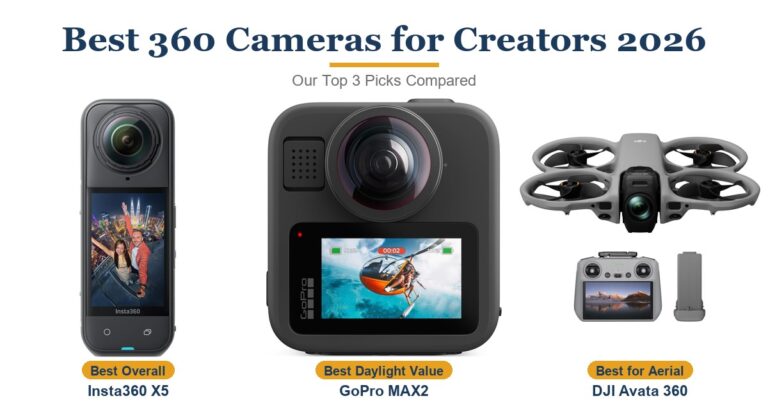
The X5’s rivals are Insta360’s newer X6 and the 8K 360 cameras DJI and GoPro sell officially in the US, the Osmo 360 and the MAX2. DJI’s newer Osmo 360 II had no official US launch as of October 2026, so the original Osmo 360 is the DJI model here.
| Feature | Insta360 X5 | Insta360 X6 | DJI Osmo 360 | GoPro MAX2 |
|---|---|---|---|---|
| Price (USD) | $549.99 | $699.99 | $404.77 (Standard Combo) | $299.00 |
| Top 360 video mode | 8K/30fps | 8K/50fps | 8K/50fps | 8K/30fps |
| 360 photos | 72MP | 120MP | 120MP | 29MP |
| Waterproof without a case | 15 m (49 ft) | 20 m (66 ft) | 10 m (33 ft) | 5 m (16 ft) |
| Built-in storage | None (microSD only) | 64GB (47GB usable) | 128GB (105GB usable) | None (microSD only) |
| User-replaceable lenses | Yes (with a tool) | Yes | No | Yes (by hand) |
| Weight | 200 g | 196 g | 183 g | 195 g |
| TTP Review | This review ↑ | Read our review → | — | Read our review → |
| Amazon | View on Amazon | View on Amazon | View on Amazon | View on Amazon |
Prices change frequently — always verify current pricing before purchasing.
Insta360 X5: Still Worth It for Low-Light 360 Video and Its Editing Tools
If you film at dusk, at night or indoors and want Insta360’s editing tools for less than the X6, the X5 is the one to buy. TechRadar called its PureVideo mode the best low-light performer in its category before the X6 pushed things further. Tom’s Guide, reviewing the X6, still recommends the X5 to most people as “the best balance of price and performance.” Its replaceable lenses and 15 m waterproofing mean you can mount it on a bike or take it into a lake. As of October 2026 it costs less than the X6 on Amazon and more than both the Osmo 360 and the MAX2, so its case rests on what it does after dark and in the app. If long, continuous 8K takes are part of your plan, record in shorter clips or step down to 5.7K, because heat can cut a single long take short.
Look elsewhere if your shooting is mostly bright daylight and you want great-looking footage with little editing: the GoPro MAX2 looks better straight out of the camera in daylight, is simpler to use, and adds built-in GPS and a lower helmet profile. Pick the DJI Osmo 360 if you want built-in storage, or already own an Osmo Action 5 Pro, whose batteries it shares. And if your budget stretches, the X6 is the better camera, with larger sensors, cleaner low-light footage and 136 minutes of 8K recording in TechRadar’s test, though X5 owners have little reason to trade up right away.
Sources
- Insta360 — Insta360 X5 product page and specifications
- Insta360 X5 — Amazon Product Listing
- Insta360 — Insta360 X6 product page and specifications
- DJI — Osmo 360 specifications
- GoPro — MAX2 product page
- Tom’s Guide — Insta360 X5 review
- TechRadar — GoPro Max 2 vs Insta360 X5
- TechRadar — DJI Osmo 360 vs Insta360 X5
- TechRadar — Insta360 X6 vs Insta360 X5
- CNET — GoPro Max 2 vs. Insta360 X5
- Notebookcheck — Insta360 X5 Satin White Limited Edition review
- T3 — Insta360 X5 review
- Digital Camera World — DJI Osmo 360 review
- Tom’s Guide — Insta360 X6 review
- Halfway Anywhere — Insta360 X5 action camera review
- Notebookcheck — Insta360 X6 review
- DroneXL — DJI Osmo 360 II release date, price and US availability
- Engadget — Insta360 X5 hands-on
Reader Poll
What matters most in your next 360 camera?
Help Our Editors Know What Matters to You
Explore on Amazon →