At $27.99, the Anker Nano Power Bank 10K covers the basics a student or commuter actually needs: a built-in USB-C cable so there's nothing extra to pack, 30W bidirectional charging, and an on-screen readout that stays accurate down to the last percent. It's compact enough to live in a backpack's front pocket permanently, and the price undercuts most 45W-and-up rivals by a wide margin. Anyone charging newer Android phones that pull more than 24W, or who wants to top up a phone and a pair of earbuds at once, should look at the UGREEN Nexode Pro or Baseus Blade2 instead — both offer higher output and a second port for a real trade-off in price.
Pros
- Built-in USB-C cable, nothing extra to pack
- Compact, pocket-friendly size at 7.58 oz
- 30W bidirectional charging
- Accurate on-screen battery percentage display
- Competitively priced vs 45W and 65W rivals
Cons
- Output tops out around 24W, slower for fast-charging Android phones
- Real-world capacity efficiency (76.9%) trails pricier rivals
- Single USB-C and single USB-A port limits it to one device at a time
As an Amazon Associate I earn from qualifying purchases. Disclosure
Overview
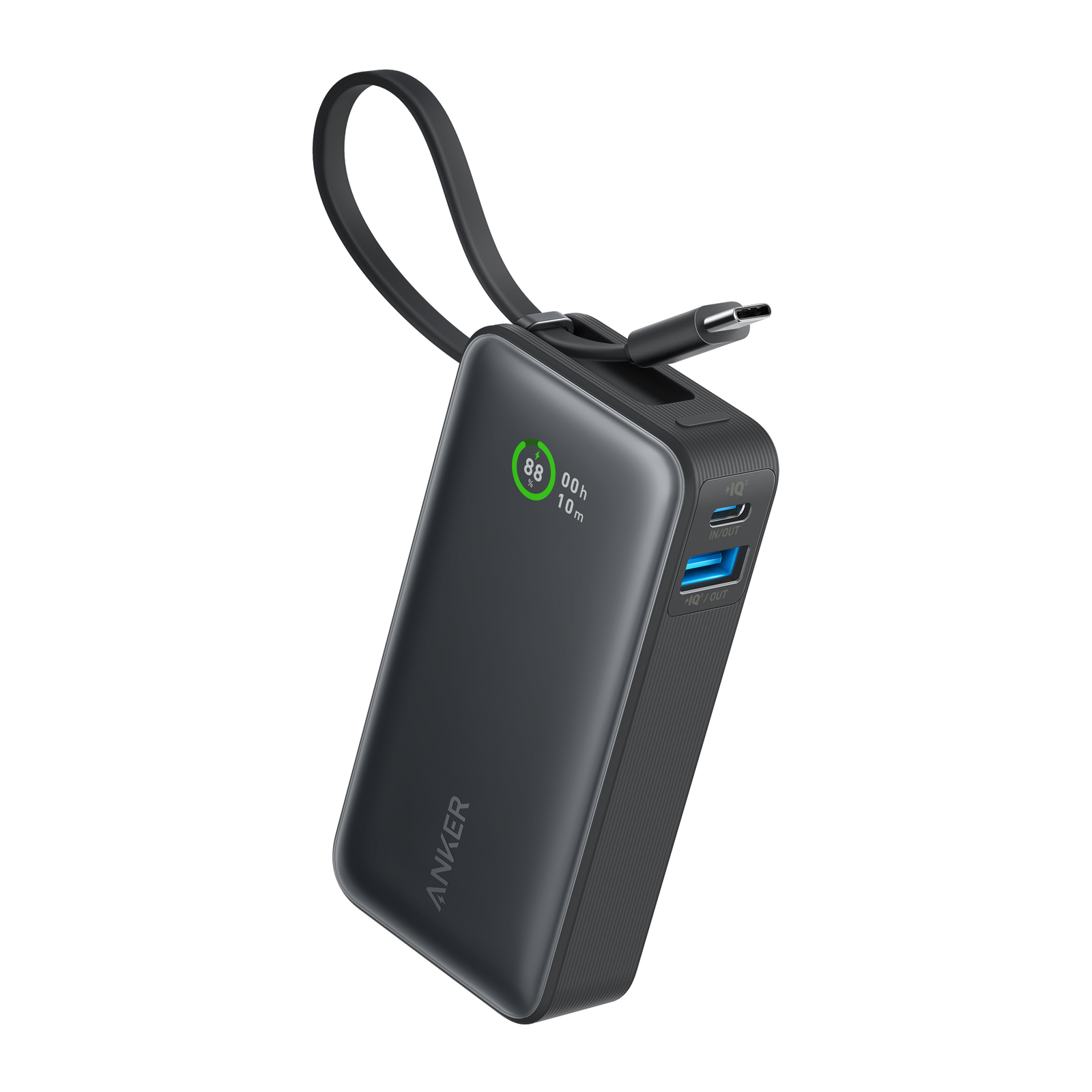
A power bank that lives in a backpack’s front pocket all semester needs to do exactly two things well: hold enough charge to matter and not be a hassle to actually use. The Anker Nano Power Bank 10K, sold as model A1259, packs a built-in USB-C cable into a 10,000mAh cell small enough to disappear next to a laptop charger, and it’s available on both Amazon.com and Amazon.ca.
The built-in cable is the headline upgrade over older Anker banks and most budget rivals — a fixed USB-C cord tucked into the body means one less cord to lose in a dorm room or a gym bag, and the bank recharges itself at up to 30W through that same port. A hidden color screen behind the frosted front panel lights up on contact to show an exact battery percentage, a feature usually reserved for pricier models.
Key Specifications
| Rated Capacity | 10,000mAh |
| Max Output | 30W via built-in USB-C; secondary USB-A port |
| Cable | Built-in USB-C, non-detachable |
| Weight | 7.58 oz (215 g) |
| Dimensions | 4.09 x 2.06 x 1.02 in (104 x 52.3 x 26 mm) |
| Display | Hidden color screen, battery percentage + time estimate |
| Price (USD) | $49.99 |
Anker Nano Power Bank 10K Charging Speed & Capacity
Anker’s own spec sheet puts recharge time at 50% in 45 minutes on a 30W source, and charging an iPhone 14 to 50% takes about 30 minutes through the built-in cable. In Trusted Reviews’ lab testing, real-world output peaked around 24W rather than the full 30W rating — enough headroom for an iPhone’s charging curve, but a touch behind current Android flagships that can pull more.
Trusted Reviews also measured usable capacity directly: 9,805mAh delivered out of the rated 10,000mAh cell, a 76.9% efficiency figure. The reviewer called that “an OK result,” noting that premium power banks in this price range typically land in the 80s. It’s not a dealbreaker for a phone top-up, but it does mean the advertised capacity number overstates what actually reaches a device.
Portability & Everyday Carry
At 215 grams and just over four inches tall, the Nano Power Bank 10K is small enough to ride in a backpack’s front pocket or a coat pocket without adding noticeable bulk. Trusted Reviews described it as roughly the size of a small brick-like feature phone despite the “nano” name — compact for its capacity class, if not quite pocket-invisible.
The built-in cable is the main portability trade-off. There’s genuinely nothing extra to pack or misplace, which matters for anyone who has left a charging cable behind before a trip. Trusted Reviews did flag one design quirk: Anker markets the cable loop as a built-in carry handle, and the reviewer warned against actually hanging the unit’s full weight from that connection point over time.
Display & Real-World Battery Tracking
The frosted front panel hides a color screen until the bank is connected or tapped, then shows a live percentage readout along with an estimated charge or discharge time. Trusted Reviews praised the accuracy of that readout specifically, noting it held at “99% until it is well and truly finished” rather than jumping straight from a high number to empty.
The body is built from 80% PCR recycled plastic, a sustainability detail Anker highlights on its product page. One scope note worth flagging: with a single USB-C and a single USB-A port, this model is built for charging one device at a time rather than juggling a phone and earbuds simultaneously — normal for a bank this size, but worth knowing before buying.
How Does It Stack Up Against the Competition?
A handful of similarly sized power banks compete directly on price and the built-in-cable convenience factor.
| Feature | Anker Nano Power Bank 10K | INIU 3-in-1 Portable Charger | UGREEN Nexode Pro 10K | Baseus Blade2 |
|---|---|---|---|---|
| Price (USD) | $49.99 | $30 | $55 | $50 |
| Capacity | 10,000mAh | 10,000mAh | 10,000mAh | 12,000mAh |
| Max Output | 30W | 30W | 45W | 65W |
| Cable | Built-in USB-C | Built-in USB-C + foldable AC plug | Built-in USB-C | Detachable USB-C |
| Weight | 7.58 oz | approx. 8 oz | approx. 7 oz | approx. 9 oz |
| TTP Review | This review ↑ | — | — | — |
Prices change frequently — always verify current pricing before purchasing.
Is the Anker Nano Power Bank 10K Worth It?
At $27.99, the Anker Nano Power Bank 10K covers the basics a student or commuter actually needs: a built-in USB-C cable so there’s nothing extra to pack, 30W bidirectional charging, and an on-screen readout that stays accurate down to the last percent. It’s compact enough to live in a backpack’s front pocket permanently, and the price undercuts most 45W-and-up rivals by a wide margin.
Anyone charging newer Android phones that pull more than 24W, or who wants to top up a phone and a pair of earbuds at once, should look at the UGREEN Nexode Pro or Baseus Blade2 instead — both offer higher output and a second port for a real trade-off in price. For single-device, single-cable simplicity, the Anker holds up.

Check the latest price for Anker Nano Power Bank 10K
Check Current Price on Amazon