If you own the AirPods 4 with ANC and the battery still covers your day, they're worth keeping: the cancelling works far better than an open design should allow, and testers who set them against the AirPods Pro 2 found the sound close behind. Independent battery tests also beat Apple's ratings. The trade-off is isolation: with no ear tips, they can't block noise like sealed earbuds. Buying new, the AirPods 5 are the better pair.
Pros
- Noise cancelling without ear tips
- Sound close to the AirPods Pro 2 in testers' comparisons
- Independent battery tests beat Apple's ratings
- Case charges on Qi pads and has a Find My speaker
- Live Translation and Adaptive Audio on iPhone
- Custom EQ added in iOS 27
Cons
- Can't block noise like sealed earbuds
- Fit depends on ear shape; testers split
- No volume swipe; limited on Android
- Discontinued: new pairs are leftover stock
As an Amazon Associate I earn from qualifying purchases. Disclosure
Overview
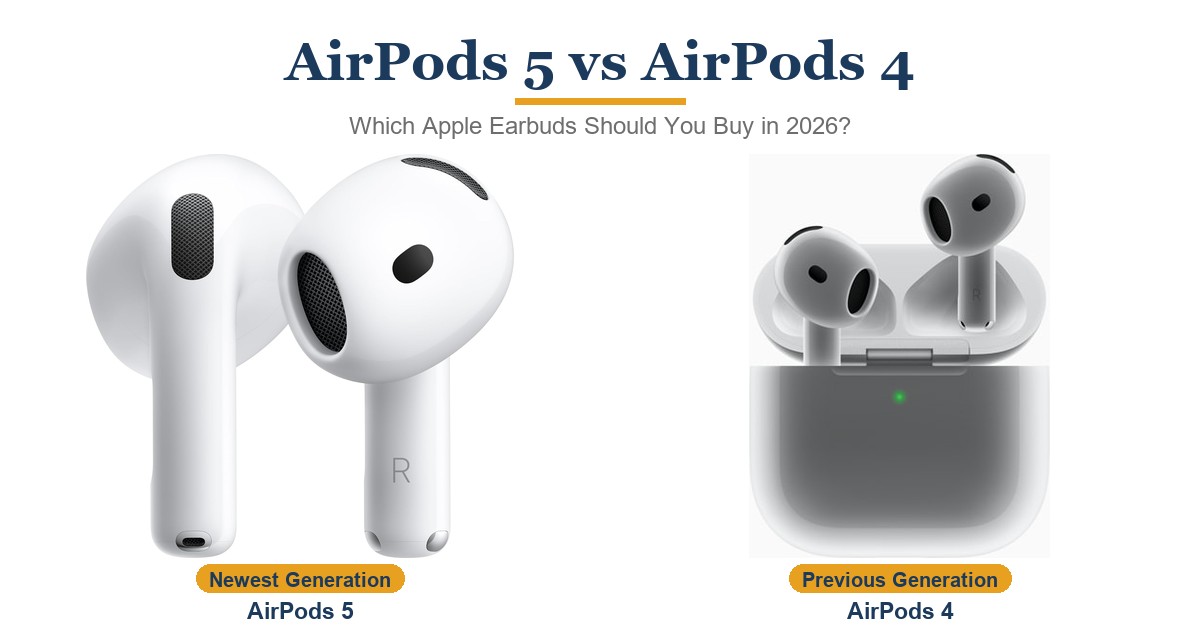
Two years after launch, Apple’s noise-cancelling AirPods 4 have become a pair people own rather than one they shop for. Apple stopped selling both AirPods 4 models after it announced the AirPods 5 in September 2026, and the ANC version reviewed here is still sold by other retailers as leftover stock. This review is written for owners deciding whether their pair is still worth keeping, and for anyone weighing a leftover new pair.
When they arrived in September 2024, they were the first AirPods to put noise cancelling into Apple’s tipless design, an idea that raised doubts among testers, since cancelling usually relies on an ear tip sealing the ear. They also brought the H2 chip from the AirPods Pro 2 to the standard line. Over the plain AirPods 4, the ANC model adds Adaptive Audio and Transparency mode, a case that charges on a Qi pad or Apple Watch charger, and a speaker in the case that plays a sound when you look for it in Find My.
Key Specifications
| Model | AirPods 4 with Active Noise Cancellation (USB-C case with speaker) |
| Price (USD) | $119.00 (Oct 29) |
| Released / discontinued | September 2024 / September 2026 |
| Chip | Apple H2 headphone chip |
| Fit | Open, no ear tips |
| Noise control | Active Noise Cancellation, Adaptive Audio, Transparency mode, Conversation Awareness |
| Battery (Apple’s rating) | Up to 4 hours per charge with ANC on (5 with noise control off); up to 20 hours with the case with ANC on (30 off) |
| Quick charge | 5 minutes in the case for about 1 hour of listening |
| Case charging | USB-C (no cable in the box), Qi-certified chargers or Apple Watch charger |
| Dust and water resistance | IP54, earbuds and case |
| Connectivity | Bluetooth 5.3; AAC |
| Weight | 4.3 g per earbud; case 34.7 g |
Apple AirPods 4 Noise Cancelling and Sound
The cancelling works far better than an open design should allow, but it can’t match earbuds that seal the ear. With no tip blocking the canal, there is almost no passive isolation to build on, so the electronics do all the work. How much they manage is where testers differ. What Hi-Fi wrote that “the rumble of engines on the road, the grinding hum of trains, the exhaust fan in the kitchen – it all disappears”, though chatter, drilling and high-pitched sounds still reached its testers. In SoundGuys’ test, the lowest bass often slipped through, while mid and high-pitched noise fell by about 20 dB. TechGearLab’s lab figures were lower: about 10 decibels from roughly 70 to 2,000 Hz, and about 15 decibels in the low and mid treble. For a sense of scale, Apple’s own claim for the AirPods 5 is up to 50% more noise removed than this model.
Sound is where the open design gives up the least. Two testers who compared them directly with the AirPods Pro 2 found them close to that sealed pair, with less weight and punch in the bass. TechGearLab heard it differently: better bass than earlier AirPods, but too little power for hip-hop, EDM or hard rock, with the midrange the strongest part. iOS 27 also added a custom equalizer for AirPods with the H2 chip, these included, so owners can now nudge the balance themselves.
Fit and Comfort
With no tips or fins, each bud rests in the outer ear and stays there by shape alone, so whether it fits comes down to your ears. Testers’ own teams split: some wore them comfortably for hours, others found them uncomfortable quickly or had them work loose, and more than one review advises trying a pair before buying. Popular Science’s reviewer, who had used the original and third-generation pairs, called these “the most comfortable (and stable-feeling) non-Pro earbuds Apple has ever made”, and TechRadar’s reviewer got through a flight of more than 4.5 hours in comfort. TechGearLab’s testers, by contrast, never got past 3.5 hours before taking them out for a rest.
For exercise, the reviews differ: SoundGuys doesn’t recommend them for running or workouts because nothing but their shape holds them in, while TechRadar’s never fell out, including during workouts. The IP54 rating covers dust, sweat and splashes for the buds and case, not submersion; the AirPods 5 moved up to IP57, which adds immersion.
Battery Life and the Charging Case
Apple rates them for 4 hours a charge with cancelling on and 5 with it off; What Hi-Fi called the four-hour figure “a pretty poor showing”. The independent rundowns we found all beat Apple’s figures. TechRadar measured 6.5 hours with cancelling on and 7.5 hours with it off. SoundGuys’ rundown, with cancelling off, reached 6 hours 21 minutes. TechGearLab’s, also with cancelling off, reached 5 hours 40 minutes. For reference, the sealed Sony WF-C710N and Bose QuietComfort Earbuds in the table below are rated for 8.5 hours with noise cancelling on.
The case is the part owners would miss most. It charges over USB-C, on a Qi pad or on an Apple Watch charger, a quick top-up goes a long way (Apple quotes about an hour of listening from five minutes), and its speaker plays a sound when you search for it in Find My. The standard AirPods 5 case charges only by USB-C cable, so an owner who relies on a pad should look at the AirPods 5 with Wireless Charging Case instead.
iPhone Features, Calls and Android
On an iPhone, they carry most of what Apple’s earbuds offer: Adaptive Audio, Conversation Awareness, Personalized Spatial Audio with head tracking, and nod or shake gestures to answer Siri. They also support Live Translation, which needs an iPhone with Apple Intelligence running iOS 26 or later. The one control testers kept missing is volume: there is no swipe on the stem, so you change it on the phone or ask Siri.
Call quality drew mixed verdicts. TechRadar called the microphone “basically as good as it gets for earbuds”, while TechGearLab described the call experience as about average. On Android, they work as plain Bluetooth earbuds: there is no app for adjusting them, and Spatial Audio is lost. Moving audio from one device to another happens automatically only within Apple’s own lineup.
How Does It Stack Up Against the Competition?
The AirPods 5 and Samsung Galaxy Buds 4 share the tipless design; the Sony WF-C710N and Bose QuietComfort Earbuds seal the ear with silicone tips and are rated for more than twice the AirPods’ battery per charge.
| Feature | Apple AirPods 4 (ANC) | Apple AirPods 5 | Samsung Galaxy Buds 4 | Sony WF-C710N | Bose QuietComfort Earbuds (2024) |
|---|---|---|---|---|---|
| Price (USD) | $119.00 (Oct 29) | $129.00 | $179.99 | $78.99 | $132.99 (Oct 30) |
| Fit | Open, no ear tips | Open, no ear tips | Open, no ear tips | Silicone ear tips (3 sizes) | Silicone ear tips and stability bands (3 sizes each) |
| Battery, ANC on (maker’s rating) | 4 hours; 20 with case | 4 hours; 20 with case | 5 hours; 24 with case | 8.5 hours; 30 with case | 8.5 hours; 31.5 with case |
| Dust and water rating | IP54 | IP57 | IP54 (earbuds only) | IPX4 | IPX4 |
| Volume on the earbud | No (phone or Siri) | No (swipe on the Wireless Charging Case model) | Yes (swipe) | Yes (4+ taps) | Yes (touch controls) |
| Wireless charging | Yes (Qi, Apple Watch charger) | No (USB-C) | Yes | No (USB-C) | Yes |
| Bluetooth | 5.3 | 5.3 | 6.1 | 5.3 | 5.3 |
| TTP Review | This review ↑ | Read our review → | — | Read our review → | — |
| Amazon | View on Amazon | View on Amazon | View on Amazon | View on Amazon | View on Amazon |
Prices change frequently — always verify current pricing before purchasing.
The Galaxy Buds 4 are the closest match in design and split two testers. Tom’s Guide judged them “better than AirPods 4 ANC in every way that matters”, with richer sound, while in SoundGuys’ head-to-head the Samsung pair picked up voices better on calls and offers far more ways to tune the sound, including a 9-band EQ, and the AirPods cut more noise and ran longer per charge (6 hours 21 minutes against 4 hours 56 minutes). Both point Android owners to the Samsung pair.
Apple AirPods 4: Worth It for Tipless Noise Cancelling You Already Own
Replace them when the battery stops covering your listening day; until then, a working pair has little to gain from the move, and MacRumors agrees there is “not a strong case to upgrade”. What a newer pair adds is narrower than it looks. Apple’s claim of stronger cancelling and IP57 protection come with either AirPods 5 model. Swipe volume and an hour more per charge need the step-up AirPods 5 model. Pick the standard model and you give up two things yours has: wireless charging and the Find My speaker.
For a new pair, the AirPods 5 are the pick, with the same tipless fit, Apple’s claim of up to 50% more noise removed, and IP57 protection. Amazon.com had no new AirPods 4 with ANC for sale on October 4, 2026, so a leftover pair makes sense only at a clear discount to the AirPods 5’s $129.00. On an Android phone, the Galaxy Buds 4 are the tipless choice; the Sony WF-C710N suits listeners who want long battery life and don’t mind ear tips; and anyone who can wear ear tips should look at the Bose QuietComfort Earbuds or Apple’s AirPods Pro 3.

Sources
- Apple — AirPods 4 with Active Noise Cancellation Tech Specs
- Amazon.com — Apple AirPods 4 with Active Noise Cancellation product listing (ASIN B0DGJ7HYG1), checked October 4, 2026
- Apple — Apple introduces AirPods 4
- MacRumors — AirPods 4 vs. AirPods 5 Buyer’s Guide
- MacRumors — Every New AirPods Feature in iOS 27
- What Hi-Fi — Apple AirPods 4 with ANC review
- SoundGuys — Apple AirPods 4 with Active Noise Cancellation review
- TechRadar — AirPods 4 with Active Noise Cancellation review
- TechGearLab — Apple AirPods 4 ANC Review
- Popular Science — AirPods 4 with Active Noise Cancellation review
- Apple — Use Live Translation with your AirPods
- Apple — AirPods 5 Technical Specifications
- Samsung — Galaxy Buds4
- SoundGuys — Samsung Galaxy Buds 4 vs Apple AirPods 4 ANC
- Tom’s Guide — Samsung Galaxy Buds 4 review
- Sony — WF-C710N Help Guide
- What Hi-Fi — Sony WF-C710N review
- Bose — QuietComfort Earbuds
- SoundGuys — Bose QuietComfort Earbuds (2024) review
Reader Poll
What would make you replace your AirPods 4 with ANC?
Help Our Editors Know What Matters to You
Explore on Amazon →