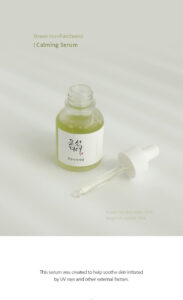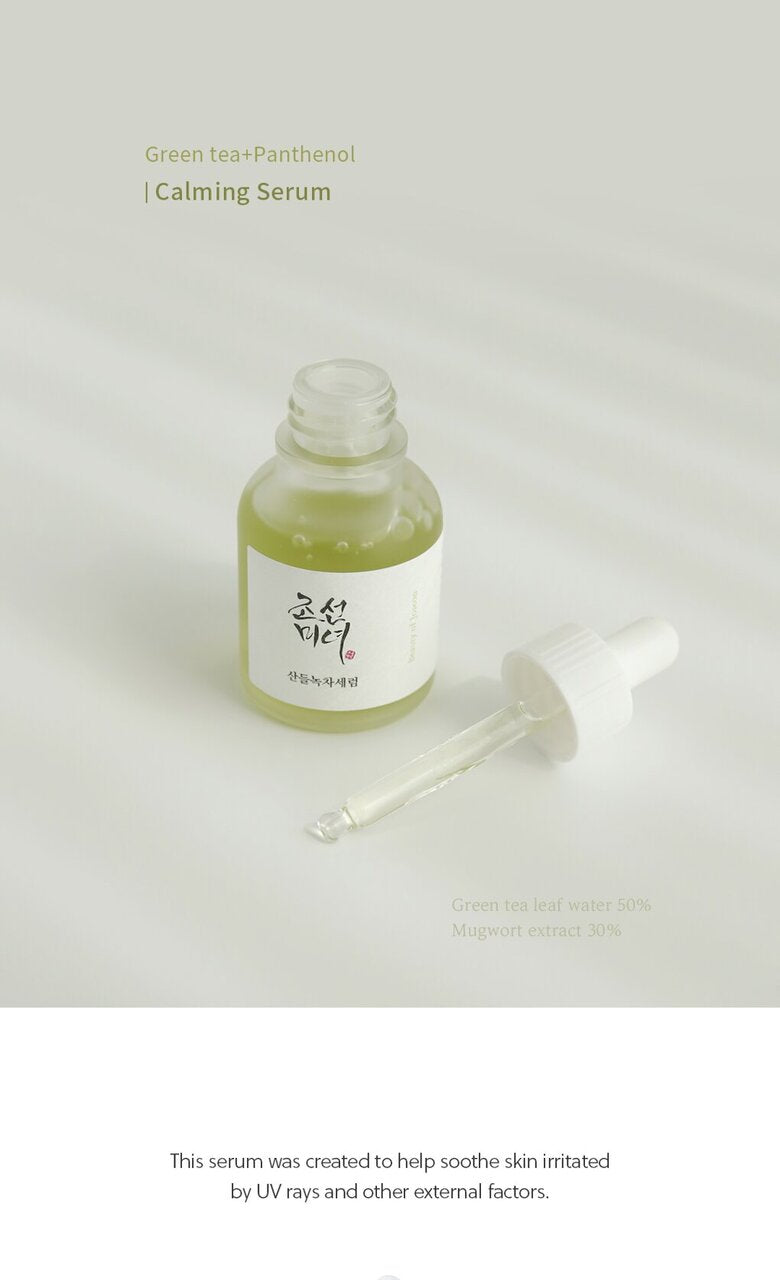
The Beauty of Joseon Calming Serum: Green Tea + Panthenol is a fragrance-free K-beauty serum built for sensitive, acne-prone, and UV-stressed skin that wants genuine calming support at an accessible price. Its 50.9% green tea water base, 30% mugwort extract, and 5% panthenol formula delivers antioxidant protection, visible redness reduction, and barrier-reinforcing hydration in a single lightweight step. The watery texture absorbs quickly and layers cleanly under SPF and moisturizer for most users. The trade-off is a 30ml size that goes quickly with daily use, and a small subset of users report potential pilling under silicone-heavy foundations or possible pore-clogging on highly congestion-prone skin.
Pros
- Fragrance-free, alcohol-free, paraben-free formula
- 50.9% green tea water base — not a token amount
- 30% mugwort extract for visible redness reduction
- 5% panthenol for barrier repair and hydration
- Lightweight texture layers under SPF without grease
- Affordable price for active-rich K-beauty serum
Cons
- Small 30ml size goes quickly with twice-daily use
- Can pill under silicone-heavy foundation layers
- Mixed reports on pore-clogging potential for congestion-prone skin
- Watery texture alone insufficient for severely dry or compromised barriers
As an Amazon Associate I earn from qualifying purchases. Disclosure
Overview
The Beauty of Joseon Calming Serum: Green Tea + Panthenol is a K-beauty serum formulated specifically for sensitive, acne-prone, and UV-stressed skin. Unlike many serums that lead with water and add active ingredients at trace levels, this formula replaces standard water with a 50.9% green tea infusion and stacks it alongside 30% mugwort extract and 5% panthenol — three ingredients that work through complementary mechanisms to calm reactivity, reinforce the skin barrier, and deliver antioxidant defense. It sits in the accessible end of the K-beauty market at roughly $14–16 USD for 30ml, making it one of the more cost-effective active-rich serums in its category.
Mugwort (Artemisia princeps) has been a cornerstone of traditional Korean herbal medicine for centuries, used topically for its soothing and anti-inflammatory properties long before it entered modern skincare formulations. Its crossover into K-beauty gained significant momentum around 2019–2021 as brands positioned it as a gentler, plant-derived alternative to synthetic calming agents for redness-prone skin. The target buyer for this serum is someone dealing with post-acne marks, environmental redness, or a sensitized barrier — particularly anyone looking for a fragrance-free, alcohol-free option that works within a layered AM and PM routine without adding weight or scent.
Key Specifications
| Volume | 30ml |
| Green Tea Water Base | 50.9% (Camellia sinensis leaf water) |
| Mugwort Extract | 30% (Artemisia princeps extract) |
| Panthenol | 5% (Provitamin B5) |
| Texture | Lightweight watery serum |
| Skin Type | Sensitive, acne-prone, normal, combination |
| Fragrance | Fragrance-free, alcohol-free, paraben-free |
Formula & Ingredients
When a serum lists “water” as its first ingredient, the actual active concentrations that follow are measured against that water — which is cheap and inert. Beauty of Joseon’s approach, as documented on the official product page and confirmed by INCIDecoder’s ingredient analysis, is to replace that base water entirely with 50.9% Camellia sinensis (green tea) leaf water. This means the liquid carrier itself delivers EGCG (epigallocatechin gallate) and other polyphenols at concentrations that would otherwise require them to be added separately at much lower doses. The practical result is a formula where the antioxidant benefit is baked into the vehicle rather than added as a secondary footnote ingredient.
Mugwort’s inclusion at 30% draws on a long tradition in Korean herbal skincare. Artemisia princeps contains flavonoids, terpenes, and volatile compounds that have demonstrated anti-inflammatory activity in cosmetic ingredient literature — particularly relevant for the kind of diffuse, post-acne redness and environmental reactivity that standard antioxidant serums don’t specifically target. The 5% panthenol rounds out the formula by addressing the barrier layer directly: panthenol (provitamin B5) converts to pantothenic acid in the skin, where it participates in barrier repair and moisture retention at a dose that ingredient databases like INCIDecoder flag as functionally meaningful rather than cosmetic.
Key Features
50.9% Green Tea Water (Camellia Sinensis): Green tea’s antioxidant profile is anchored by EGCG, a catechin that research published in the Journal of Investigative Dermatology has linked to reduced UV-induced inflammation and sebum regulation in in-vitro and small clinical studies. By using green tea leaf water as the actual base of the formula — not a splash added at the end of the ingredient list — the serum delivers polyphenol content at a scale that INCIDecoder’s analysis identifies as genuinely differentiated from typical “green tea extract” serums where the ingredient sits below 1%. For acne-prone skin, the sebum-regulating and antioxidant properties work alongside the mugwort to address two overlapping concerns: oxidative stress and inflammatory response.
30% Mugwort (Artemisia Princeps) Extract: Mugwort has been used in Korean traditional medicine (hanbang) as a topical anti-inflammatory agent for centuries, applied for skin conditions associated with heat, redness, and irritation. In modern K-beauty formulation, it became a mainstream ingredient after brands including Beauty of Joseon, I’m From, and Dr. Oracle validated its redness-calming credentials on sensitive skin. The anti-inflammatory mechanism is attributed to flavonoids and terpenoids in Artemisia princeps, which cosmetic ingredient literature suggests may inhibit cytokine pathways associated with skin reactivity. At 30%, this is one of the higher concentrations in the mugwort serum category — K-beauty reviewers at Skin Carisma and Into The Gloss have noted the visible difference between token-concentration mugwort products and formulas where it’s a headline active.
5% Panthenol (Provitamin B5): Panthenol is one of the better-studied barrier-repair ingredients in cosmetic dermatology. Once absorbed, it converts to pantothenic acid, a coenzyme involved in fatty acid synthesis that supports the skin’s lipid barrier structure. A 5% concentration is widely cited by formulation chemists as the threshold at which hydration and wound-healing benefits become clinically meaningful — well above the 0.1–1% concentrations common in panthenol-containing moisturizers where it functions more as a humectant than a barrier repair agent. For sensitized or post-acne skin where the barrier is compromised, this dose provides repair support alongside the calming actives rather than adding hydration as an afterthought.
Routine Compatibility: According to Beauty of Joseon’s official application guidance and K-beauty routine layering principles documented by Skin Carisma, this serum fits best immediately after cleansing and any toning step, before heavier water-based serums, moisturizer, and SPF. Its watery viscosity means it absorbs within seconds and doesn’t compete with products applied on top. In an AM routine it works well under chemical or mineral SPF — the antioxidant green tea base provides complementary UV defense to SPF’s physical blocking mechanism. In a PM routine it can precede a ceramide moisturizer or overnight barrier-repair product. The one layering caution flagged in user reviews: some silicone-heavy foundations applied over the serum without a moisturizer barrier between them have reported pilling, suggesting a moisturizer layer between serum and makeup is preferable.
Performance
Ingredient analysis from INCIDecoder rates the formula highly for sensitive and acne-prone skin, noting that the combination of green tea water, mugwort, and panthenol covers three distinct functional axes — antioxidant, anti-inflammatory, and barrier-repair — without any of the commonly flagged sensitizing ingredients (fragrance, alcohol, essential oils). K-beauty editors at Into The Gloss and Skin Carisma’s community review aggregates consistently report visible redness reduction within two to three weeks of daily use on reactive skin, with barrier-disrupted users noting improved comfort (reduced tightness and reactivity) within the first week. The typical improvement timeline documented in review aggregates suggests antioxidant and calming effects are noticeable before the full barrier-repair cycle completes — which is consistent with panthenol’s documented rapid absorption profile.
The main performance caveat in community reviews relates to congestion-prone skin. A subset of users — particularly those with fungal acne history or highly occlusion-sensitive pores — have reported potential comedogenic concerns, though INCIDecoder’s ingredient-level analysis does not flag the core actives as inherently pore-clogging. Beauty of Joseon recommends patch-testing on the inner arm or jawline for one to two weeks before full-face application, particularly for anyone with a history of congestion from botanical extracts. For the target user — sensitive, reactive, or UV-stressed skin without active comedone concerns — the formula’s performance profile is well-matched to its price point.
How Does It Stack Up Against the Competition?
| Feature | Beauty of Joseon Calming Serum | COSRX Snail Mucin 96% Essence | Innisfree Green Tea Seed Serum | Dr. Jart+ Cicapair Serum |
|---|---|---|---|---|
| Price (USD, approx.) | $15.00 | $18.50 | $30.00 | $49.00 |
| Size | 30ml | 100ml | 80ml | 30ml |
| Key Active | Green tea water + mugwort + panthenol | 96% snail secretion filtrate | Green tea seed extract | Centella asiatica + tiger grass |
| Fragrance-Free | Yes | Yes | No | Yes |
| Alcohol-Free | Yes | Yes | No | Yes |
| Primary Focus | Calming + antioxidant + barrier repair | Barrier repair + hydration | Hydration + antioxidant | Redness correction + calming |
| TTP Review | This review ↑ | Read our review → | — | — |
| Amazon | View on Amazon | View on Amazon | View on Amazon | View on Amazon |
Prices change frequently — always verify current pricing before purchasing.
Is Beauty of Joseon Calming Serum Worth It?
For sensitive, reactive, or post-acne skin, the Beauty of Joseon Calming Serum delivers a genuinely differentiated formula at a price point that undercuts most of its functional competitors by a meaningful margin. The combination of high-concentration green tea water, 30% mugwort, and a clinically relevant 5% panthenol dose addresses calming, antioxidant defense, and barrier repair in a single step — a stack that would cost considerably more if assembled from separate targeted serums. The fragrance-free, alcohol-free formulation removes two of the most common sensitizing triggers, making it well-suited for reactive skin that has historically struggled to tolerate actives-heavy products.
The trade-offs are real and worth acknowledging. At 30ml, the bottle depletes quickly with twice-daily use — typically four to six weeks — which affects the effective cost-per-use despite the attractive upfront price. Highly congestion-prone skin types should patch-test before committing, as the botanical extract concentration has produced clogging reports in a minority of users with that specific sensitivity. And for severely dry or compromised barriers, the watery texture alone won’t provide the occlusion needed for deep repair — it works best in combination with a substantive moisturizer rather than as a standalone barrier treatment. Within its intended use case, though, the value-to-active-ratio is difficult to match in this price bracket.
Frequently Asked Questions
Is mugwort safe for acne-prone skin?
Generally yes. Mugwort (Artemisia princeps) is anti-inflammatory rather than comedogenic, and its mechanism — reducing cytokine-driven skin reactivity — is directly relevant to the redness and sensitization that often accompanies acne-prone skin. The concern for acne-prone users is not the mugwort itself but the botanical extract concentration: a small subset of users with highly congestion-sensitive pores have reported potential clogging, likely due to the density of plant-derived compounds in the formula rather than any single ingredient. A two-week patch test on the jawline is the standard recommendation for anyone with a history of congestion from serum-type products.
Can you use Beauty of Joseon Calming Serum with retinol?
Yes, and the combination is arguably beneficial. Panthenol and green tea antioxidants have documented complementary effects for retinol-sensitized skin: panthenol supports the barrier repair that retinol can temporarily disrupt, while green tea’s EGCG helps counter the oxidative stress component of retinol-induced purging in some skin types. The standard layering approach is to apply the calming serum first (after toning), allow it to absorb, and then apply retinol product. On high-dose retinoid nights where barrier disruption is more likely, the panthenol layer is particularly useful.
Is this serum suitable for AM and PM use?
Yes — Beauty of Joseon’s formulation guidance and K-beauty routine documentation both support twice-daily use. In the morning, apply after cleansing and toning, before SPF and moisturizer. The antioxidant green tea base provides a complementary layer of UV-stress defense that works alongside rather than replacing SPF. In the evening, the panthenol and mugwort work through the skin’s overnight repair cycle when barrier recovery is most active. The one AM requirement that applies to all serums: always follow with a broad-spectrum SPF 30 or higher, regardless of any antioxidant content in the serum itself.