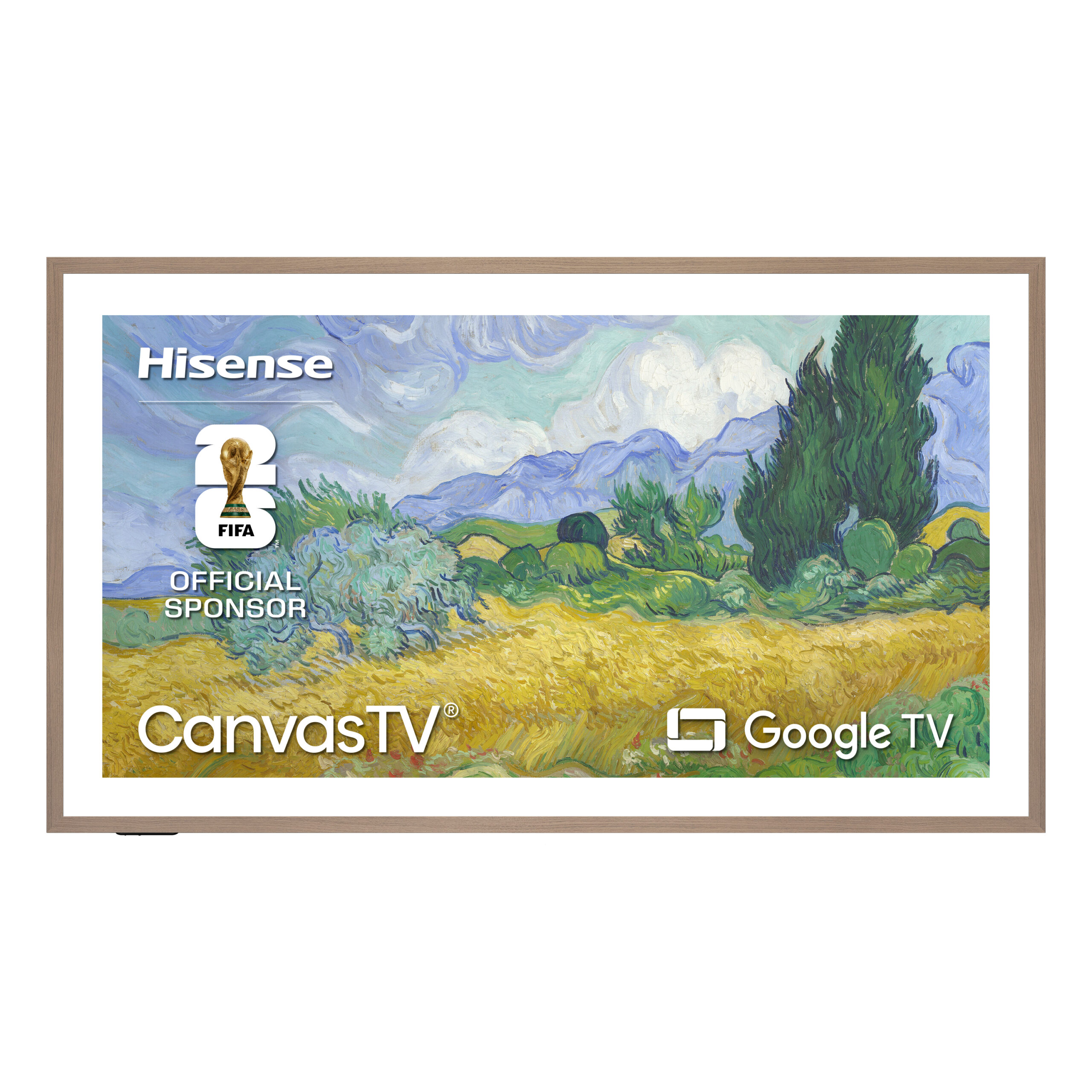
For a bright living room where the TV doubles as wall art, the CanvasTV S7SG is worth buying. Its matte screen nearly removes glare and it gets bright enough for daytime viewing, while more than 1,000 artworks and a teak frame come with it, no subscription needed; RTINGS rated it a bit better than Samsung's standard Frame 2026. The trade-off is night viewing: low contrast leaves dark-room movies without depth, and fast motion blurs. If evening movies come first, look at TCL's A400U and its Mini LED backlight, though no independent test had shown how well its dimming works as of October 2026.
Pros
- Matte screen handles glare in bright rooms
- Good SDR brightness for daytime viewing
- 1,000+ free artworks, no subscription
- Teak magnetic frame and flush wall mount included
- Native 144Hz panel with two HDMI 2.1 inputs
Cons
- Low contrast and no local dimming for dark rooms
- Slow response time blurs fast motion
- Picture degrades when viewed from the sides
As an Amazon Associate I earn from qualifying purchases. Disclosure
Overview
For most of the day, the Hisense CanvasTV S7SG is meant to pass for a framed painting: a matte screen, a teak frame that snaps on with magnets, a wall mount that holds it flush, and a built-in library of more than 1,000 artworks that costs nothing extra. It is the 2026 replacement for the original 2024 CanvasTV and comes in 50-, 55-, 65-, 75- and 85-inch sizes; this review covers the 75-inch 75S7SG.
Its strength is daylight. In RTINGS’ test of the 65-inch, the screen got bright enough to overcome glare in SDR while the matte coating nearly eliminated reflections, and its head-to-head rated the CanvasTV 2026 a bit better than Samsung’s standard Frame 2026. That makes it a TV for sunny rooms and daytime shows more than for movie nights with the lights off. It also has gaming hardware: a native 144Hz panel and two HDMI 2.1 inputs.
Key Specifications
| Model reviewed | 75S7SG (75-inch class, 74.5-inch diagonal); also 50, 55, 65 and 85 inches |
| Price (USD) | $1,299.99 |
| Display | 4K (3840 x 2160) QLED with quantum dot color, Hi-Matte anti-glare screen |
| Backlight | LED (ELED in Hisense’s spec), no local dimming |
| HDR formats | Dolby Vision, Dolby Vision IQ, HDR10, HDR10+, HDR10+ Adaptive, HLG |
| Refresh rate | 144Hz native; VRR from 48Hz to 144Hz |
| Gaming features | AMD FreeSync Premium, ALLM, Low Latency MEMC, Dolby Vision Gaming, HDR10+ Gaming, Game Bar |
| HDMI | 4 inputs (2 x HDMI 2.1, 2 x HDMI 2.0); eARC on HDMI 1 |
| Audio | 2.0.2-channel speakers with height channels |
| Smart platform | Google TV with Google Assistant; works with Alexa and Apple HomeKit/AirPlay |
| Art | 1,000+ free artworks, no subscription; your own photos by USB or QR code |
| Sensors | AI RGB light sensor, motion detector |
| Depth | 1.3 in without the frame, 1.4 in with it |
| In the box | Teak magnetic frame, UltraSlim wall mount, voice remote (white and walnut frames sold separately) |
Hisense CanvasTV S7SG Picture Quality
Daytime viewing is where this screen earns its place. RTINGS found good peak brightness in SDR, enough to push through glare, and a matte coating that strips out direct reflections, so a window across the room doesn’t turn the picture into a mirror. It also found that the TV cleans up low-quality content well, which helps with older shows and lower-bitrate streams. Hisense adds an AI RGB light sensor that adjusts brightness and color temperature to the light in the room.
After dark, the picture loses that advantage. RTINGS measured low contrast and found no local dimming, so dark scenes in a dark room lack the depth of a TV that can dim parts of its backlight. RTINGS also reported that the image degrades when you watch from the sides and that screen uniformity is mediocre, and it summed the set up as just an okay TV overall.
Homecrux’s reviewer, who lived with the 55-inch for several days, came away warmer: they found colors vibrant without looking artificial, enjoyed HDR content, and found the Filmmaker Mode and Theater presets well judged enough that little time went into picture menus. Format support is broad either way: Dolby Vision, Dolby Vision IQ, HDR10+ and HLG are all on the list, while Samsung’s standard Frame 2026 has no Dolby Vision.
Art Mode, Frame and Sound
When you’re not watching, the CanvasTV shows pieces from a library of more than 1,000 works with no subscription, or your own photos from a USB stick or a phone via a QR code. Samsung’s Frame takes a different route, with 30 free artworks a month through Art Store Streams and the full Art Store behind a subscription. A motion detector switches the art off when nobody is in the room, which saves power on a screen meant to stay on for much of the day.
The frame is part of the package rather than an upsell. A teak frame comes in the box and attaches with magnets, and white or walnut frames are sold separately; Homecrux found it clicks securely into place and comes off just as easily. Hisense’s two-part UltraSlim mount hangs the screen flush, and the TV measures 1.3 inches deep without the frame. Homecrux noted that the look only really works when it is mounted flush, and that routing channels on the back keep the power and HDMI cables tidy.
Sound comes from a 2.0.2-channel system with height channels for overhead effects. On the 55-inch, Homecrux found dialogue clear at moderate volume and never felt the need for a soundbar. Google TV runs the streaming side, with Google Assistant built in, and the TV also works with Alexa and Apple’s HomeKit and AirPlay.
Gaming and Motion
The spec sheet reads like a gaming TV’s. The panel runs at a native 144Hz with variable refresh from 48Hz to 144Hz, AMD FreeSync Premium and auto low latency mode, two of the four HDMI inputs are HDMI 2.1, and Dolby Vision Gaming and HDR10+ Gaming are supported. Samsung’s standard Frame 2026 goes further on ports, running all four of its HDMI inputs at 4K 144Hz.
Measured motion tells a different story. RTINGS found a very slow, uneven response time that leaves fast motion very blurry, with noticeable color and edge artifacts, and judged it poorly suited to sports and gaming. Homecrux, playing a few casual console sessions on the 55-inch in 144Hz mode, saw smooth motion and no distracting lag. The two don’t fully conflict: Homecrux played casually, while RTINGS’ verdict is about how fast motion holds up in sports and games.
How Does It Stack Up Against the Competition?
All four hang close to the wall and show art when idle; they differ in backlight, HDR support and how the art library is paid for. Every price is for the 75-inch size.
| Feature | Hisense CanvasTV S7SG | Samsung The Frame (2026) | TCL NXTVISION A300W | TCL A400U |
|---|---|---|---|---|
| Price (USD) | $1,299.99 (75") | $1,497.99 (75") (Nov 2) | $1,097.99 (75") | $1,199.99 (75") |
| Backlight | QLED, ELED backlight, no local dimming | QLED, Dual LED | QLED, edge-lit LED | QD-Mini LED, 836 dimming zones |
| Refresh rate | 144Hz native | 144Hz (VRR) | 120Hz (144Hz VRR) | 144Hz native |
| HDR formats | Dolby Vision IQ, HDR10+, HDR10, HLG | HDR10+ (no Dolby Vision) | Dolby Vision IQ, HDR10+, HDR10, HLG | Dolby Vision, HDR10+, HDR10, HLG |
| HDMI inputs | 4 (two HDMI 2.1) | 4 (all 4K 144Hz) | 4 | 4 (two at 4K 144Hz) |
| Depth | 1.3 in (1.4 in with frame) | 1.2 in | 1.1 in | 1.57 in |
| Free art | 1,000+ artworks, no subscription | 30 free artworks a month; full Art Store by subscription | 350+ artworks and AI art, no subscription | Art Library and AI art, no subscription |
| TTP Review | This review ↑ | — | Read our review → | Read our review → |
| Amazon | View on Amazon | View on Amazon | View on Amazon | View on Amazon |
Prices change frequently — always verify current pricing before purchasing.
Hisense CanvasTV S7SG: Worth It for Bright, Art-Filled Living Rooms
The CanvasTV S7SG fits a living room that gets real daylight and where the TV will spend more hours showing art than shows: daytime streaming and the news with the blinds open, a painting on the wall the rest of the time. In that room its matte screen and SDR brightness do the work, the art library and teak frame come with it, and RTINGS’ comparison puts it a step ahead of Samsung’s standard Frame 2026 for daytime viewing. Movie nights still work, just without the inky blacks a dimming backlight gives.
If most of your viewing happens after dark, TCL’s A400U is the one to look at: its Mini LED backlight has 836 dimming zones at 75 inches, though no independent test had shown how well they control blooming as of October 2026. Gamers with more than two high-refresh sources will prefer Samsung’s Frame (2026), which runs every HDMI input at 4K 144Hz but lists no Dolby Vision and offers 30 free artworks a month, with the full Art Store by subscription. TCL’s NXTVISION A300W keeps subscription-free art and Dolby Vision IQ in a thinner 1.1-inch body, trading the 144Hz panel for 120Hz. Shopping for a 55- or 65-inch instead? Amazon’s Ember Artline also has Dolby Vision and offers more than 2,000 artworks with no subscription, but it isn’t sold at 75 inches and runs at 60Hz.

Sources
- Hisense — 75″ Class S7 CanvasTV 4K QLED Google TV (75S7SG)
- Hisense — 2026 S7 Series CanvasTV Specification Sheet
- Hisense 75″ S7 CanvasTV (75S7SG) — Amazon Product Listing
- RTINGS — Hisense CanvasTV 2026 TV Review
- RTINGS — Samsung The Frame 2026 vs Hisense CanvasTV 2026
- Homecrux — Hisense S7SG CanvasTV Review
- The Gadgeteer — Hisense Built a 50-Inch Art TV
- Notebookcheck — Hisense’s new 2026 CanvasTV launches as Samsung The Frame competitor
- BGR — Cheap Alternatives to Samsung’s The Frame TV
- Digital Citizen — Amazon Ember Artline Fire TV Drops to $699 Ahead of Prime Day
- Samsung — 75″ The Frame LS03HE Specifications
- Samsung — The Frame LS03HE (Art Store Streams)
- TCL — NXTVISION A300W Specifications
- TCL — A400U Designer Series QD-Mini LED TV
- WFTV — TCL A400U adds Mini LED and 144Hz gaming to its art TV lineup
Reader Poll
What matters most in an art TV for your room?
Help Our Editors Know What Matters to You
Explore on Amazon →