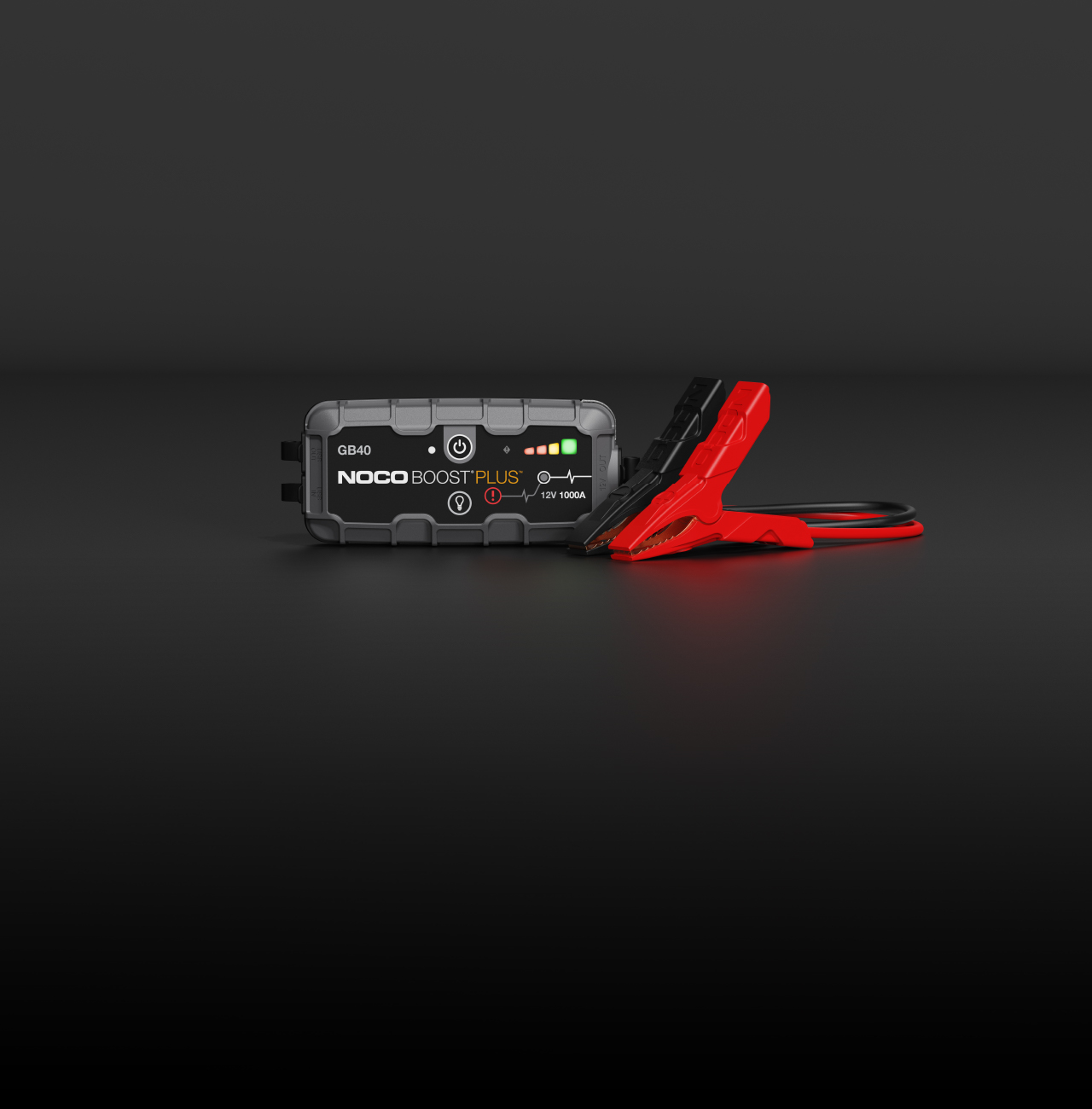
Buy the GB40 if you drive a gas car, crossover or smaller pickup and want a jump starter tough enough to live in the trunk: its water-resistant, rubber-armoured case and wide-gripping clamps are what testers praise most, and in TechGearLab's cold-weather test it restarted a drained 4-liter V6 three times in a row. Its smaller battery means checking the charge at least twice a year; for a diesel up to 4.0 liters or a gas engine up to 6.5, NOCO's GBX45 covers more.
Pros
- IP65 water- and dust-resistant, rubber-armoured case
- Wide-opening clamps that fit tight battery terminals
- Spark-proof with reverse-polarity protection
- Manual override for batteries below 2 volts
- Compact pack with a 100-lumen, seven-mode light
Cons
- Smaller usable battery than most rivals
- Rated only to 6.0L gas and 3.0L diesel engines
- Slow USB ports and no status screen
As an Amazon Associate I earn from qualifying purchases. Disclosure
Overview
A car that won’t even click on a cold morning is the moment the NOCO Boost Plus GB40 is made for. It’s a 2.45 lb lithium pack with a 1,000-amp peak rating that clips onto a 12-volt battery and, by NOCO’s rating, restarts gas engines up to 6.0 liters and diesels up to 3.0 liters. That covers small to midsize cars, SUVs and pickups, and it’s small enough to tuck into a glovebox or under a seat.
The GB40’s appeal over budget packs that advertise far higher peak amps is the way it’s built. Its rubber-overmolded case is rated IP65 against dust and water, and its heavy-duty clamps grip awkward battery terminals. That build wins consistent praise in independent tests, and CAR Magazine named it the best model in its group test for build quality. The compromises are a modest internal battery, slow USB ports and no screen, all covered below.
Key Specifications
| Price (USD) | $99.95 |
| Peak current | 1,000 amps |
| Engine rating (NOCO) | Gas up to 6.0 L, diesel up to 3.0 L |
| Battery types | 12-volt lead-acid (wet, gel, MF, EFB, AGM) |
| Internal battery | 24 Wh lithium-ion; up to 20 jump starts per charge (NOCO rating) |
| Charging input | USB-C, 5 V 2.1 A; about 3 hours to recharge |
| USB output | One USB-A, 5 V 2.1 A |
| Flashlight | 100 lumens, seven modes including SOS and strobe |
| Dust and water rating | IP65 |
| Size | 7.72 x 3.16 x 1.71 in (196 x 80.3 x 43.5 mm) |
| Weight | 2.45 lb (1.11 kg) |
| Operating temperature | -4°F to 122°F (-20°C to 50°C); charges at 32°F to 104°F (0°C to 40°C) |
| In the box | Battery clamps, USB-C to USB-C cable, microfiber storage bag |
| Warranty | 1-year limited |
NOCO Boost Plus GB40 Starting Power
Peak amps on the box are a poor guide here. Budget packs print 1,500 or 2,000 amps, yet the GB40’s 1,000 has proved enough in independent tests: TechGearLab got a drained 4-liter V6 (a 2010 Ford Explorer) running three times back to back on a cold day, and CAR Magazine’s tester found its test car fired up as if the battery had never been flat. TechGearLab’s explanation is that a newer engine with a healthy starter often doesn’t need an enormous current. For scale, Popular Mechanics puts the average engine in US vehicles at roughly 2.4 to 3.0 liters, well inside the GB40’s 6.0-liter gas rating.
The limit testers agree on is the big or tired engine. CAR Magazine lists it as less useful for larger engines, and TechGearLab’s buying guide warns that it might not manage larger pickups or big SUVs; its review adds that it would be less inclined to rely on the GB40 for an older vehicle that needs extra cranking to start. Gas engines over 6.0 liters and diesels over 3.0 liters are outside what NOCO rates it for.
Using it is simple. Clip the red clamp to the positive terminal and the black to the negative, and the GB40 checks the connection before it sends current. NOCO’s guide says some vehicles need it connected for up to 30 seconds before they’ll start, and it asks for no more than five attempts in 15 minutes. For a battery so drained the pack can’t detect it (below 2 volts), a manual override forces the boost on, but NOCO warns that this mode switches off the safety protections, so it’s for that one situation only. The controls are a few buttons and LEDs, and TechGearLab marked it down on ease of use because they’re less intuitive than the LCD screens some rivals have.
Build, Clamps and Safety
This is where the GB40 earns its reputation. The case is rubber-overmolded and rated IP65, and Popular Mechanics’ reviewer picks it for Oregon’s rainy season for that rating and its spark-proof design. The clamps are the other highlight: TechGearLab, which scored craftsmanship as the GB40’s strongest category, called them the easiest and most secure of any it tested, with jaws that open wide and are slim enough to reach terminals squeezed in by modern engine bays. NOCO fits the same clamp design to its more powerful models.
NOCO’s spark-proof design and reverse-polarity protection mean a crossed clamp won’t send current, and TechGearLab saw no sparks or problems in its use. NOCO’s own guide adds the warnings worth knowing before an emergency: never jump a frozen or damaged battery, use it only on 12-volt lead-acid batteries, and store it indoors rather than leaving it outdoors when not in use.
Battery Life and USB Charging
NOCO rates the internal battery at 24 Wh, good for up to 20 jump starts on a full charge. In TechGearLab’s capacity test it delivered only 15.57 Wh of that, and Popular Mechanics’ guide lists the GB40 with the lowest capacity of the models it recommends. Lithium packs can still start a car when partly charged, as TechGearLab points out, but a smaller reserve leaves fewer attempts before the next recharge, so the site’s advice is to check the charge at least every six months. NOCO’s guide adds that an unused pack discharges over time and that it shouldn’t be left on the charger for more than a week at a time.
Testers split on how useful it is as a power bank. TechGearLab found the single USB-A output and the USB-C input (charging only) slow, and wouldn’t count on the GB40 to keep phones going in a power outage. CAR Magazine’s tester had a better experience, charging a phone from about 26% to full in just over an hour on a road trip. NOCO itself rates it at up to four smartphone recharges, while TechGearLab estimates one or two. Recharging the pack takes about 3 hours from a 2.1-amp USB source, by NOCO’s figure. Current units charge over USB-C; NOCO’s older manual describes a Micro-USB input, so older reviews may mention that.
How Does It Stack Up Against the Competition?
Testers most often set the GB40 against compact, higher-amp packs from GOOLOO and AstroAI, and against NOCO’s own step-up model, the Boost X GBX45.
| Feature | NOCO Boost Plus GB40 | GOOLOO GP2000 | AstroAI S8 1500A | NOCO Boost X GBX45 |
|---|---|---|---|---|
| Price (USD) | $99.95 | $49.99 | Prime deal $42.19 | $124.95 |
| Peak current (maker rating) | 1,000 A | 2,000 A | 1,500 A | 1,250 A |
| Engine rating (maker) | 6.0 L gas, 3.0 L diesel | 8.0 L gas, 6.0 L diesel | 6.0 L gas, 3.0 L diesel | 6.5 L gas, 4.0 L diesel |
| Weight (maker) | 2.45 lb (1.11 kg) | 1.2 lb (0.54 kg) | 0.95 lb (0.43 kg) | 2.16 lb (0.98 kg) |
| Dust and water rating | IP65 | None listed | None listed | IP65 (ports closed) |
| USB charging | USB-C input; one USB-A output (5 V, 2.1 A) | USB input (5 V, 3 A); two USB outputs, one up to 12 V | Two USB-A outputs (5 V, 2.4 A), per Popular Mechanics | 60 W USB-C in and out, plus USB-A |
| Flashlight (maker) | 100 lumens | 400 lumens | Three modes; no lumen figure listed | 100 lumens |
| Amazon | View on Amazon | View on Amazon | View on Amazon | View on Amazon |
Prices change frequently — always verify current pricing before purchasing.
NOCO Boost Plus GB40: Worth It for a Tough Jump Starter That Lives in Your Car
The GB40 makes the most sense as a set-and-forget emergency tool for a gas car, crossover or smaller pickup: something you keep in the car that shrugs off rain and grime, then clamps securely onto a hard-to-reach terminal when the battery dies. The GOOLOO GP2000 and AstroAI S8 claim more peak amps for less money (at Amazon prices in October 2026), and TechGearLab credits the GP2000 with a bigger battery at a budget price. But neither lists a dust and water rating, and TechGearLab, which tested all three, ranks the GB40 above both, pointing to its durability and better clamps. If you’d rather have the sturdier pack than the bigger number, this is the one to buy.
NOCO’s GBX45 is the step up if you drive a diesel up to 4.0 liters or a gas engine up to 6.5 liters, or want a real power bank: its 60-watt USB-C port works both ways, powering phones, tablets and laptops, and it recharges the pack itself in about 48 minutes, by NOCO’s figures. CAR Magazine named it the best jump starter in its test, though it called it slight overkill for smaller cars. For full-size pickups and big SUVs, TechGearLab’s buying guide points to larger packs such as the HULKMAN Alpha85S or WOLFBOX MegaVolt24, and for a car that sits for months or has a worn starter, it recommends a jump starter with a sealed lead-acid battery. If you’d like a tire inflator in the same box, see our NOCO Boost Air AX65 review.

Sources
- NOCO — GB40 Official Product Page
- NOCO — GB40 Tech Specs
- NOCO Boost Plus GB40 — Amazon Product Listing
- NOCO — GB40 User Guide & Warranty (PDF)
- NOCO — GB40 Data Sheet (PDF)
- NOCO — GB40 User Guide, Earlier Micro-USB Edition (PDF)
- NOCO — GB40 Support
- TechGearLab — NOCO Boost Plus GB40 Review
- TechGearLab — The Best Jump Starters
- CAR Magazine — The Best Jump Starters Tried and Tested
- Popular Mechanics — The Best Portable Jump Starters
- GOOLOO — GP2000 Official Product Page
- AstroAI — S8 Jump Starter Official Product Page
- NOCO — GBX45 Official Product Page
- NOCO — GBX45 Tech Specs
Reader Poll
What matters most in a jump starter that lives in your car?
Help Our Editors Know What Matters to You
Explore on Amazon →