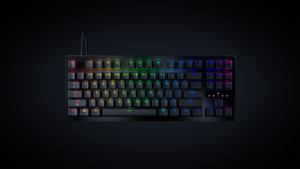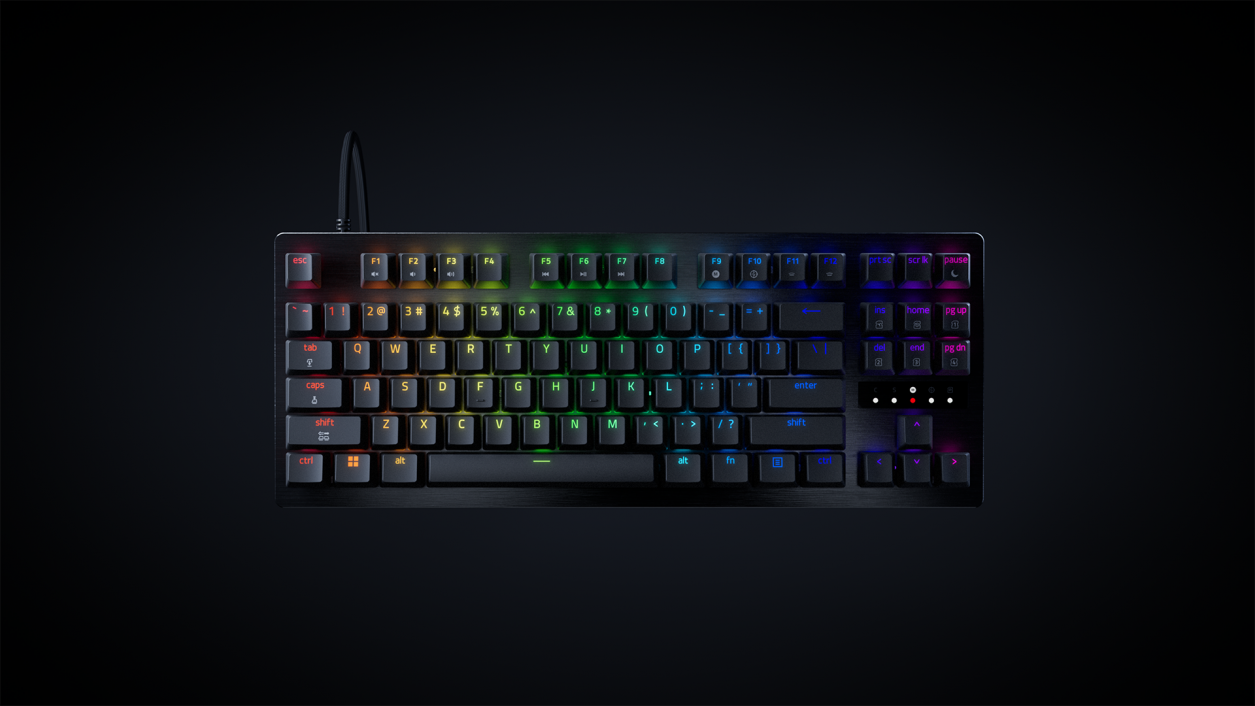
The Razer Huntsman V3 Tenkeyless 8KHz brings Razer's flagship Analog Optical Switches Gen-2 and true 8000Hz polling down to a sub-$200 price, giving competitive players adjustable 0.1-4.0mm actuation and Snap Tap rapid trigger without paying for the Pro model's media dial. Razer's own spec sheet lists 0.48ms latency, a figure CGMagazine's testing came close to matching at 0.58ms. The Synapse software adds deep customization most rivals at this price don't offer. The optical switches trade away tactile feedback for that speed, though — TechRadar found them harsh-feeling and fatiguing over long typing sessions.
Pros
- True 8000Hz HyperPolling and 0.48ms latency for near-instant response
- Fully adjustable 0.1mm to 4.0mm actuation with Snap Tap rapid trigger
- Deep Synapse software customization with onboard memory profiles
- Sturdy brushed-metal top plate with a detachable USB-C cable
- Sub-$200 price undercuts the SteelSeries Apex Pro TKL and Wooting 60HE
Cons
- Optical switches lack tactile dampening and feel harsh at the top of each keystroke
- No media keys or LED status indicators found on the pricier Pro model
- Tall keycap profile can slow finger movement during fast typing
As an Amazon Associate I earn from qualifying purchases. Disclosure
Overview
Razer sells the same core switch platform three different ways, and the cheapest entry point undercuts the flagship Huntsman V3 Pro TKL 8KHz by roughly $130 while keeping the identical Analog Optical Switches Gen-2 inside. That’s the pitch behind the Huntsman V3 Tenkeyless 8KHz: nearly all of the competitive-grade speed the Pro line is known for, minus the dedicated media dial and a few cosmetic extras, at a price that finally undercuts $200.
The analog switch inside is the reason this board can do things a standard mechanical keyboard can’t. Instead of a binary on/off keystroke, each key reports its exact depth of travel, which is what makes adjustable actuation points and Razer’s Snap Tap rapid-trigger mode possible. Paired with true 8000Hz HyperPolling, the result is a keyboard built around eliminating input lag rather than adding RGB flourishes.
Key Specifications
| Switch Type | Razer Analog Optical Switches Gen-2 |
| Actuation Range | 0.1mm–4.0mm, adjustable per key |
| Polling Rate | True 8000Hz HyperPolling |
| Latency | 0.48ms (Razer spec) |
| Layout | Tenkeyless (TKL), ~87 keys |
| Keycaps | Doubleshot PBT |
| Connection | Detachable braided USB-A to USB-C cable |
| Weight | 719.5g (1.60 lbs) |
| Special Features | Razer Snap Tap, Rapid Trigger, onboard memory profiles |
| Price (USD) | $163.99 |
Razer Huntsman V3 Tenkeyless 8KHz Switch Performance & Latency
The Analog Optical Switches Gen-2 measure light passing through the switch stem across the full range of travel, so the keyboard can read exactly how far a key has been pressed rather than treating it as a simple open or closed circuit. That’s what lets Snap Tap and Rapid Trigger work: the board can reset a keystroke the instant a key starts moving back up, which shooters use to cut movement-stop delay in competitive play. Actuation is adjustable per key from 0.1mm all the way to 4.0mm, so a player can set feather-light triggers on WASD and heavier thresholds elsewhere to cut down on accidental presses.
Razer’s own spec sheet lists 0.48ms latency when the analog switches are paired with true 8000Hz HyperPolling — a polling rate eight times the industry-standard 1000Hz. In CGMagazine’s hands-on testing, the board measured a very close 0.58ms, with the reviewer noting the response “feels instantaneous with no keystroke going unregistered” and describing the controls as tight and reactive throughout testing.
Build Quality & Typing Feel
CGMagazine’s review praised the brushed-metal top plate for a construction that “feels sturdy and durable,” crediting it with excellent shock absorption under the repeated, forceful keypresses typical of competitive play. The reviewer also credited a thick PCB foam layer underneath the switches for a typing sound and feel that held up well day to day, even though it’s a more cost-effective solution than the EPDM and EVA foam stack used in the pricier V3 Pro Tenkeyless 8KHz.
TechRadar’s review told a different story on feel specifically: its reviewer found the optical switches lack the dampening and clickiness of other analog boards, calling them “a little harsh at times,” with the sensation most noticeable during general typing rather than gaming. The site also flagged the height of the keycaps as a factor, noting they make it harder to move fingers quickly between keys, and that there’s a lack of feedback right at the top of each key’s travel — a trade-off that shows up mainly outside of gaming, where the analog switches were otherwise called responsive and precise.
Software, Customization & What the Pro Model Adds
Razer’s Synapse software is where the adjustable actuation, Snap Tap, and Rapid Trigger settings actually get configured, and TechRadar singled it out as a strength, describing “a smorgasbord of options to play around with,” including extensive rebinding and controller-emulation features layered on top of the performance settings. Onboard memory means those profiles travel with the keyboard rather than staying tied to one PC.
The trade-offs against the Huntsman V3 Pro Tenkeyless 8KHz are cosmetic rather than performance-related: this model drops the Pro’s dedicated media keys and digital dial, replacing them with fixed print screen, screen lock, and pause keys, and it skips the LED array status indicator found on the pricier board. The core Analog Optical Switches Gen-2 and 8000Hz HyperPolling are identical on both.
How Does It Stack Up Against the Competition?
The Huntsman V3 Tenkeyless 8KHz competes against other analog and rapid-trigger boards built for the same competitive-gaming audience.
| Feature | Razer Huntsman V3 Tenkeyless 8KHz | SteelSeries Apex Pro TKL | Wooting 60HE | Corsair K65 Plus Wireless |
|---|---|---|---|---|
| Price (USD) | $163.99 | $249.99 | $240.00 | $129.99 |
| Switch Type | Analog optical | Magnetic (HyperMagnetic) | Magnetic (Hall effect) | Mechanical linear |
| Max Polling Rate | 8000Hz | 1000Hz (wired) | 8000Hz (v2) | 8000Hz |
| Rapid Trigger | Yes (Snap Tap) | Yes (Rapid Trigger) | Yes (Rapid Trigger) | No |
| Media Controls | No (fixed keys only) | OLED display | No | No |
| TTP Review | This review ↑ | — | — | Read our review → |
| Amazon | View on Amazon | View on Amazon | — | View on Amazon |
Prices change frequently — always verify current pricing before purchasing.
Is the Razer Huntsman V3 Tenkeyless 8KHz Worth It?
For competitive players who want true analog switches, adjustable actuation, and 8000Hz polling without paying Pro-tier prices, this is one of the more straightforward recommendations in the category — it delivers the same core switch technology as Razer’s flagship board for meaningfully less money. Rapid Trigger and Snap Tap alone make a real difference in fast-paced shooters, and Synapse’s depth of customization gives it long-term flexibility most rivals don’t match at this price.
Anyone who spends more hours writing documents or emails than fragging should think twice, though — the tall keycaps and the lack of feedback at the top of each keystroke that TechRadar flagged are real trade-offs for long typing sessions, not just gaming. Buyers who want the dedicated media dial and OLED-style status readouts should budget for the Pro Tenkeyless 8KHz instead.