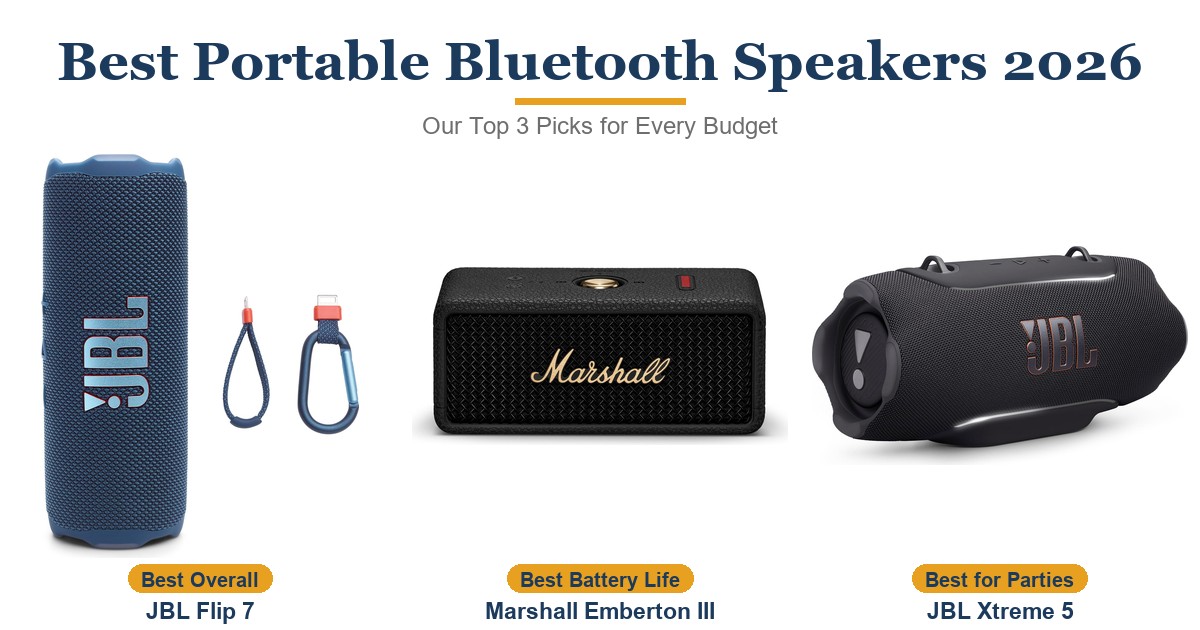
Get the JBL Xtreme 5 if you host outdoor parties and want deep bass that keeps vocals clear at high volume. Its IP68, drop-proof build suits sand, pool decks and campsites, and the battery can be swapped out as it ages instead of retiring the speaker. The trade-off is bulk: at 2.9 kg it rides on a shoulder strap, not in a daypack. Anyone who wants a speakerphone should look at the Sony ULT Field 5 instead.
Pros
- Deep, weighty bass that keeps vocals clear
- IP68 dust and water rating, certified drop-proof
- User-swappable battery
- Auracast linking, 7-band EQ and lossless USB-C audio
- Charges your phone; power adapter in the box
Cons
- Heavier and bulkier than the Xtreme 4
- No microphone for calls
- Muffled off to the side or behind, in RTINGS' test
- Playtime Boost makes the sound leaner
As an Amazon Associate I earn from qualifying purchases. Disclosure
Overview
The JBL Xtreme 5 is built for the moment a small speaker runs out of steam: a backyard full of people, a beach, a campsite. It’s rated at 130 watts plugged in and 90 watts on battery, it’s sealed to IP68 against dust and water, and JBL certifies it as drop-proof. It replaced the Xtreme 4 in April 2026 and comes with a shoulder strap.
Inside, JBL swapped the Xtreme 4’s two woofers for one larger racetrack woofer, kept the two tweeters and raised the power, and most of the testers who compared the two generations heard deeper bass and cleaner detail. It also adds edge lighting, a 7-band EQ, Bluetooth 6.0 and Auracast, and it keeps a battery you can swap out yourself.
Key Specifications
| Price (USD) | $399.95 |
| Drivers | One 98 x 145 mm racetrack woofer, two 20 mm (0.75-inch) tweeters |
| Rated output power | 130W on AC power (90W woofer + 2 x 20W tweeters); 90W on battery (60W + 2 x 15W) |
| Frequency response | 40 Hz – 20 kHz |
| Battery (JBL rating) | Up to 24 hours, plus 4 with Playtime Boost; 3.5-hour charge; user-swappable battery |
| Bluetooth | 6.0; SBC, AAC and LC3 codecs; Auracast |
| Wired audio | USB-C (lossless); no 3.5 mm input |
| Charging out (power bank) | USB-C, 5V/3A, 9V/2A or 11V/2A |
| Microphone | None (no speakerphone calls) |
| Dust and water rating | IP68; drop-proof |
| Dimensions (W x H x D) | 34.6 x 16.5 x 15.5 cm (13.6 x 6.5 x 6.1 in) |
| Weight | 2.9 kg (6.38 lb) |
JBL Xtreme 5 Sound Quality
Bass is the headline, and it doesn’t swamp the rest of the mix. Testers describe deep, weighty low end that still leaves vocals clear and detailed, and most heard a real step up from the Xtreme 4: What Hi-Fi? says the new model makes its predecessor “sound hazy and cluttered in comparison.” Tom’s Guide is the exception, finding it sounds just as good as the Xtreme 4.
It plays loud enough for an outdoor party, and that’s where it’s happiest. TechRadar notes it needs mains power to reach its peak volume and heard a little compression close to 100%, which it calls common for Bluetooth speakers like this; Techaeris found the mix stayed clean at full volume. At the other end of the dial, T3 found it can play impressively quietly and still sound great, so it works for everyday listening too. Indoors, Techaeris found the bass can occasionally turn boomy in a small room with reflective walls, which the app’s EQ can tame.
Where you put it matters more than with a round speaker. RTINGS found that from the side or behind, vocals and instruments sound muffled and lack detail, so aim it at the crowd. SoundGuys’ MDAQS score (HEAD Acoustics’ algorithm, based on evaluations from more than 200 listeners) was 2.7 overall, which it calls a fair result for a portable speaker, with a low 1.7 for immersiveness that SoundGuys says the enclosure’s limited left-to-right separation likely explains. Pairing a second Xtreme 5 in the app gives true stereo.
Battery Life and the Swappable Battery
JBL rates the Xtreme 5 for up to 24 hours, plus four more with Playtime Boost, and the independent battery tests land on either side of that. SoundGuys played it at a steady 80 dB from one metre with the lighting on and got 30 hours and 6 minutes, while RTINGS got 21 hours, against 27.2 hours for the Xtreme 4. SoundGuys adds that 80 dB isn’t especially taxing for a speaker of this size, and that higher volumes, bass-heavy music and the lighting all drain it faster.
Playtime Boost is best kept as a last resort. It buys its extra hours by cutting bass, and testers found a clear drop in sound quality with it switched on; What Hi-Fi? describes the result as leaner and more compressed.
The battery itself is the long-term advantage. As on the Xtreme 4, it can be swapped out, so a worn battery doesn’t mean replacing the speaker, and JBL sells a second battery pack for longer days away from power. A full charge takes 3.5 hours with the included USB-C power adapter, JBL says a 10-minute charge adds about two hours, and the same USB-C port can charge your phone.
Build, Strap and Portability
It’s made for rough handling. The IP68 rating means it’s dust-tight and can go under water (TechRadar cites 30 minutes at a metre and a half), JBL certifies it as drop-proof, and rubber fins guard the bass radiators at each end.
The cost is weight: at 2.9 kg (6.38 lb) it’s about 0.8 kg heavier than the Xtreme 4, so it’s a shoulder-strap speaker rather than one for a daypack. The included strap is adjustable, still has a built-in bottle opener, and clips onto larger floating hooks with more clearance, which What Hi-Fi? says makes it slightly easier to attach than before.
App, Auracast and What’s Missing
The JBL Portable app adds a 7-band custom EQ (up from 5 bands on the Xtreme 4, SoundGuys notes), sound presets, lighting controls and stereo pairing. Auracast links it to a second Xtreme 5 for stereo or to other Auracast-capable JBL speakers for a bigger setup, and the edge lighting can be recoloured or switched off to save battery.
Wired listening goes through USB-C, which carries lossless audio (What Hi-Fi? cites up to 24-bit/48kHz). There’s no 3.5 mm aux input, so an older player with neither Bluetooth nor USB-C audio can’t plug in. Over Bluetooth 6.0 it supports SBC, AAC and LC3, with no aptX or LDAC.
The bigger absence for some buyers is a microphone: it can’t take calls or work as a speakerphone, something the Sony ULT Field 5 can do.
How Does It Stack Up Against the Competition?
The rivals most often weighed against the Xtreme 5 are Bose’s SoundLink Max and Sony’s ULT Field 5, with JBL’s own Charge 6 as the smaller step down.
| Feature | JBL Xtreme 5 | Bose SoundLink Max | Sony ULT Field 5 | JBL Charge 6 |
|---|---|---|---|---|
| Price (USD) | $399.95 | $399.00 | $268.00 | $149.95 (last Amazon price, Sep 27, 2026) |
| Rated battery life (maker) | Up to 24 hrs (28 with Playtime Boost) | Up to 20 hrs | Up to 25 hrs | Up to 24 hrs (28 with Playtime Boost) |
| Dust and water rating | IP68 | IP67 | IP67 | IP68 |
| Wired audio input | USB-C (digital) | 3.5 mm aux | 3.5 mm aux | USB-C (digital) |
| Multi-speaker linking | Auracast | A second SoundLink Max (Stereo or Party Mode) | Sony Party Connect | Auracast |
| TTP Review | This review ↑ | — | — | Read our review → |
| Amazon | View on Amazon | View on Amazon | View on Amazon | View on Amazon |
Prices change frequently — always verify current pricing before purchasing.
JBL Xtreme 5: Worth It for Loud, Rugged Outdoor Parties
If you host outdoors and want one speaker that can carry a party, the Xtreme 5 is the one to get. Its bass has real weight without burying vocals, it shrugs off water, sand and drops, and because the battery can be swapped, an ageing cell doesn’t end its life. It’s at its best aimed at a crowd outside or plugged in on a patio, and T3 found it still sounds great turned down low.
Look elsewhere if you’ll mostly carry it on foot or want a speakerphone. The JBL Charge 6 is much easier to pack, and SoundGuys points out that two of them, run in stereo, cost about the same as one Xtreme 5 at full price. RTINGS rates the Xtreme 5 a better outdoor speaker than Sony’s ULT Field 5, for its IP68 sealing and user-replaceable battery, though the Sony has a microphone and an aux input and, as RTINGS noted when we checked in October 2026, is typically the cheaper option. The Bose SoundLink Max adds a 3.5 mm input and is often on sale, but it’s rated for fewer hours and to IP67 rather than IP68. And if you can find the Xtreme 4 at a real discount, it may be the smarter buy for many people: it lasted longer in RTINGS’ battery test (27.2 hours to 21), though its bass is weaker.

Sources
- JBL — Xtreme 5 Official Product Page and Specifications
- JBL Xtreme 5 — Amazon Product Listing
- What Hi-Fi? — JBL Xtreme 5 review
- TechRadar — JBL Xtreme 5 review
- Tom’s Guide — JBL Xtreme 5 review
- SoundGuys — JBL Xtreme 5 review
- SoundGuys — JBL Xtreme 5 vs Charge 6
- RTINGS — JBL Xtreme 5 Speaker Review
- T3 — JBL Xtreme 5 review
- Techaeris — JBL Xtreme 5 review
- Bose — SoundLink Max Portable Speaker
- What Hi-Fi? — Bose SoundLink Max review
- Sony — ULT Field 5 Wireless Speaker
- SoundGuys — Sony ULT Field 5 review
- JBL — Charge 6 Official Product Page
Reader Poll
Where would your Xtreme 5 spend most of its time?
Help Our Editors Know What Matters to You
Explore on Amazon →