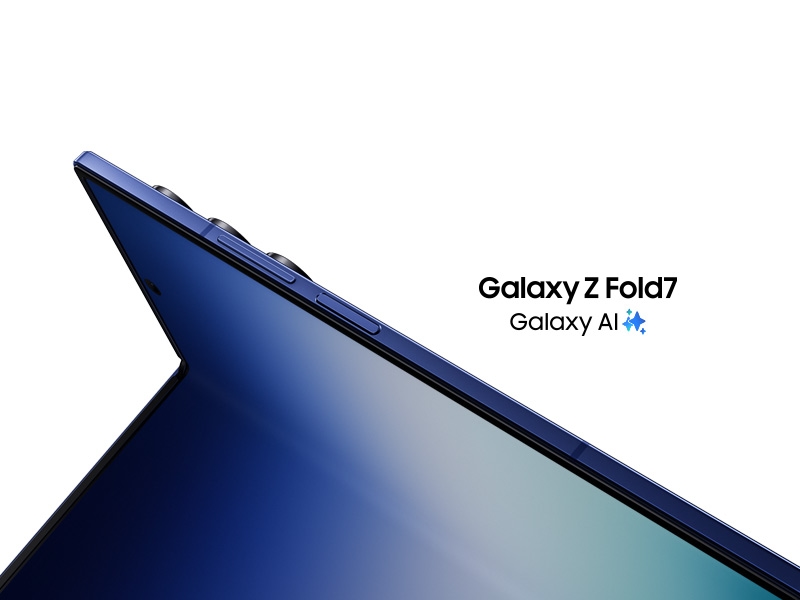
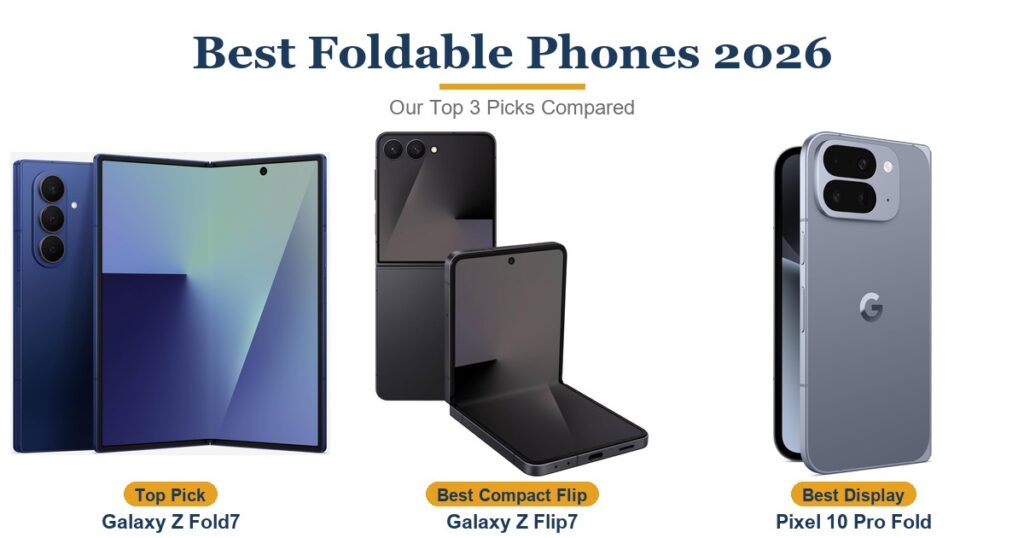
The Galaxy Z Fold7 is worth buying if you can get it for clearly less than the Fold8 Ultra: it carries like a regular phone at 215 g, opens into a roomy 8-inch screen for side-by-side apps, and its 200MP main camera takes detailed, natural-looking photos. Its battery life trails rivals and the Fold8 Ultra in lab tests, which matters most to heavy users. At full price, the Fold8 Ultra is the better buy, with a brighter screen and a faster chip.
Pros
- Thin and light enough to carry like a regular phone
- Roomy 8-inch inner screen and a normal-width 6.5-inch cover screen
- Detailed 200MP main camera
- Ultrawide with autofocus for macro shots
- Fast Snapdragon 8 Elite performance
- Seven years of OS and security updates
Cons
- Battery life trails rivals and the Fold8 Ultra in lab tests
- 3x telephoto is soft in low light
- No S Pen support
- IP48 rating isn't sealed against sand or fine dust
As an Amazon Associate I earn from qualifying purchases. Disclosure
Overview
Samsung’s Galaxy Z Fold7 is the book-style foldable that finally carries like an ordinary phone. Folded, it is 8.9 mm thick and weighs 215 g, a touch lighter than Samsung’s own Galaxy S25 Ultra, yet it opens into an 8-inch screen with room for side-by-side apps, documents and video. It went on sale in July 2025, and Samsung still lists it for sale on its US store.
Newer models are what changed the buying decision. The Galaxy Z Fold8 Ultra, on sale since August 2026, keeps the Fold7’s shape and screen sizes and is its direct successor; in Samsung’s own words, “what began as the original Galaxy Z Fold continues forward as Galaxy Z Fold8 Ultra.” Next to it sits the Galaxy Z Fold8, a smaller, wider model with a different shape. The Fold7 is still a very capable phone, so the real question is what it is worth next to its replacement.
Key Specifications
| Price | $1,999.99 (256GB) |
| Inner display | 8.0-inch Dynamic AMOLED 2X, 1968 x 2184, up to 120Hz |
| Cover display | 6.5-inch Dynamic AMOLED 2X, 1080 x 2520, 120Hz |
| Size folded | 158.4 x 72.8 x 8.9 mm |
| Size unfolded | 158.4 x 143.2 x 4.2 mm |
| Weight | 215 g |
| Processor | Qualcomm Snapdragon 8 Elite |
| Memory and storage | 12GB RAM with 256GB or 512GB; 16GB RAM with 1TB |
| Rear cameras | 200MP wide, 12MP ultrawide with autofocus, 10MP 3x telephoto |
| Selfie cameras | 10MP on the cover screen, 10MP on the inner screen |
| Battery | 4,400 mAh |
| Charging | 25W wired, 15W wireless, 4.5W reverse wireless |
| Water and dust rating | IP48 |
| S Pen | Not supported |
| Software | Android 16 with One UI 8; seven years of OS and security updates |
Samsung Galaxy Z Fold7 Design and Portability
The Fold7’s biggest achievement is how little it asks of your pocket. Unfolded it is 4.2 mm thick, and closed it is only slightly thicker than a regular flagship, so when closed it handles much like a regular phone. The frame is Samsung’s Armor Aluminum, the cover screen sits under Gorilla Glass Ceramic 2 and the back under Gorilla Glass Victus 2, and the hinge feels solid, with a firm but smooth action when you open it.
Two design habits take some getting used to. The camera bump is thick and sits in one corner, so the phone rocks and wobbles when you tap it lying flat on a table, a complaint several reviewers make. And it is so thin that it can take a fingernail to open; Samsung later told TechRadar that some users found the Fold7 difficult to open, and it added a chamfered edge to the Fold8 Ultra for that reason.
The IP48 rating is the weak spot for outdoor use. Water protection is solid, rated for submersion in up to 1.5 m of fresh water for 30 minutes, but the dust rating only covers particles larger than 1 mm, so it isn’t sealed against sand or fine dust, and several reviewers would keep it away from the beach.
Displays and Multitasking
Both screens grew. The cover display is now 6.5 inches with a 21:9 shape, wide enough that typing on it feels like using a normal phone, so you can leave the Fold7 shut for quick replies and email. Inside, the folding panel went from 7.6 to 8 inches, with room for several apps side by side, and the crease is much harder to see and feel than on older Folds, though it still shows at some angles and under reflected light.
GSMArena measured 1,408 nits on the inner screen in auto mode, about 200 nits below the Fold6 but still, in its view, bright enough for comfortable outdoor use, while Tom’s Guide’s HDR test peaked at 2,310 nits, level with the Fold6. The Fold8 Ultra’s inner screen is brighter and adds an anti-reflective coating, which Tom’s Guide found made a large difference to glare.
Two trade-offs came with the thinner panel. Samsung dropped the digitizer layer, so the S Pen no longer works on the Fold7; TechRadar found that a basic capacitive stylus still works for rough sketches, without pressure sensitivity. The inner selfie camera also moved from under the screen to a visible punch hole, which Tom’s Guide’s reviewer found unsightly. TechRadar also points out that the near-square inner screen can leave larger black borders on some videos and games.
Cameras
The camera is where the Fold7 closed most of the gap to Samsung’s S Ultra phones. GSMArena found its main-camera photos virtually identical to the Galaxy S25 Ultra’s, though several reviewers still give the S25 Ultra the edge overall. The main camera uses a 200MP sensor of the kind found in the Galaxy S25 Ultra, and it produces detailed, well-exposed photos with wide dynamic range and natural colour; shooting at full resolution lets you crop deep into a shot. The 12MP ultrawide gained autofocus, which turns it into a capable macro camera for flowers and close-up textures.
The 3x telephoto is the weak link. It is a small 10MP sensor carried over from the Fold6, and it gives up the 5x reach of the Galaxy S25 Ultra. GSMArena found it sharp in daylight, while HotHardware found even its native 3x shots often softer than expected; both found it struggles as the light drops. In low light, GSMArena’s advice is to switch on Night mode yourself, because the automatic version rarely kicks in with the main camera.
Selfies improved as well: both selfie cameras are now 10MP, and the inner one, with its wider lens, takes clearly better shots than the old 4MP under-display camera. Video reaches 8K at 30 fps from the main camera, with 10-bit HDR on by default. The Fold8 Ultra keeps the same main and telephoto hardware and moves to a 50MP ultrawide, and Tom’s Guide still found its photos crisper, especially at night.
Battery Life and Charging
Battery is the Fold7’s main weakness. Samsung kept the same 4,400 mAh capacity as the Fold6 while some rivals moved to larger silicon-carbon cells, and in Tom’s Guide’s web-surfing test over 5G it averaged 10 hours and 44 minutes, against more than 17 hours for the Galaxy S25 Ultra. GSMArena’s Active Use Score of 11:44h is likewise slightly below average for its class. In mixed everyday use, reviewers mostly got through a full day on a charge, and Pickr expects most owners to charge it every night. Its successor does better, by how much depends on the test: the Fold8 Ultra’s 5,000 mAh battery lasted 14 hours and 33 minutes in the same Tom’s Guide test, while Expert Reviews’ video-loop test found it ran only around an hour and a half longer than the previous generation.
Charging is slow by current standards. The 25W wired charging reached 53% in 30 minutes in GSMArena’s test and took almost an hour and a half for a full charge, and wireless charging tops out at 15W, plus 4.5W reverse wireless charging. There’s no charger in the box, only a USB-C cable. The Fold8 Ultra moves to 45W wired and 20W wireless.
Performance and Software
Speed is no concern. The Snapdragon 8 Elite with 12GB of RAM ran demanding games smoothly, matched the Galaxy S25 Ultra in Tom’s Guide’s Geekbench run, and beat the iPhone 16 Pro Max’s multi-core score in TechRadar’s testing. The thin body does show under sustained load: T3 saw the processor throttle and the screen dim after long sessions, which matters most to heavy gamers.
The software is the other reason to choose a Fold. One UI 8 on Android 16 is tailored to the big screen, with easy split-screen multitasking, drag and drop between apps, and Gemini Live, which can look at what’s on your screen and answer questions about it while it floats in a corner. Samsung promises seven years of OS and security updates, the same span Google gives the Pixel 11 Pro Fold.
How Does It Stack Up Against the Competition?
At launch, GSMArena saw Google’s Pixel Pro Fold as the Fold7’s only real US rival; today that means the Pixel 11 Pro Fold, alongside Samsung’s own Fold8 Ultra. The Galaxy S26 Ultra is here for anyone weighing a foldable against Samsung’s best regular phone.
| Feature | Samsung Galaxy Z Fold7 | Samsung Galaxy Z Fold8 Ultra | Google Pixel 11 Pro Fold | Samsung Galaxy S26 Ultra |
|---|---|---|---|---|
| Price (USD) | $1,999.99 (256GB) | $1,899.99 (256GB) | $1,899.00 (256GB) | $1,099.99 (256GB) |
| Folding inner screen | 8.0-inch | 8.0-inch | 8.0-inch | None (not a foldable) |
| Outer screen | 6.5-inch | 6.5-inch | 6.5-inch | 6.9-inch |
| Weight | 215 g | 215 g | 238 g (8.4 oz) | 214 g |
| Battery capacity | 4,400 mAh | 5,000 mAh | 4,806 mAh (typical) | 5,000 mAh |
| Rear cameras | 200MP wide, 12MP ultrawide, 10MP 3x telephoto | 200MP wide, 50MP ultrawide, 10MP 3x telephoto | 48MP wide, 10.5MP ultrawide, 10.8MP 5x telephoto | 200MP wide, 50MP ultrawide, 50MP 5x and 10MP 3x telephoto |
| Water and dust rating | IP48 | IP48 | IP68 | IP68 |
| Processor | Snapdragon 8 Elite | Snapdragon 8 Elite Gen 5 for Galaxy | Google Tensor G6 | Snapdragon 8 Elite Gen 5 for Galaxy |
| TTP Review | This review ↑ | Read our review → | Read our review → | Read our review → |
| Amazon | View on Amazon | View on Amazon | View on Amazon | View on Amazon |
Prices change frequently — always verify current pricing before purchasing.
Samsung Galaxy Z Fold7: Worth It as a Discounted Big-Screen Foldable
The Fold7 makes the most sense for someone who wants a phone that opens into a small tablet without the old foldable bulk, and who can get it for clearly less than the Fold8 Ultra. At that price you keep almost everything that matters day to day: the same shape and screen sizes, the same 200MP main camera and plenty of speed. If you already own one, there’s little reason to upgrade unless you need the bigger battery, the 50MP ultrawide or the brighter, less reflective screen; otherwise, in BGR’s words, “your Z Fold 7 is still most of this phone at none of the additional cost.”
At full price, though, the newer phone is the better buy. On Amazon in October 2026, the 256GB Fold8 Ultra was $1,899.99, against $1,999.99 for the Fold7 the last time Amazon sold it new (October 7, 2026), and Tom’s Guide’s verdict is that “if you’re in the market for a new foldable phone, the Fold 8 Ultra is hands-down the better option,” citing its brighter screen and faster chip. If you’d rather carry less, the Fold8 is lighter at 201 g and built around a wider screen for watching content, but it has no telephoto camera; it was $1,699.99 for 256GB on Amazon in October 2026. If zoom and dust protection matter more to you than Samsung’s software, the Pixel 11 Pro Fold has a 5x telephoto and an IP68 rating, though it is the heaviest phone here. And if you can live without a folding screen, the Galaxy S26 Ultra adds a 5x telephoto, a built-in S Pen and IP68 protection, and it was $1,151.78 on Amazon in October 2026.
Sources
- Samsung — Galaxy Z Fold7 product page
- Samsung — Galaxy Z Fold8 Ultra product page
- Samsung — Galaxy Z Fold8 product page
- Google — Pixel 11 Pro Fold tech specs
- Samsung — Galaxy S26 Ultra product page
- GSMArena — Samsung Galaxy S26 Ultra review
- Samsung Galaxy Z Fold7 — Amazon Product Listing
- GSMArena — Samsung Galaxy Z Fold7 review
- GSMArena — Samsung Galaxy Z Fold7 review: lab tests
- GSMArena — Samsung Galaxy Z Fold7 review: camera
- GSMArena — Samsung Galaxy Z Fold7 review: verdict
- Tom’s Guide — Samsung Galaxy Z Fold 7 review
- Tom’s Guide — Samsung Galaxy Z Fold 8 Ultra vs Galaxy Z Fold 7
- TechRadar — Samsung Galaxy Z Fold 7 review
- TechRadar — Samsung Galaxy Z Fold 8 Ultra vs Galaxy Z Fold 7
- TechRadar — Samsung Galaxy Z Fold 8 Ultra review
- HotHardware — Galaxy Z Fold7 review
- T3 — Samsung Galaxy Z Fold 7 review
- Pickr — Samsung Galaxy Z Fold 7 review
- Android Central — Samsung Galaxy Z Fold 7 review
- BGR — Samsung Galaxy Z Fold 8 Ultra review
- SamMobile — Galaxy Z Fold 8 vs Fold 8 Ultra: which one replaces your Fold 7
- Expert Reviews — Samsung Galaxy Z Fold 8 Ultra review
Reader Poll
What matters most to you in a book-style foldable?
Help Our Editors Know What Matters to You
Explore on Amazon →