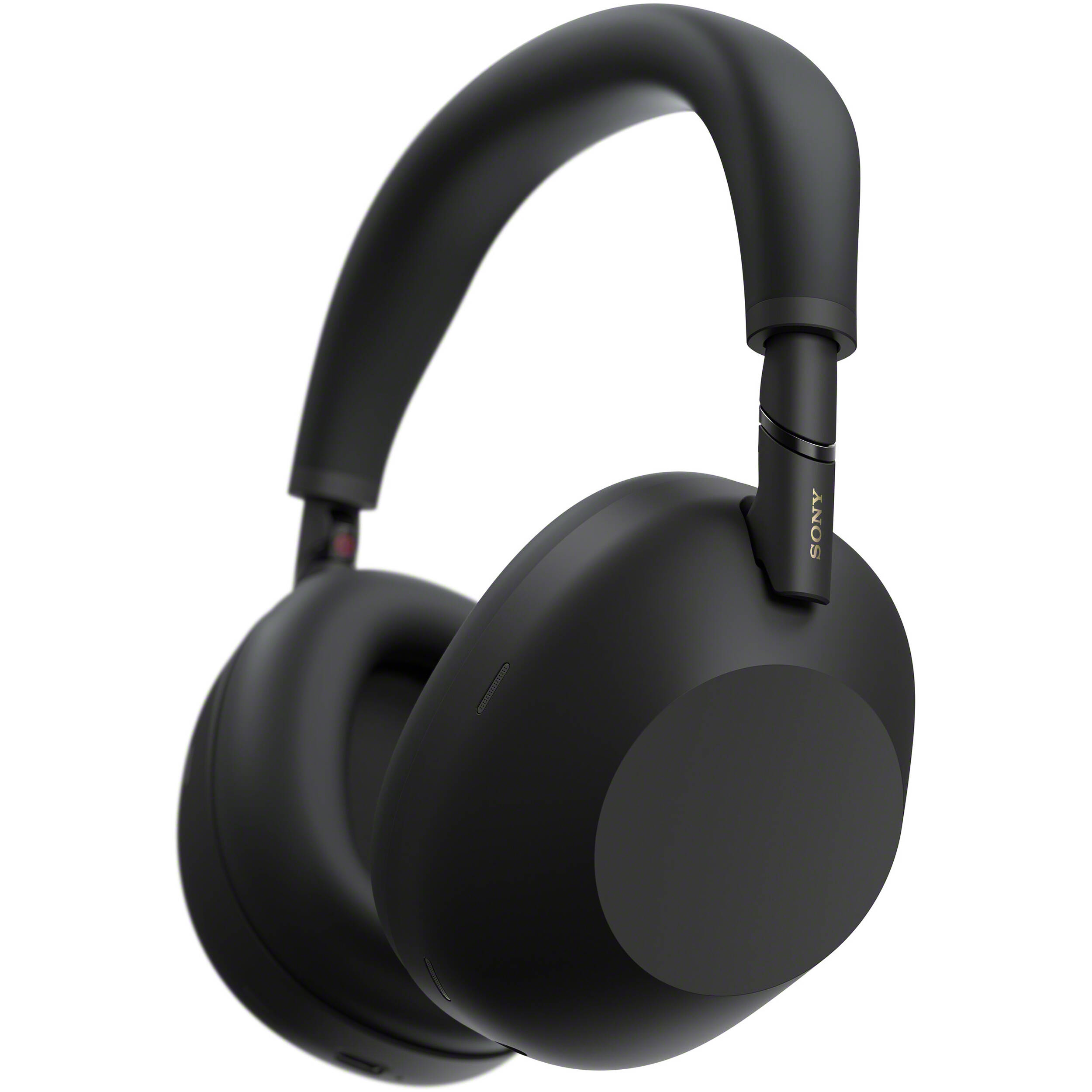
Buy the Sony WH-1000XM6 if you want one pair of headphones that does everything well: noise cancelling that ranks with the very best, detailed and balanced sound, and excellent call quality. It folds up for travel again, and testing beat its 30-hour battery rating. The main trade-off is that it can't play audio over USB-C, which every rival in the comparison table can. If comfort matters most, try the Bose QuietComfort Ultra Headphones (2nd Gen).
Pros
- Noise cancelling that ranks with the very best
- Detailed, balanced sound with a 10-band EQ
- Excellent call quality in most noisy places
- Folds up again and weighs just 254 g
- 3-minute USB-PD top-up gives about 3 hours
Cons
- No audio over USB-C; 3.5 mm cable only
- 30-hour rating trails Sennheiser's 57 hours
- Thin pads and shallow cups don't suit every ear
- No water-resistance rating
As an Amazon Associate I earn from qualifying purchases. Disclosure
Overview
Most people shopping for premium noise-cancelling headphones want one pair that handles a flight, a noisy commute and a work call equally well. That is the job the Sony WH-1000XM6 does best. It combines noise cancelling that ranks with the strongest in the class, a detailed and balanced sound, and excellent call quality.
The XM6 is Sony’s first new flagship over-ear since the WH-1000XM5 of 2022, and most of the changes answer complaints about that model. The earcups fold up again, the headband is wider and flatter, and the power and noise-cancelling buttons now have different shapes so you can find them by touch. Inside, Sony’s QN3 processor, which Sony says is seven times faster than the QN1 in the XM5, runs 12 microphones instead of eight. What hasn’t moved is the 30-hour battery rating.
Key Specifications
| Type | Closed-back, over-ear wireless headphones with active noise cancelling; folding |
| Drivers | 30 mm carbon fibre composite dome |
| Processor and microphones | HD Noise Cancelling Processor QN3; 12 microphones (six per earcup) |
| Battery life (Sony rating) | Up to 30 hours with noise cancelling on, 40 hours with it off |
| Charging | USB-C; 3 minutes on a USB-PD charger for about 3 hours of playback; full charge in 3.5 hours; plays while charging |
| Bluetooth | Bluetooth 5.3; multipoint (two devices); SBC, AAC, LDAC and LC3 |
| Wired listening | 3.5 mm cable (included); no audio over USB-C |
| Weight | 254 g (9 oz) |
| Water resistance | No IP rating |
| Price (USD) | Deal $378.00 until Nov 18 |
Sony WH-1000XM6 Noise Cancelling
This is the reason most people buy an XM-series pair, and the XM6 delivers. Across the reviews, it cut out the low drone of engines and trains and the mid-range rumble of traffic, offices and household appliances, leaving a quiet background for music at moderate volume. SoundGuys found the earcups block a lot of sound on their own, which leaves the active system less work to do. An adaptive optimizer retunes the cancelling as your surroundings change. What Hi-Fi? points out the one control Bose offers and Sony doesn’t: you can’t set the cancelling to a chosen strength yourself.
Against Bose’s QuietComfort Ultra Headphones (2nd Gen), the closest rival, the testers split. RTINGS found the Sony slightly stronger at isolating noise, though it called the gap close; What Hi-Fi? found Bose’s Quiet mode blocks a little more outright, while describing the Sony’s effect as more natural and subtle. Either way, it is a contest between the two best, not a clear loss. No headphones erase everything: Tom’s Guide played recorded airplane noise through a speaker system and found it barely noticeable at 70 dB, but audible over music at 75 to 80 dB.
Glasses wearers may see mixed results. SoundGuys found that breaking the seal with glasses frames made bass cancelling less predictable, while Expert Reviews’ reviewer noticed little effect on either comfort or cancelling with glasses on. RTINGS also lists audio delivery consistency as the XM6’s one con, meaning how much the sound changes from one wearer or listening session to the next, and found the Bose 2nd Gen gives a more consistent sound with glasses on.
Hearing the world: cupping a hand over the right earcup lowers the music and pipes in outside sound, a quick way to catch an announcement or talk to someone. The Ambient Sound mode can also be set by hand on a 20-step scale.
Sound Quality and Tuning
The XM6 is the best-sounding pair in the line so far. The new 30 mm carbon fibre drivers and the QN3’s revised digital-to-analogue processing produce a balanced, detailed sound with punchy but controlled bass. What Hi-Fi?, which gave the XM6 its 2025 Award for best wireless headphones at £250 to £500, called it “the most detailed, dynamic, precise and open sound we’ve heard from a wireless Sony flagship”. SoundGuys’ panel-based audio model scored it 4.8 out of 5, ahead of 96% of the over-ear headphones in its rankings.
Two points split the reviewers. The first is the soundstage: Tom’s Guide found the XM6 traded some width for vocal clarity compared with the XM5, while TechRadar heard a wider soundstage that helps with films. The second is the best-sounding rival at this price, the Bowers & Wilkins Px7 S3. TechRadar and Expert Reviews both preferred it for pure sound, while What Hi-Fi? rated the two as equals with different characters. Against Bose’s 2nd Gen pair, What Hi-Fi? found the Sony ahead in every area of sound.
Bass splits opinion: Expert Reviews heard bombastic bass, while Tom’s Guide thought bass lovers might want a touch more. Either way, the 10-band equalizer in Sony’s Sound Connect app can shift it, and the app also offers presets and a guided “Find Your Equalizer” test. LDAC streams at up to 990 kbps on Android phones; iPhones connect over AAC, which still sounds very good but isn’t hi-res.
Calls and Microphones
Calls are the clearest step up from the XM5. Beamforming microphones and AI processing pick out your voice and filter the noise around you. What Hi-Fi? rated its calls a bigger step up than the first Bose QuietComfort Ultra Headphones, the Px7 S3 and the original AirPods Max manage. Of the newer models, RTINGS rates the Sony’s mic generally better than the AirPods Max 2’s, which disappoints unless paired with an Apple device, and a likely better pick than the Bose 2nd Gen’s for frequent callers, though the two aren’t worlds apart.
Very loud places are the exception. Expert Reviews played aircraft noise at rising levels during calls and found voice pickup fine up to about 77 dBA, then distorted and compressed as the noise rose, getting quite bad at around 87 dBA. You can mute the microphone from the noise-cancelling button, and head gestures can answer or decline calls.
Comfort, Fit and Build
At 254 g the XM6 weighs less than the AirPods Max 2, Px7 S3 and Momentum 5 in the table below, and most testers found it comfortable for hours: the wider headband spreads the load, the sliders adjust smoothly with no fixed steps, and the clamp is a little firmer than the XM5’s to help the seal. The dissent is about depth. SoundGuys found the pads thin and the earcups shallow enough that an inner microphone can touch some ears, and RTINGS found Bose’s QuietComfort Ultra Headphones (2nd Gen) comfortable on more people. If your ears are large or sensitive, that is worth trying on before buying.
The redesigned hinges let the earcups fold inward again, and the hard case closes with a magnet. The case still needs the headphones folded flat rather than balled up, so it is not much smaller than before. There is no water-resistance rating, so keep them out of the rain.
Controls: a touch panel on the right earcup handles play, skip and volume (hold a swipe to keep changing the volume), and you can switch the panel off. TechRadar called them the most consistent, intuitive touch controls its reviewer had used on any headphones.
Battery, Charging and Connections
Battery life beats its billing. Sony’s rating is 30 hours with noise cancelling on, unchanged from the XM5, yet SoundGuys’ standard battery test ran for 37 hours 14 minutes. RTINGS measured 31.75 hours of continuous use with noise cancelling on. That covers the longest flights. Among the rivals, the AirPods Max 2 are rated for 20 hours and Sennheiser rates its Momentum 5 Wireless at 57; the Bose 2nd Gen shares the 30-hour rating, and the testers split on which lasts longer in practice, with RTINGS favouring the Bose and What Hi-Fi? calling them even.
When it does run low, this is the first Sony flagship you can keep listening to while it charges, and a 3-minute top-up on a USB-PD charger gives about 3 hours of playback.
Connections are where the XM6 is behind. It can’t play audio over USB-C, so wired listening means the included 3.5 mm cable, while every rival in the table below plays lossless or hi-res audio through its USB-C port. Bluetooth is version 5.3 with LE Audio’s LC3 codec and two-device multipoint.
Spatial audio with head tracking works only with Android phones that support Android’s built-in head tracking, which TechRadar notes excludes Samsung phones and Apple devices; the 360 Reality Audio upmix for films works with any stereo source.
How Does It Stack Up Against the Competition?
The XM6 sits among the premium noise-cancelling flagships: Bose’s QuietComfort Ultra (2nd Gen) is its closest rival for cancelling, the AirPods Max 2 suit iPhone owners, the Bowers & Wilkins Px7 S3 is the sound-first choice, and Sennheiser’s Momentum 5 Wireless is the battery champion.
| Feature | Sony WH-1000XM6 | Bose QuietComfort Ultra Headphones (2nd Gen) | Apple AirPods Max 2 | Bowers & Wilkins Px7 S3 | Sennheiser MOMENTUM 5 Wireless |
|---|---|---|---|---|---|
| Price (USD) | Deal $378.00 until Nov 18 | $339.99 | $449.00 | $474.21 | $339.99 |
| Rated battery, noise cancelling on | 30 hours | 30 hours | 20 hours | 30 hours | 57 hours |
| Weight | 254 g | 250 g | 386.2 g | 300 g | 290 g |
| Wired listening | 3.5 mm cable only | USB-C (lossless) or 2.5 mm cable | USB-C (lossless) | USB-C or 3.5 mm | USB-C or 3.5 mm |
| Hi-res Bluetooth codec | LDAC | aptX Adaptive | None (SBC and AAC only) | aptX Adaptive, aptX Lossless | aptX Adaptive, aptX Lossless |
| Earcups fold inward | Yes | Yes | No | No (lies flat) | No (lies flat) |
| TTP Review | This review ↑ | Read our review → | Read our review → | — | — |
| Amazon | View on Amazon | View on Amazon | View on Amazon | View on Amazon | View on Amazon |
Prices change frequently — always verify current pricing before purchasing.
Sony WH-1000XM6: Worth It for Quiet Travel, Clear Calls and Detailed Sound
Buy the XM6 if one pair has to cover planes, trains and the working day. Few rivals match its mix of near-top cancelling, sound that What Hi-Fi? rates class-leading, microphones that hold up in most noisy places, and a 30-hour rating that testing beat. Android owners also get LDAC streaming, and the folding design finally makes it easy to pack. The main gap is wired listening over USB-C, which matters mostly if you want lossless audio from a laptop or phone by cable.
Look elsewhere in a few cases. If comfort comes first, Bose’s QuietComfort Ultra Headphones (2nd Gen) fit more people comfortably in RTINGS’ testing. If you live in Apple’s ecosystem, the AirPods Max 2 add Personalized Spatial Audio and tighter integration with Apple devices, at the cost of weight and battery. If sound matters more than cancelling, try the Bowers & Wilkins Px7 S3, and if you rarely want to charge, the Sennheiser Momentum 5 Wireless is rated for almost twice the playback.


Sources
- Sony — WH-1000XM6 Product Page
- Sony WH-1000XM6 — Amazon Product Listing
- What Hi-Fi? — Sony WH-1000XM6 review
- What Hi-Fi? — Sony WH-1000XM6 vs Bose QuietComfort Ultra Headphones (2nd Gen)
- TechRadar — Sony WH-1000XM6 review
- Tom’s Guide — Sony WH-1000XM6 review
- SoundGuys — Sony WH-1000XM6 review
- RTINGS — Sony WH-1000XM6 review
- Expert Reviews — Sony WH-1000XM6 review
- MusicTech — Sony WH-1000XM6 review
- What Hi-Fi? — Bose QuietComfort Ultra Headphones (2nd Gen) review
- Bose — QuietComfort Ultra Headphones (2nd Gen)
- Apple — AirPods Max 2 Technical Specifications
- SoundGuys — Apple AirPods Max 2 review
- T3 — Apple AirPods Max 2 review
- What Hi-Fi? — Bowers & Wilkins Px7 S3 review
- TechRadar — Bowers & Wilkins Px7 S3 review
- Sennheiser — Introducing MOMENTUM 5 Wireless
- What Hi-Fi? — Sennheiser Momentum 5 Wireless review
- SoundGuys — Sennheiser MOMENTUM 5 Wireless review
Reader Poll
Would you give up audio over USB-C for the XM6's cancelling and calls?
Help Our Editors Know What Matters to You
Explore on Amazon →