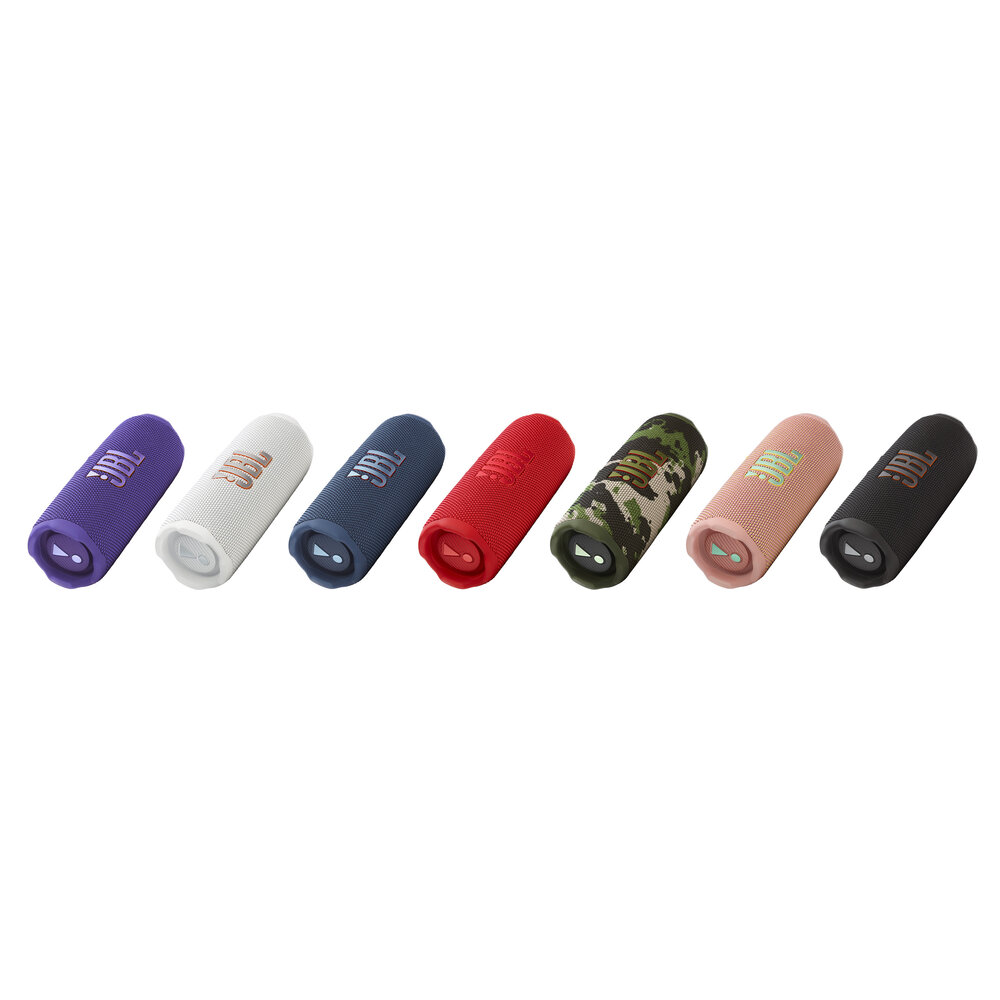
Buy the Flip 7 if your speaker has to survive beaches, trails and bike rides: it's the only IP68 speaker in our comparison, and it sounds full and punchy at everyday volumes. A 7-band EQ, Auracast linking and a USB-C lossless input round out a solid set of upgrades over the Flip 6, and in Canada JBL sells it in nine finishes. The trade-offs: it gets harsh near the top of the dial, and its battery fell well short of JBL's rating in some tests. If you want calls or a voice assistant, the Bose SoundLink Flex (2nd Gen) or Beats Pill has the microphone it lacks.
Pros
- IP68 dust and water rating, drop-rated to 1 m
- Full, punchy sound at everyday volumes
- 7-band EQ in a free app with no account needed
- Auracast linking and two-speaker stereo pairing
- Lossless wired audio over USB-C
Cons
- Harsh near full volume, and battery fell short of the rating in some tests
- No microphone for calls or a voice assistant
- Can't link with a Flip 6 or other Party Boost speakers
As an Amazon Associate I earn from qualifying purchases. Disclosure
Overview
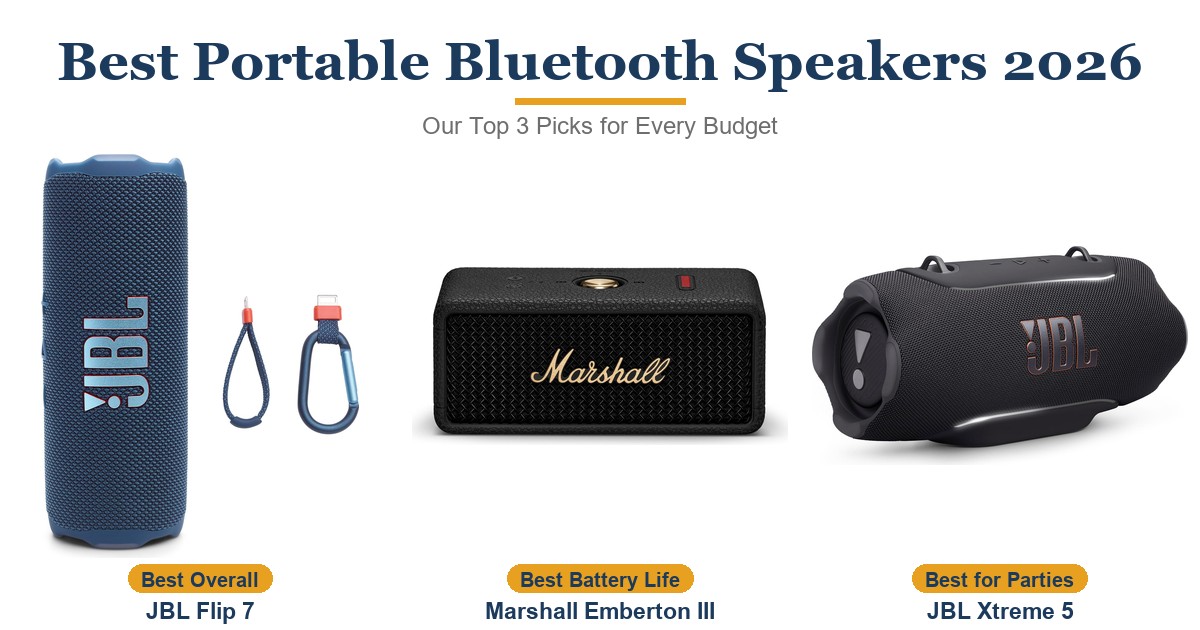
A speaker that rides in a beach bag or clips to a backpack takes knocks, sand and the odd swim, and most small speakers ask you to trade some sound for that kind of toughness. The JBL Flip 7, the seventh version of JBL’s can-shaped speaker, gives up less than most. It carries an IP68 dust and water rating, JBL rates it to survive a 1 m (3 ft) drop onto concrete, and What Hi-Fi? gave it five stars and picks it as the best portable speaker in its Bluetooth speaker guide.
From the outside it looks almost the same as the Flip 6, but the changes add up. The woofer gets 25W instead of 20W, the water rating rises from IP67 to IP68, and JBL’s battery rating goes from 12 to 14 hours. The app’s EQ grows from 3 bands to 7, Auracast replaces JBL’s older Party Boost for linking speakers, and for the first time on a Flip you can play music over a USB-C cable, including lossless files. Canadian buyers get the same model on Amazon.ca, and JBL Canada’s own store lists it in nine finishes, including Sand and Funky Black. Of the speakers in our comparison table, it’s the only one rated IP68, and the only one with no microphone for calls.
Key Specifications
| Price (CAD) | $189.98 |
| Drivers | 45 x 80 mm (1.75 x 3 in) woofer, 16 mm (0.6 in) tweeter, two passive radiators |
| Output power | 25W woofer + 10W tweeter (35W total) |
| Frequency response | 60 Hz – 20 kHz |
| Battery (JBL rating) | Up to 14 hours; 16 with Playtime Boost; 2.5 hours to charge |
| Bluetooth | 5.4, with Auracast |
| Wired audio | USB-C, lossless up to 24-bit/96 kHz; no 3.5 mm aux input |
| Microphone | None |
| Dust and water rating | IP68 (1.5 m of water for 30 minutes) |
| Dimensions (W x H x D) | 18.3 x 7.0 x 7.2 cm (7.2 x 2.7 x 2.8 in) |
| In the box | Loop strap and carabiner; no charger or USB-C cable |
JBL Flip 7 Sound Quality
For a speaker this size, the Flip 7 sounds full and lively: punchy bass, a clear midrange and crisp, detailed treble. What Hi-Fi? played it side by side with the Flip 6 and found the new model smoother and weightier, with far more bass. The bass also holds up at low volume, so it still has some body when it’s playing in the background by a pool or under a conversation. What it can’t do is reach the deepest sub-bass. Most testers found the lowest notes thin out, which the 60 Hz lower limit predicts; TechRadar was the exception, finding it digs deep into the low frequencies.
It goes loud for its size, and Expert Reviews says no other Bluetooth speaker it has tested matches that volume from such a compact package. Push it toward the top of the dial, though, and it turns harsh: PCMag heard sharper sibilance and a tilt toward the treble past about 70% volume. Expert Reviews tamed the treble by turning it down in the app’s EQ. Busy, dense music shows its size too. PCGamesN found it lacks a little lower-midrange warmth, so it can sound a touch shrill at middling volumes with rock, metal and classical piano, and it rates it right for a kitchen gathering or a few friends around a barbecue rather than for filling a large space.
On its own it plays in mono, mixing stereo tracks down to one channel. Real stereo needs a second Flip 7, because other JBL models can’t form a stereo pair with it.
Build, Durability and Portability
Toughness is the Flip 7’s biggest advantage. IP68 means it’s sealed against dust and can sit under 1.5 m (4.9 ft) of water for 30 minutes, half a metre deeper than the Flip 6’s IP67 allowed. The rubber bumpers that guard the passive radiators at each end are slightly longer and thicker than before. Expert Reviews tried JBL’s 1 m drop rating on a patio, and the speaker came away unscathed. One weak spot remains: PCGamesN points out that the passive radiators have no grille, so a fall onto a rock or uneven ground could still damage them.
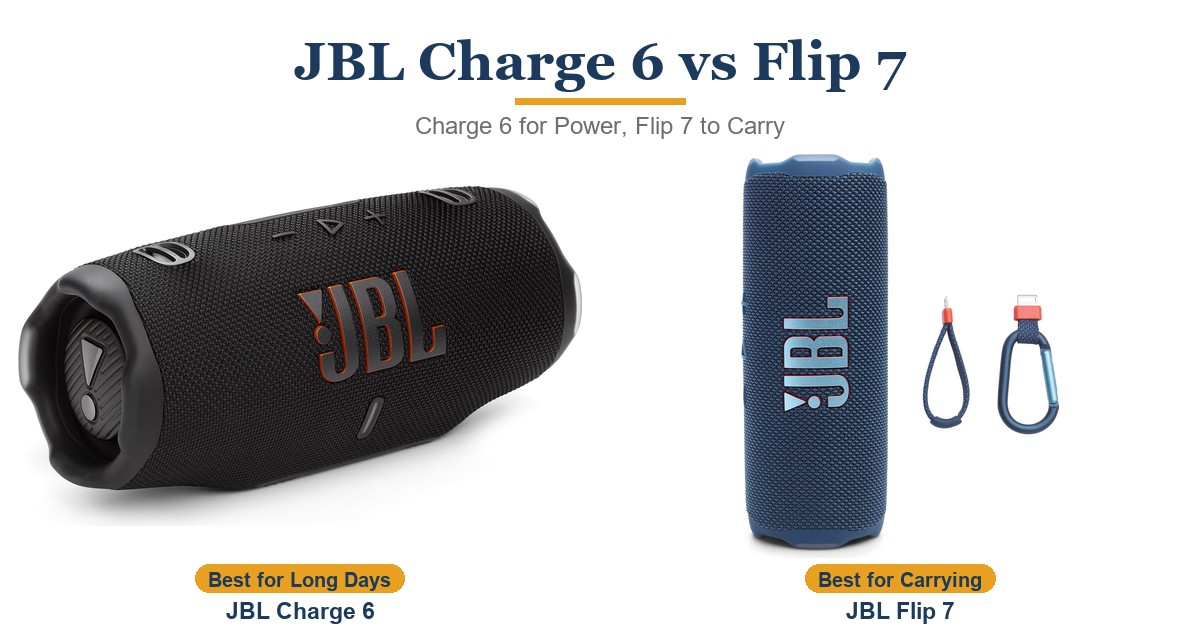
It’s about the size of a large drink can, and PCMag notes that it fits most bike bottle cages. JBL replaced the Flip 6’s built-in strap with a PushLock mount that clicks in like a seatbelt; the box includes a small loop strap and a carabiner, so you can carry it by hand or clip it to a bag or a branch. Expert Reviews would have liked a bigger loop, since it fits only a couple of slender fingers, not a wrist. A small rubber foot keeps it from rolling on a flat surface, though PCGamesN found it doesn’t always catch on uneven ground.
Battery Life and Charging
JBL rates the Flip 7 at 14 hours, or 16 with Playtime Boost, a mode that cuts the bass to save power and switches off your custom EQ. Playtime Boost isn’t a good way to stretch it, though, because it makes the speaker sound noticeably worse.
Battery results vary with the test. Two testers found JBL’s rating about right in everyday listening, one of them at 50% volume. SoundGuys’ standard test, which loops music at a steady 80 dB from a metre away, ran it down after 6 hours and 16 minutes, behind the Bose SoundLink Flex (2nd Gen)’s 7 hours and 3 minutes in the same test. At 80% volume, PCGamesN saw runtime fall to nearly half the claim.
A full charge takes about 2.5 hours from a 5V/3A charger. JBL doesn’t include a charger or a USB-C cable, so you’ll need your own.
App, Controls and Connectivity
The buttons sit in two rows: volume and play/pause in one, and power, Bluetooth pairing and a new Auracast button in the other. The free JBL Portable app for iOS and Android works without an account. It offers four EQ presets and a custom 7-band EQ, the Playtime Boost switch, stereo pairing and firmware updates.
The Auracast button links the Flip 7 with other Auracast JBL speakers, such as the Charge 6 or Clip 5, to play the same music. The catch for existing owners is that it can’t link with a Flip 6 or other Party Boost speakers.
It connects over Bluetooth 5.4. Most testers list SBC and AAC codecs, while PCMag found only SBC. For video, sources differ: Tom’s Guide found voices and effects arrive slightly out of sync, not hugely but enough to distract, and doesn’t recommend it for laptop video or games, while PCGamesN found it a reasonable step up from laptop speakers for YouTube.
New for a Flip is wired audio over USB-C, including lossless files up to 24-bit/96 kHz; you hold the play button as you plug in the cable. Whether you’ll hear the difference is a split call: What Hi-Fi? found 24-bit tracks sounded more open and refined over the cable, while PCMag says not to expect a noticeable improvement. There’s no 3.5 mm aux input. And with no microphone, it can’t take calls or talk to a voice assistant.
How Does It Stack Up Against the Competition?
Three compact, rugged rivals from Bose, Beats and Marshall, each with a built-in microphone the Flip 7 lacks.
| Feature | JBL Flip 7 | Bose SoundLink Flex (2nd Gen) | Beats Pill | Marshall Emberton III |
|---|---|---|---|---|
| Price (CAD) | $189.98 | $189.00 | $199.94 | $249.98 |
| Battery life (maker rating) | Up to 14 hours (16 with Playtime Boost) | Up to 12 hours | Up to 24 hours | 32+ hours |
| Dust and water rating | IP68 | IP67 (floats) | IP67 | IP67 |
| Microphone | No | Yes: calls and voice assistant | Yes: calls and voice assistant | Yes: hands-free calls |
| TTP Review | This review ↑ | — | — | Read our review → |
| Amazon | View on Amazon | View on Amazon | View on Amazon | View on Amazon |
Prices change frequently — always verify current pricing before purchasing.
JBL Flip 7: Worth It as the Toughest Small Speaker Here
If your speaker will live in a backpack, a beach bag or a bike’s bottle cage, the Flip 7 is the one to get. Nothing in our table matches its IP68 rating, and at background and moderate volumes it sounds fuller than its size suggests. It was $139.98 CAD on Amazon.ca on October 11, 2026, well below the Marshall Emberton III’s $249.99 CAD that day. Scores for it vary: What Hi-Fi? gave it five stars and TechRadar full marks in every category, while PCMag gave it 3.5 out of 5 and prefers a rival with a speakerphone as the better value. Our score sits between them: its toughness and everyday sound are what nearly every test praised, and we weigh them above the weak spots described earlier.
Look elsewhere if you want calls or a voice assistant: the Bose SoundLink Flex (2nd Gen) and the Beats Pill both have a microphone, and the Pill adds a 24-hour rating and its own USB-C lossless input. For a long weekend away from outlets, the Marshall Emberton III is rated for more than 32 hours. If you want more bass and volume for a bigger space, the JBL Charge 6 is the step up. If you already own a Flip 6, testers split on upgrading: Tom’s Guide thinks the sound and Auracast make it worth it, while SoundGuys and Expert Reviews see no need to rush, and SoundGuys notes that the Flip 6 is still a durable speaker that sounds perfectly good.

Sources
- JBL — Flip 7 Official Product Specifications
- JBL Flip 7 — Amazon.ca Product Listing
- What Hi-Fi? — JBL Flip 7 Review
- What Hi-Fi? — Best Bluetooth Speakers
- TechRadar — JBL Flip 7 Review
- Tom’s Guide — JBL Flip 7 Review
- SoundGuys — JBL Flip 7 Review
- PCMag — JBL Flip 7 Review
- Expert Reviews — JBL Flip 7 Review
- PCGamesN — JBL Flip 7 Review
- Bose — SoundLink Flex (2nd Gen) Official Product Page
- SoundGuys — Bose SoundLink Flex (2nd Gen) Review
- Beats — Beats Pill Official Product Page
- Marshall — Emberton III Official Product Page
- JBL Canada — Flip 7
- Bose Canada — SoundLink Flex (2nd Gen)
- Marshall Canada — Emberton III
Reader Poll
Would the Flip 7's missing microphone matter to you?
Help Our Editors Know What Matters to You
Explore on Amazon →