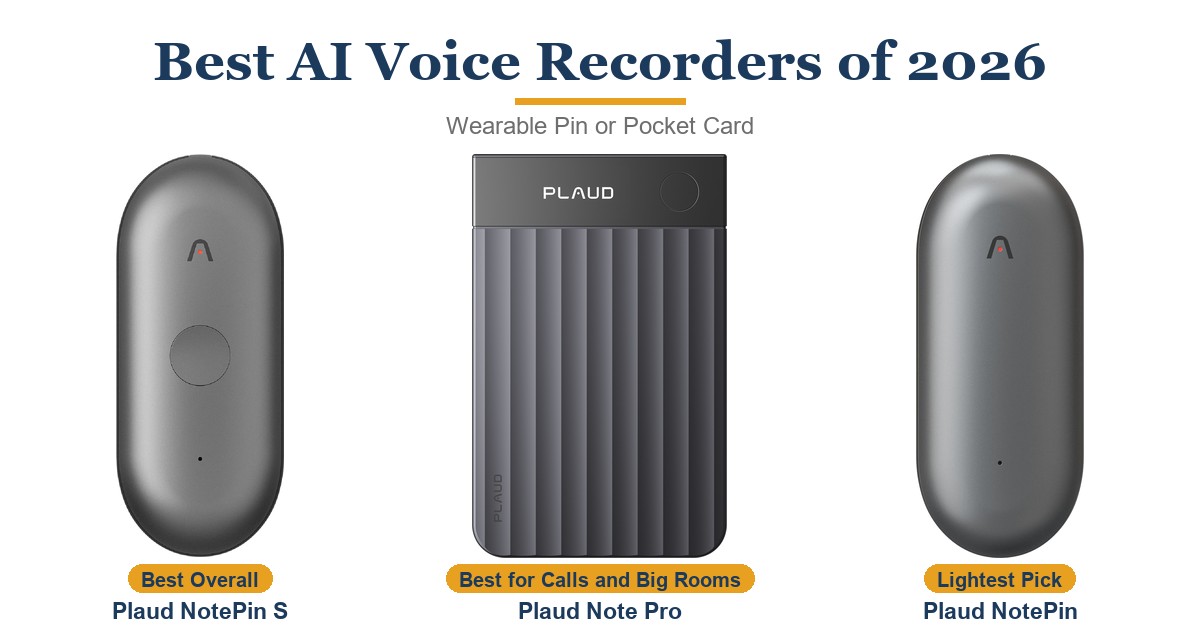
The Note Pro is the one to buy if meetings, interviews and client calls fill your week. It records a whole room or a phone call from a card about 3 mm thick, and Plaud's app turns that into accurate transcripts, speaker labels and summaries built around the moments you highlight, while the battery lasts weeks between charges. The trade-off is the free plan's 300 minutes a month, which regular meeting-goers will outgrow, so count a paid plan in the cost; heavy users who want unlimited free transcription should look at the Comulytic Note Pro.
Pros
- Accurate transcripts with speaker labels
- Picks up a whole room from up to 5 m
- Records phone calls and in-person talks, switching automatically
- Weeks between charges in long-term use
- About 3 mm thick and 30 g, with a status screen
Cons
- The free plan's 300 minutes a month run out fast
- The magnetic charging cable comes loose easily
- Trusted Reviews found background noise creeps into recordings
- Trusted Reviews found the case hard to remove and the Android fit hit-and-miss
As an Amazon Associate I earn from qualifying purchases. Disclosure
Overview
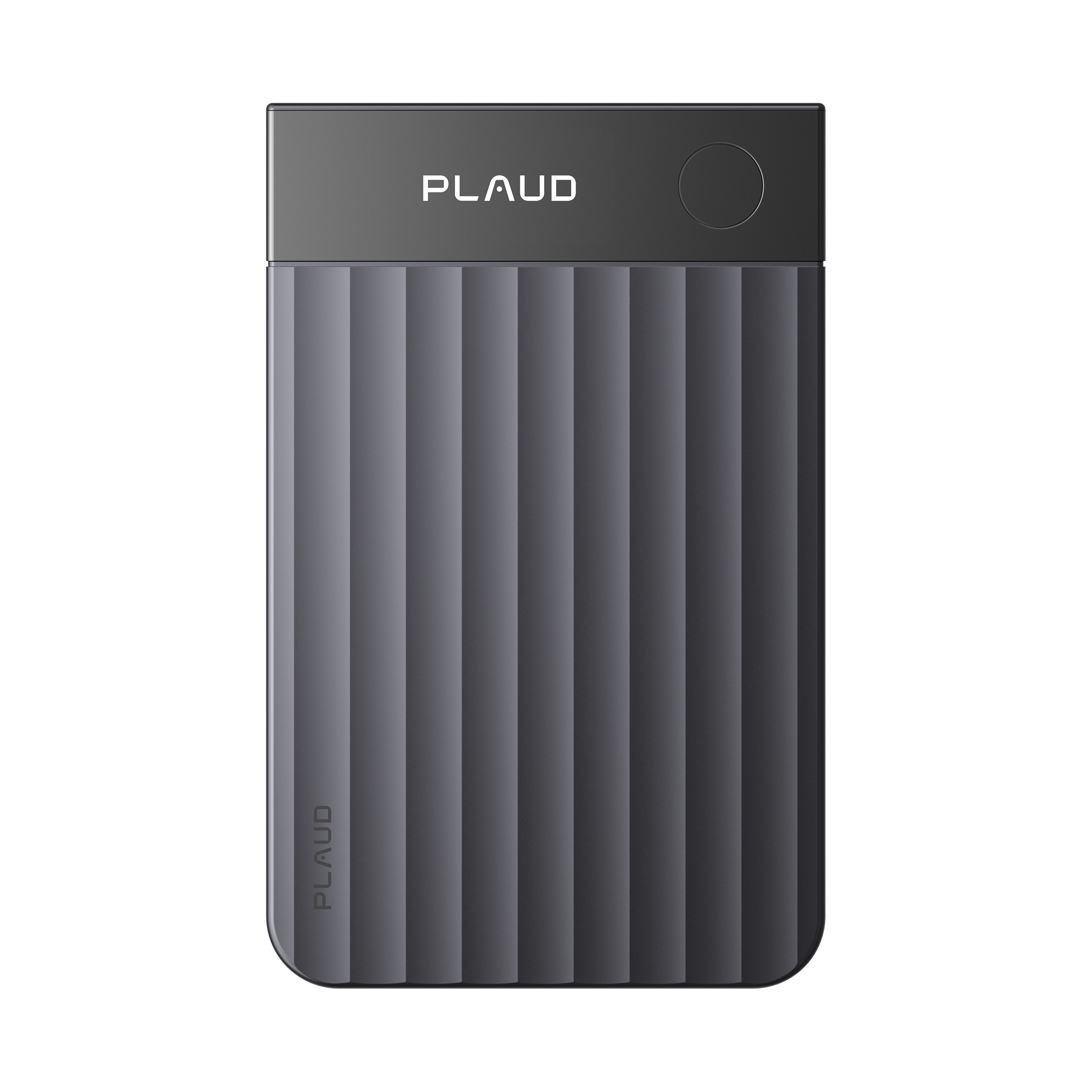
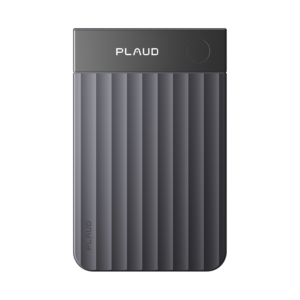
Plaud’s Note Pro is a recorder the size of a credit card and about 3 mm thick, made to sit on a meeting table or ride on the back of a phone. It hands the audio to Plaud’s app for transcripts, speaker labels and AI summaries. It records both in-person conversations and phone calls, and one button starts a recording and marks the moments you want the summary to stress. It is aimed at people whose week is full of meetings, interviews, lectures or client calls.
Plaud opened preorders in August 2025, two years after the original Plaud Note, and still sells both. Against the Note, the Pro has four microphones instead of two and a pickup range of up to 5 m (16.4 ft) against the Note’s 3 m. It adds a 0.95-inch AMOLED status screen, and it switches between room and call recording by itself where the Note uses a manual switch. Its 500 mAh battery is rated for 30 hours of recording in Enhance mode or 50 hours in Endurance mode.
Key Specifications
| Price (USD) | $189.00 |
| Size | 85.6 × 54.1 × 2.99 mm (3.37 × 2.13 × 0.12 in) |
| Weight | 30 g (1.06 oz) |
| Display | 0.95-inch AMOLED, 600 nits |
| Microphones | 4 MEMS, 1 VPU |
| Pickup range | Up to 5 m (16.4 ft) in Enhance mode; 3 m (9.8 ft) in Endurance mode |
| Recording modes | In person and phone calls, detected automatically |
| Battery | 500 mAh; 30 hours (Enhance) or 50 hours (Endurance) of recording; 60 days standby |
| Charging | Magnetic charging cable; about 2 hours |
| Storage | 64 GB |
| Connectivity | Bluetooth 5.4, Wi-Fi |
| In the box | Magnetic case, magnetic ring, charging cable |
| Tracking | Apple Find My |
| Free plan | 300 transcription minutes a month |
| Warranty | One year (as listed on Plaud’s store) |
Plaud Note Pro Transcription and AI Summaries
The card records the audio; the transcripts, summaries and answers come from Plaud’s app and web service once a recording syncs. In ordinary conversation the transcripts are accurate. Trusted Reviews found they held up even with people talking over one another, slipping only on new tech brand and processor names, which are quick to correct by hand. In Notebookcheck’s test of a five-person English conversation there were almost no speaker mix-ups, though a three-person talk with two similar-sounding voices and not always a pause between speakers produced more misattributed lines.
The summaries are the main reason to buy it. The app lays each one out to suit the recording; Trusted Reviews saw its product briefings split by topic without any setup, though some summaries left out details it wanted. When a summary isn’t laid out the way you need, pick one of Plaud’s templates, which run from general meeting notes to niche formats, or build your own, a process Trusted Reviews found tedious. A press of the button during a recording marks a highlight, which then stands out in the summary. Plaud’s support pages (October 2026) say Ask Plaud, which answers questions about your recordings, and custom templates come with every plan.
For online meetings you can leave the card in your pocket: Plaud’s desktop app, part of the free plan that comes with the device, takes notes from the computer’s own audio. Trusted Reviews ended up using it more than the recorder, because many of its briefings were remote.
Recording Quality and Pickup Range
Four microphones along the card’s edges and a voice processing unit (VPU) handle the audio, and the recordings capture a whole room rather than just the person opposite. TechCrunch’s reviewer recorded conference talks from seats far from the stage and got satisfactory results. The audio is made for transcription more than for listening: Trusted Reviews called it good enough to refresh your memory, not high-end microphone quality.
The reviews split on background noise. Notebookcheck rated its noise cancellation as good and found it recorded better than the two-microphone Comulytic Note Pro in louder, busier places. Trusted Reviews heard a fan or quiet music come through, with song lyrics sometimes transcribed mid-conversation, and suggests quieter rooms for the most accurate transcripts.
For most recordings, leave it in Enhance, the 5 m setting: Trusted Reviews used it for most tasks and found the battery cost small. Endurance shortens the reach to 3 m in exchange for 50 hours of recording instead of 30, which matters mainly on long stretches away from a charger.
Design, Display and Phone Calls
At 30 g and about 3 mm thick, the Note Pro fits a wallet’s card slot or rides on the back of a phone in its magnetic case, which holds to a MagSafe iPhone directly and to other phones through the included magnetic ring. One button does everything: a long press starts or stops a recording, with a buzz to confirm, and a short press marks a highlight. The small AMOLED screen shows whether it is recording and how much battery is left. TechCrunch’s reviewer found the screen and the deliberate button press made it easier to show others in the meeting that a recording was running.
If you plan to pull the card out often, the case is a nuisance: Trusted Reviews had to take the whole case off the phone to get the recorder out. On an Android phone with a large camera bump, the ring-mounted case also hung past the phone’s bottom edge, though it sat perfectly on an iPhone.
For calls, the recorder sits on the back of the phone and the Pro detects whether it is hearing a call or the room, switching on its own, even mid-recording. Notebookcheck found it told the two people on a phone call apart more reliably than in its three-person room test, which it put down to the recorder picking up the phone’s vibration. Plaud asks owners to tell people they are recording and get their agreement first, and recording laws differ by place.
Battery Life and Charging
Battery life is the Note Pro’s strongest hardware point. TechCrunch’s unit still had 55% charge after 15 days of interviews, conference talks, phone calls and personal notes. After about a month of meetings and briefings, mostly in Enhance mode, Trusted Reviews’ unit was at 60%.
Charging is the weak spot. The Note Pro uses a proprietary magnetic cable instead of a USB-C port, and two of the reviews found it came loose; Trusted Reviews said the magnets won’t hold if the cable is tugged even slightly. A full charge takes about two hours. The cable ends in a USB-C plug and no adapter comes in the box, so charging from an older computer without USB-C needs one.
Plaud’s Plans and What They Cost
The Note Pro comes with Plaud’s free Starter plan, which includes 300 transcription minutes a month, and Plaud’s support pages (October 2026) say every plan has the full feature set, so the paid plans buy minutes. As of October 2026, Pro gives 1,200 minutes a month for $17.99 monthly or $8.33 a month billed annually, and Unlimited covers up to 24 hours a day for $29.99 monthly or $20.00 a month billed annually. Unused minutes don’t roll over, and one-off top-ups of 600, 3,000 or 6,000 minutes last 24 months.
On Plaud’s annual rates that comes to about $100 a year for Pro or $240 for Unlimited (October 2026). The Comulytic Note Pro takes the other approach, with unlimited transcription and basic summaries on its free plan.
How Does It Stack Up Against the Competition?
The Note Pro’s closest rivals are Comulytic’s card-shaped Note Pro, a similar card-shaped recorder with a near-identical name and unlimited free transcription that costs less as of October 2026, Plaud’s own NotePin S wearable and Anker’s coin-sized soundcore Work.
| Feature | Plaud Note Pro | Comulytic Note Pro | Plaud NotePin S | Soundcore Work |
|---|---|---|---|---|
| Price (USD) | $189.00 | $128.99 | $179.00 | $169.99 (64 GB) |
| Form | Card that attaches to a phone’s back | Card that attaches to a phone’s back | Wearable pin | Coin-sized clip, necklace or phone mount |
| Weight | 30 g (1.06 oz) | 27.6 g | 17.4 g (0.61 oz) | 10 g (0.35 oz); 48 g with case |
| Microphones | 4 MEMS, 1 VPU | 2 MEMS, 1 VPU | 2 MEMS | 2 |
| Pickup range | Up to 5 m (16.4 ft) | 5 m (16.4 ft) | Up to 3 m (9.8 ft) | 5 m radius |
| Recording time | 30 hours (Enhance); 50 hours (Endurance) | 45 hours | Up to 20 hours | 8 hours; 32 hours with case |
| Recording mode | In person and phone calls | In person and phone calls | In person | Meetings and interviews; Anker’s page doesn’t mention call recording |
| Storage | 64 GB | 64 GB | 64 GB | 64 GB (8 GB version also sold) |
| Free transcription | 300 min a month | Unlimited, with basic summaries | 300 min a month | 300 min a month |
| Languages | 112 | 100+ | 112+ | 150+ |
| TTP Review | This review ↑ | — | Read our review → | — |
| Amazon | View on Amazon | View on Amazon | View on Amazon | View on Amazon |
Prices change frequently — always verify current pricing before purchasing.
Plaud Note Pro: Worth It for Back-to-Back Meetings and Calls
Buy the Note Pro if you record a lot of meetings, interviews, lectures or client calls and want them turned into searchable transcripts and summaries without leaving your phone on the table. It captures a whole room from a card that fits in a wallet, records calls from the back of a phone, and in the long-term tests its battery ran for weeks between charges. As of October 2026 it costs more than every rival in the table here, and the free plan’s 300 minutes a month won’t cover a busy meeting schedule, so budget for a paid plan if you record most days.
If most of your meetings are online, you may use Plaud’s desktop app, which comes with the device’s free plan, more than the card itself, as Trusted Reviews did. Heavy users who would rather not subscribe should look at the Comulytic Note Pro, whose free plan transcribes without a monthly cap, though Notebookcheck found Plaud better at telling speakers apart and at recording in noisy places. The NotePin S is the choice for wearing a recorder through in-person conversations, and the soundcore Work is lighter again, with a case that stretches recording to 32 hours and more transcription languages. The original Plaud Note is the budget route: Notebookcheck (March 2026) found it cheaper and often discounted, with half the microphones and a shorter pickup range.
Sources
- Plaud — Plaud Note Pro Product Page
- Plaud — What is the difference between Note and Note Pro?
- Plaud — Hardware Comparison
- Plaud — Plaud Note Pro vs. Plaud Note
- Plaud — AI Membership FAQ
- Plaud — Plan Comparison
- Plaud — Extra Minutes and Plans
- Plaud — Plaud NotePin S Product Page
- Plaud Note Pro — Amazon Product Listing
- Trusted Reviews — Plaud Note Pro Review
- Notebookcheck — Review of the Plaud Note Pro AI recorder
- TechCrunch — Plaud Note Pro is an excellent AI-powered recorder that I carry everywhere
- T3 — Can this credit-card sized device take the pain out of meetings?
- Notebookcheck — Comulytic Note Pro review
- 9to5Mac — Review: Comulytic Note Pro
- Comulytic — Comulytic Note Pro
- Soundcore — soundcore Work AI Voice Recorder
- TechCrunch — Plaud launches a new AI pin and a desktop meeting notetaker
Reader Poll
What would you mostly record with the Note Pro?
Help Our Editors Know What Matters to You
Explore on Amazon →