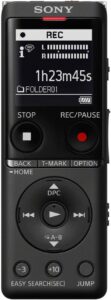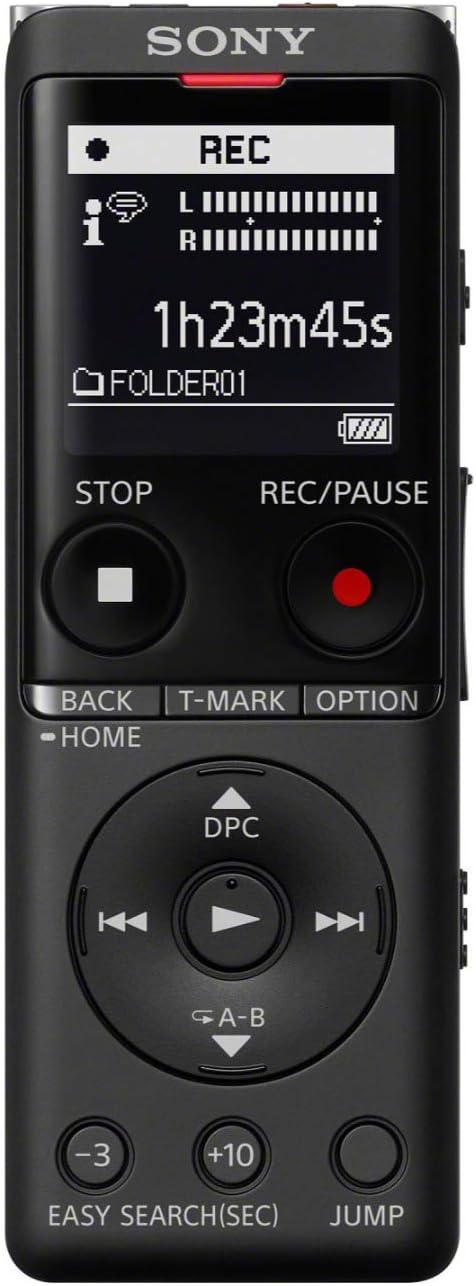
The Sony ICD-UX570 is a straightforward pick for Canadian buyers who need to capture a lecture, interview, or meeting and just want the audio file — no app, no account, no subscription. A 27-hour battery and a direct-USB connector make daily use painless, and Sony's S-Microphone system handles speech clearly enough for transcription or note-taking later. It's available directly through Amazon.ca. The trade-off is the 4GB built-in storage and the complete absence of automatic transcription — anyone who wants their recordings turned into searchable text will need to look at an AI recorder instead.
Pros
- 27-hour battery life on a 3-minute quick charge
- Ultra-compact and pocket-friendly at about 48g
- Built-in USB connector - no cable needed to transfer files
- Available directly through Amazon.ca, no cross-border ordering
- Expandable storage via microSD, up to 128GB
Cons
- Only 4GB of built-in storage before adding a card
- No Wi-Fi, Bluetooth, or AI transcription - strictly a standalone recorder
As an Amazon Associate I earn from qualifying purchases. Disclosure
Overview
At $248.59 CAD on Amazon.ca, the Sony ICD-UX570 costs less than half of what a wearable AI recorder like Plaud’s NotePin S asks — and it skips the app pairing, cloud transcription, and monthly fee entirely. It’s a plain digital voice recorder built for anyone who records lectures, interviews, or dictation notes and just wants the audio file afterward, not a summarized transcript.
Sony has kept this exact model in its lineup with only minor firmware and packaging changes for years, which says more about how well the basic formula works than any flashy update could. The trade-off is obvious: Canadian buyers who want automatic transcription or smart-device syncing should look at an AI recorder instead — this one is deliberately unconnected, and it’s readily available on Amazon.ca.
Key Specifications
| Built-in Storage | 4GB (expandable via microSD, up to 128GB) |
| Recording Formats | MP3, LPCM (WAV) |
| Recording Modes | Normal, Focus, Wide Stereo |
| Battery Life | Up to 27 hours continuous recording |
| Charging | 3-minute quick charge for ~1 hour of use (USB) |
| Dimensions | 102.8 x 36.6 x 12.2 mm |
| Weight | Approx. 48g |
| Connectivity | Built-in retractable USB connector (direct-to-PC) |
| Price (CAD) | $248.59 |
Sony ICD-UX570 Recording & Audio Quality
The ICD-UX570 uses Sony’s S-Microphone system with three recording modes — Normal, Focus, and Wide Stereo — that let you narrow the pickup for a single speaker across a table or widen it to capture a full room. According to Sony’s own technical specifications, Focus mode is meant for close dictation while Wide Stereo suits lectures and group meetings. A hands-on review at Make Life Click described the recorded audio as clean and easy to follow on playback, calling the unit a lightweight option that “sounds excellent” for its price.
An Auto Voice Recording feature reduces background hiss during quiet stretches, and a Playback Normalization function evens out volume swings so a soft voice isn’t drowned out by an inconsistent recording level. It’s not built for music or podcast production — that’s where a 32-bit float recorder like the Zoom H1essential pulls ahead — but for speech capture at meetings, interviews, and classes, it does the one job it’s designed for cleanly.
Battery Life & Charging
Sony rates the built-in lithium battery for up to 27 hours of continuous recording, and a 3-minute quick charge over USB is enough for about an hour of use — useful if you grab the recorder on the way out the door and realize it’s low. A full charge tops it off for a multi-day trip without needing a separate wall adapter, since charging happens through the same USB connector used for file transfer.
That built-in battery is also the trade-off: unlike the Olympus WS-882, which runs on a pair of AAA batteries you can swap mid-session, the ICD-UX570 has to be plugged in once it’s drained. For most single-session recording — a class, a meeting, an interview — 27 hours is more runway than anyone actually needs between charges.
Storage & File Transfer
4GB of built-in memory holds roughly 55 to 59 hours of MP3 recording at standard stereo bitrate, according to Sony’s specifications, with a microSD slot available for anyone who wants more headroom — the recorder supports cards up to 128GB. That’s modest next to a 64GB wearable like the Plaud NotePin S, but the ICD-UX570 was never designed to store months of continuous audio the way an always-on AI recorder is.
The built-in retractable USB connector is the more practical everyday feature: it plugs straight into a laptop’s USB-A port with no separate cable to lose. Owners who’ve used it for file transfer consistently point to this as one of the more convenient parts of daily use, since pulling files off doesn’t require hunting for a cord first.
Build & Portability
At 102.8 x 36.6mm and roughly 48 grams, the ICD-UX570 is small enough to disappear into a shirt pocket or the front pocket of a bag — closer in size to a USB flash drive than a handheld recorder. The simple button layout and small display keep the learning curve short; there’s no menu-diving required just to hit record.
The Zoom H1essential, by comparison, is bulkier and built around X/Y stereo microphones and a 3.5mm input for external mics — a real advantage for anyone recording music or multi-source podcasts, but overkill, and less pocketable, for someone who just needs to capture a conversation.
How Does It Stack Up Against the Competition?
All four handle voice capture, but they’re built for different jobs and budgets.
| Feature | Sony ICD-UX570 | Olympus WS-882 | Zoom H1essential | Plaud NotePin S |
|---|---|---|---|---|
| Price (CAD) | $248.59 | $120.77 | $170.79 | $249.99 |
| Battery Life | Up to 27 hrs | ~110 hrs (AAA) | Up to 10 hrs | Up to 20 hrs |
| Storage | 4GB + microSD | 4GB + microSD | microSDXC (user-supplied) | 64GB built-in |
| Best For | Simple dictation, no subscription | Battery-swap reliability | Music/podcast-grade capture | AI transcription & summaries |
| TTP Review | This review ↑ | — | — | Read our review → |
Prices change frequently — always verify current pricing before purchasing.
Is the Sony ICD-UX570 Worth It?
For anyone who records a weekly lecture, a string of interviews, or dictation notes and just wants a clean audio file afterward, the ICD-UX570 does that one job well without the higher price tag of the other recorders here. The long battery life, direct-USB transfer, and Sony’s S-Microphone system cover the basics competently without asking for an app account or a subscription — and it ships to Canadian addresses through Amazon.ca.
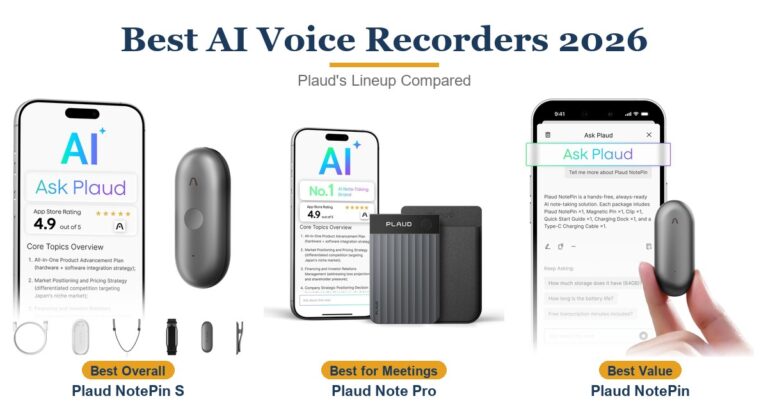
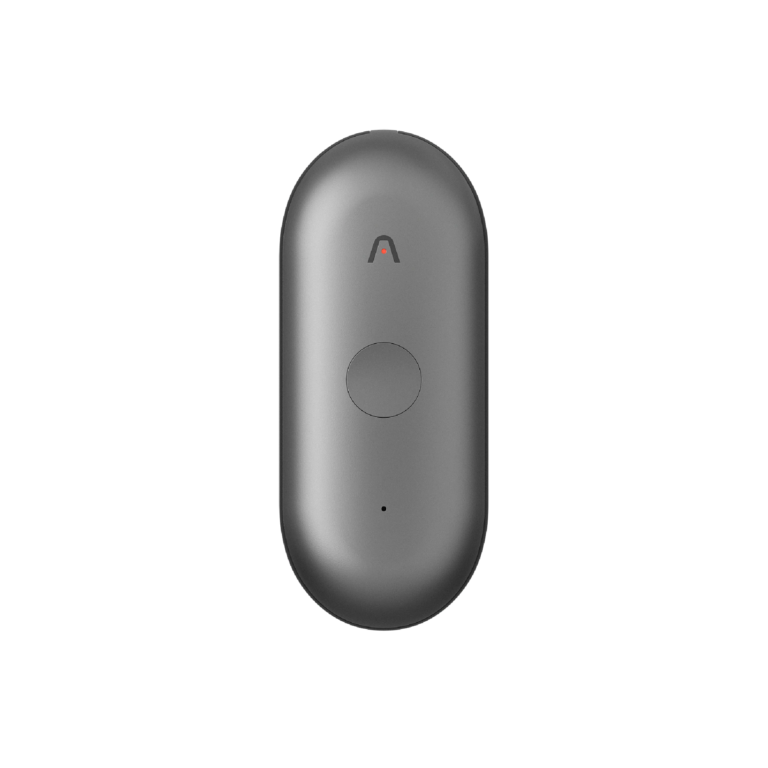
Anyone who wants automatic transcription, searchable summaries, or cloud backup should look at the Plaud NotePin S instead — at that point you’re paying for AI convenience the ICD-UX570 was never designed to offer.