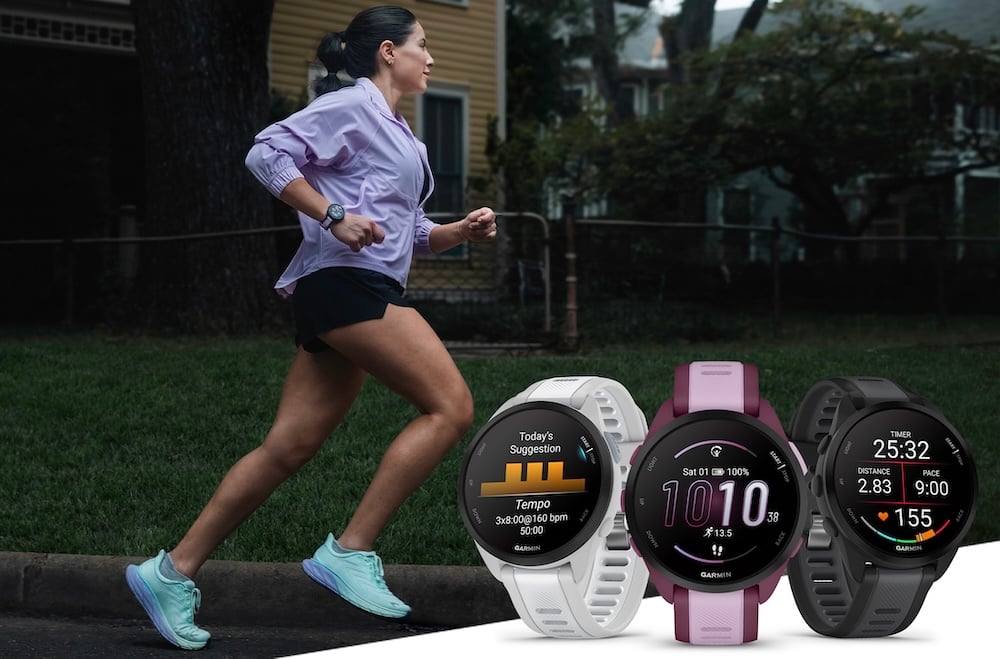
The Forerunner 165 is for runners who want Garmin's adaptive plans, accurate GPS and Garmin Pay in a light 39 g watch. Its bright AMOLED screen and battery life that holds up to Garmin's ratings make it easy to live with. The trade-offs are no Training Readiness or Training Status, which Garmin's newer Forerunner 70 includes, no triathlon mode, and wrist heart rate that can lag sudden changes in effort and was off the mark in some tests.
Pros
- Accurate GPS without multi-band hardware
- Bright 1.2-inch AMOLED touchscreen
- Adaptive plans and daily suggested workouts
- Light 39 g case with standard 20 mm bands
- Garmin Pay and a barometric altimeter
Cons
- No Training Readiness or Training Status
- No triathlon mode or power meter support
- Wrist heart rate can lag or be off; a chest strap helps
- Music and Wi-Fi only on the Music model
As an Amazon Associate I earn from qualifying purchases. Disclosure
Overview
The Garmin Forerunner 165 is a compact running watch for people who want Garmin’s training plans and dependable pace and distance without stepping up to its most advanced models. It pairs a 1.2-inch AMOLED touchscreen with five physical buttons, weighs 39 g, and shapes its daily workout suggestions around how your recent runs went.
It launched in February 2024, and in May 2026 Garmin introduced its successor, the Forerunner 170, alongside a new entry-level Forerunner 70, so the older watch now has to win on price. What hasn’t changed is the core: in most tests its GPS tracks stay close to multi-band watches without that hardware, and it keeps the barometric altimeter and Garmin Pay that the Forerunner 70 leaves out.
Key Specifications
| Display | 1.2-inch AMOLED touchscreen, 390 x 390 pixels, plus five buttons |
| Weight | 39 g (1.4 oz) |
| Water rating | 5 ATM (swim-rated) |
| Battery (smartwatch) | Up to 11 days; about 4 days with always-on display |
| Battery (GPS) | Up to 19 hours GPS-only; up to 17 hours All-Systems |
| Satellite tracking | Single-frequency, with an All-Systems multi-GNSS mode (no multi-band) |
| Sensors | Elevate V4 optical heart rate, Pulse Ox, barometric altimeter, compass |
| Payments | Garmin Pay |
| Music and Wi-Fi | Forerunner 165 Music only (4 GB storage) |
| Bands | Standard 20 mm quick-release |
| Operating temperature | −20 °C to 60 °C (−4 °F to 140 °F) |
| Price (USD) | $197.94 |
Garmin Forerunner 165 GPS and Heart Rate Accuracy
Garmin keeps multi-band (dual-frequency) GPS for its higher-end Forerunners, so the 165 relies on standard GPS or an All-Systems mode that also uses other satellite networks. Most of the tests we read found its tracks stayed close to multi-band reference watches anyway, on city streets, trails and wooded routes. The5krunner was the exception, rating the GPS good in many conditions but finding clear trouble under tree cover and near tall buildings. OutdoorGearLab’s 2.8-mile (4.5 km) test course is a good example: the 165 finished within 0.03 miles (about 50 metres) of the true distance.
Where it erred, it tended to read slightly long: Coach’s week of runs on the 165 Music came out under 1 percent longer than on a multi-band Garmin Epix Pro, partly because it took some corners wide. Getting a fix can take a while, too: before one bike ride, Tom’s Guide waited about 45 seconds, which it judged slow next to dual-band GPS watches.
Heart rate comes from Garmin’s Elevate V4 optical sensor, the generation before the one that adds ECG. On steady runs it tracked a chest strap closely in most tests; OutdoorGearLab measured it within 0.30 bpm of a Polar H10. Its weak spot is a sudden change in effort: in two tests it trailed the strap during warm-ups and fast interval changes before catching up. Two testers were exceptions: Coach logged readings above its chest strap on most runs, and the5krunner rated its heart rate accuracy “good for a long tempo run but otherwise disappointing.” Coach recommends pairing a strap if you train by heart rate. The standard 165 connects to ANT+ sensors; Bluetooth sensors need the Music version.
Training Tools: Plenty for a Plan, Less for Recovery
For following a plan, the 165 is well equipped. You can add a race to the Garmin Connect calendar and get a training plan that adapts after each run, or choose one of Garmin Coach’s free plans, which cover the 5K, 10K and half-marathon distances. PacePro sets grade-adjusted pacing for a course, and the watch estimates VO2 max, recovery time and race finish times while reporting cadence, stride length, ground contact time and running power from the wrist.
What it leaves out is the layer that judges your training as a whole. There’s no Training Readiness score, no Training Status and no training load tracking; you get HRV status, Body Battery, a recovery timer and Training Effect after each run instead.
It also has no triathlon or multisport mode, doesn’t pair with cycling power meters, and has no skiing or snowboarding profiles, so triathletes and riders who train with power are better served elsewhere. Navigation is limited to breadcrumb courses synced from Garmin Connect plus a back-to-start pointer; there are no maps.
Battery Life and the AMOLED Display
Garmin rates the 165 at up to 11 days as a smartwatch with the screen waking on a wrist raise, about 4 days with the always-on display, 19 hours of GPS-only recording and 17 hours in All-Systems mode. Those ratings held up in testing. With the always-on display and an hour or two of GPS a day, testers got four to five days, in line with Garmin’s four-day figure. OutdoorGearLab recorded the full 19 hours of GPS tracking.
In daily life with regular workouts, plan on charging every five to seven days.
The AMOLED panel is the biggest change from Garmin’s older budget Forerunners, whose memory-in-pixel screens had far lower resolution, and it stays easy to read in direct sun. By default the screen stays dark until you lift your wrist; always-on mode keeps it lit, at the battery cost above.
Fit, Build and Everyday Smart Features
At 39 g with a plastic case, it’s light enough that testers who wore it for weeks found it easy to forget. It comes in one size and takes standard 20 mm quick-release straps, so you can fit a third-party band without tools.
The smart features cover the essentials: phone notifications, Garmin Pay contactless payments, LiveTrack location sharing, incident detection that can message an emergency contact, and the Connect IQ store for watch faces and apps. The standard model has no music storage and syncs only over Bluetooth through your phone; the Forerunner 165 Music adds 4 GB for Spotify, Deezer and Amazon Music downloads, plus Wi-Fi.
How Does It Stack Up Against the Competition?
The Forerunner 170 that replaces it and Garmin’s new entry-level Forerunner 70 are the obvious alternatives, along with the COROS PACE 4, which competes on battery life and multi-band GPS.
| Feature | Garmin Forerunner 165 | Garmin Forerunner 70 | Garmin Forerunner 170 | COROS PACE 4 |
|---|---|---|---|---|
| Price (USD) | $197.94 | $249.00 | $279.99 | $249.00 |
| Display | 1.2-inch AMOLED touchscreen | 1.2-inch AMOLED touchscreen | 1.2-inch AMOLED touchscreen | 1.2-inch AMOLED touchscreen |
| Satellite tracking | Single-frequency, multi-GNSS | Single-frequency, multi-GNSS | Single-frequency, multi-GNSS | Dual-frequency, multi-GNSS |
| Rated battery, everyday use | Up to 11 days | Up to 13 days | Up to 10 days | Up to 19 days |
| Rated GPS battery (All-Systems) | Up to 17 hours | Up to 16 hours | Up to 14 hours | Up to 41 hours |
| Readiness and training-load metrics | No (recovery time and HRV status only) | Training Readiness, Training Status | Training Readiness, Training Status | EvoLab training load and recovery |
| Contactless payments | Garmin Pay | No | Garmin Pay | No |
| Onboard maps | No (breadcrumb courses) | No | No | Yes |
| TTP Review | This review ↑ | — | Read our review → | Read our review → |
| Amazon | View on Amazon | View on Amazon | View on Amazon | View on Amazon |
Prices change frequently — always verify current pricing before purchasing.
Is the Garmin Forerunner 165 Worth It?
Buy the Forerunner 165 if you run several times a week and want pace and distance you can trust, plus a plan that adjusts itself. Over the Forerunner 70, it’s the one to pick if you run hills, since its barometric altimeter measures climbing directly rather than estimating it from GPS, or if you want to pay for a drink mid-run from your wrist. As of October 2026, Amazon lists it below both of Garmin’s newer models, and that is what keeps it relevant now that it has been replaced.
Look elsewhere if you want a readiness score to tell you how hard to go: both newer Garmins have Training Readiness and Training Status. The Forerunner 70 adds a longer rated smartwatch battery but gives up the altimeter and Garmin Pay; the Forerunner 170 keeps both and adds a gyroscope and many more sport modes, from skiing to team sports. Triathletes and anyone planning long days out should look at the COROS PACE 4: it has a multisport mode, dual-frequency GPS and more than double the rated All-Systems GPS time, though it has no contactless payments or music streaming.

Sources
- Garmin — Forerunner 165 Series Owner’s Manual (specifications and battery life)
- Garmin — Forerunner 165 Series announcement
- Garmin Forerunner 165 — Amazon Product Listing
- DC Rainmaker — Garmin Forerunner 165 In-Depth Review
- OutdoorGearLab — Garmin Forerunner 165 Review
- Tom’s Guide — Garmin Forerunner 165 Review
- Android Central — Garmin Forerunner 165 Review
- the5krunner — Garmin Forerunner 165 Review
- Coach — Garmin Forerunner 165 Review
- Triathlete — Garmin Forerunner 165 Reviewed
- Garmin — Forerunner 70 and Forerunner 170 announcement
- Garmin — Forerunner 170 Series Owner’s Manual
- Garmin — Forerunner 70 Owner’s Manual
- the5krunner — Forerunner 70 and 170 launch analysis
- Gadgets & Wearables — Garmin Forerunner 170 vs 165
- Tom’s Guide — Forerunner 165 vs Forerunner 170
- COROS — PACE 4 Official Product Page
- the5krunner — COROS PACE 4 In-Depth Review
Reader Poll
Would you trade the 165's altimeter and Garmin Pay for Training Readiness?
Help Our Editors Know What Matters to You
Explore on Amazon →