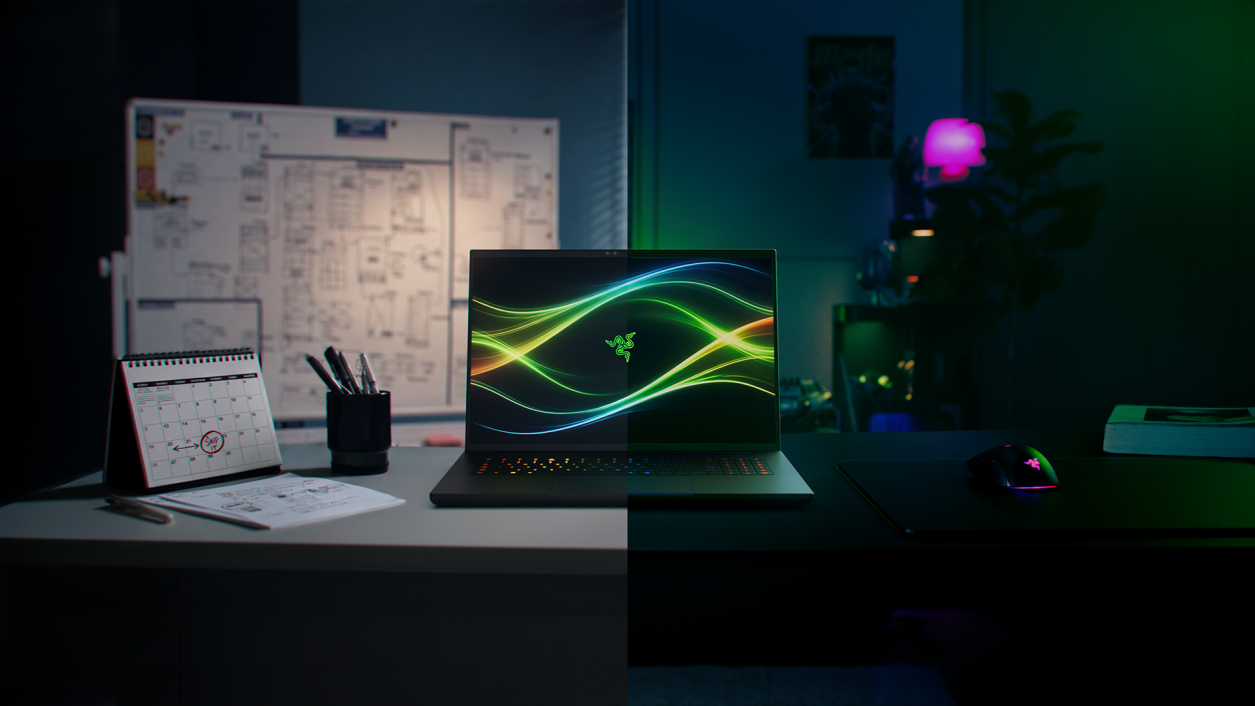
The dual-mode 18-inch display and flagship RTX 5090 performance make the Blade 18 (2026) one of the fastest gaming laptops Tom's Hardware has tested this generation, with enough CPU and RAM headroom to double as a local AI and creative workstation for Canadian buyers shopping Amazon.ca. The 64GB configuration reviewed here adds real day-to-day flexibility over the base 32GB model. It runs noticeably warmer and louder under sustained load than the ASUS ROG Strix SCAR 18, and at $8,199.99 CAD it costs meaningfully more than the similarly-equipped Lenovo Legion Pro 7i Gen 10.
Pros
- Class-leading RTX 5090 performance
- Dual-mode 4K 240Hz / FHD+ 440Hz display
- Solid battery life for an 18-inch gaming laptop
- CNC-milled aluminum chassis with premium build
- Thunderbolt 5 and Wi-Fi 7 connectivity
Cons
- Runs hot and loud under sustained gaming load
- Among the most expensive 18-inch gaming laptops available
- Heavy at over 7 lbs, not built for portability
Overview
Razer’s Blade 18 has always been the brand’s answer to “what if a gaming laptop didn’t compromise on screen size,” and the 2026 refresh pushes that idea further into desktop-replacement territory. Available through Razer.com and Amazon in configurations from RTX 5070 Ti up to a fully loaded RTX 5090 with 128GB of RAM, the tested-here build pairs the flagship RTX 5090 Laptop GPU with 64GB of DDR5 and a 2TB SSD — a configuration Razer prices at $8,199.99 CAD, positioning it as a genuine 4K-capable workstation-and-gaming hybrid rather than just the most expensive laptop on the shelf.
The 2026 refresh’s biggest upgrade over the outgoing Blade 18 is the new Intel Core Ultra 9 290HX Plus processor, paired with a dual-mode display that switches between a 3840 x 2400 UHD+ panel at 240Hz for creative work and a 1920 x 1200 FHD+ mode at 440Hz for competitive gaming — the same panel doing double duty instead of forcing a choice at purchase time. It’s sold directly through Amazon.ca alongside Razer’s own Canadian storefront, and Razer says every 2026 Blade now uses recycled aluminum in its CNC-milled chassis, a small but genuine shift from prior generations.
Key Specifications
| Price (as tested) | $8,199.99 CAD |
| Processor | Intel Core Ultra 9 290HX Plus (24 cores, up to 5.5GHz boost) |
| Graphics | NVIDIA GeForce RTX 5090 Laptop GPU, 24GB GDDR7, up to 175W TGP |
| Memory | 64GB DDR5-6400 (upgradeable to 128GB) |
| Storage | 2TB PCIe Gen 4 SSD |
| Display | 18-inch dual-mode: 3840×2400 at 240Hz or 1920×1200 at 440Hz |
| Connectivity | Wi-Fi 7, Thunderbolt 5, HDMI 2.1 |
| Weight / Dimensions | 7.06 lbs; 15.74 x 10.84 x 1.1 inches |
| OS | Windows 11 |
Razer Blade 18 (2026) Performance & Thermals
The RTX 5090 Laptop GPU running at up to 175W TGP is the headline here, and Tom’s Hardware’s review backs that up directly, calling the 2026 Blade 18 a chart-topping performer with the horsepower to run every current AAA title at native 4K with high settings and 60+ fps — a bar most 18-inch gaming laptops still can’t clear. TechRadar went further, describing it as a machine that “annihilates the competition” at the top of the RTX 5090 laptop field.
That performance comes with a real cost, though: Tom’s Hardware also found the chassis runs noticeably warm under sustained load, with the fans working overtime to keep up — a contrast to the ASUS ROG Strix SCAR 18, whose GPU peaked at a comparatively cool 78°C in the same class of testing. The Blade 18 wins on raw output; it doesn’t win on how quietly or coolly it gets there.
Display & Refresh Rate
The dual-mode panel is the Blade 18’s other real differentiator. Flip to UHD+ mode for 3840 x 2400 resolution at 240Hz when color accuracy and screen real estate matter more than frame rate, or switch to FHD+ at 440Hz when competitive response time is the priority. Tom’s Hardware called the display “striking,” and the ability to toggle modes without an external monitor is a genuine convenience rather than a marketing checkbox.
Nvidia G-Sync is supported across both modes, so neither refresh-rate option sacrifices tear-free gaming to get there — a detail some dual-mode competitors have historically gotten wrong.
Battery Life & Portability
Eighteen-inch gaming laptops are not portability plays, and the Blade 18 doesn’t pretend otherwise — at 7.06 lbs before its 400W power brick, this is a desk-bound machine that happens to fold shut. Where it does better than expected is battery life: Tom’s Hardware specifically flagged “surprisingly solid battery life” as one of the model’s strengths, an unusual note for a laptop packing a 175W GPU.
That said, sustained gaming or heavy GPU workloads will still drain the battery quickly on any laptop in this class, Blade 18 included — the battery-life praise applies to lighter, unplugged use rather than untethered gaming sessions.
How Does It Stack Up Against the Competition?
The RTX 5090 laptop tier is crowded in 2026 — here’s how the Blade 18 compares to three of its closest 18-inch and 16-inch rivals at similar specs.
| Feature | Razer Blade 18 (2026) | ASUS ROG Strix SCAR 18 | Lenovo Legion Pro 7i Gen 10 | MSI Titan 18 HX AI |
|---|---|---|---|---|
| Price (CAD) | $8,199.99 CAD | ~$6,834.99 CAD | ~$5,194.99 CAD | ~$9,158.99 CAD |
| GPU | RTX 5090, 24GB, 175W TGP | RTX 5090, 24GB, 175W TGP | RTX 5090, 24GB, 175W TGP | RTX 5090, 24GB, 175W TGP |
| CPU | Core Ultra 9 290HX Plus | Core Ultra 9 290HX Plus | Core Ultra 9 275HX | Core Ultra 9 285HX |
| RAM | 64GB DDR5 | 32GB DDR5 | 64GB DDR5 | 64GB DDR5 |
| Display | 18″ dual-mode, up to 440Hz | 18″ Mini-LED 4K, 240Hz | 16″ WQXGA OLED, 240Hz | 18″ Mini-LED 4K, 120Hz |
| TTP Review | This review ↑ | — | — | — |
Prices change frequently — always verify current pricing before purchasing.
Is the Razer Blade 18 (2026) Worth It?
If the priority is the single most capable 18-inch gaming laptop screen — a dual-mode panel that genuinely earns its “productivity or competitive gaming” pitch — paired with class-leading raw RTX 5090 performance, the Blade 18 delivers on both counts and looks the part doing it. Anyone who wants a desktop-class rig they can still close and carry between rooms, without the thermal throttling that plagues thinner 18-inch machines, has good reason to pay the premium.
Buyers chasing the lowest possible price for RTX 5090 performance should look at the Lenovo Legion Pro 7i Gen 10 instead — it undercuts the Blade 18 by roughly $3,000 CAD with nearly identical core specs. And anyone who cares more about running cool and quiet than about brand cachet should weigh the ASUS ROG Strix SCAR 18, which posted lower thermals in independent testing for about $1,400 CAD less.
Check the latest price for Razer Blade 18 (2026)